

09 — The print edition
The latest issue is live
Flip through all 11 pages below, or download the PDF.
The latest issue is live
Flip through all 11 pages below, or download the PDF.
The GigXchange Index · Issue 04
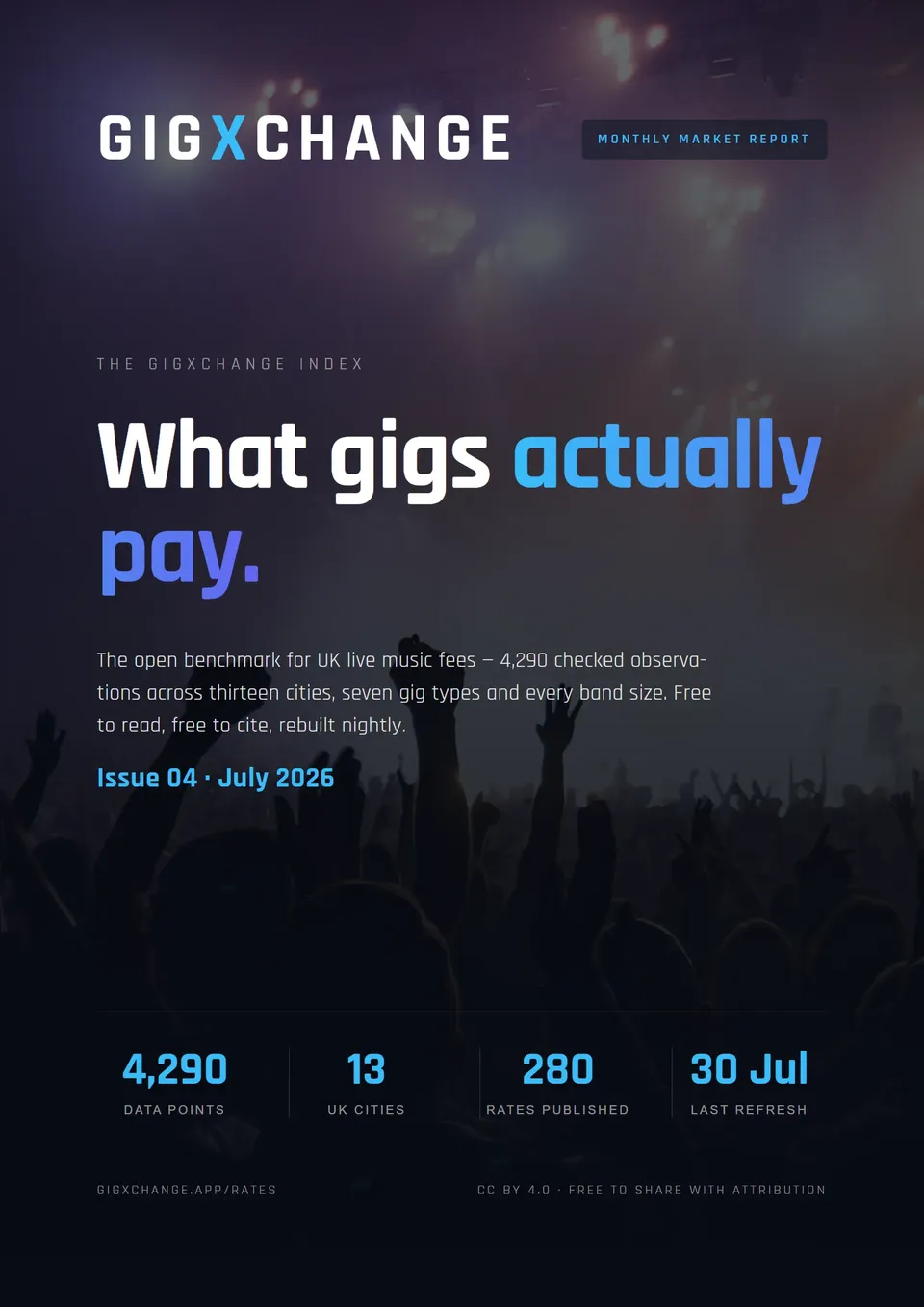
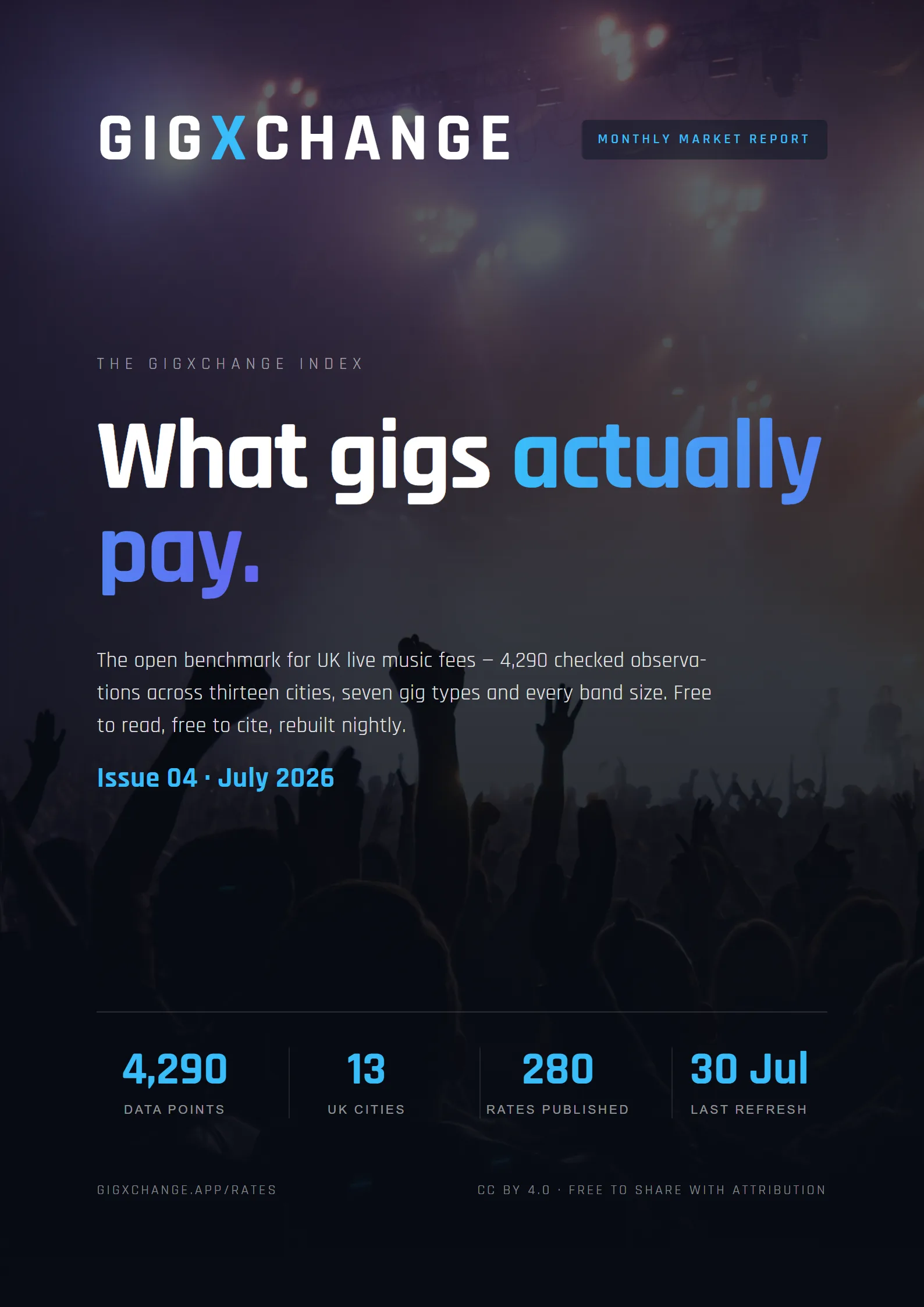
The GigXchange Index is the UK's open benchmark of live music fees. In July 2026 a 3–4 piece wedding band's median fee was £1,042, from 4,290 data points across 13 cities.
Last updated: 1 November 2026
4,290 weighted observations — nine sources, quality-firewalled, rebuilt nightly. Where these numbers come from — the pipeline in plain English
4,290 data points in this issue
Built with Method v1, the first method - see the method note for what it got wrong
Source weights were recorded but not yet applied to the figures
A quality firewall before any row could land
A regional layer filled thin cells; real data always won
The method has since been rebuilt - the full history is published in the open
| Full methodology | |
| UK market statistics | |
| Find out more | |
| Full methodology |
13 UK cities with enough data to publish. Which cities this issue can publish a rate for, and why
13 cities publish the same 23-cell grid
A cell publishes once it clears the sample floor, and every figure carries its n
Thin cells fall back to region, then the UK baseline
Every cell says which level actually answered it
Coverage grows wherever artists and venues sign up
City league tables run right through the report
| All UK cities | |
| Read the report | |
| Find out more | |
| Browse city directories |
280 rate cells published — free to cite, quote and redistribute. How many rate cells published — and how to reuse every one of them
280 rate cells published this issue
Each cell is one place × gig type × band size
Four percentiles per cell — p25/p50/p75/p90, never an average
All artist take-home, agency commission normalised out
Raw CSV behind every figure, DOI-registered on Zenodo, mirrored on Hugging Face and Kaggle
CC BY 4.0 — cite it, quote it, redistribute it, even commercially
| Download CSV | |
| Zenodo DOI | |
| Hugging Face | |
| Find out more | |
| Use the calculator |
July 2026 — free, 11 pages, CC BY 4.0. Read the July 2026 issue in-browser, or take the PDF away
11 pages — city league tables, methodology notes and honest limits
Built from 4,290 weighted observations across 13 UK cities
Read in-browser, page by page, or download the PDF
A fresh issue in the third week of every month
Every back issue kept online and citable — plus the annual Yearbook and earnings specials
Free to read, free to cite, no signup, no paywall
| Read the report | |
| All reports | |
| Previous issue | |
| Next issue | |
| Find out more | |
| Download PDF |
The figure that defines this issue. The headline medians from this issue, and what moved them
Wedding, corporate, pub and city-level medians
Artist take-home — agency commission normalised out
Percentiles p25/p50/p75/p90, never a flat average
Compared issue-on-issue so you can see the trend
Benchmark your own quote against it
Every figure free to cite under CC BY 4.0
| What gigs pay | |
| Issue FAQ | |
| Find out more | |
| Use the calculator |
In July 2026 a 3–4 piece wedding band's median fee was £1,042 and a pub booking £375, from 4,290 data points across 13 UK cities.
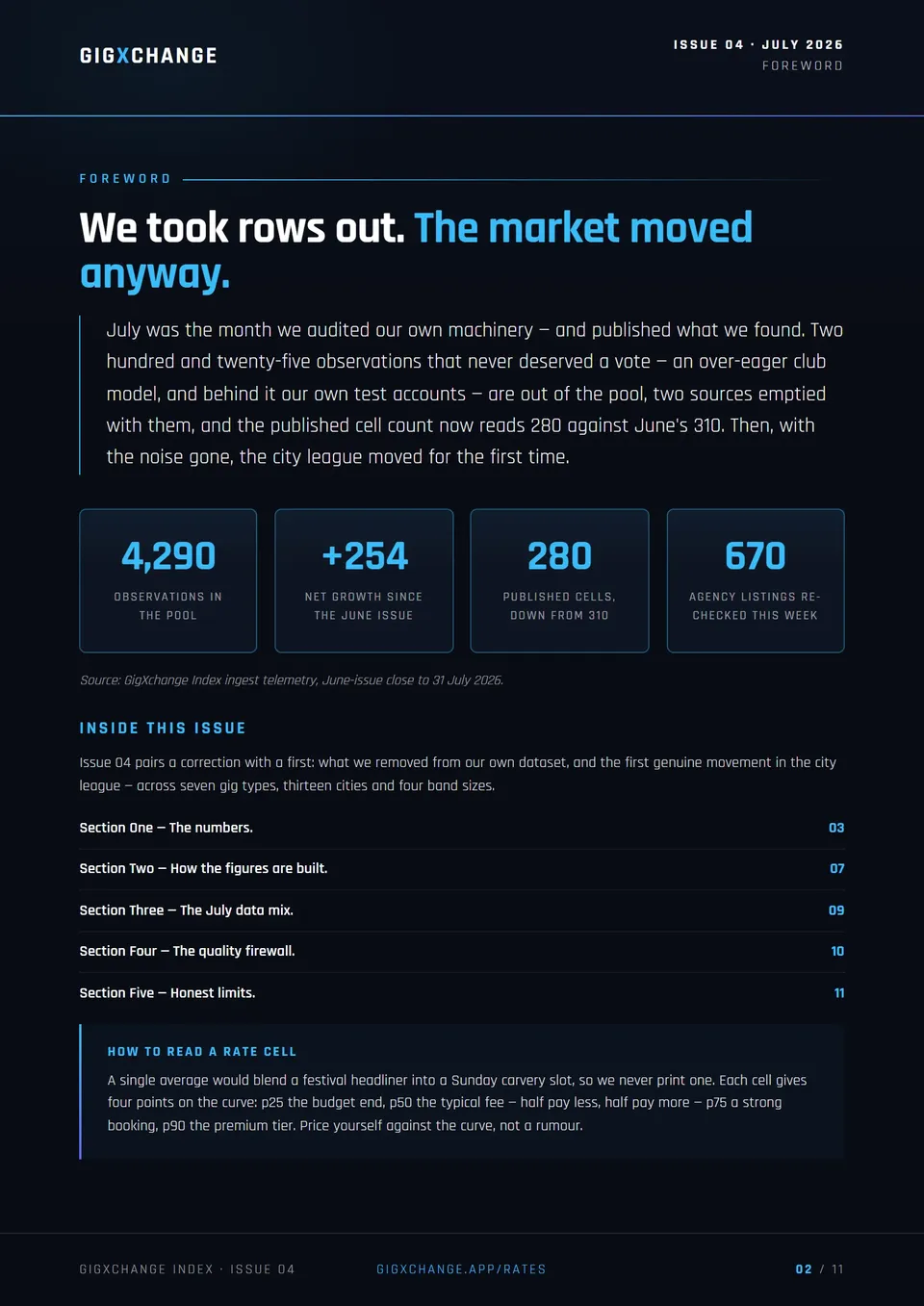
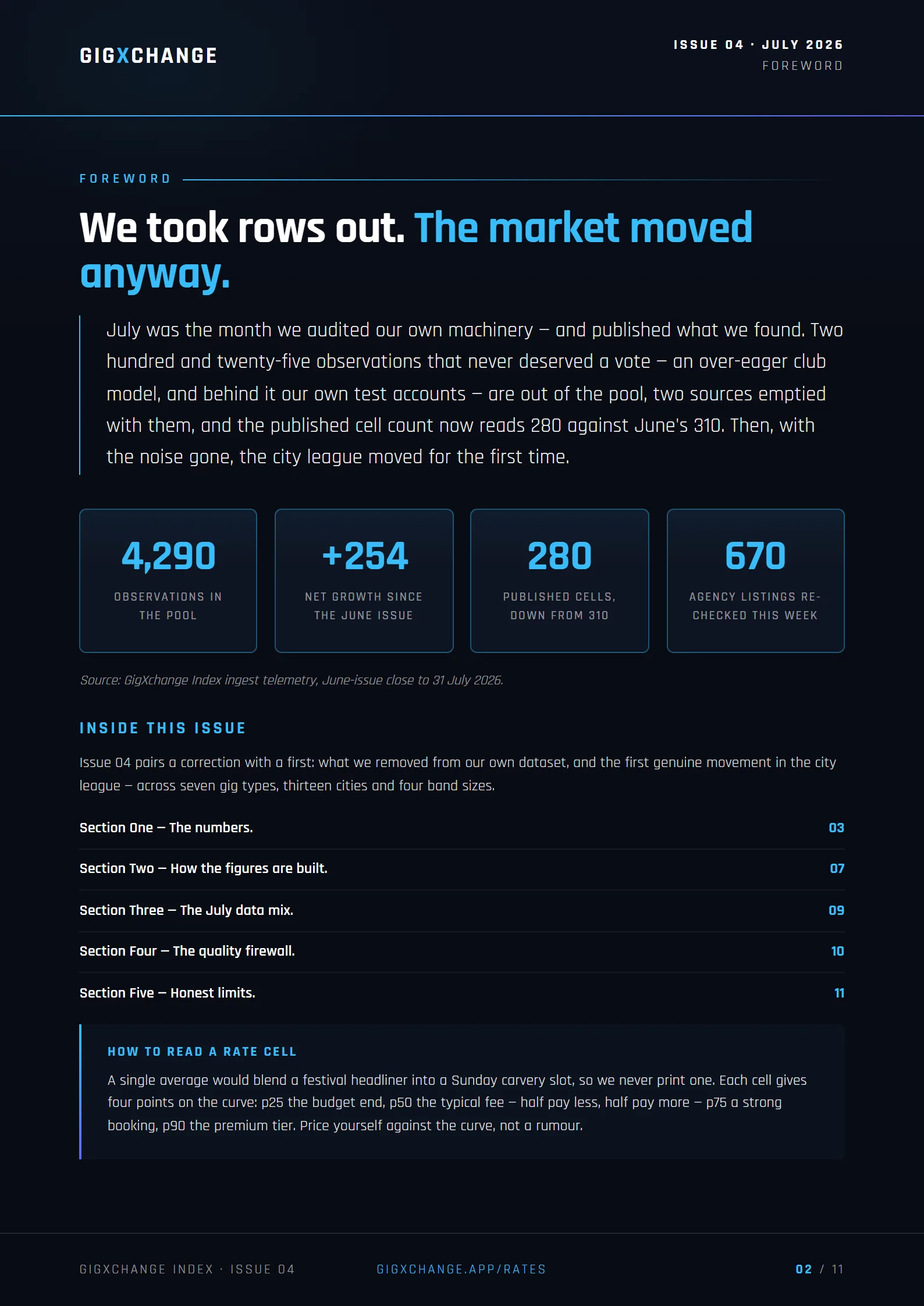
July was the month we audited our own machinery — and published what we found. Two hundred and twenty-five observations that never deserved a vote — an over-eager club model, and behind it our own test accounts — are out of the pool, two sources emptied with them, and the published cell count now reads 280 against June's 310. Then, with the noise gone, the city league moved for the first time.
Source: GigXchange Index ingest telemetry, June-issue close to 31 July 2026.
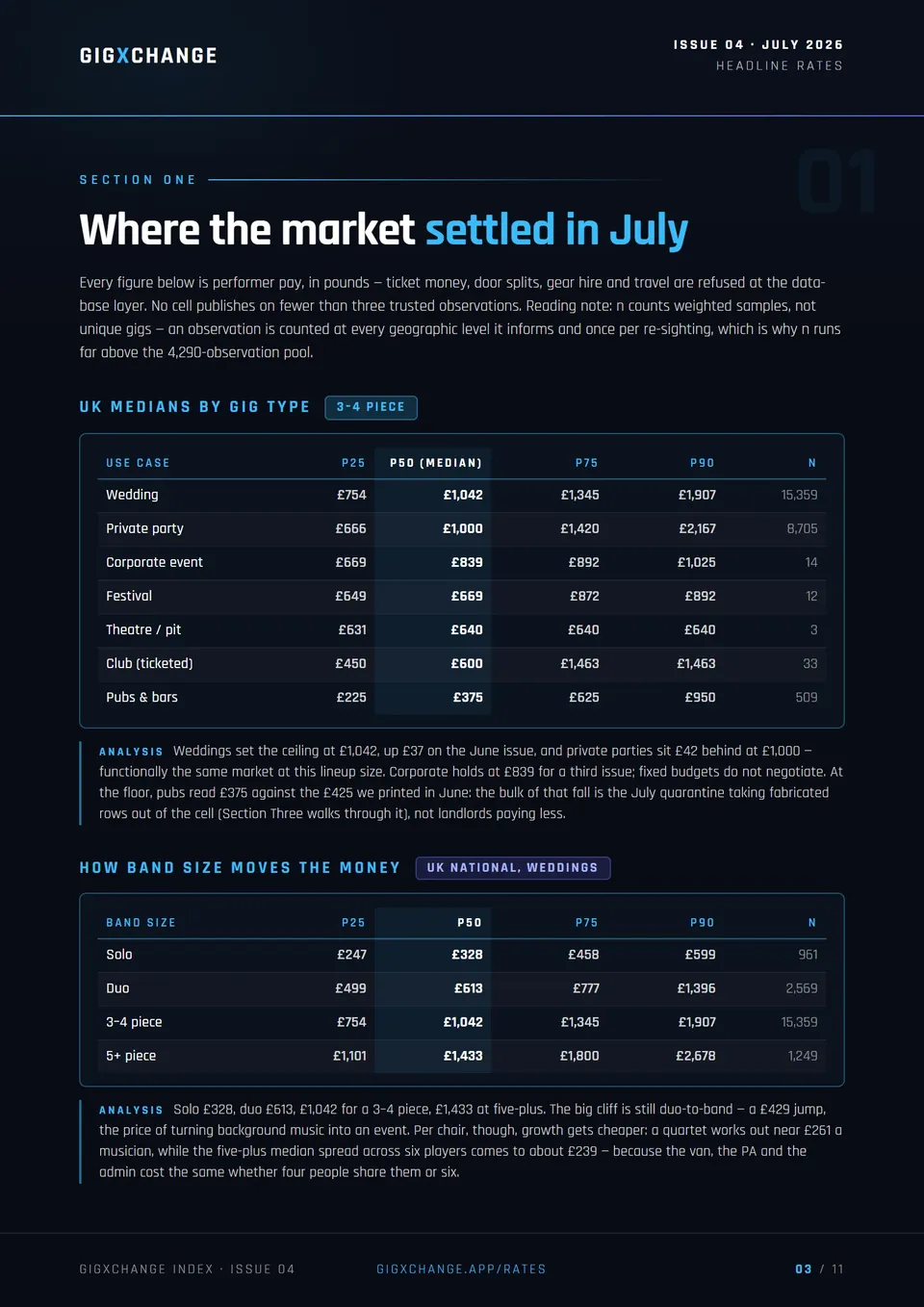
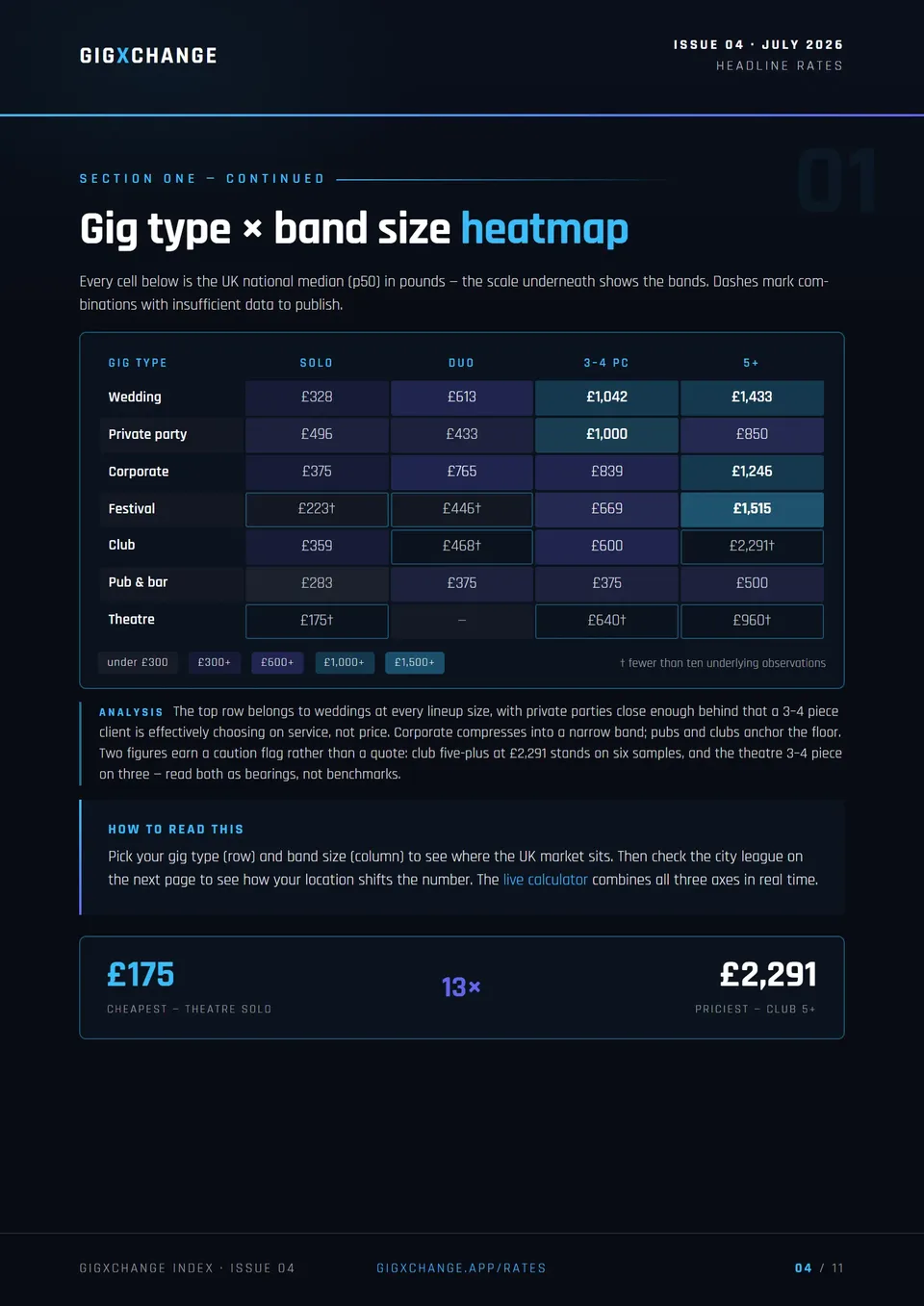
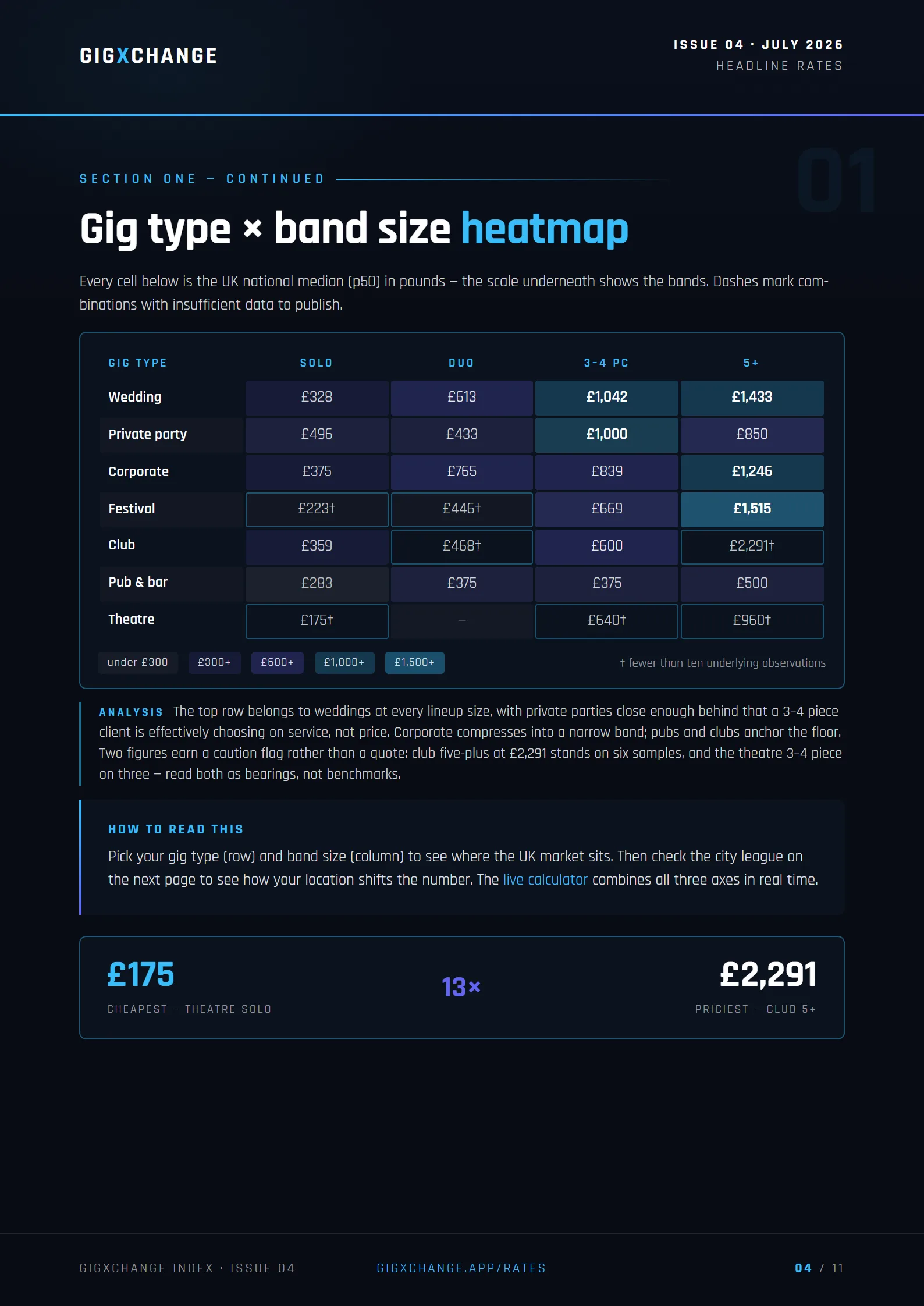
Pick a gig type and band size for the full range a UK act was paid in July 2026: the lower quarter, the median, a strong booking and the top tenth, with how many fees stand behind it.
| Gig type | Solo | Duo | 3–4 piece | 5+ |
|---|---|---|---|---|
| Wedding | ||||
| Private party | ||||
| Corporate | ||||
| Festival | ||||
| Club | ||||
| Pub & bar | ||||
| Theatre | – |
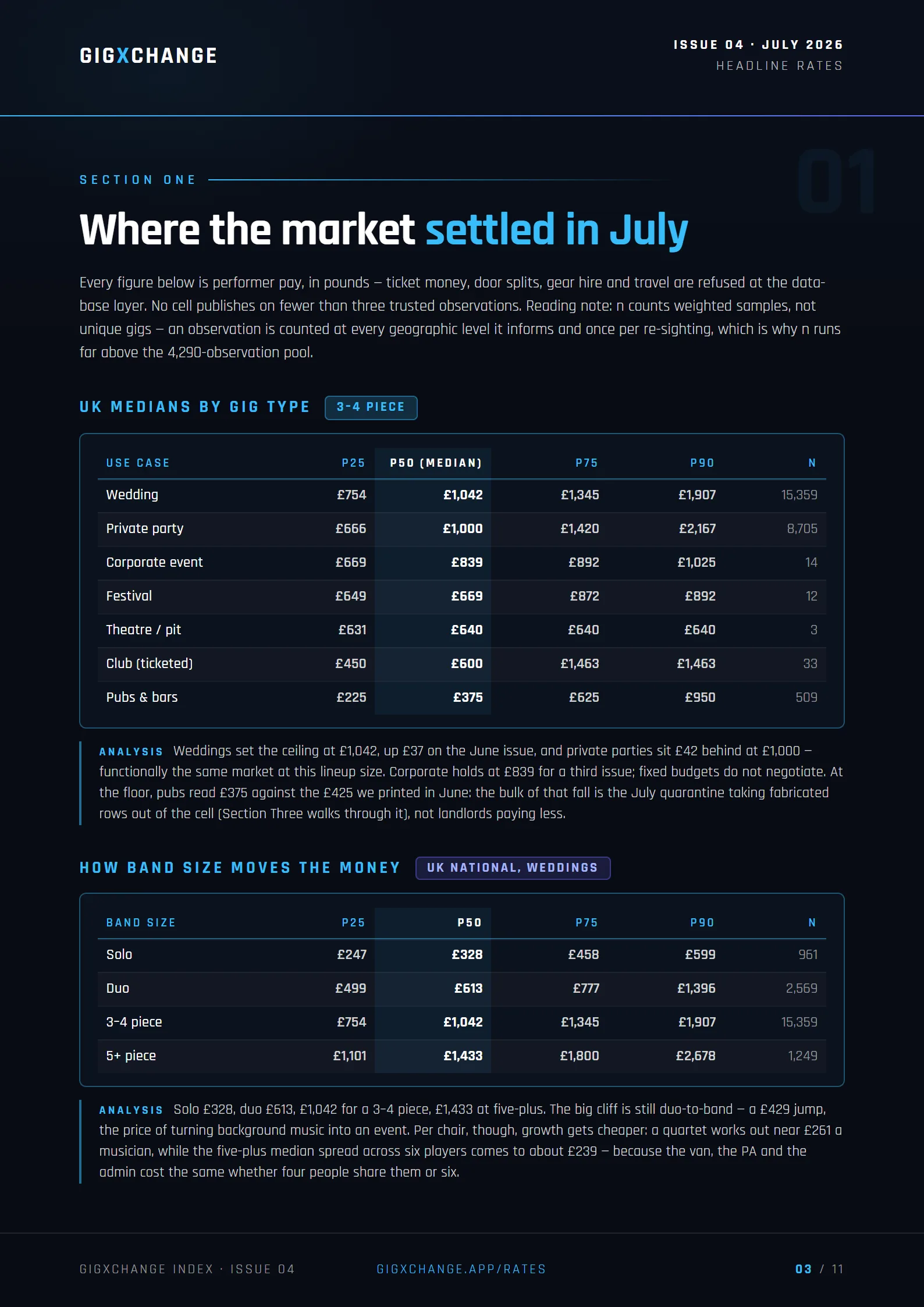
Every figure below is performer pay, in pounds — ticket money, door splits, gear hire and travel are refused at the database layer. A city or region cell needed three trusted sightings to publish; under this issue's method one observation seen repeatedly could meet that, and the UK baseline had no floor (see the Method note). Reading note: n counts weighted samples, not unique gigs — an observation is counted at every geographic level it informs and once per re-sighting, which is why n runs far above the 4,290-observation pool.
Weddings set the ceiling at £1,042, up £37 on the June issue, and private parties sit £42 behind at £1,000 — functionally the same market at this lineup size. Corporate holds at £839 for a third issue; fixed budgets do not negotiate. At the floor, pubs read £375 against the £425 we printed in June: the bulk of that fall is the July quarantine taking fabricated rows out of the cell (Section Three walks through it), not landlords paying less.
Solo £328, duo £613, £1,042 for a 3–4 piece, £1,433 at five-plus. The big cliff is still duo-to-band — a £429 jump, the price of turning background music into an event. Per chair, though, growth gets cheaper: a quartet works out near £261 a musician, while the five-plus median spread across six players comes to about £239 — because the van, the PA and the admin cost the same whether four people share them or six.
Weddings lead the 3–4 piece column, with private parties close enough behind that a 3–4 piece client is effectively choosing on service, not price. Other lineups have other leaders: private parties at solo (£496), corporate at duo (£765), and club (£2,291) and festival (£1,515) at five-plus. Corporate compresses into a narrow band; pubs and clubs anchor the floor. Two figures earn a caution flag rather than a quote: club five-plus at £2,291 stands on six samples, and the theatre 3–4 piece on three — read both as bearings, not benchmarks.
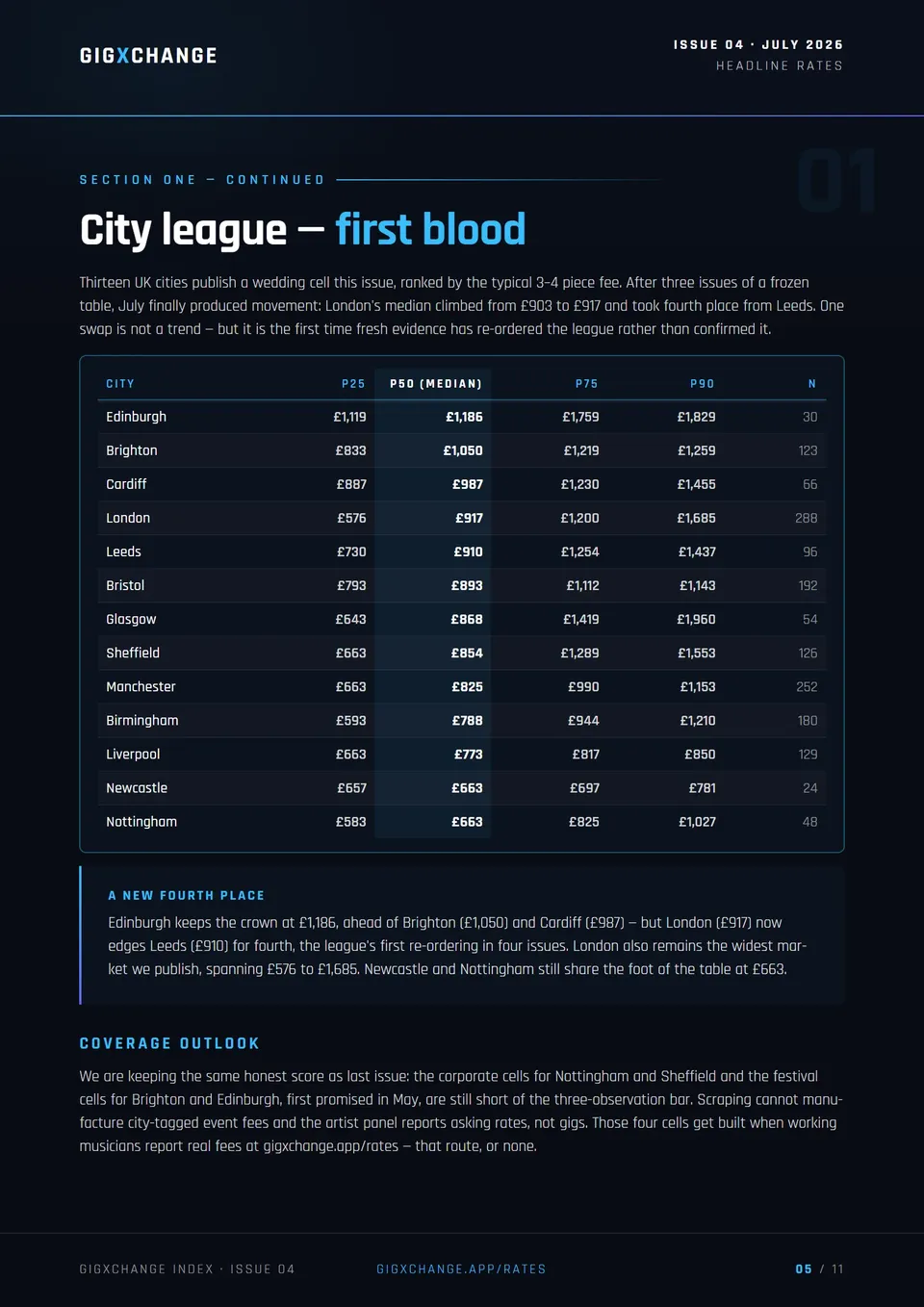
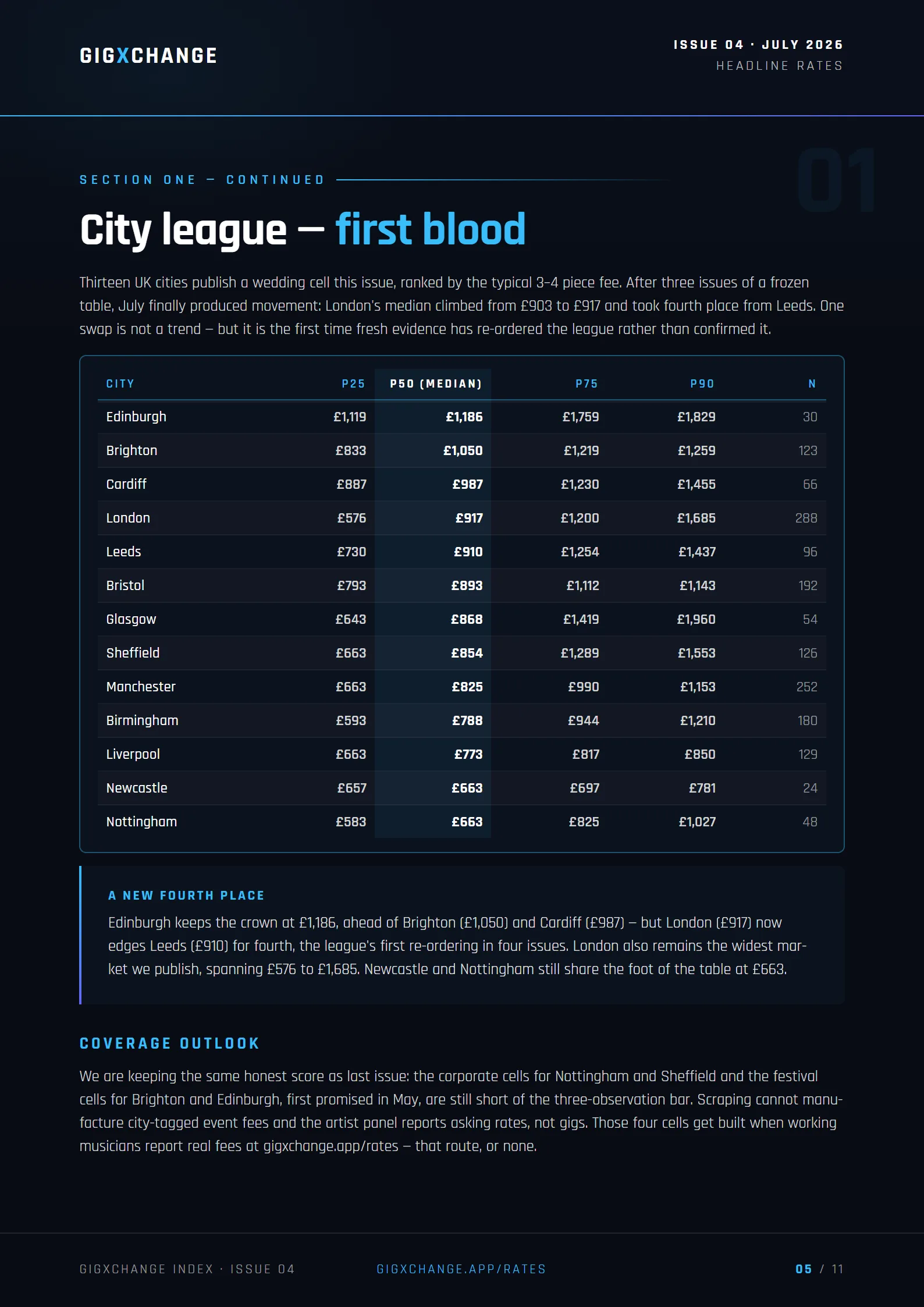
Across 13 UK cities a 3–4 piece wedding band's median ran from £663 in Nottingham to £1,186 in Edinburgh - £523 apart, against £1,042 for the UK as a whole.
Wedding, 3–4 piece: median and middle half by city, July 2026, as the issue published them.
| # | City | Median | Middle half |
|---|---|---|---|
| 1 | Edinburgh | £1,186 | £1,119–£1,759 |
| 2 | Brighton | £1,050 | £833–£1,219 |
| 3 | Cardiff | £987 | £887–£1,230 |
| 4 | London | £917 | £576–£1,200 |
| 5 | Leeds | £910 | £730–£1,254 |
| 6 | Bristol | £893 | £793–£1,112 |
| 7 | Glasgow | £868 | £643–£1,419 |
| 8 | Sheffield | £854 | £663–£1,289 |
| 9 | Manchester | £825 | £663–£990 |
| 10 | Birmingham | £788 | £593–£944 |
| 11 | Liverpool | £773 | £663–£817 |
| 12 | Newcastle | £663 | £657–£697 |
| 13 | Nottingham | £663 | £583–£825 |
Thirteen UK cities publish a wedding cell this issue, ranked by the typical 3–4 piece fee. After three issues of a frozen table, July finally produced movement: London's median climbed from £903 to £917 and took fourth place from Leeds. One swap is not a trend — but it is the first time fresh evidence has re-ordered the league rather than confirmed it.
We are keeping the same honest score as last issue: the corporate cells for Nottingham and Sheffield and the festival cells for Brighton and Edinburgh, first promised in May, are still short of the three-observation bar. Scraping cannot manufacture city-tagged event fees and the artist panel reports asking rates, not gigs. Those four cells get built when working musicians report real fees at gigxchange.app/rates — that route, or none.
What the July 2026 issue reported about weddings and pubs. The moves it names were computed under Method v1 against the previous issue and are not re-checked here.
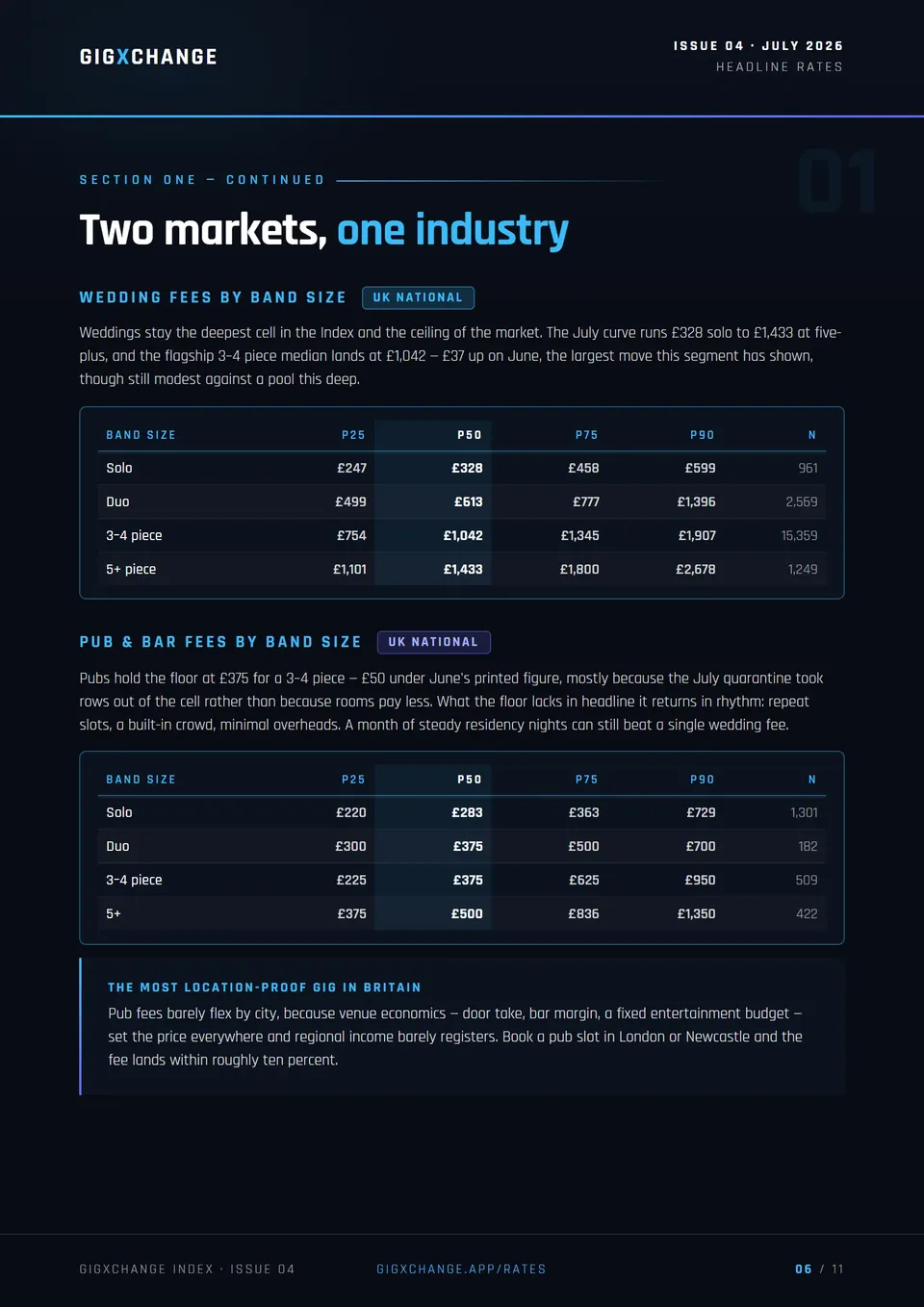
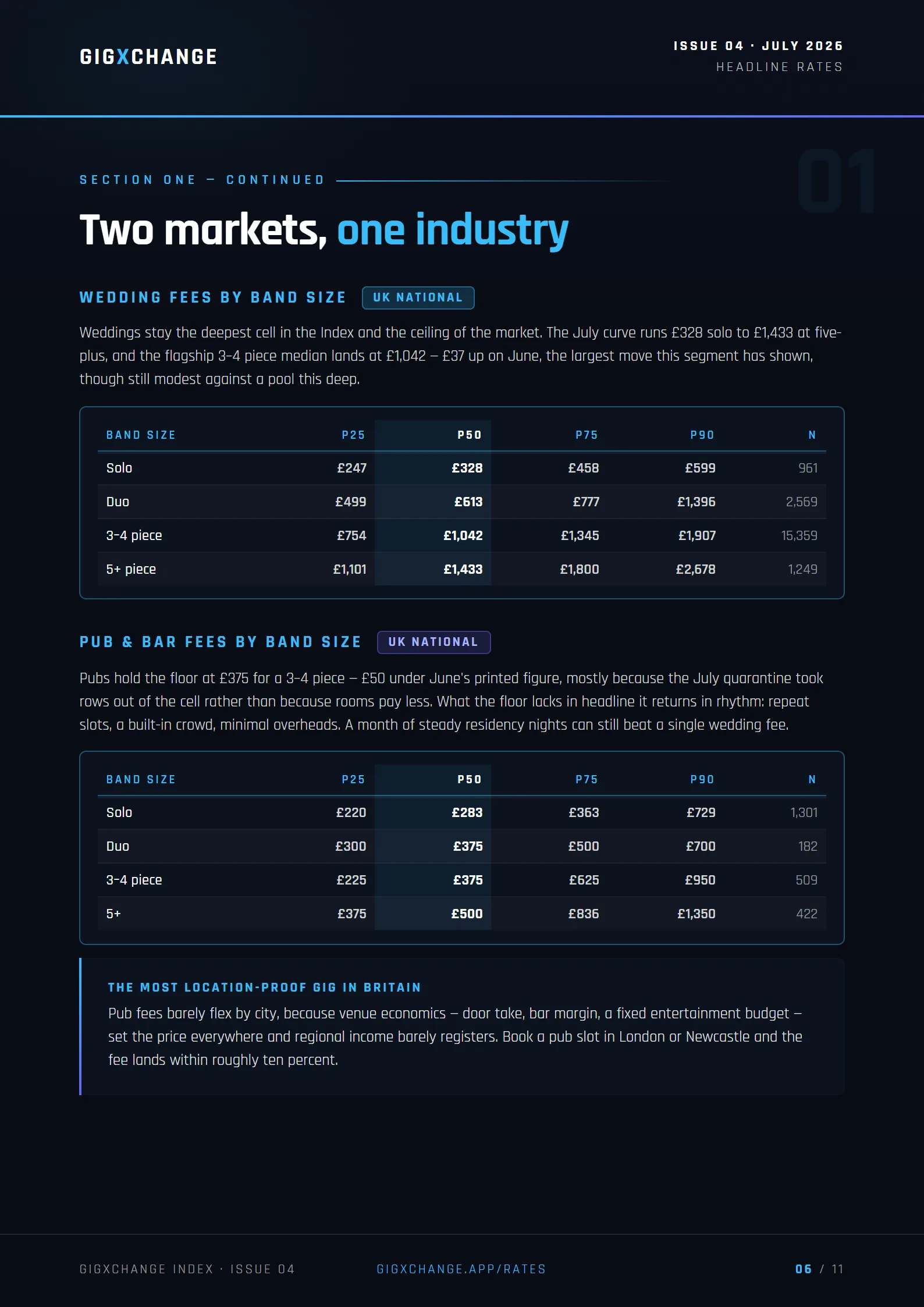
Weddings stay the deepest cell in the Index and the dearest 3–4 piece booking. The July curve runs £328 solo to £1,433 at five-plus, and the flagship 3–4 piece median lands at £1,042 — £37 up on June, the largest move this segment has shown, though still modest against a pool this deep.
Pubs hold the floor at £375 for a 3–4 piece — £50 under June's printed figure, mostly because the July quarantine took rows out of the cell rather than because rooms pay less. What the floor lacks in headline it returns in rhythm: repeat slots, a built-in crowd, minimal overheads. A month of steady residency nights can still beat a single wedding fee.
Every figure is a percentile of real fees paid, asked or budgeted, from 6 sources, built with Method v1 - see the method note for what that method got wrong.
Built with Method v1 - method history and corrections policy.
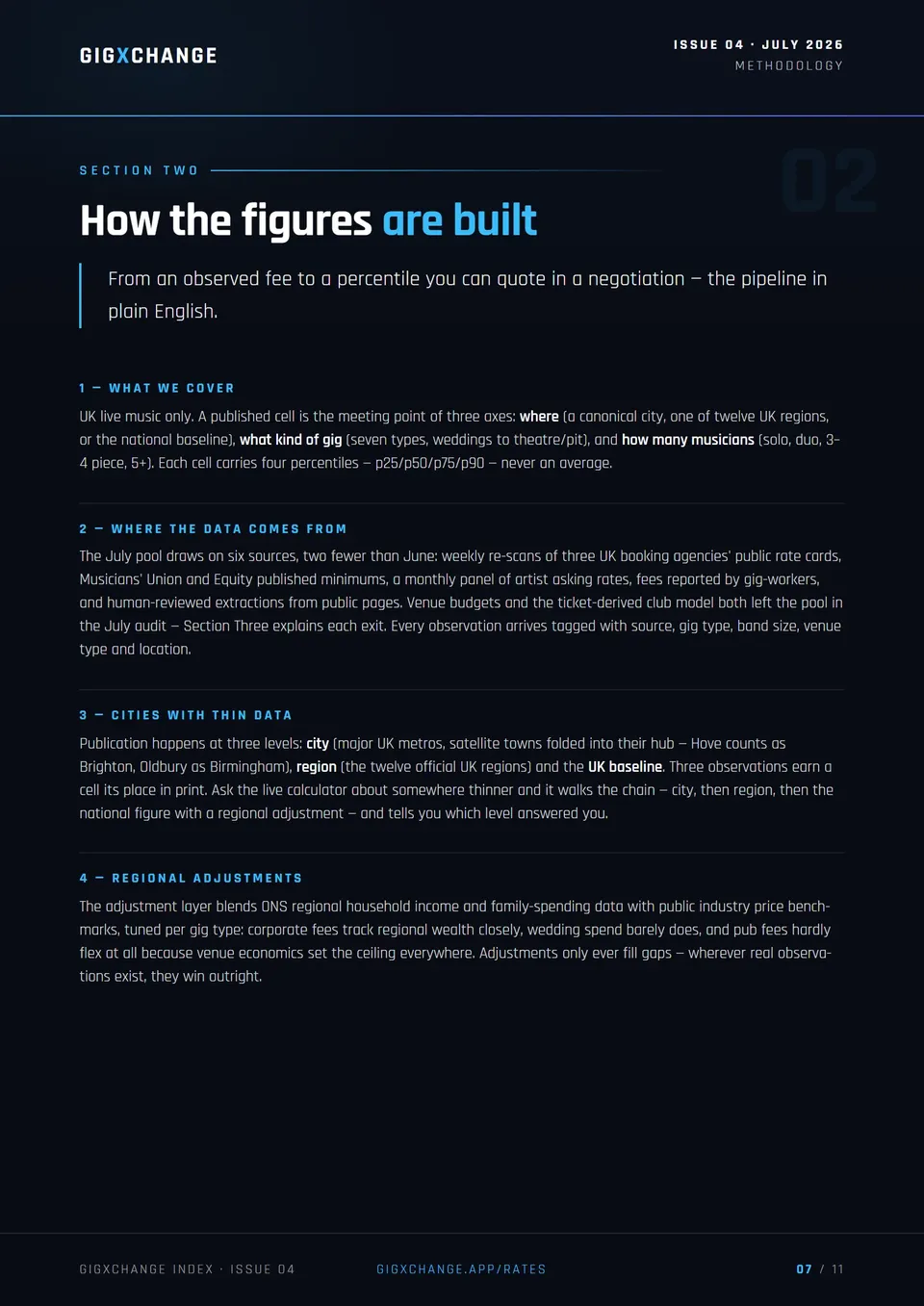
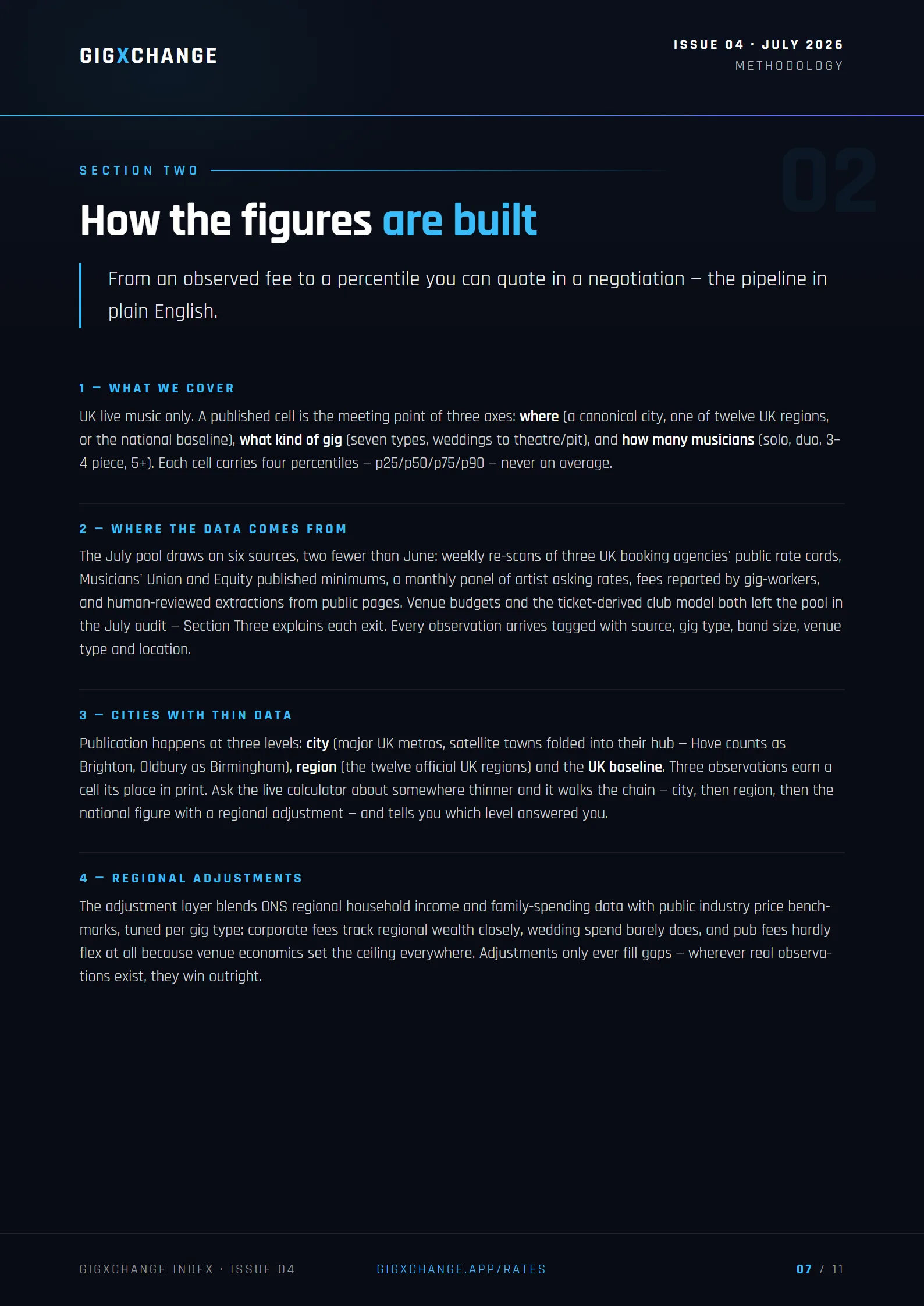
From an observed fee to a percentile you can quote in a negotiation — the pipeline in plain English.
UK live music only. A published cell is the meeting point of three axes: where (a canonical city, one of twelve UK regions, or the national baseline), what kind of gig (seven types, weddings to theatre/pit), and how many musicians (solo, duo, 3–4 piece, 5+). Each cell carries four percentiles — p25/p50/p75/p90 — never an average.
The July pool draws on six sources, two fewer than June: weekly refreshes of published UK market rates, Musicians' Union and Equity published minimums, a monthly panel of artist asking rates, fees reported by gig-workers, and human-reviewed extractions from public pages. Venue budgets and the ticket-derived club model both left the pool in the July audit — Section Three explains each exit. Every observation arrives tagged with source, gig type, band size, venue type and location.
Publication happens at three levels: city (major UK metros, satellite towns folded into their hub — Hove counts as Brighton, Oldbury as Birmingham), region (the twelve official UK regions) and the UK baseline. Three trusted sightings earned a city or region cell its place in print — under this issue's method, possibly one observation seen three times (see the Method note). Ask the live calculator about somewhere thinner and it walks the chain — city, then region, then the national figure with a regional adjustment — and tells you which level answered you.
The adjustment layer blends ONS regional household income and family-spending data with public industry price benchmarks, tuned per gig type: corporate fees track regional wealth closely, wedding spend barely does, and pub fees hardly flex at all because venue economics set the ceiling everywhere. Adjustments only ever fill gaps — wherever real observations exist, they win outright.
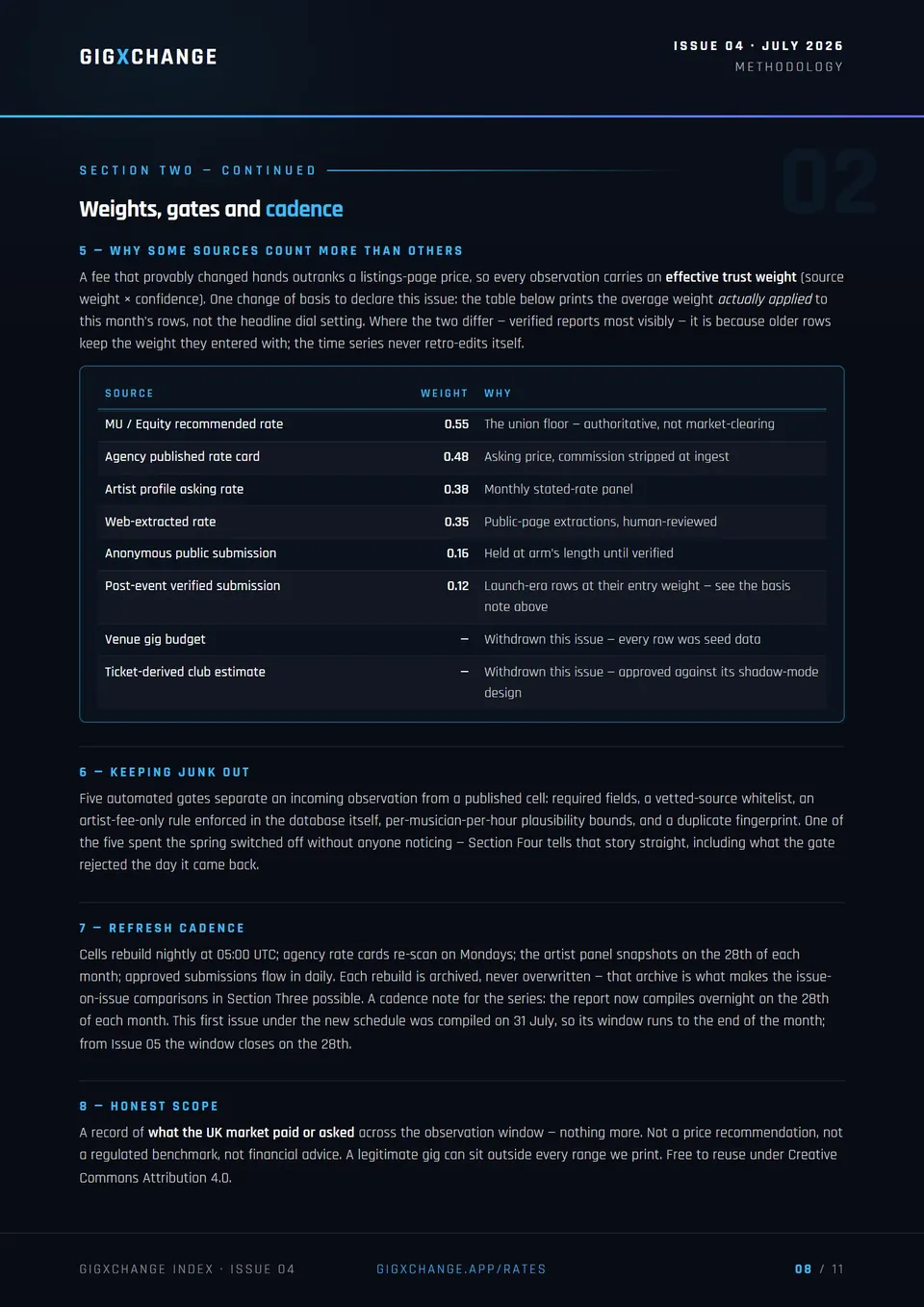
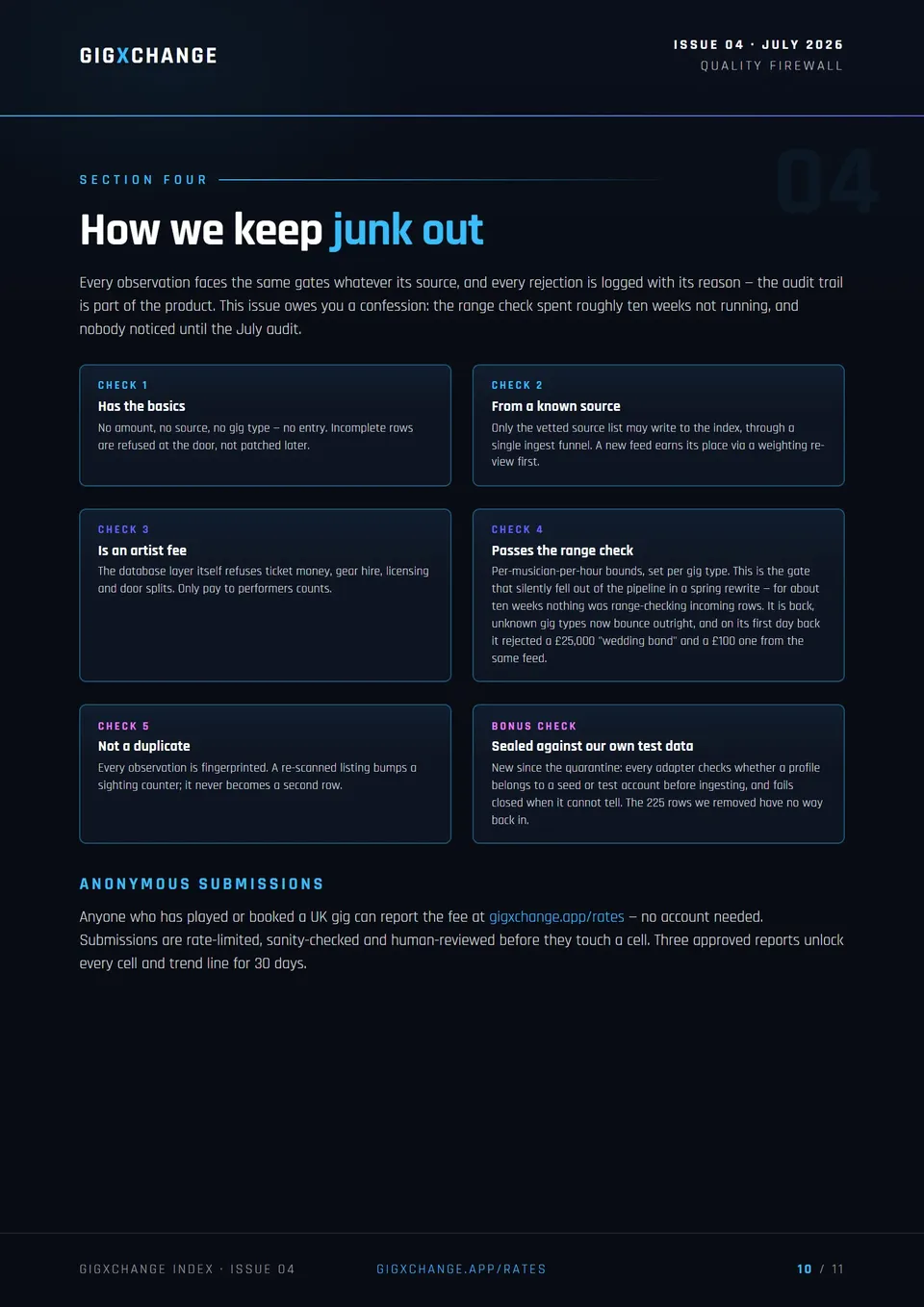
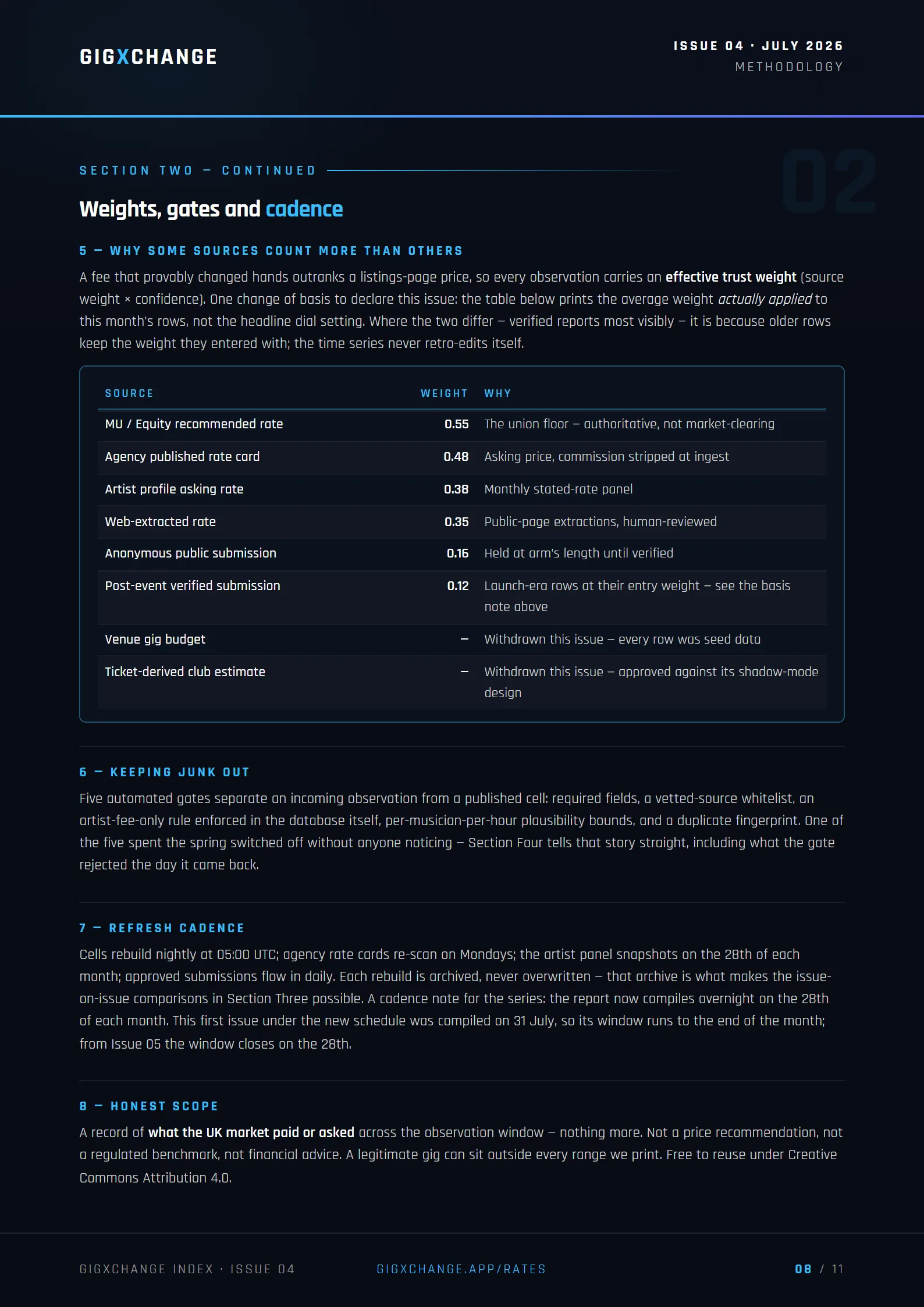
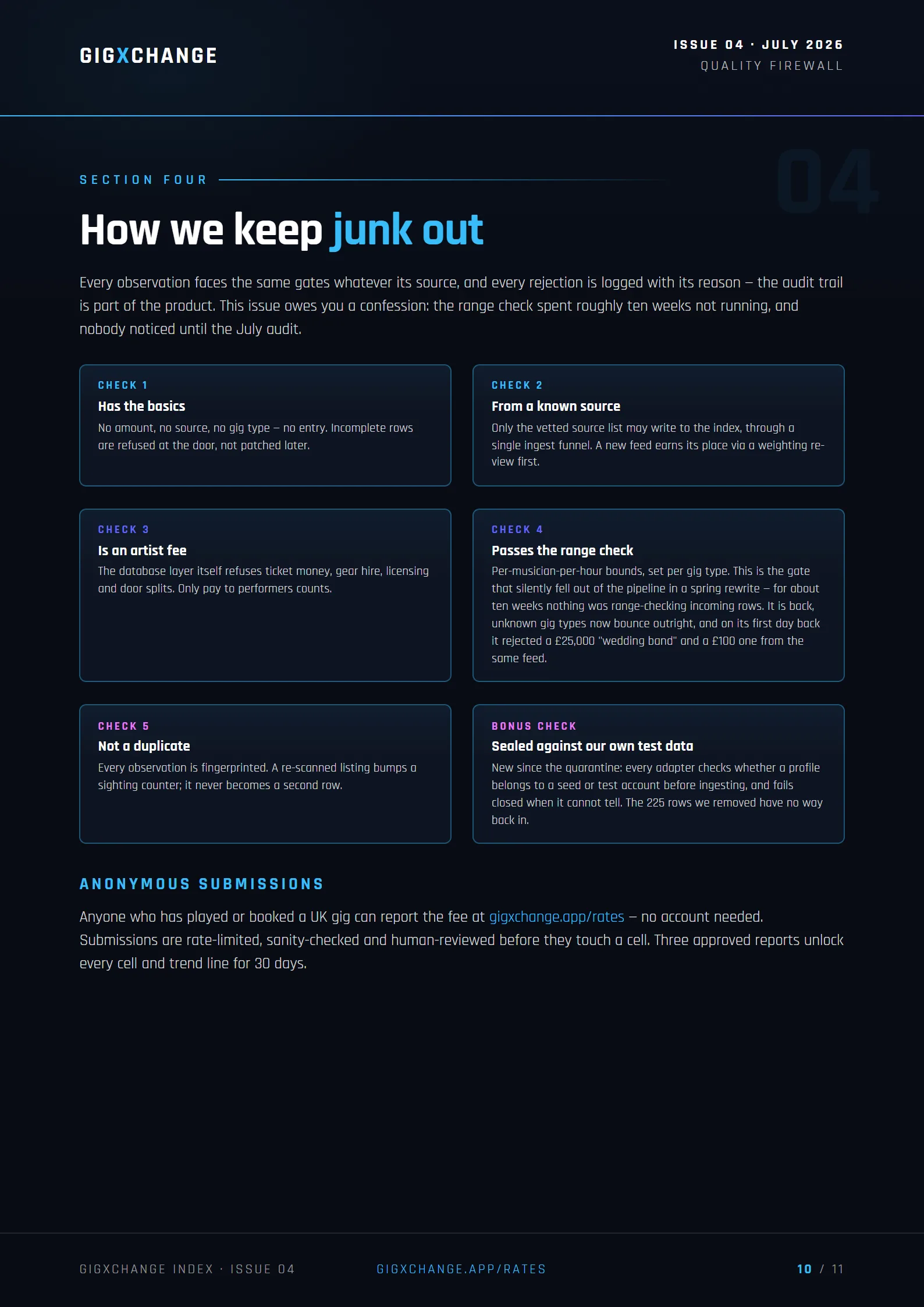
Five automated gates separate an incoming observation from a published cell: required fields, a vetted-source whitelist, an artist-fee-only rule enforced in the database itself, per-musician-per-hour plausibility bounds, and a duplicate fingerprint. One of the five spent the spring switched off without anyone noticing — Section Four tells that story straight, including what the gate rejected the day it came back.
Cells rebuild nightly at 05:00 UTC; published market rates refresh on Mondays; the artist panel snapshots on the 28th of each month; approved submissions flow in daily. Each rebuild is archived, never overwritten — that archive is what makes the issue-on-issue comparisons in Section Three possible. A cadence note for the series: the report now compiles overnight on the 28th of each month. This first issue under the new schedule was compiled on 31 July, so its window runs to the end of the month; from Issue 05 the window closes on the 28th.
A record of what the UK market paid or asked across the observation window — nothing more. Not a price recommendation, not a regulated benchmark, not financial advice. A legitimate gig can sit outside every range we print. Free to reuse under Creative Commons Attribution 4.0.
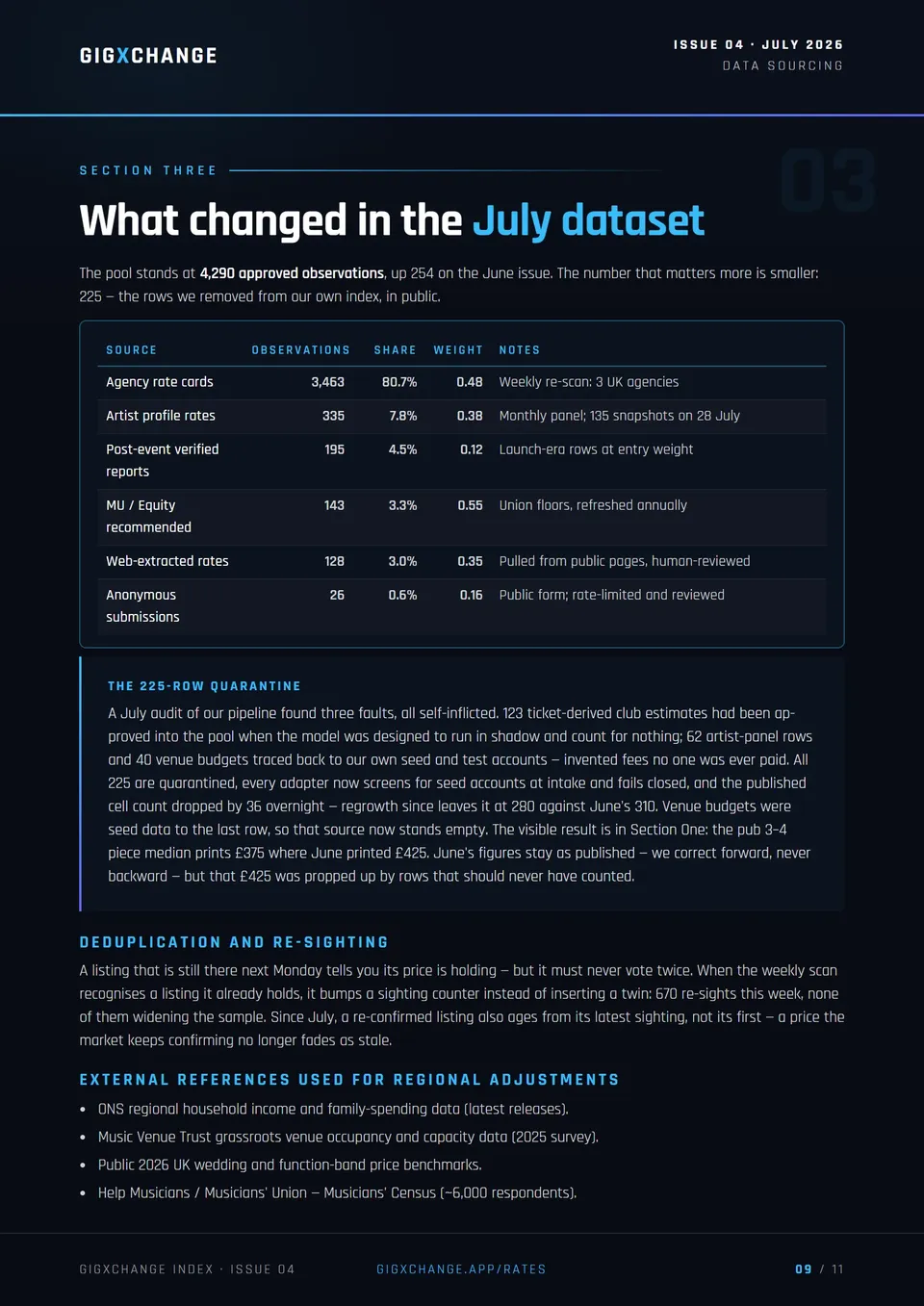
A fee that provably changed hands outranks a listings-page price, so every observation carries an effective trust weight (source weight × confidence). One change of basis to declare this issue: the table below prints the average weight actually applied to this month's rows, not the headline dial setting. Where the two differ — verified reports most visibly — it is because older rows keep the weight they entered with; the time series never retro-edits itself.
| Source | Observations | Share | Avg weight | Notes |
|---|---|---|---|---|
| Published market rates | 3,463 | 80.7% | 0.48 | Weekly refresh — published UK market rates |
| Artist profile rates | 335 | 7.8% | 0.38 | Monthly panel; 135 snapshots on 28 July |
| Post-event verified reports | 195 | 4.5% | 0.12 | Launch-era rows at entry weight |
| MU / Equity recommended | 143 | 3.3% | 0.55 | Union floors, refreshed annually |
| Reviewed public rates | 128 | 3.0% | 0.35 | Pulled from public pages, human-reviewed |
| Anonymous submissions | 26 | 0.6% | 0.16 | Public form; rate-limited and reviewed |
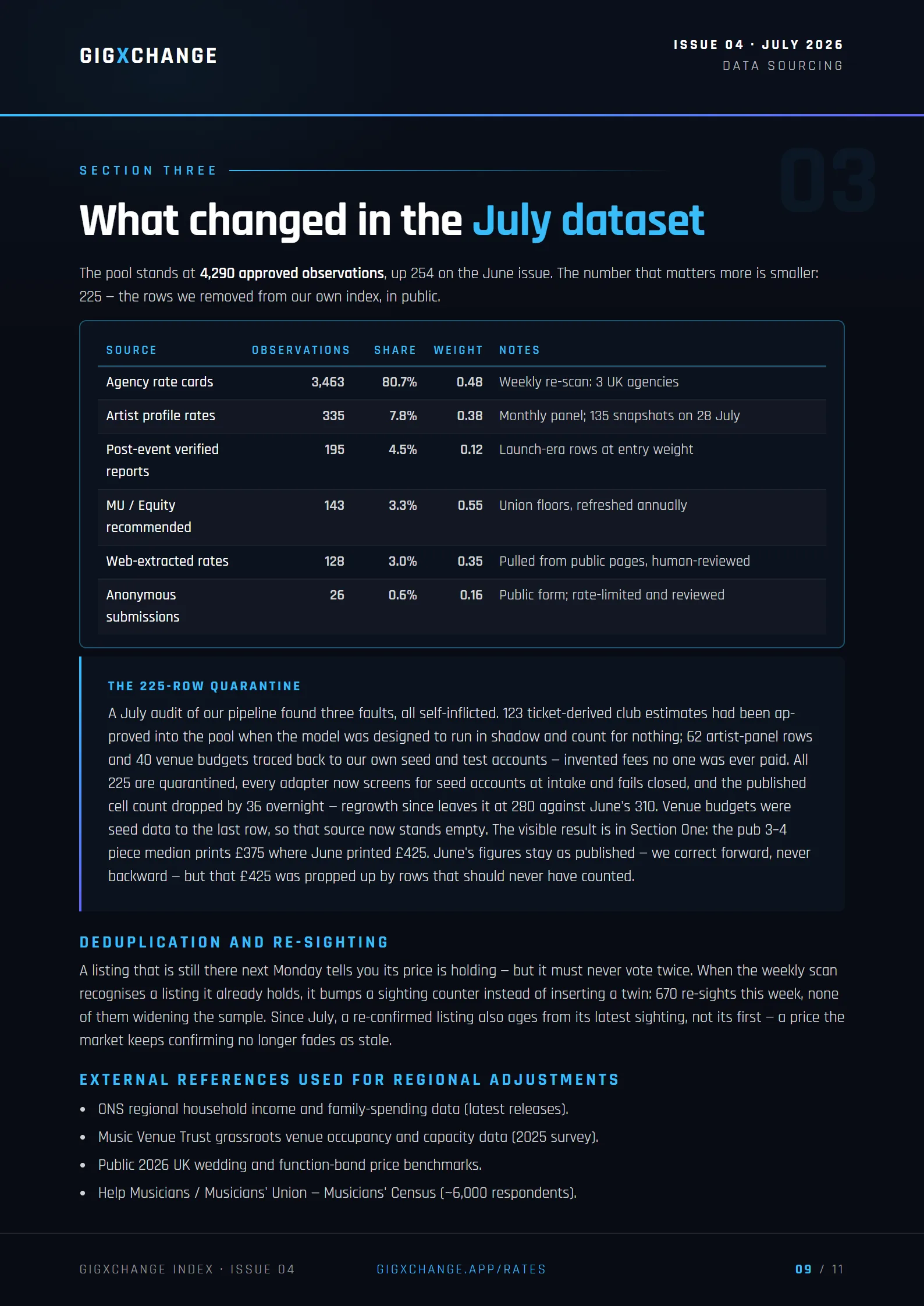
The pool stands at 4,290 approved observations, up 254 on the June issue. The number that matters more is smaller: 225 — the rows we removed from our own index, in public.
A listing that is still there next Monday tells you its price is holding — but it must never vote twice. When the weekly refresh recognises a listing it already holds, it bumps a sighting counter instead of inserting a twin: 670 re-sights this week, none of them widening the sample. Since July, a re-confirmed listing also ages from its latest sighting, not its first — a price the market keeps confirming no longer fades as stale.
Every observation faces the same gates whatever its source, and every rejection is logged with its reason — the audit trail is part of the product. This issue owes you a confession: the range check spent roughly ten weeks not running, and nobody noticed until the July audit.
Anyone who has played or booked a UK gig can report the fee at gigxchange.app/rates — no account needed. Submissions are rate-limited, sanity-checked and human-reviewed before they touch a cell. Three approved reports unlock every cell and trend line for 30 days.
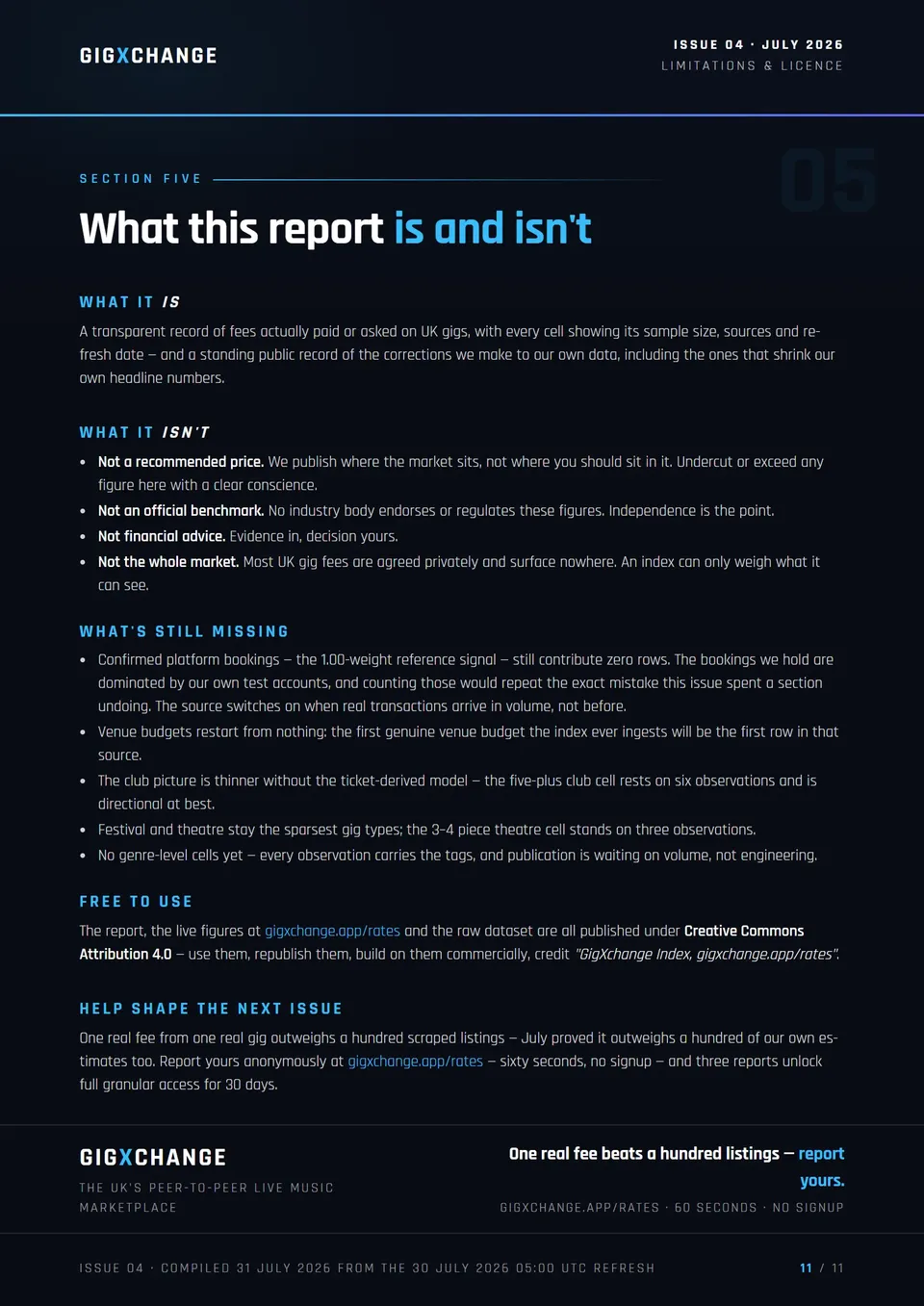
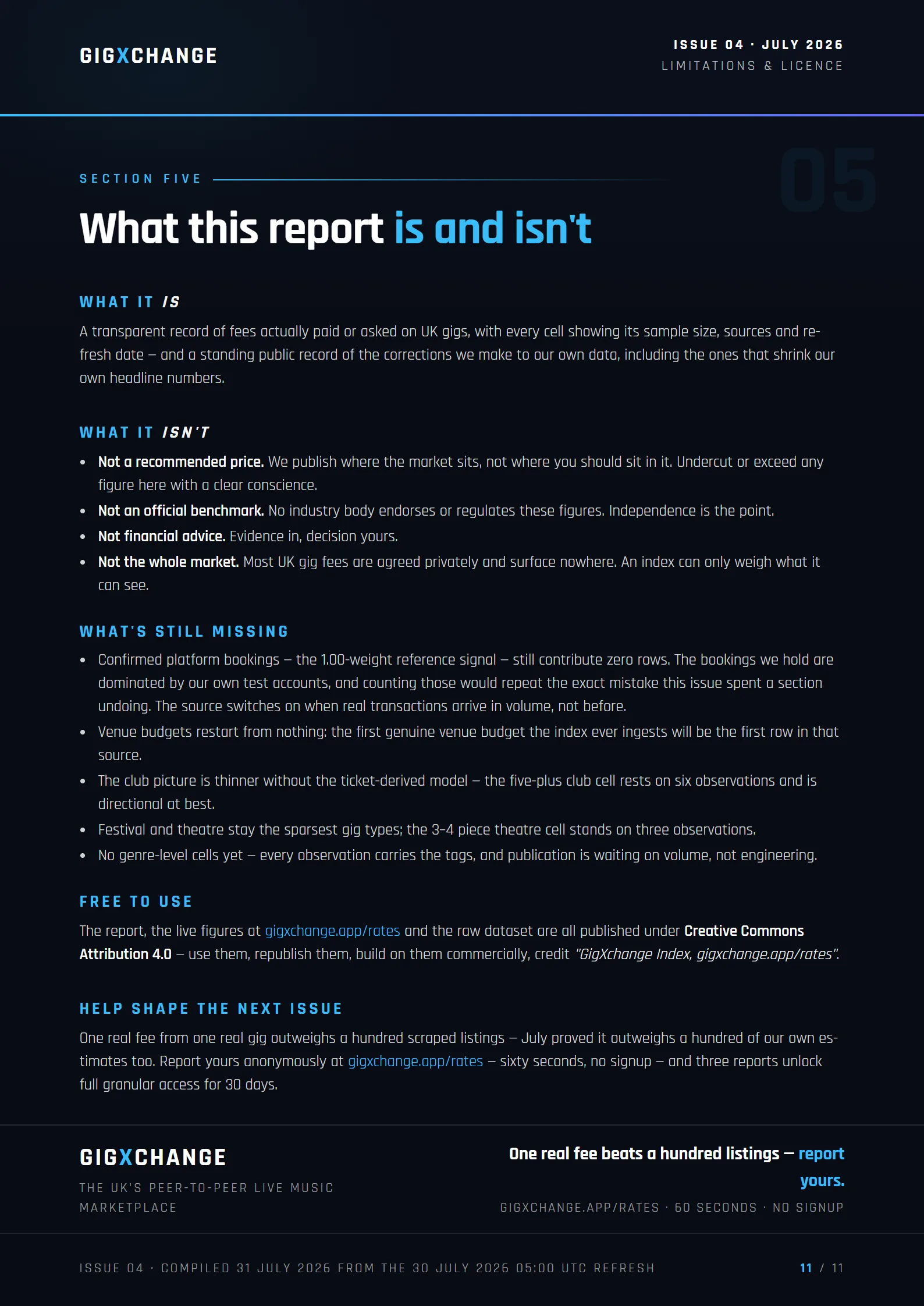
The GX Index is a record of what the UK market paid or asked - not a recommended price, an official benchmark or financial advice. Here is what it still cannot tell you.
A transparent record of fees actually paid or asked on UK gigs, with every cell showing its sample size, sources and refresh date — and a standing public record of the corrections we make to our own data, including the ones that shrink our own headline numbers.
The report, the live figures at gigxchange.app/rates and the raw dataset are all published under Creative Commons Attribution 4.0 — use them, republish them, build on them commercially, credit "GigXchange Index, gigxchange.app/rates".
One real fee from one real gig outweighs a hundred scraped listings — July proved it outweighs a hundred of our own estimates too. Report yours anonymously at gigxchange.app/rates — sixty seconds, no signup — and three reports unlock full granular access for 30 days.
5 revisions to the July 2026 issue since it was published, the latest on 31 October 2026. The PDF is kept as issued; open a revision to see what was printed, what it should say and why.

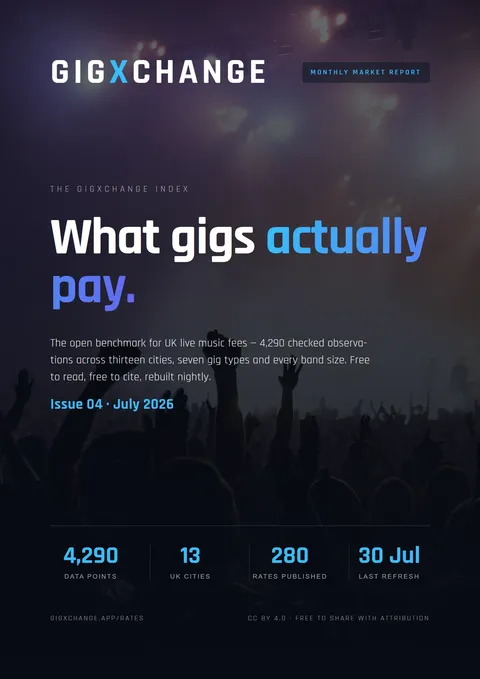
The GigXchange Index is the UK's open benchmark of live music fees. In July 2026 a 3–4 piece wedding band's median fee was £1,042, from 4,290 data points across 13 cities.
Last updated: 1 November 2026
In July 2026 a 3–4 piece wedding band's median fee was £1,042 and a pub booking £375, from 4,290 data points across 13 UK cities.
July was the month we audited our own machinery — and published what we found. Two hundred and twenty-five observations that never deserved a vote — an over-eager club model, and behind it our own test accounts — are out of the pool, two sources emptied with them, and the published cell count now reads 280 against June's 310. Then, with the noise gone, the city league moved for the first time.
Source: GigXchange Index ingest telemetry, June-issue close to 31 July 2026.
Pick a gig type and band size for the full range a UK act was paid in July 2026: the lower quarter, the median, a strong booking and the top tenth, with how many fees stand behind it.
| Gig type | Solo | Duo | 3–4 piece | 5+ |
|---|---|---|---|---|
| Wedding | ||||
| Private party | ||||
| Corporate | ||||
| Festival | ||||
| Club | ||||
| Pub & bar | ||||
| Theatre | – |
Every figure below is performer pay, in pounds — ticket money, door splits, gear hire and travel are refused at the database layer. A city or region cell needed three trusted sightings to publish; under this issue's method one observation seen repeatedly could meet that, and the UK baseline had no floor (see the Method note). Reading note: n counts weighted samples, not unique gigs — an observation is counted at every geographic level it informs and once per re-sighting, which is why n runs far above the 4,290-observation pool.
Weddings set the ceiling at £1,042, up £37 on the June issue, and private parties sit £42 behind at £1,000 — functionally the same market at this lineup size. Corporate holds at £839 for a third issue; fixed budgets do not negotiate. At the floor, pubs read £375 against the £425 we printed in June: the bulk of that fall is the July quarantine taking fabricated rows out of the cell (Section Three walks through it), not landlords paying less.
Solo £328, duo £613, £1,042 for a 3–4 piece, £1,433 at five-plus. The big cliff is still duo-to-band — a £429 jump, the price of turning background music into an event. Per chair, though, growth gets cheaper: a quartet works out near £261 a musician, while the five-plus median spread across six players comes to about £239 — because the van, the PA and the admin cost the same whether four people share them or six.
Weddings lead the 3–4 piece column, with private parties close enough behind that a 3–4 piece client is effectively choosing on service, not price. Other lineups have other leaders: private parties at solo (£496), corporate at duo (£765), and club (£2,291) and festival (£1,515) at five-plus. Corporate compresses into a narrow band; pubs and clubs anchor the floor. Two figures earn a caution flag rather than a quote: club five-plus at £2,291 stands on six samples, and the theatre 3–4 piece on three — read both as bearings, not benchmarks.
Across 13 UK cities a 3–4 piece wedding band's median ran from £663 in Nottingham to £1,186 in Edinburgh - £523 apart, against £1,042 for the UK as a whole.
Wedding, 3–4 piece: median and middle half by city, July 2026, as the issue published them.
| # | City | Median | Middle half |
|---|---|---|---|
| 1 | Edinburgh | £1,186 | £1,119–£1,759 |
| 2 | Brighton | £1,050 | £833–£1,219 |
| 3 | Cardiff | £987 | £887–£1,230 |
| 4 | London | £917 | £576–£1,200 |
| 5 | Leeds | £910 | £730–£1,254 |
| 6 | Bristol | £893 | £793–£1,112 |
| 7 | Glasgow | £868 | £643–£1,419 |
| 8 | Sheffield | £854 | £663–£1,289 |
| 9 | Manchester | £825 | £663–£990 |
| 10 | Birmingham | £788 | £593–£944 |
| 11 | Liverpool | £773 | £663–£817 |
| 12 | Newcastle | £663 | £657–£697 |
| 13 | Nottingham | £663 | £583–£825 |
Thirteen UK cities publish a wedding cell this issue, ranked by the typical 3–4 piece fee. After three issues of a frozen table, July finally produced movement: London's median climbed from £903 to £917 and took fourth place from Leeds. One swap is not a trend — but it is the first time fresh evidence has re-ordered the league rather than confirmed it.
We are keeping the same honest score as last issue: the corporate cells for Nottingham and Sheffield and the festival cells for Brighton and Edinburgh, first promised in May, are still short of the three-observation bar. Scraping cannot manufacture city-tagged event fees and the artist panel reports asking rates, not gigs. Those four cells get built when working musicians report real fees at gigxchange.app/rates — that route, or none.
What the July 2026 issue reported about weddings and pubs. The moves it names were computed under Method v1 against the previous issue and are not re-checked here.
Weddings stay the deepest cell in the Index and the dearest 3–4 piece booking. The July curve runs £328 solo to £1,433 at five-plus, and the flagship 3–4 piece median lands at £1,042 — £37 up on June, the largest move this segment has shown, though still modest against a pool this deep.
Pubs hold the floor at £375 for a 3–4 piece — £50 under June's printed figure, mostly because the July quarantine took rows out of the cell rather than because rooms pay less. What the floor lacks in headline it returns in rhythm: repeat slots, a built-in crowd, minimal overheads. A month of steady residency nights can still beat a single wedding fee.
Every figure is a percentile of real fees paid, asked or budgeted, from 6 sources, built with Method v1 - see the method note for what that method got wrong.
Built with Method v1 - method history and corrections policy.
From an observed fee to a percentile you can quote in a negotiation — the pipeline in plain English.
UK live music only. A published cell is the meeting point of three axes: where (a canonical city, one of twelve UK regions, or the national baseline), what kind of gig (seven types, weddings to theatre/pit), and how many musicians (solo, duo, 3–4 piece, 5+). Each cell carries four percentiles — p25/p50/p75/p90 — never an average.
The July pool draws on six sources, two fewer than June: weekly refreshes of published UK market rates, Musicians' Union and Equity published minimums, a monthly panel of artist asking rates, fees reported by gig-workers, and human-reviewed extractions from public pages. Venue budgets and the ticket-derived club model both left the pool in the July audit — Section Three explains each exit. Every observation arrives tagged with source, gig type, band size, venue type and location.
Publication happens at three levels: city (major UK metros, satellite towns folded into their hub — Hove counts as Brighton, Oldbury as Birmingham), region (the twelve official UK regions) and the UK baseline. Three trusted sightings earned a city or region cell its place in print — under this issue's method, possibly one observation seen three times (see the Method note). Ask the live calculator about somewhere thinner and it walks the chain — city, then region, then the national figure with a regional adjustment — and tells you which level answered you.
The adjustment layer blends ONS regional household income and family-spending data with public industry price benchmarks, tuned per gig type: corporate fees track regional wealth closely, wedding spend barely does, and pub fees hardly flex at all because venue economics set the ceiling everywhere. Adjustments only ever fill gaps — wherever real observations exist, they win outright.
Five automated gates separate an incoming observation from a published cell: required fields, a vetted-source whitelist, an artist-fee-only rule enforced in the database itself, per-musician-per-hour plausibility bounds, and a duplicate fingerprint. One of the five spent the spring switched off without anyone noticing — Section Four tells that story straight, including what the gate rejected the day it came back.
Cells rebuild nightly at 05:00 UTC; published market rates refresh on Mondays; the artist panel snapshots on the 28th of each month; approved submissions flow in daily. Each rebuild is archived, never overwritten — that archive is what makes the issue-on-issue comparisons in Section Three possible. A cadence note for the series: the report now compiles overnight on the 28th of each month. This first issue under the new schedule was compiled on 31 July, so its window runs to the end of the month; from Issue 05 the window closes on the 28th.
A record of what the UK market paid or asked across the observation window — nothing more. Not a price recommendation, not a regulated benchmark, not financial advice. A legitimate gig can sit outside every range we print. Free to reuse under Creative Commons Attribution 4.0.
A fee that provably changed hands outranks a listings-page price, so every observation carries an effective trust weight (source weight × confidence). One change of basis to declare this issue: the table below prints the average weight actually applied to this month's rows, not the headline dial setting. Where the two differ — verified reports most visibly — it is because older rows keep the weight they entered with; the time series never retro-edits itself.
Sources in the pool at the July 2026 refresh, as the issue printed them.
| Source | Observations | Share | Avg weight | Notes |
|---|---|---|---|---|
| Published market rates | 3,463 | 80.7% | 0.48 | Weekly refresh — published UK market rates |
| Artist profile rates | 335 | 7.8% | 0.38 | Monthly panel; 135 snapshots on 28 July |
| Post-event verified reports | 195 | 4.5% | 0.12 | Launch-era rows at entry weight |
| MU / Equity recommended | 143 | 3.3% | 0.55 | Union floors, refreshed annually |
| Reviewed public rates | 128 | 3.0% | 0.35 | Pulled from public pages, human-reviewed |
| Anonymous submissions | 26 | 0.6% | 0.16 | Public form; rate-limited and reviewed |
The pool stands at 4,290 approved observations, up 254 on the June issue. The number that matters more is smaller: 225 — the rows we removed from our own index, in public.
A listing that is still there next Monday tells you its price is holding — but it must never vote twice. When the weekly refresh recognises a listing it already holds, it bumps a sighting counter instead of inserting a twin: 670 re-sights this week, none of them widening the sample. Since July, a re-confirmed listing also ages from its latest sighting, not its first — a price the market keeps confirming no longer fades as stale.
Every observation faces the same gates whatever its source, and every rejection is logged with its reason — the audit trail is part of the product. This issue owes you a confession: the range check spent roughly ten weeks not running, and nobody noticed until the July audit.
Anyone who has played or booked a UK gig can report the fee at gigxchange.app/rates — no account needed. Submissions are rate-limited, sanity-checked and human-reviewed before they touch a cell. Three approved reports unlock every cell and trend line for 30 days.
The GX Index is a record of what the UK market paid or asked - not a recommended price, an official benchmark or financial advice. Here is what it still cannot tell you.
A transparent record of fees actually paid or asked on UK gigs, with every cell showing its sample size, sources and refresh date — and a standing public record of the corrections we make to our own data, including the ones that shrink our own headline numbers.
The report, the live figures at gigxchange.app/rates and the raw dataset are all published under Creative Commons Attribution 4.0 — use them, republish them, build on them commercially, credit "GigXchange Index, gigxchange.app/rates".
One real fee from one real gig outweighs a hundred scraped listings — July proved it outweighs a hundred of our own estimates too. Report yours anonymously at gigxchange.app/rates — sixty seconds, no signup — and three reports unlock full granular access for 30 days.
5 revisions to the July 2026 issue since it was published, the latest on 31 October 2026. The PDF is kept as issued; open a revision to see what was printed, what it should say and why.
Flip through all 11 pages below, or download the PDF.
Flip through all 11 pages below, or download the PDF.
GigXchange (2026). GigXchange Index — July 2026. Issue 04. Available at: gigxchange.app/rates/reports/july-2026. Licensed under CC BY 4.0.
Cite this report
GigXchange (2026). GigXchange Index — July 2026. Issue 04. Available at: gigxchange.app/rates/reports/july-2026. Licensed under CC BY 4.0.
DOI 10.5281/zenodo.21712429 · PDF · CSV · Hugging Face · Kaggle
| GX Index — June 2026Previous issue · 11 pages · PDF | |
| GX Index — August 2026Next issue · 11 pages · PDF | |
| UK Festival Season 202731 Oct 2026 · Annual · 11 pages · PDF | |
| GIGXCHANGE Index — October 202629 Oct 2026 · Index · 11 pages · PDF | |
| GIGXCHANGE Index — September 20266 Oct 2026 · Index · 11 pages · PDF | |
| State of the Circuit 20266 Aug 2026 · Annual · 11 pages · PDF | |
| GIGXCHANGE Index — May 202620 May 2026 · Index · 11 pages · PDF | |
| UK Musician Earnings 202623 Apr 2026 · Special · 11 pages · PDF | |
| Browse all reports & datasets |
Benchmark your fee against the live UK rate index, refreshed nightly.
| Live rate calculator |
Add your real gig fees to the UK Gig Pay Survey — anonymous, ~60 seconds, and every entry sharpens the next GX Index.
| Take the survey |
| UK market statistics | |
| Gig directory |
Every gig you've done is a data point we need. Submit three rates anonymously and you unlock every figure for 30 days.
Everything artists, venues and event planners ask about UK gig fees in July 2026 — answered with real data from 4,290 observations across 13 cities.
Every gig you've done is a data point we need. Submit three rates anonymously and you unlock every figure for 30 days.
Real UK gig-fee data, not guesswork — built from actual bookings. Add yours and it gets sharper for everyone.