

11 — The print edition
The print edition
Flip through all 11 pages below, or download the PDF.
The print edition
Flip through all 11 pages below, or download the PDF.


GigXchange Industry Reports · Annual Edition · 31 October 2026
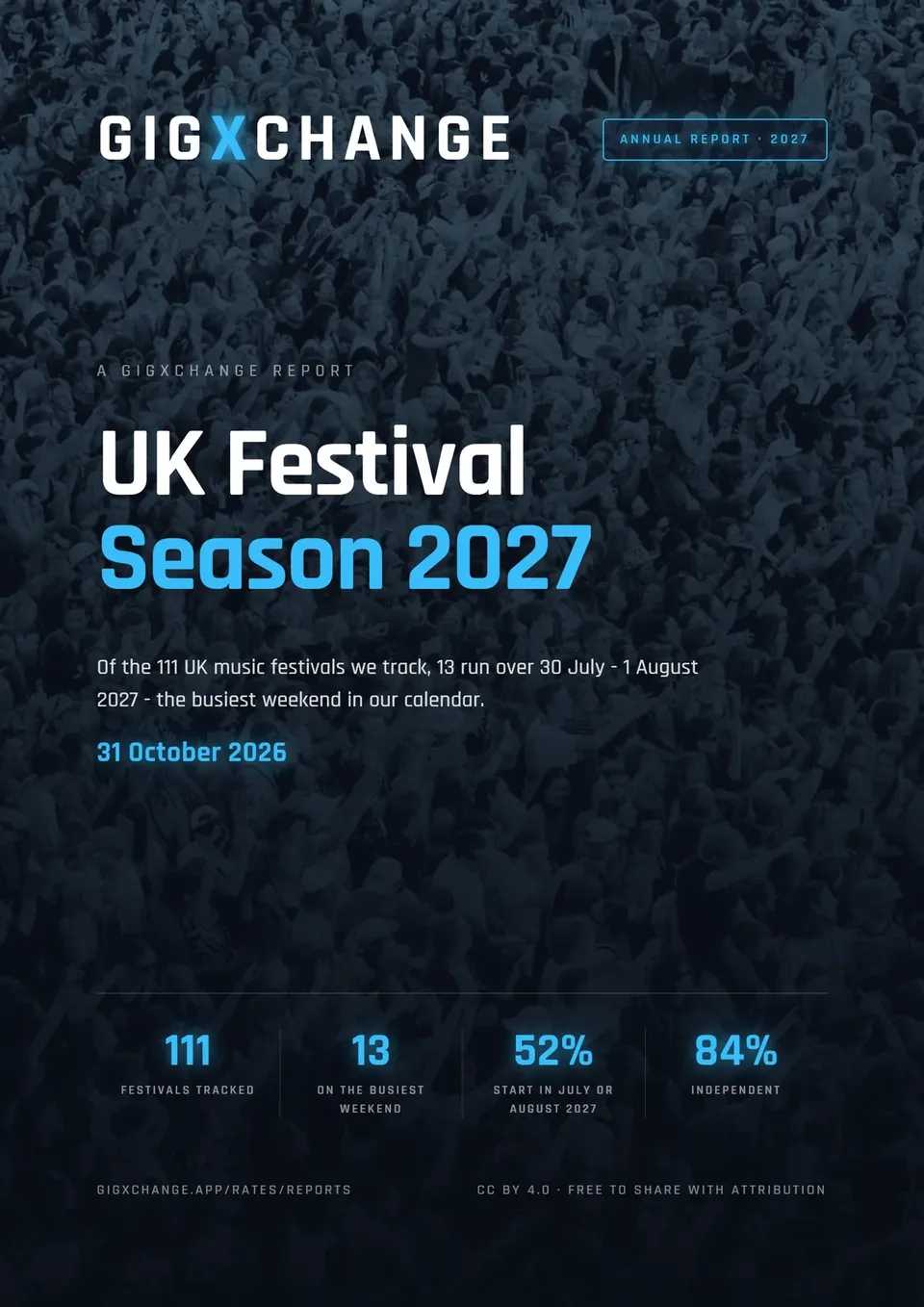
When, where and for how long 111 UK music festivals run in the 2027 season, each date checked on its own website and, where an archived record exists, compared with its last edition. 11 pages, free.
Last updated: 31 October 2026
UK music festivals in our 2027 calendar. 111 festivals tracked, dates confirmed on their own sites
Frozen on 31 October 2026
Each date read on the festival's own website
Shares are of the festivals we track, not every UK festival
The live calendar keeps growing
Free to cite under CC BY 4.0
| Read the report | |
| The full festival calendar | |
| Find out more | |
| Download PDF |
The busiest weekend in our calendar. Of the 111 UK music festivals we track, 13 run over 30 July - 1 August 2027 - the busiest weekend in our calendar.
A festival counts when it runs on the Saturday or Sunday
11 weekends have five or more festivals at once
The five busiest weekends are named in the report
| When the season peaks | |
| Plan your season | |
| Find out more | |
| Download PDF |
The summer share of the season. 52% of the festivals we track start in July or August 2027
67% start between June and August
Counted once, in the month a festival starts
5 festivals open the season in late 2026
| Festivals by month | |
| Find out more | |
| Download PDF |
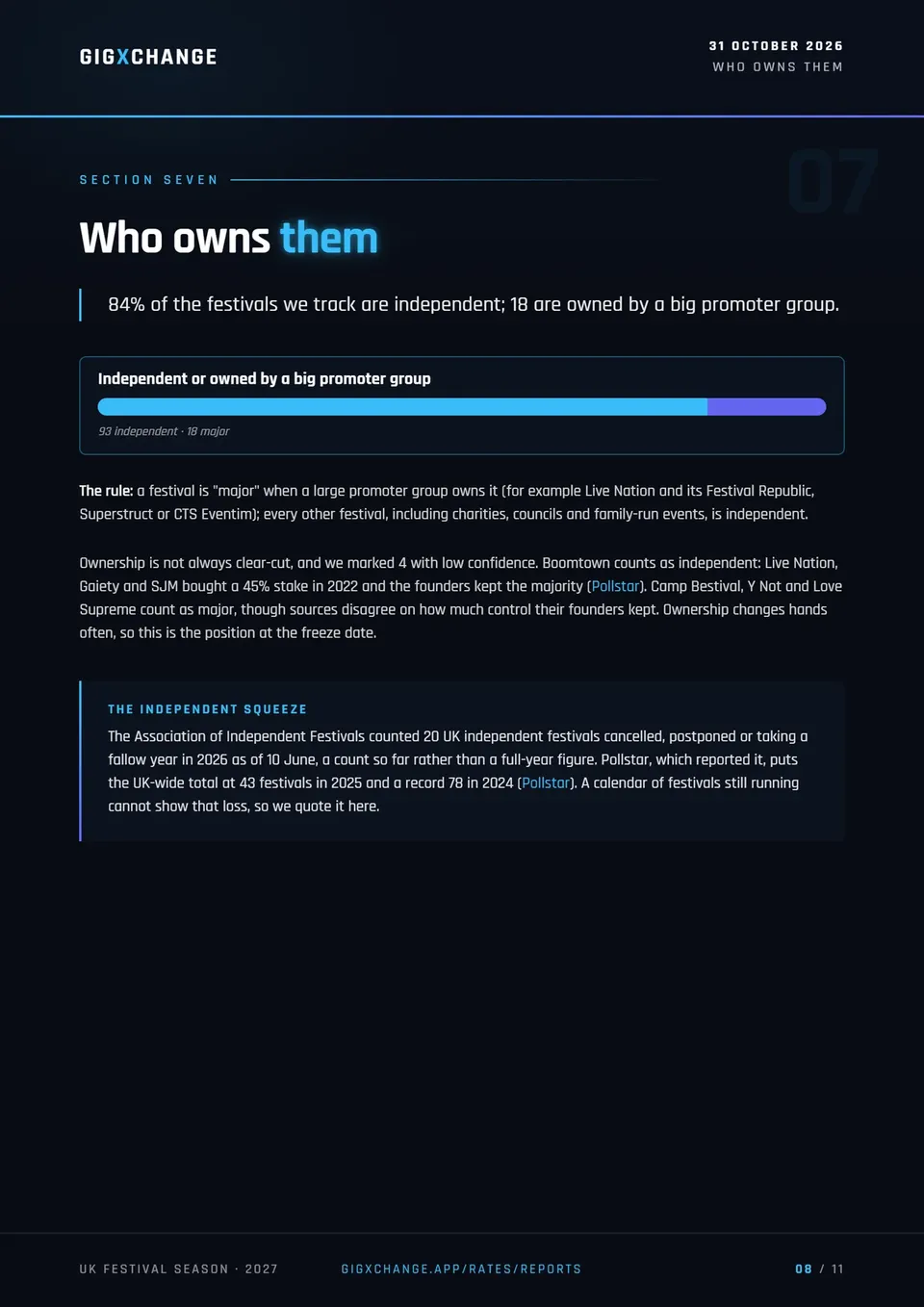
Who owns the festivals we track. 84% are independent (not owned by a big promoter group)
18 are owned by a big promoter group
The ownership rule is stated in the report
Contested cases are named, not hidden
| Who owns them | |
| Find out more | |
| Download PDF |
UK Festival Season 2027 - 11 pages. A citable snapshot of the 2027 UK festival season, compared with each festival's last edition where an archived record exists
11 pages, free to read, no signup
When, how long, what kind, where and who owns them
Every count from one frozen list
Read in-browser or download the PDF
CC BY 4.0 - quote, adapt, build on it
| Read the report | |
| All reports library | |
| Find out more | |
| Download PDF |
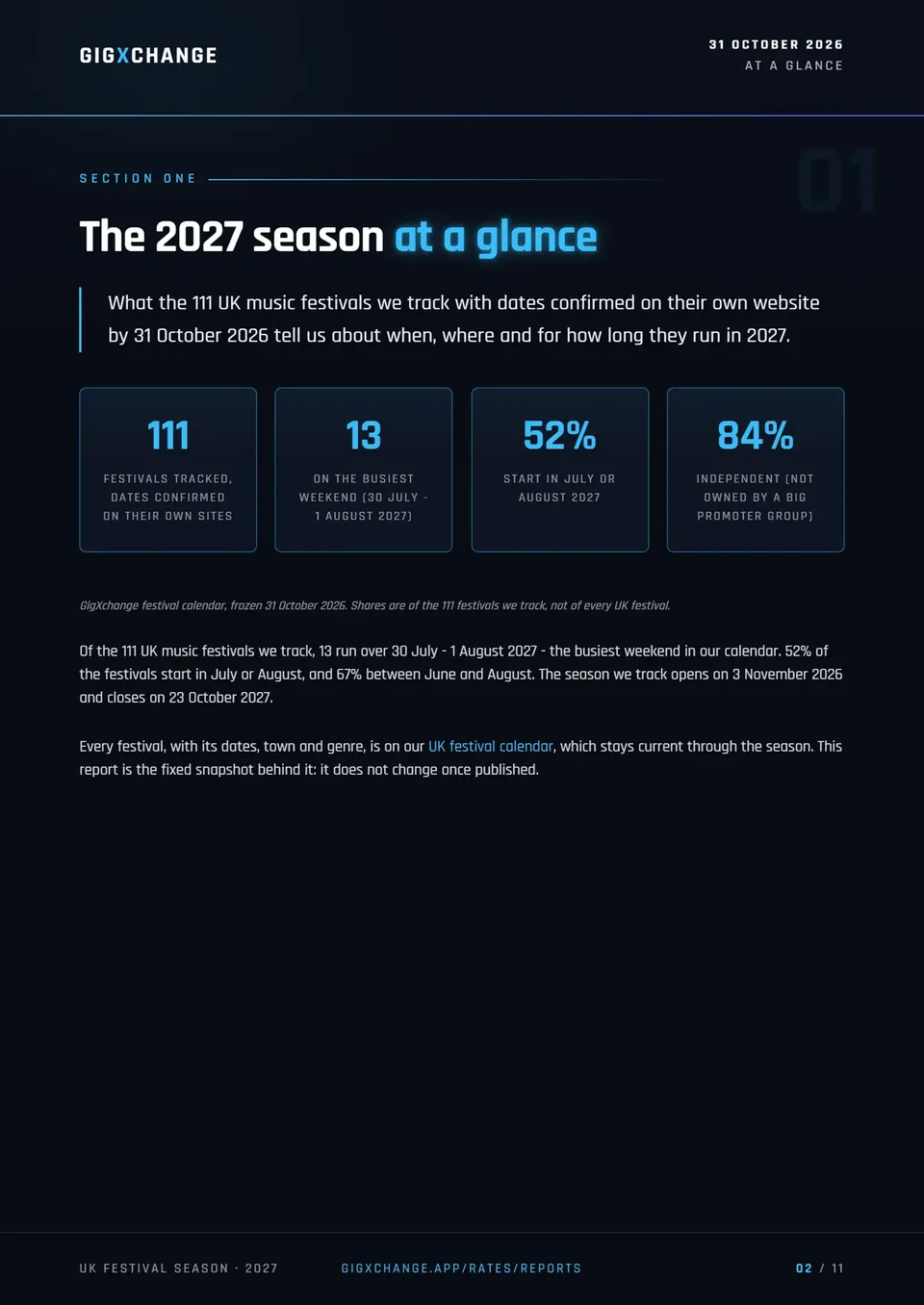
What the 111 UK music festivals we track with dates confirmed on their own website by 31 October 2026 tell us about when, where and for how long they run in 2027.
GigXchange festival calendar, frozen 31 October 2026. Shares are of the 111 festivals we track, not of every UK festival.
Of the 111 UK music festivals we track, 13 run over 30 July - 1 August 2027 - the busiest weekend in our calendar. 52% of the festivals start in July or August, and 67% between June and August. The season we track opens on 3 November 2026 and closes on 23 October 2027.
Every festival, with its dates, town and genre, is on our UK festival calendar, which stays current through the season. This report is the fixed snapshot behind it: it does not change once published.
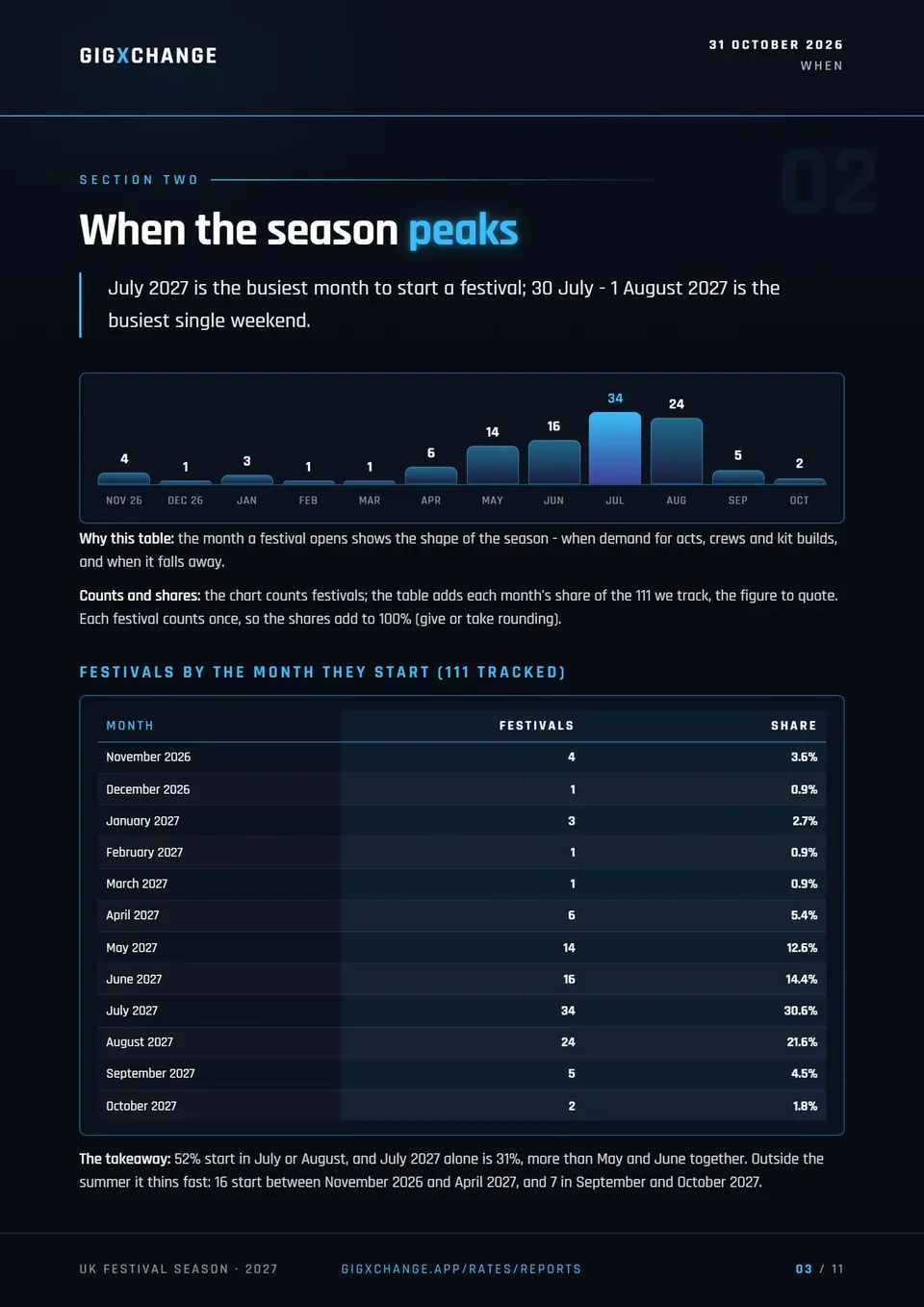
July 2027 is the busiest month to start a festival; 30 July - 1 August 2027 is the busiest single weekend.
Why this table: the month a festival opens shows the shape of the season - when demand for acts, crews and kit builds, and when it falls away.
Each of the 111 festivals we track, counted once in its opening month.
Counts and shares: the chart counts festivals; the table adds each month's share of the 111 we track, the figure to quote. Each festival counts once, so the shares add to 100% (give or take rounding).
Festivals by the month they start (111 tracked)
| Month | Festivals | Share |
|---|---|---|
| November 2026 | 4 | 3.6% |
| December 2026 | 1 | 0.9% |
| January 2027 | 3 | 2.7% |
| February 2027 | 1 | 0.9% |
| March 2027 | 1 | 0.9% |
| April 2027 | 6 | 5.4% |
| May 2027 | 14 | 12.6% |
| June 2027 | 16 | 14.4% |
| July 2027 | 34 | 30.6% |
| August 2027 | 24 | 21.6% |
| September 2027 | 5 | 4.5% |
| October 2027 | 2 | 1.8% |
The takeaway: 52% start in July or August, and July 2027 alone is 31%, more than May and June together. Outside the summer it thins fast: 16 start between November 2026 and April 2027, and 7 in September and October 2027.
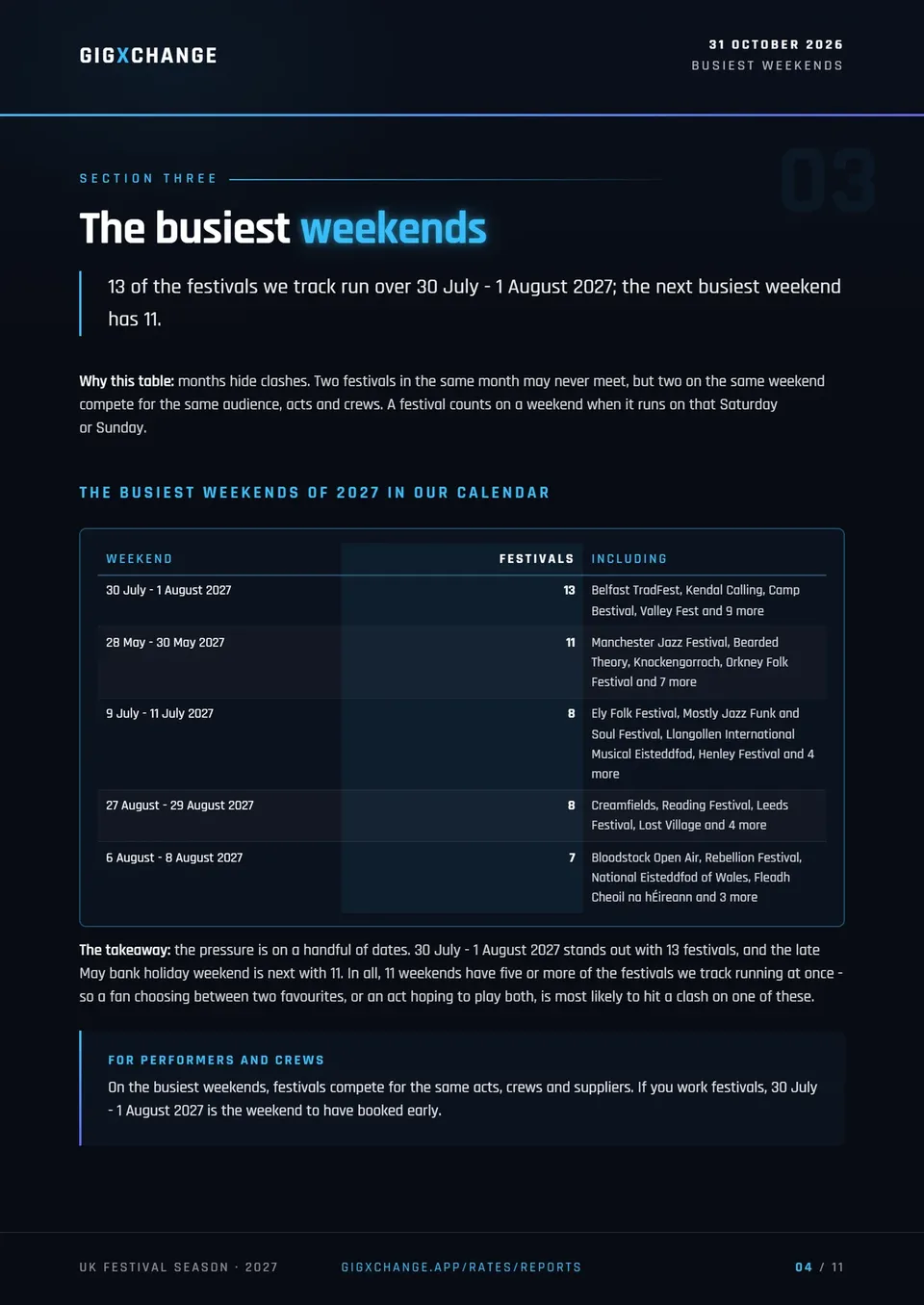
13 of the festivals we track run over 30 July - 1 August 2027; the next busiest weekend has 11.
Why this table: months hide clashes. Two festivals in the same month may never meet, but two on the same weekend compete for the same audience, acts and crews. A festival counts on a weekend when it runs on that Saturday or Sunday.
The busiest weekends of 2027 in our calendar
| # | Weekend | Festivals | Including |
|---|---|---|---|
| 1 | 30 July - 1 August 2027 | 13 | Belfast TradFest, Kendal Calling, Camp Bestival, Valley Fest and 9 more |
| 2 | 28 May - 30 May 2027 | 11 | Manchester Jazz Festival, Bearded Theory, Knockengorroch, Orkney Folk Festival and 7 more |
| 3 | 9 July - 11 July 2027 | 8 | Ely Folk Festival, Mostly Jazz Funk and Soul Festival, Llangollen International Musical Eisteddfod, Henley Festival and 4 more |
| 4 | 27 August - 29 August 2027 | 8 | Creamfields, Reading Festival, Leeds Festival, Lost Village and 4 more |
| 5 | 6 August - 8 August 2027 | 7 | Bloodstock Open Air, Rebellion Festival, National Eisteddfod of Wales, Fleadh Cheoil na hÉireann and 3 more |
The takeaway: the pressure is on a handful of dates. 30 July - 1 August 2027 stands out with 13 festivals, and the late May bank holiday weekend is next with 11. In all, 11 weekends have five or more of the festivals we track running at once - so a fan choosing between two favourites, or an act hoping to play both, is most likely to hit a clash on one of these.
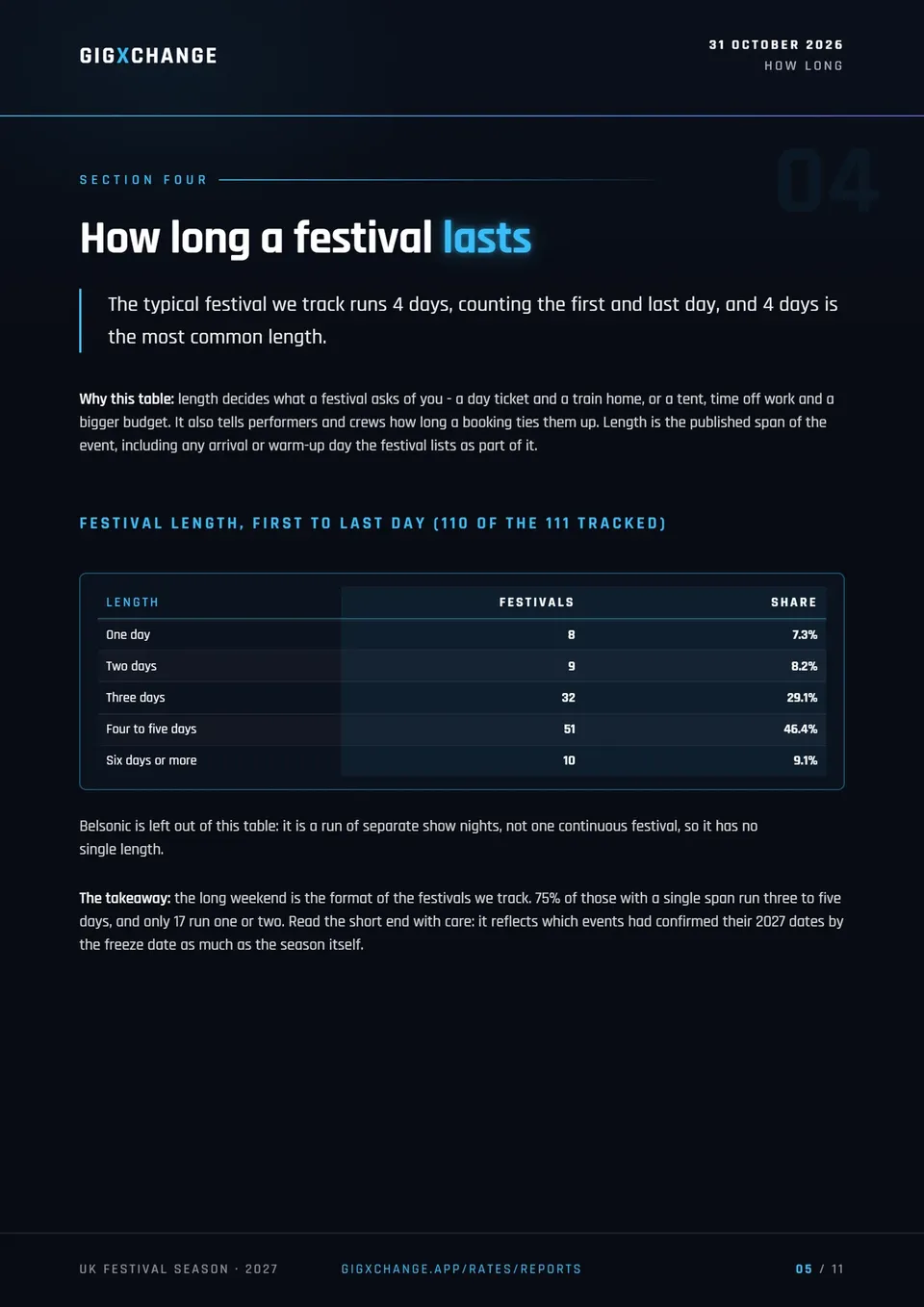
The typical festival we track runs 4 days, counting the first and last day, and 4 days is the most common length.
Why this table: length decides what a festival asks of you - a day ticket and a train home, or a tent, time off work and a bigger budget. It also tells performers and crews how long a booking ties them up. Length is the published span of the event, including any arrival or warm-up day the festival lists as part of it.
First to last day, 110 of the 111 festivals we track.
Festival length, first to last day (110 of the 111 tracked)
| Length | Festivals | Share |
|---|---|---|
| One day | 8 | 7.3% |
| Two days | 9 | 8.2% |
| Three days | 32 | 29.1% |
| Four to five days | 51 | 46.4% |
| Six days or more | 10 | 9.1% |
Belsonic is left out of this table: it is a run of separate show nights, not one continuous festival, so it has no single length.
The takeaway: the long weekend is the format of the festivals we track. 75% of those with a single span run three to five days, and only 17 run one or two. Read the short end with care: it reflects which events had confirmed their 2027 dates by the freeze date as much as the season itself.
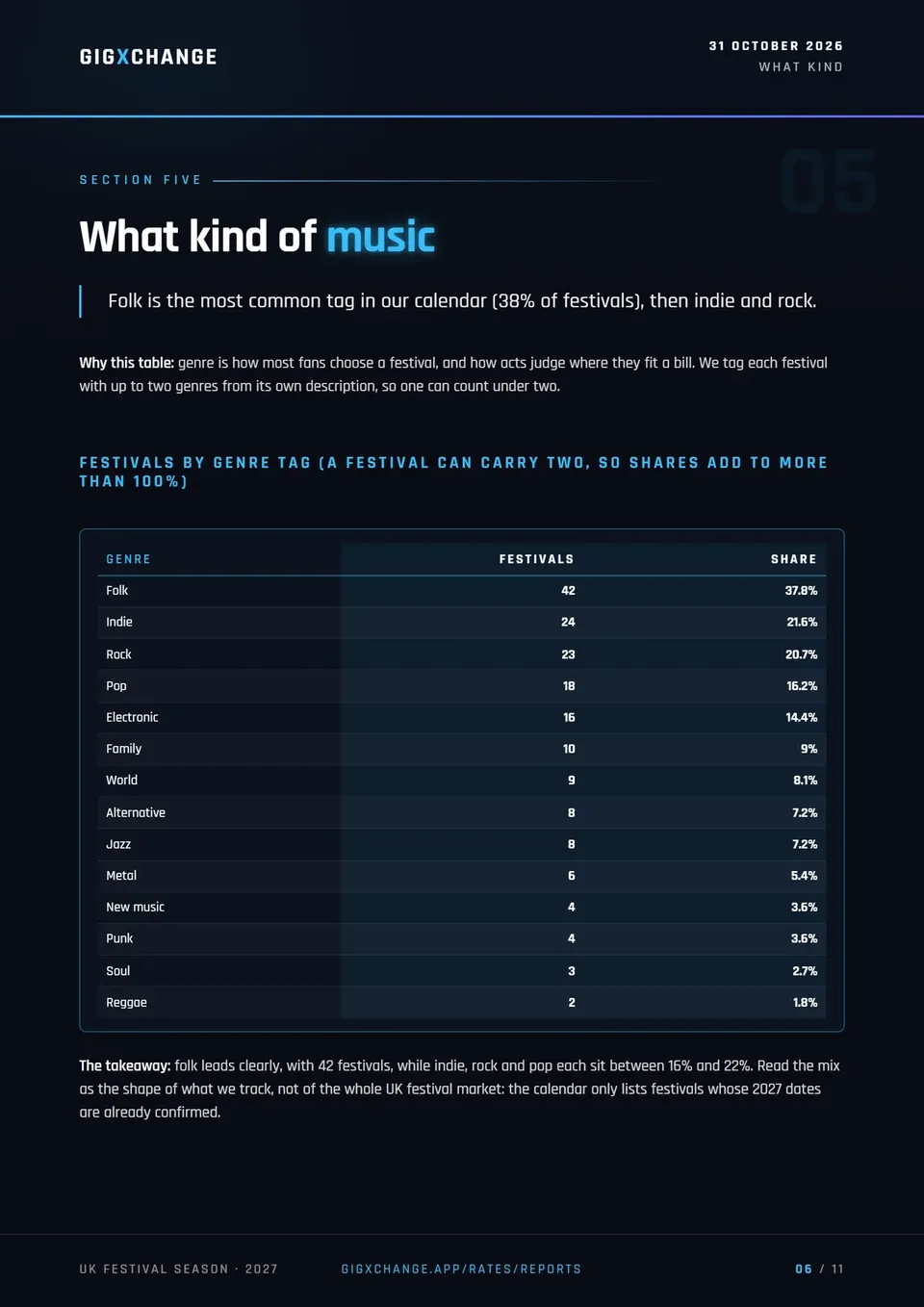
Folk is the most common tag in our calendar (38% of festivals), then indie and rock.
Why this table: genre is how most fans choose a festival, and how acts judge where they fit a bill. We tag each festival with up to two genres from its own description, so one can count under two.
Festivals by genre tag (a festival can carry two, so shares add to more than 100%)
| # | Genre | Festivals | Share |
|---|---|---|---|
| 1 | Folk | 42 | 37.8% |
| 2 | Indie | 24 | 21.6% |
| 3 | Rock | 23 | 20.7% |
| 4 | Pop | 18 | 16.2% |
| 5 | Electronic | 16 | 14.4% |
| 6 | Family | 10 | 9% |
| 7 | World | 9 | 8.1% |
| 8 | Alternative | 8 | 7.2% |
| 9 | Jazz | 8 | 7.2% |
| 10 | Metal | 6 | 5.4% |
| 11 | New music | 4 | 3.6% |
| 12 | Punk | 4 | 3.6% |
| 13 | Soul | 3 | 2.7% |
| 14 | Reggae | 2 | 1.8% |
The takeaway: folk leads clearly, with 42 festivals, while indie, rock and pop each sit between 16% and 22%. Read the mix as the shape of what we track, not of the whole UK festival market: the calendar only lists festivals whose 2027 dates are already confirmed.
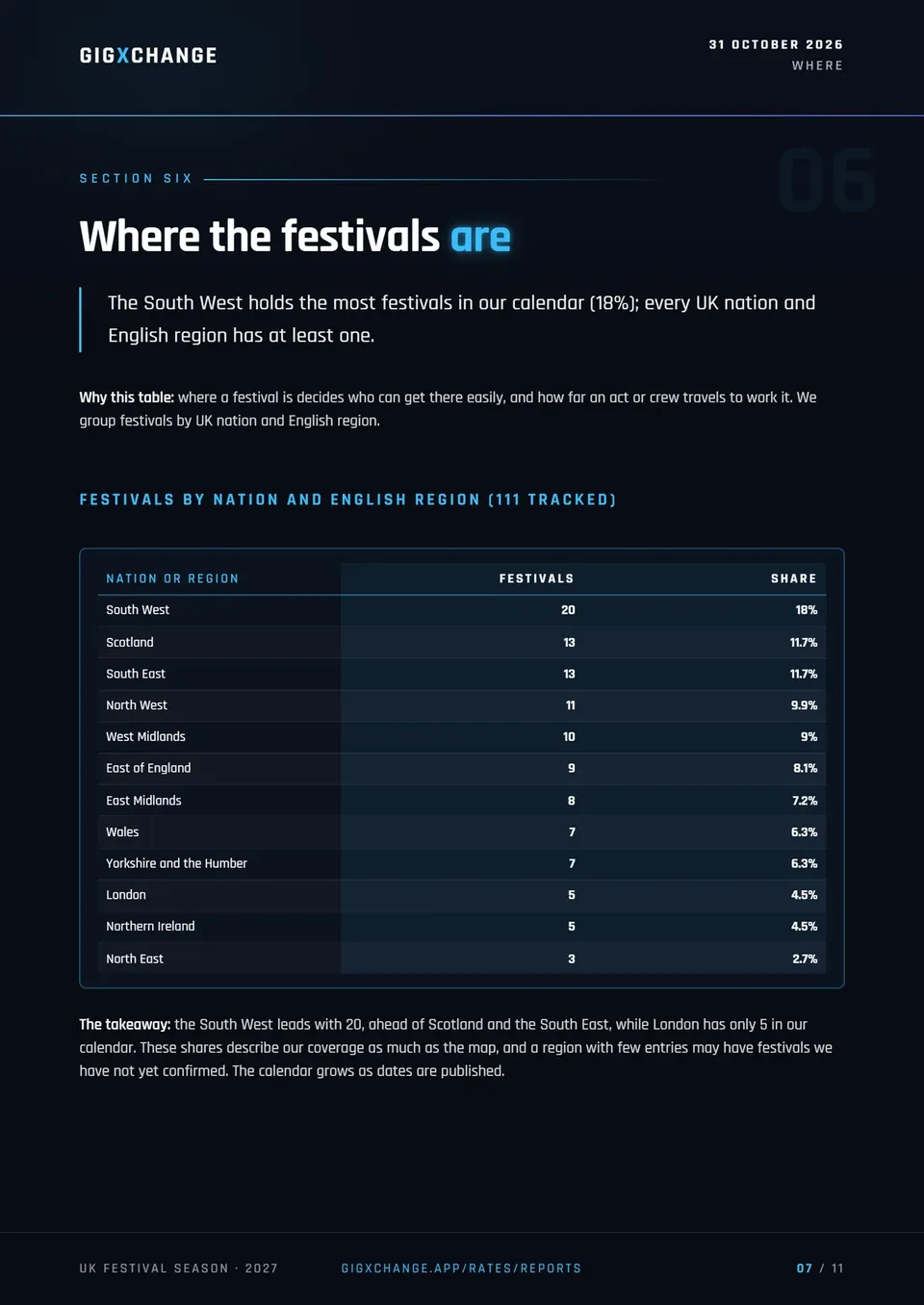
The South West holds the most festivals in our calendar (18%); every UK nation and English region has at least one.
Why this table: where a festival is decides who can get there easily, and how far an act or crew travels to work it. We group festivals by UK nation and English region.
Each of the 111 festivals we track, by UK nation and English region.
Festivals by nation and English region (111 tracked)
| # | Nation or region | Festivals | Share |
|---|---|---|---|
| 1 | South West | 20 | 18% |
| 2 | Scotland | 13 | 11.7% |
| 3 | South East | 13 | 11.7% |
| 4 | North West | 11 | 9.9% |
| 5 | West Midlands | 10 | 9% |
| 6 | East of England | 9 | 8.1% |
| 7 | East Midlands | 8 | 7.2% |
| 8 | Wales | 7 | 6.3% |
| 9 | Yorkshire and the Humber | 7 | 6.3% |
| 10 | London | 5 | 4.5% |
| 11 | Northern Ireland | 5 | 4.5% |
| 12 | North East | 3 | 2.7% |
The takeaway: the South West leads with 20, ahead of Scotland and the South East, while London has only 5 in our calendar. These shares describe our coverage as much as the map, and a region with few entries may have festivals we have not yet confirmed. The calendar grows as dates are published.
84% of the festivals we track are independent; 18 are owned by a big promoter group.
The rule: a festival is "major" when a large promoter group owns it (for example Live Nation and its Festival Republic, Superstruct or CTS Eventim); every other festival, including charities, councils and family-run events, is independent.
Ownership is not always clear-cut, and we marked 4 with low confidence. Boomtown counts as independent: Live Nation, Gaiety and SJM bought a 45% stake in 2022 and the founders kept the majority (Pollstar). Camp Bestival, Y Not and Love Supreme count as major, though sources disagree on how much control their founders kept. Ownership changes hands often, so this is the position at the freeze date.
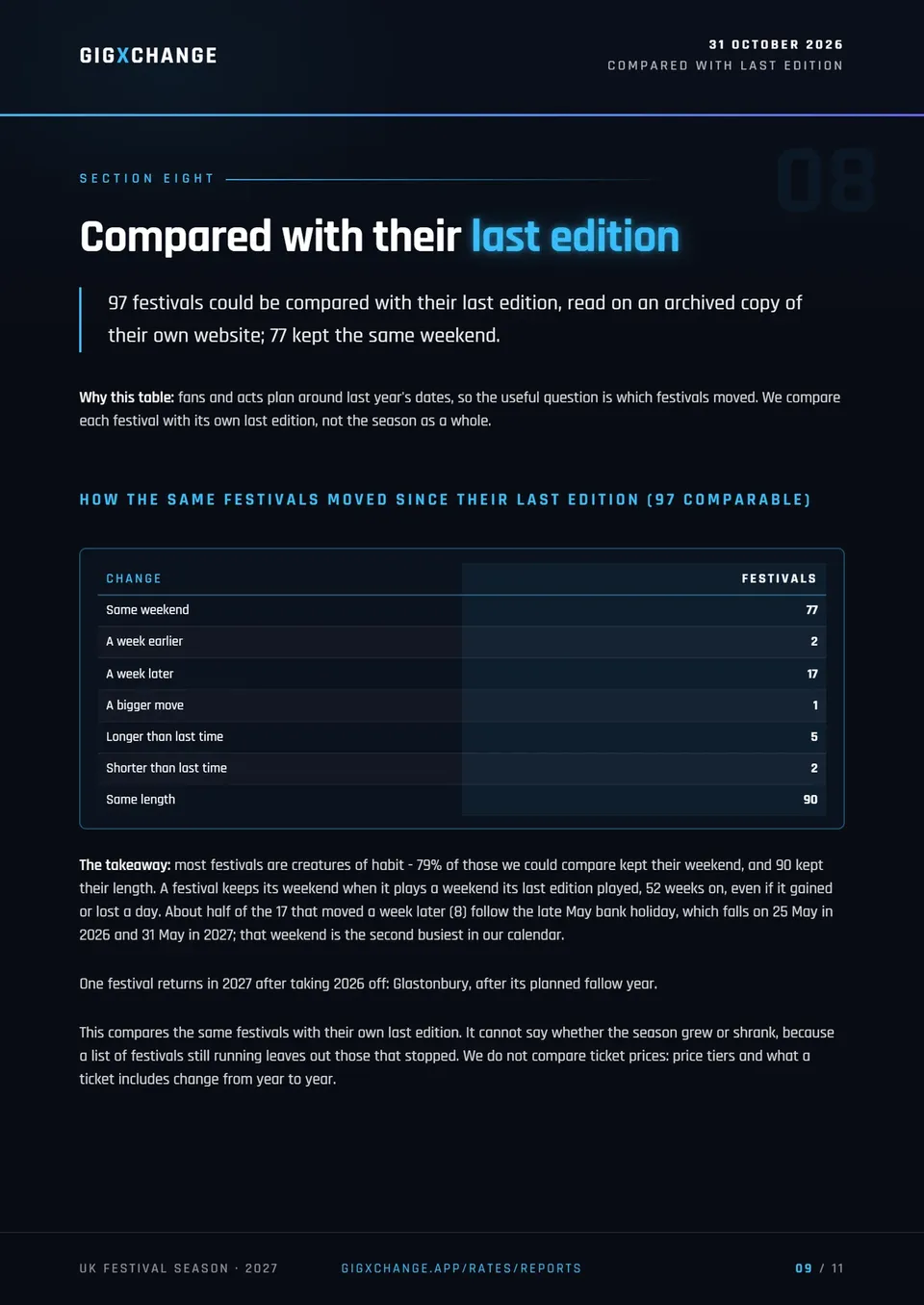
97 festivals could be compared with their last edition, read on an archived copy of their own website; 77 kept the same weekend.
Why this table: fans and acts plan around last year's dates, so the useful question is which festivals moved. We compare each festival with its own last edition, not the season as a whole.
How the same festivals moved since their last edition (97 comparable)
| Change | Festivals |
|---|---|
| Same weekend | 77 |
| A week earlier | 2 |
| A week later | 17 |
| A bigger move | 1 |
| Longer than last time | 5 |
| Shorter than last time | 2 |
| Same length | 90 |
The takeaway: most festivals are creatures of habit - 79% of those we could compare kept their weekend, and 90 kept their length. A festival keeps its weekend when it plays a weekend its last edition played, 52 weeks on, even if it gained or lost a day. About half of the 17 that moved a week later (8) follow the late May bank holiday, which falls on 25 May in 2026 and 31 May in 2027; that weekend is the second busiest in our calendar.
One festival returns in 2027 after taking 2026 off: Glastonbury, after its planned fallow year.
This compares the same festivals with their own last edition. It cannot say whether the season grew or shrank, because a list of festivals still running leaves out those that stopped. We do not compare ticket prices: price tiers and what a ticket includes change from year to year.
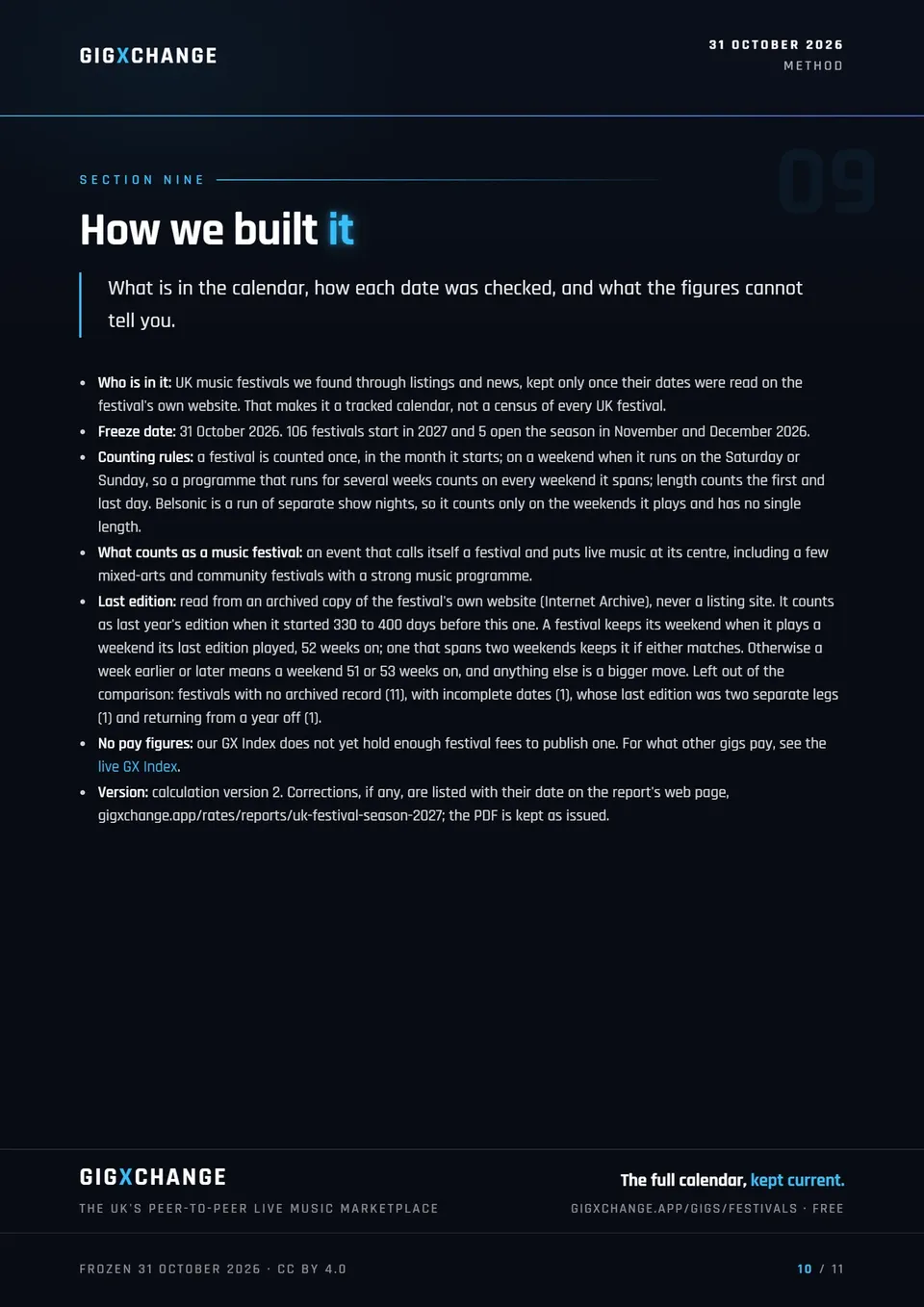
What is in the calendar, how each date was checked, and what the figures cannot tell you.
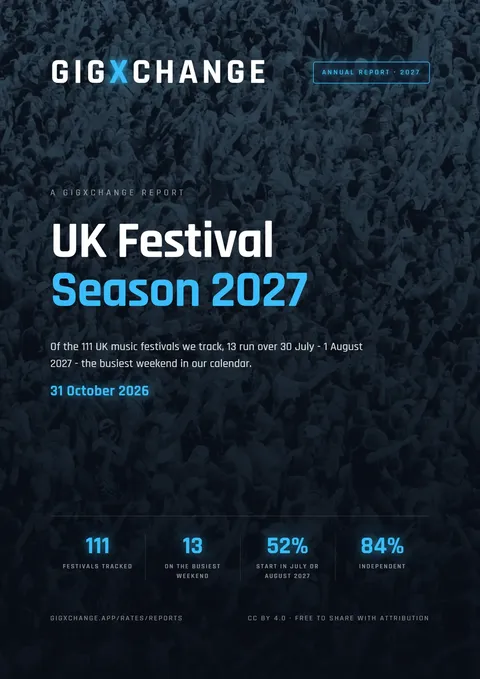
When, where and for how long 111 UK music festivals run in the 2027 season, each date checked on its own website and, where an archived record exists, compared with its last edition. 11 pages, free.
Last updated: 31 October 2026
What the 111 UK music festivals we track with dates confirmed on their own website by 31 October 2026 tell us about when, where and for how long they run in 2027.
GigXchange festival calendar, frozen 31 October 2026. Shares are of the 111 festivals we track, not of every UK festival.
Of the 111 UK music festivals we track, 13 run over 30 July - 1 August 2027 - the busiest weekend in our calendar. 52% of the festivals start in July or August, and 67% between June and August. The season we track opens on 3 November 2026 and closes on 23 October 2027.
Every festival, with its dates, town and genre, is on our UK festival calendar, which stays current through the season. This report is the fixed snapshot behind it: it does not change once published.
July 2027 is the busiest month to start a festival; 30 July - 1 August 2027 is the busiest single weekend.
Why this table: the month a festival opens shows the shape of the season - when demand for acts, crews and kit builds, and when it falls away.
Each of the 111 festivals we track, counted once in its opening month.
Counts and shares: the chart counts festivals; the table adds each month's share of the 111 we track, the figure to quote. Each festival counts once, so the shares add to 100% (give or take rounding).
Festivals by the month they start (111 tracked)
| Month | Festivals | Share |
|---|---|---|
| November 2026 | 4 | 3.6% |
| December 2026 | 1 | 0.9% |
| January 2027 | 3 | 2.7% |
| February 2027 | 1 | 0.9% |
| March 2027 | 1 | 0.9% |
| April 2027 | 6 | 5.4% |
| May 2027 | 14 | 12.6% |
| June 2027 | 16 | 14.4% |
| July 2027 | 34 | 30.6% |
| August 2027 | 24 | 21.6% |
| September 2027 | 5 | 4.5% |
| October 2027 | 2 | 1.8% |
The takeaway: 52% start in July or August, and July 2027 alone is 31%, more than May and June together. Outside the summer it thins fast: 16 start between November 2026 and April 2027, and 7 in September and October 2027.
13 of the festivals we track run over 30 July - 1 August 2027; the next busiest weekend has 11.
Why this table: months hide clashes. Two festivals in the same month may never meet, but two on the same weekend compete for the same audience, acts and crews. A festival counts on a weekend when it runs on that Saturday or Sunday.
The busiest weekends of 2027 in our calendar
| # | Weekend | Festivals | Including |
|---|---|---|---|
| 1 | 30 July - 1 August 2027 | 13 | Belfast TradFest, Kendal Calling, Camp Bestival, Valley Fest and 9 more |
| 2 | 28 May - 30 May 2027 | 11 | Manchester Jazz Festival, Bearded Theory, Knockengorroch, Orkney Folk Festival and 7 more |
| 3 | 9 July - 11 July 2027 | 8 | Ely Folk Festival, Mostly Jazz Funk and Soul Festival, Llangollen International Musical Eisteddfod, Henley Festival and 4 more |
| 4 | 27 August - 29 August 2027 | 8 | Creamfields, Reading Festival, Leeds Festival, Lost Village and 4 more |
| 5 | 6 August - 8 August 2027 | 7 | Bloodstock Open Air, Rebellion Festival, National Eisteddfod of Wales, Fleadh Cheoil na hÉireann and 3 more |
The takeaway: the pressure is on a handful of dates. 30 July - 1 August 2027 stands out with 13 festivals, and the late May bank holiday weekend is next with 11. In all, 11 weekends have five or more of the festivals we track running at once - so a fan choosing between two favourites, or an act hoping to play both, is most likely to hit a clash on one of these.
The typical festival we track runs 4 days, counting the first and last day, and 4 days is the most common length.
Why this table: length decides what a festival asks of you - a day ticket and a train home, or a tent, time off work and a bigger budget. It also tells performers and crews how long a booking ties them up. Length is the published span of the event, including any arrival or warm-up day the festival lists as part of it.
First to last day, 110 of the 111 festivals we track.
Festival length, first to last day (110 of the 111 tracked)
| Length | Festivals | Share |
|---|---|---|
| One day | 8 | 7.3% |
| Two days | 9 | 8.2% |
| Three days | 32 | 29.1% |
| Four to five days | 51 | 46.4% |
| Six days or more | 10 | 9.1% |
Belsonic is left out of this table: it is a run of separate show nights, not one continuous festival, so it has no single length.
The takeaway: the long weekend is the format of the festivals we track. 75% of those with a single span run three to five days, and only 17 run one or two. Read the short end with care: it reflects which events had confirmed their 2027 dates by the freeze date as much as the season itself.
Folk is the most common tag in our calendar (38% of festivals), then indie and rock.
Why this table: genre is how most fans choose a festival, and how acts judge where they fit a bill. We tag each festival with up to two genres from its own description, so one can count under two.
Festivals by genre tag (a festival can carry two, so shares add to more than 100%)
| # | Genre | Festivals | Share |
|---|---|---|---|
| 1 | Folk | 42 | 37.8% |
| 2 | Indie | 24 | 21.6% |
| 3 | Rock | 23 | 20.7% |
| 4 | Pop | 18 | 16.2% |
| 5 | Electronic | 16 | 14.4% |
| 6 | Family | 10 | 9% |
| 7 | World | 9 | 8.1% |
| 8 | Alternative | 8 | 7.2% |
| 9 | Jazz | 8 | 7.2% |
| 10 | Metal | 6 | 5.4% |
| 11 | New music | 4 | 3.6% |
| 12 | Punk | 4 | 3.6% |
| 13 | Soul | 3 | 2.7% |
| 14 | Reggae | 2 | 1.8% |
The takeaway: folk leads clearly, with 42 festivals, while indie, rock and pop each sit between 16% and 22%. Read the mix as the shape of what we track, not of the whole UK festival market: the calendar only lists festivals whose 2027 dates are already confirmed.
The South West holds the most festivals in our calendar (18%); every UK nation and English region has at least one.
Why this table: where a festival is decides who can get there easily, and how far an act or crew travels to work it. We group festivals by UK nation and English region.
Each of the 111 festivals we track, by UK nation and English region.
Festivals by nation and English region (111 tracked)
| # | Nation or region | Festivals | Share |
|---|---|---|---|
| 1 | South West | 20 | 18% |
| 2 | Scotland | 13 | 11.7% |
| 3 | South East | 13 | 11.7% |
| 4 | North West | 11 | 9.9% |
| 5 | West Midlands | 10 | 9% |
| 6 | East of England | 9 | 8.1% |
| 7 | East Midlands | 8 | 7.2% |
| 8 | Wales | 7 | 6.3% |
| 9 | Yorkshire and the Humber | 7 | 6.3% |
| 10 | London | 5 | 4.5% |
| 11 | Northern Ireland | 5 | 4.5% |
| 12 | North East | 3 | 2.7% |
The takeaway: the South West leads with 20, ahead of Scotland and the South East, while London has only 5 in our calendar. These shares describe our coverage as much as the map, and a region with few entries may have festivals we have not yet confirmed. The calendar grows as dates are published.
84% of the festivals we track are independent; 18 are owned by a big promoter group.
The rule: a festival is "major" when a large promoter group owns it (for example Live Nation and its Festival Republic, Superstruct or CTS Eventim); every other festival, including charities, councils and family-run events, is independent.
Ownership is not always clear-cut, and we marked 4 with low confidence. Boomtown counts as independent: Live Nation, Gaiety and SJM bought a 45% stake in 2022 and the founders kept the majority (Pollstar). Camp Bestival, Y Not and Love Supreme count as major, though sources disagree on how much control their founders kept. Ownership changes hands often, so this is the position at the freeze date.
97 festivals could be compared with their last edition, read on an archived copy of their own website; 77 kept the same weekend.
Why this table: fans and acts plan around last year's dates, so the useful question is which festivals moved. We compare each festival with its own last edition, not the season as a whole.
How the same festivals moved since their last edition (97 comparable)
| Change | Festivals |
|---|---|
| Same weekend | 77 |
| A week earlier | 2 |
| A week later | 17 |
| A bigger move | 1 |
| Longer than last time | 5 |
| Shorter than last time | 2 |
| Same length | 90 |
The takeaway: most festivals are creatures of habit - 79% of those we could compare kept their weekend, and 90 kept their length. A festival keeps its weekend when it plays a weekend its last edition played, 52 weeks on, even if it gained or lost a day. About half of the 17 that moved a week later (8) follow the late May bank holiday, which falls on 25 May in 2026 and 31 May in 2027; that weekend is the second busiest in our calendar.
One festival returns in 2027 after taking 2026 off: Glastonbury, after its planned fallow year.
This compares the same festivals with their own last edition. It cannot say whether the season grew or shrank, because a list of festivals still running leaves out those that stopped. We do not compare ticket prices: price tiers and what a ticket includes change from year to year.
What is in the calendar, how each date was checked, and what the figures cannot tell you.
Flip through all 11 pages below, or download the PDF.
Flip through all 11 pages below, or download the PDF.
GigXchange (2026). UK Festival Season 2027. GigXchange Industry Reports, Annual Edition. Available at: gigxchange.app/rates/reports/uk-festival-season-2027. Licensed under CC BY 4.0.
Cite this report
GigXchange (2026). UK Festival Season 2027. GigXchange Industry Reports, Annual Edition. Available at: gigxchange.app/rates/reports/uk-festival-season-2027. Licensed under CC BY 4.0.
DOI 10.5281/zenodo.23840288 · PDF
| GigXchange Index — October 202629 Oct 2026 · Index · 11 pages · PDF | |
| GigXchange Index — September 20266 Oct 2026 · Index · 11 pages · PDF | |
| GigXchange Index — August 20263 Sept 2026 · Index · 11 pages · PDF | |
| State of the Circuit 20266 Aug 2026 · Annual · 11 pages · PDF | |
| GigXchange Index — July 202631 Jul 2026 · Index · 11 pages · PDF | |
| GigXchange Index — June 20264 Jul 2026 · Index · 11 pages · PDF | |
| GigXchange Index — May 202620 May 2026 · Index · 11 pages · PDF | |
| UK Musician Earnings 202623 Apr 2026 · Special · 11 pages · PDF | |
| GigXchange Index — April 202620 Apr 2026 · Index · 11 pages · PDF | |
| Browse all reports & datasets |
GX Index - October 2026 · this report is the festival season; the Index shows what gigs pay right now.
The festivals| UK festival calendar | |
| What's on near you |
| GX Index - live rates |
Add your real gig fees to the UK Gig Pay Survey — anonymous, ~60 seconds, and every entry sharpens the next GX Index.
| Take the survey |
| Gig directory |
This report is the fixed snapshot. The festival calendar stays current all season: every date, town and genre, with a planner.
This report is the fixed snapshot. The festival calendar stays current all season: every date, town and genre, with a planner.
Real UK gig-fee data, not guesswork — built from actual bookings. Add yours and it gets sharper for everyone.