Free tool · For venues
Martyn's Law reaches venues holding 200 or more people from around 2027 — and most owners haven't heard of it. Six plain-English questions on GigXchange give your tier, your duties, and a first-draft written-procedures document. Free with every venue profile.
Updated 14 November 2026
GIGXCHANGE Martyn's Law readiness check is a free tool that tells a UK venue whether Martyn's Law applies to it, and what to do, in six questions. Martyn's Law, the Terrorism (Protection of Premises) Act 2025, turns on how many people can be on your premises at once, staff and performers included. Under 200, you are out of scope. 200 to 799 is the standard tier: notify the regulator, the SIA, and keep written procedures for evacuation, invacuation, lockdown and communication. 800 or more is the enhanced tier, which adds public protection measures and a documented assessment. The duties are expected in force around 2027 — the Act allows at least 24 months from Royal Assent (3 April 2025) to prepare.
The check gives your tier, the duties that apply to you and an action plan, each linked to the Home Office statutory guidance or ProtectUK, and it drafts your written procedures. The worked example below runs three example venues through it, one for each outcome.
| 03Walk the readiness checkThe real app, screen by screen | |
| 04How it worksFrom six questions to an action plan | |
| 05Worked exampleThree example venues, one per tier | |
| 06Everything in the readiness checkTier, duties and a procedures draft | |
| 08The biggest venue-law change in a generationWhat the Act changes for venues | |
| 09Venues already on GigXchangeReal venue profiles, open any one | |
| 10More free tools for venuesOther free tools for venues | |
| 11Frequently asked questionsTiers, timing and who it covers |
The real Martyn's Law readiness check in the GigXchange app, step by step - from six questions to your tier, your duties and a first-draft procedures document.
Martyn's Law is the biggest change to venue law in a generation, and most owners have not heard of it yet. It reaches every room where 200 or more people may be present, and the duties are expected to bite from around 2027: notify the Security Industry Authority and have procedures for evacuating, sheltering, locking down and communicating in an attack.
The readiness check turns that into a short, practical list. Below is the real thing, screen by screen, for a 200-799 capacity pub that controls its own premises and hosts public events - the standard tier most grassroots venues land in.
- 01 / 05 Six questions
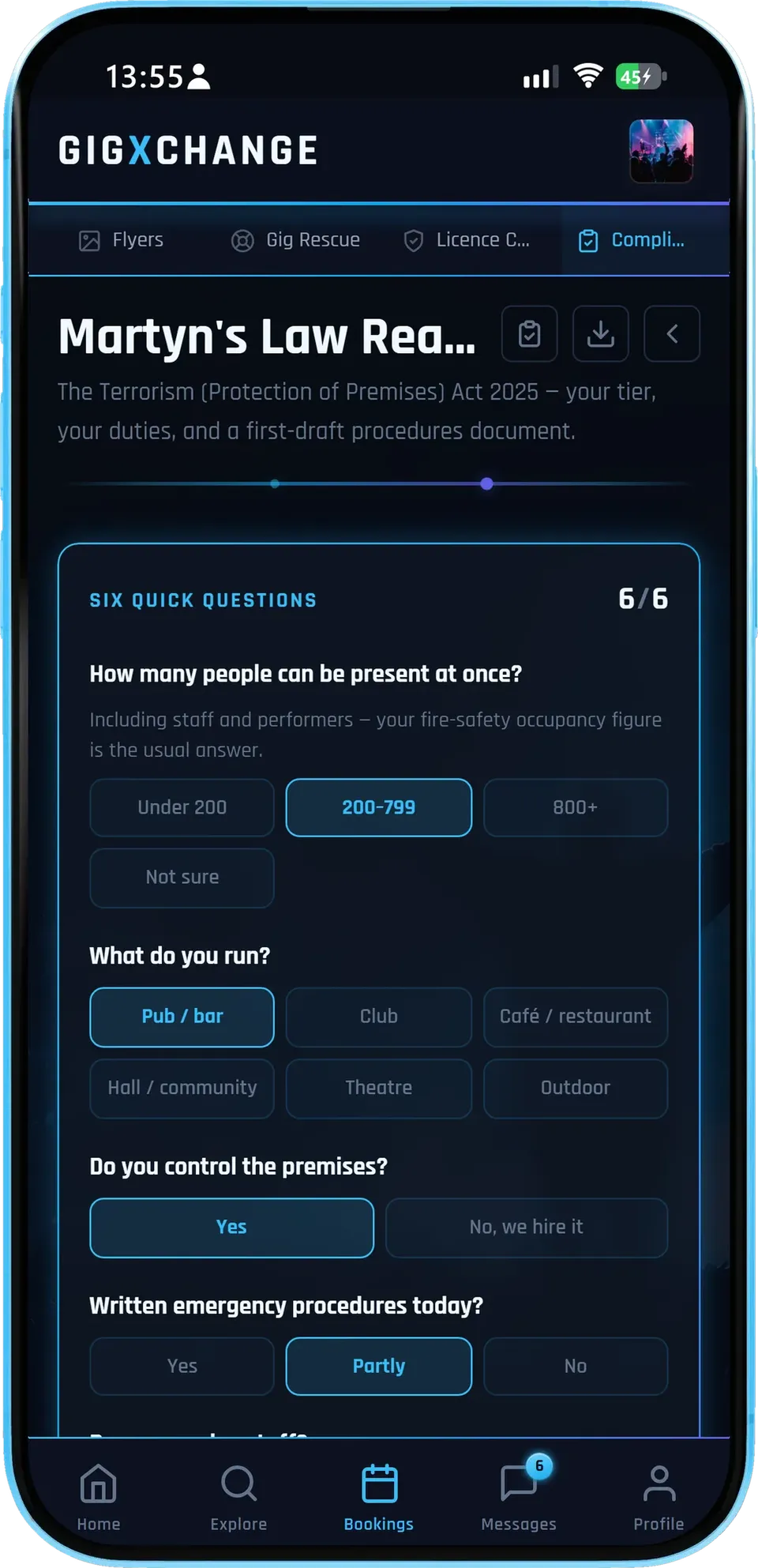
How many people can be present at once, what you run, whether you control the premises, whether you have written emergency procedures today, whether staff know them and whether you host public events.
- Capacity firstIncluding staff and performers - your fire-safety occupancy is the usual answer.
- Your premises or a hireWho controls the building changes who holds the duty.
- Where you are todaySay what you already have, so the list starts from there.
This venue answers 200-799, a pub or bar, its own premises, procedures partly in place and public events - which puts it in the standard tier.
- 02 / 05 Your tier
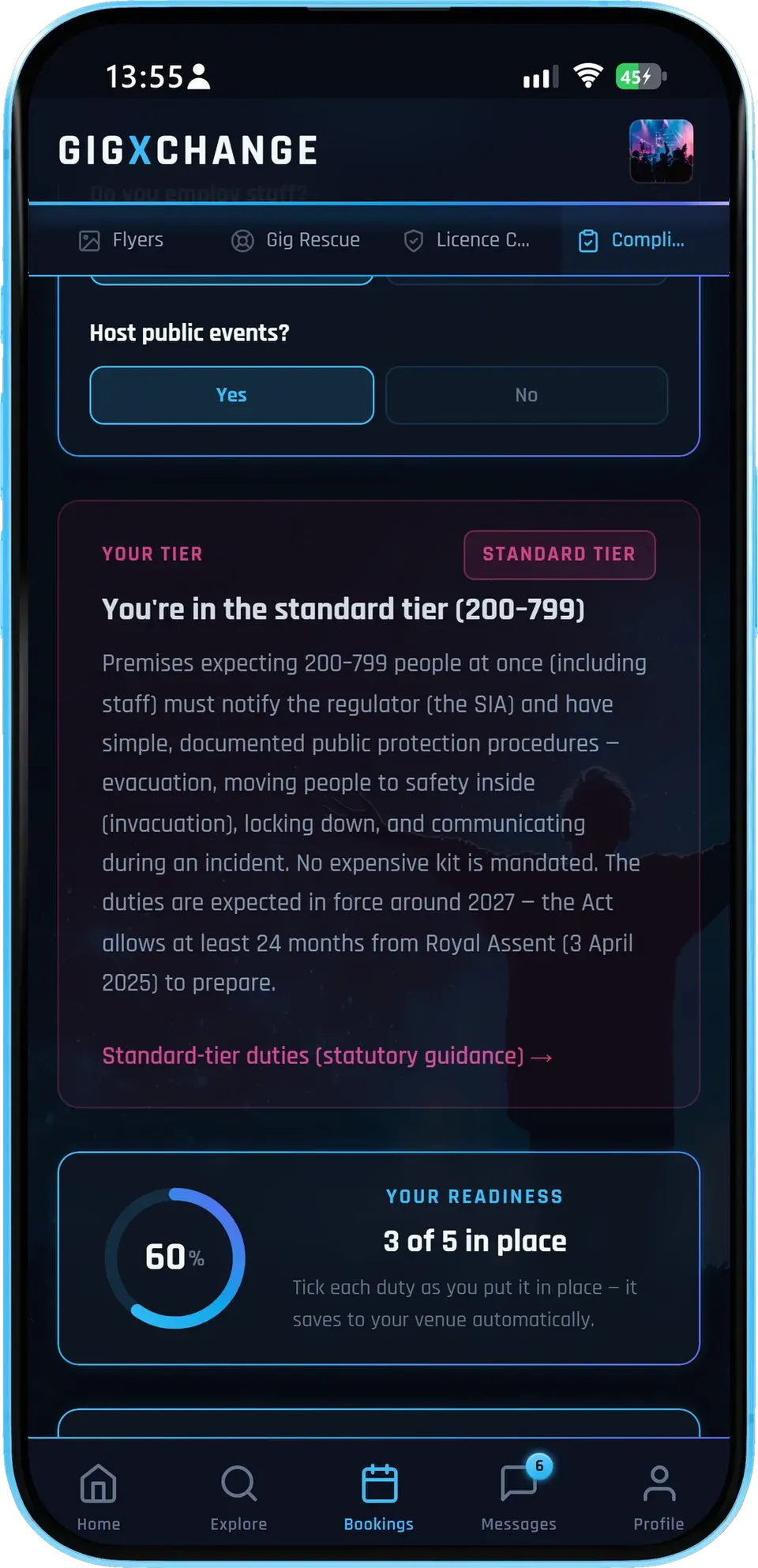
The verdict says which tier you are in and what that tier actually asks of you, with a readiness ring that fills as you put each duty in place.
- Standard or enhanced200-799 is standard, 800+ enhanced, under 200 out of scope.
- No kit mandatedThe standard tier asks for procedures, not equipment.
- A readiness scoreThree of five in place reads 60%.
Here the venue is in the standard tier and three of its five items are already in place, so the ring reads 60% - the remaining two are what stand between it and being ready.
- 03 / 05 Your duties
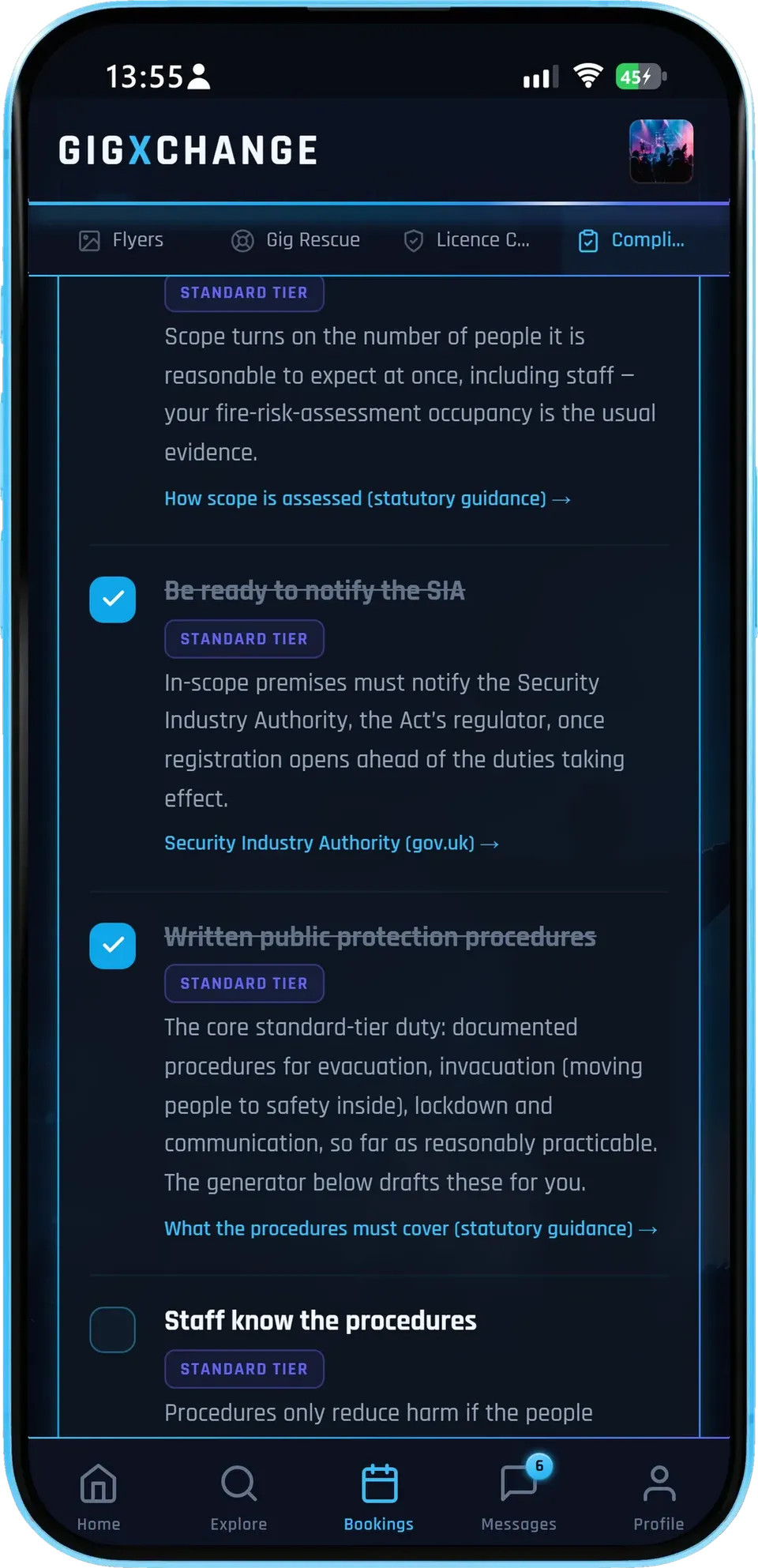
Each duty is a tickable item tagged with its tier and linked to the statutory guidance that explains it.
- Tagged by tierStandard-tier items and enhanced-tier items are labelled.
- The official linkEvery item links the official guidance behind it.
- Saves as you goTicks save to your venue account automatically.
Being ready to notify the Security Industry Authority and having procedures in place are ticked here; the next items are staff knowing the procedures and reviewing them when the venue or its events change.
- 04 / 05 The procedures draft
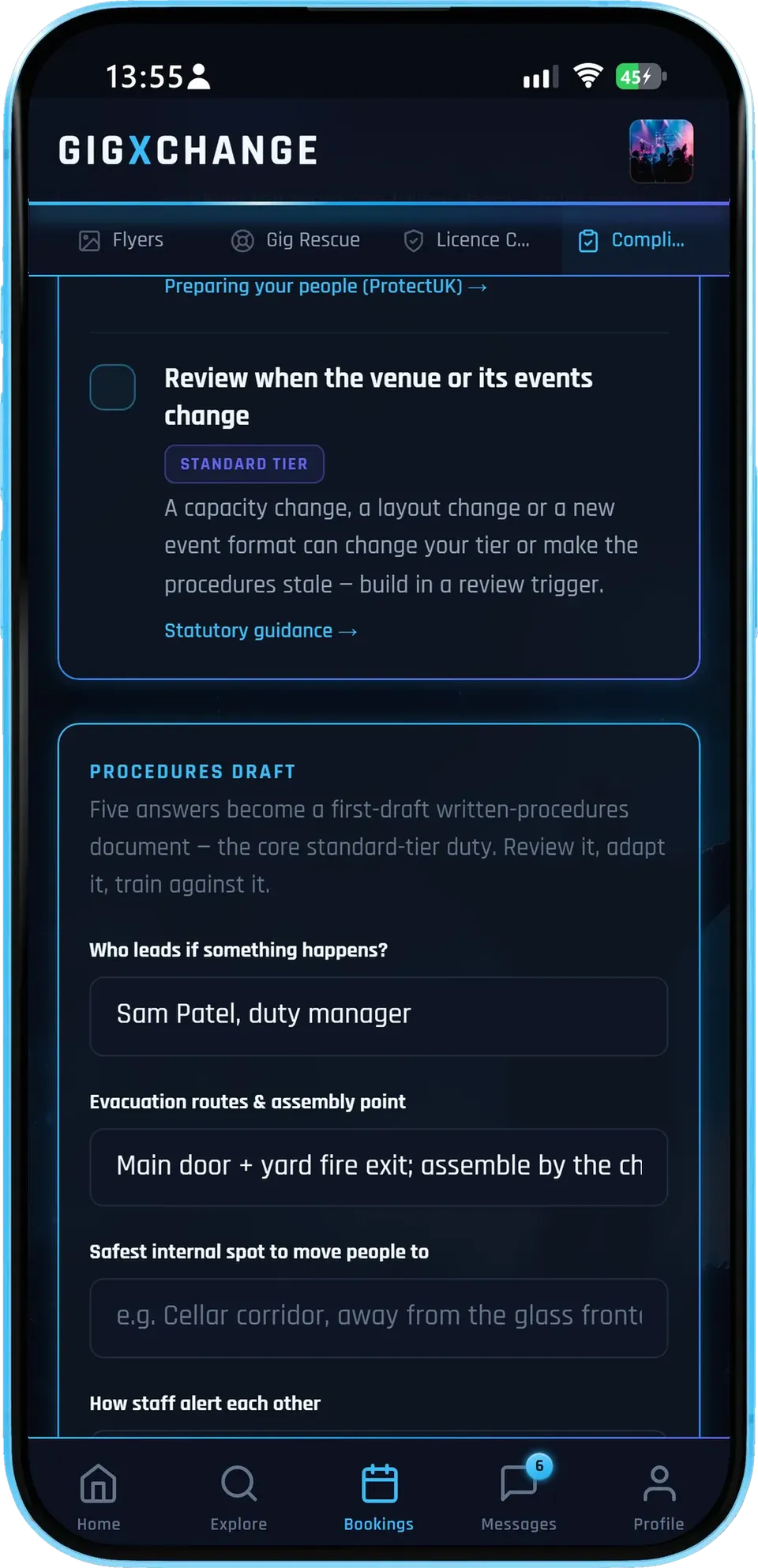
Five short answers - who leads, the evacuation routes and assembly point, where to move people inside, how staff alert each other and what responders need to know - become a printable procedures document.
- Five answersWho leads, where people go, how staff talk to each other.
- A PDF to signGenerate a draft with a sign-off line, or print it blank.
- Train against itWriting it down is the easiest way to brief every shift.
Writing the procedures down is a legal duty only at the enhanced tier, but a written version is how the rest of the team learns them - this draft gives you one in minutes to adapt to your building.
- 05 / 05 Every source, one list
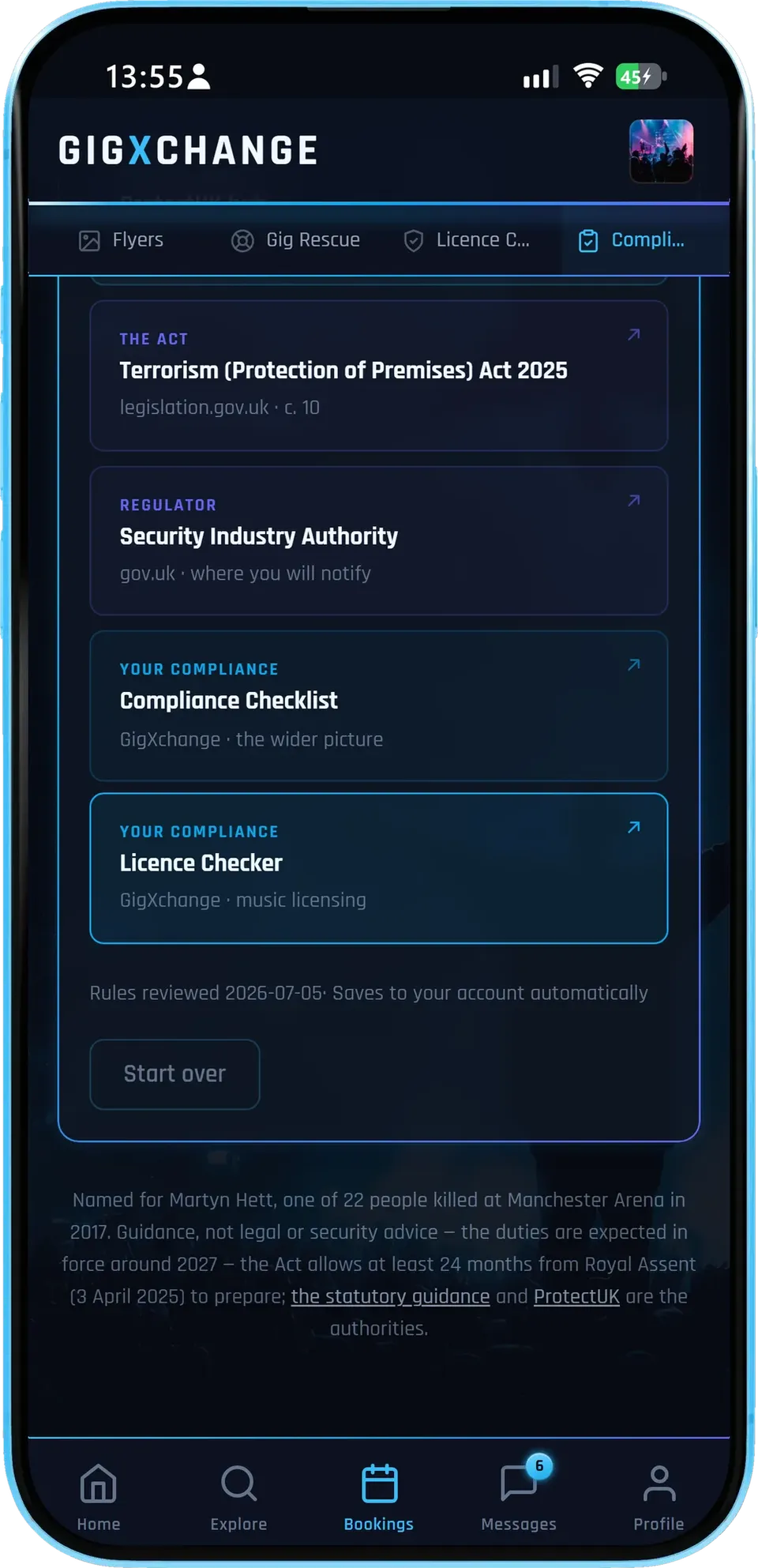
The statutory guidance, ProtectUK, the Act itself and the Security Industry Authority, alongside the Compliance Checklist and the Licence Checker.
- The authoritiesHome Office guidance, ProtectUK and legislation.gov.uk.
- Where you will notifyThe Security Industry Authority, the Act's regulator.
- The wider pictureLinks on to the rest of your venue's compliance.
Every link is to the authority that owns the rule, so the answer to "says who?" is always the Home Office, ProtectUK or the Act itself.
- 01 / 05
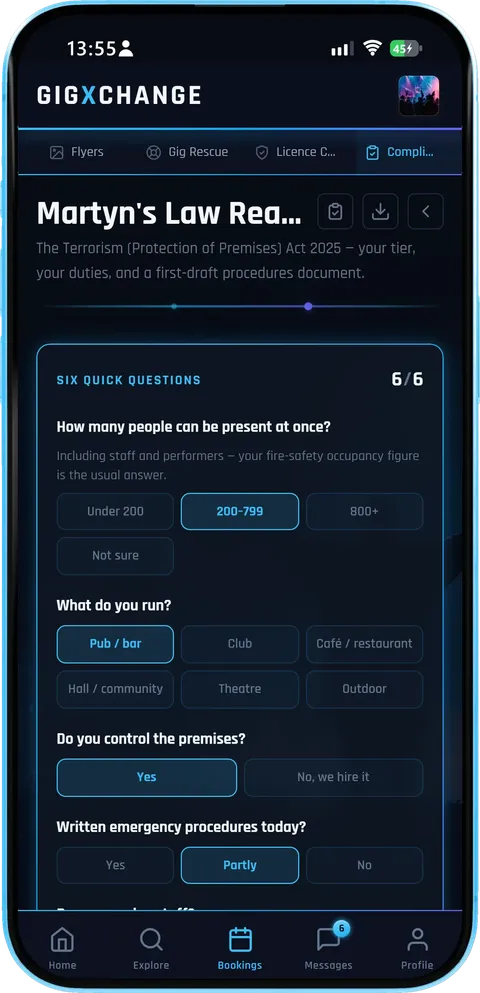 Six questions
How many people can be present at once, what you run, whether you control the premises, whether you have written emergency procedures today, whether staff know them and whether you host public events.
- Capacity firstIncluding staff and performers - your fire-safety occupancy is the usual answer.
- Your premises or a hireWho controls the building changes who holds the duty.
- Where you are todaySay what you already have, so the list starts from there.
This venue answers 200-799, a pub or bar, its own premises, procedures partly in place and public events - which puts it in the standard tier.
- 02 / 05
 Your tier
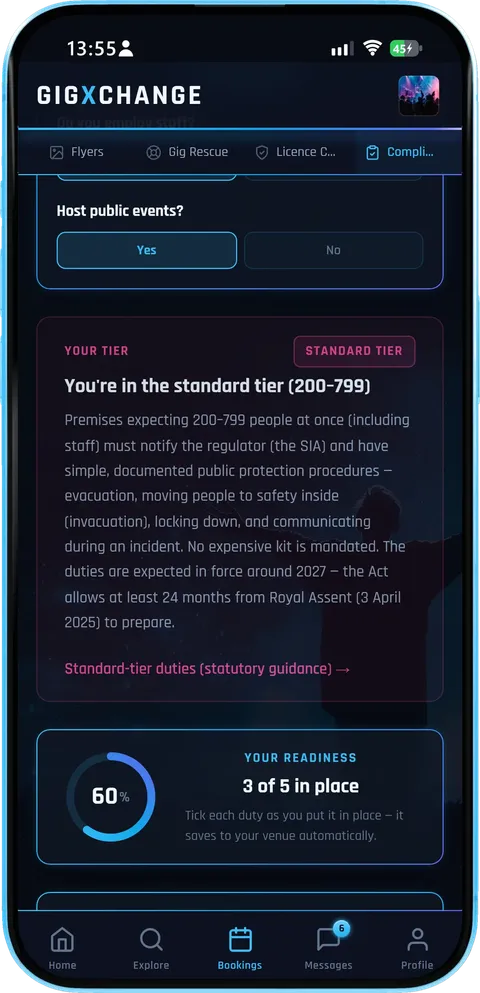
The verdict says which tier you are in and what that tier actually asks of you, with a readiness ring that fills as you put each duty in place.
- Standard or enhanced200-799 is standard, 800+ enhanced, under 200 out of scope.
- No kit mandatedThe standard tier asks for procedures, not equipment.
- A readiness scoreThree of five in place reads 60%.
Here the venue is in the standard tier and three of its five items are already in place, so the ring reads 60% - the remaining two are what stand between it and being ready.
- 03 / 05
 Your duties
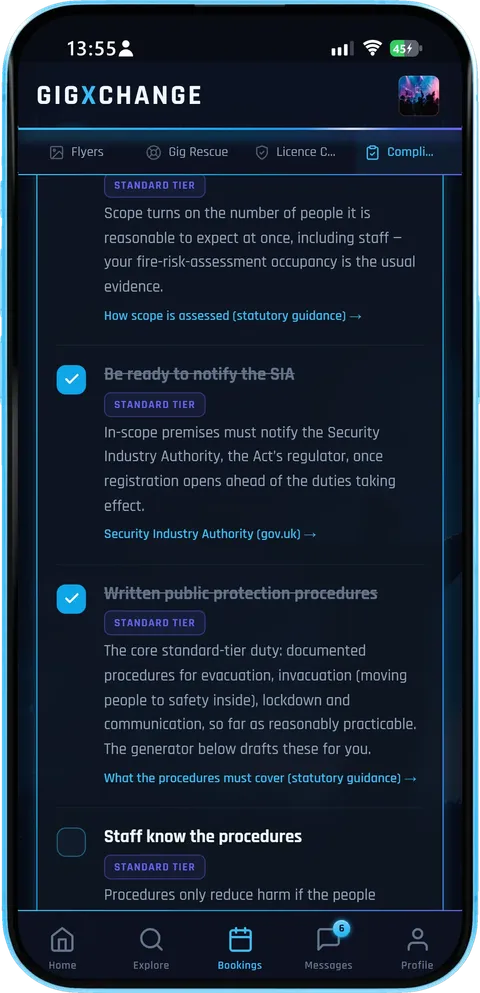
Each duty is a tickable item tagged with its tier and linked to the statutory guidance that explains it.
- Tagged by tierStandard-tier items and enhanced-tier items are labelled.
- The official linkEvery item links the official guidance behind it.
- Saves as you goTicks save to your venue account automatically.
Being ready to notify the Security Industry Authority and having procedures in place are ticked here; the next items are staff knowing the procedures and reviewing them when the venue or its events change.
- 04 / 05
 The procedures draft
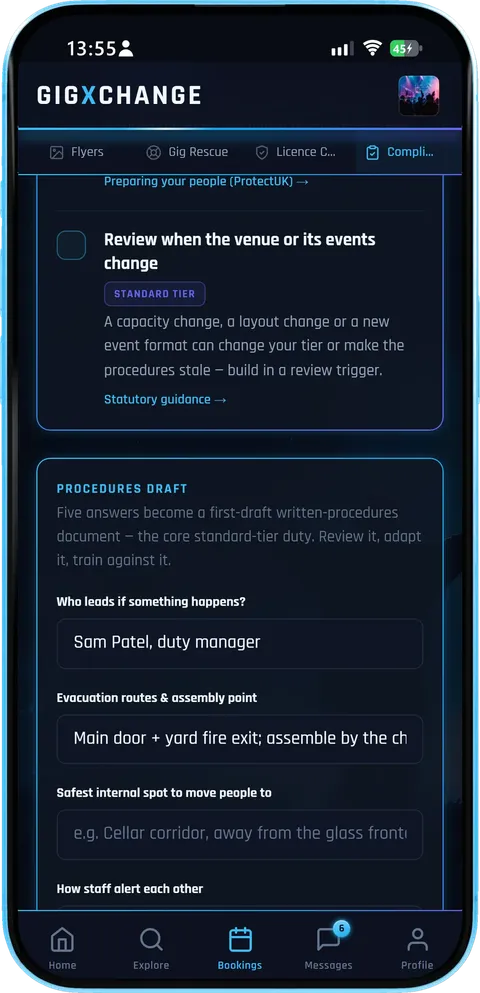
Five short answers - who leads, the evacuation routes and assembly point, where to move people inside, how staff alert each other and what responders need to know - become a printable procedures document.
- Five answersWho leads, where people go, how staff talk to each other.
- A PDF to signGenerate a draft with a sign-off line, or print it blank.
- Train against itWriting it down is the easiest way to brief every shift.
Writing the procedures down is a legal duty only at the enhanced tier, but a written version is how the rest of the team learns them - this draft gives you one in minutes to adapt to your building.
- 05 / 05
 Every source, one list
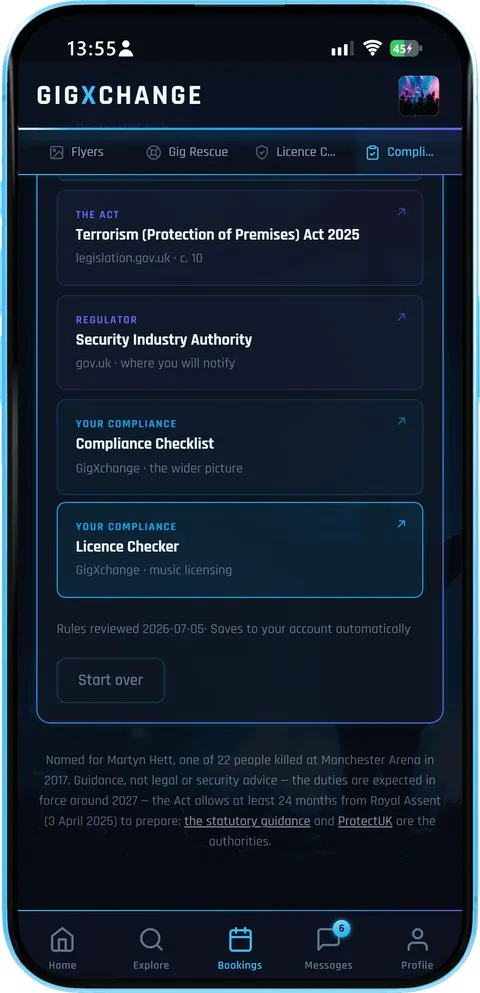
The statutory guidance, ProtectUK, the Act itself and the Security Industry Authority, alongside the Compliance Checklist and the Licence Checker.
- The authoritiesHome Office guidance, ProtectUK and legislation.gov.uk.
- Where you will notifyThe Security Industry Authority, the Act's regulator.
- The wider pictureLinks on to the rest of your venue's compliance.
Every link is to the authority that owns the rule, so the answer to "says who?" is always the Home Office, ProtectUK or the Act itself.
The Martyn’s Law check takes a venue from “does this even apply to us?” to a signed-off procedures draft in minutes: answer the questions about your capacity and events, read your tier, then give five short answers and review the procedures draft it writes.
| 01 | AnswerSix quick questionsCapacity (including staff — the detail venues get wrong), venue type, who controls the premises, what's written down today. |
| 02 | Your tierThe verdictOut of scope, standard tier (200–799) or enhanced (800+) — with what each one actually means, in plain English, linked to the statutory guidance. |
| 03 | ReadinessTick off your dutiesEvery obligation as a tickable item with a readiness score — SIA notification, written procedures, staff briefing. Saves to your venue automatically. |
| 04 | The draftGenerate your proceduresFive short answers become a written-procedures PDF with a sign-off line — the core standard-tier duty, drafted for you to review, adapt and train against. |
Three example venues, run through the readiness check itself: a pub under 200, a hired hall in the standard tier and a theatre in the enhanced tier. Pick one to see its answers in one sentence, its tier, the duties that apply and the steps.
A pub or bar for fewer than 200 people at once, that they control, with no written procedures, employing staff, hosting public events.
1
Martyn's Law duties don't apply to you
Premises where fewer than 200 people (including staff) are expected at once are outside the Act. The procedures it asks bigger venues to write are still good practice for any room with a crowd — and note that one-off events expecting 800 or more people have their own duties under the Act, whatever the venue’s usual capacity.
Martyn's Law overview (ProtectUK) →No duties under the Act below 200 people. The procedures it asks bigger venues to write are still good practice.
This is the readiness check's own answer for an example venue. Yours takes six questions.
Check your own venueEverything in the readiness check is built so a 250-capacity room can prepare for Martyn’s Law without hiring a security consultant: your tier, the duties that come with it and a procedures draft you can adapt.
| GuidedSix questions, plain EnglishCapacity, venue type, who controls the premises, what you have written down today — and your tier verdict appears with the duties that actually apply. |
| The tiers200 is the magic numberStandard tier runs 200–799 people INCLUDING staff and performers; 800+ is enhanced. Under 200 you are out of scope — and the checker says so plainly. |
| ReadinessA score you can moveEvery duty is a tickable item — notify the SIA, written procedures, staff briefing — with a readiness ring that fills as you put things in place. |
| The draftYour procedures, drafted for youFive short answers — who leads, evacuation route, safe internal spot, staff alert method, responder info — become a written-procedures document with a sign-off line. |
| FileableTwo exportable PDFsA readiness summary for the file, and the procedures draft to review, adapt and train against. Both branded, dated and stamped with the rules version. |
| TimingIn force around 2027Royal Assent came on 3 April 2025 with at least 24 months to prepare. The venues that write their procedures now do it calmly; the rest will do it in a rush. |
| SourcesOfficial links onlyThe statutory guidance (published April 2026), ProtectUK and the Act itself — every claim links to the authority so you can verify everything. |
| SavedPart of your compliance hubTicks and answers save to your venue record alongside the Licence Checker and Compliance Checklist — restored on any device, re-checkable any time. |
Standard tier200
The tier most venues land in. Standard tier runs 200-799 people INCLUDING staff and performers — under 200 you are out of scope
Your fire-safety occupancy figure is the starting point
Two duties: notify the SIA + have procedures in place
Evacuation, invacuation, lockdown, communication
So far as reasonably practicable — no kit mandated
Six plain-English questions give your verdict
Under 200? The checker says so plainly
| How it works | |
| Small-venues guide | |
| Find out more | |
| Create a free venue profile |
Enhanced tier800+
Bigger rooms, bigger duties. From 800 people the Act adds public protection MEASURES on top of the procedures
Monitoring the premises and managing movement
Physical safety and security of information
A documented vulnerability assessment
A designated senior individual for organisations
One-off 800+ events carry duties whatever your usual capacity
| How it works | |
| Compliance checklist | |
| Find out more | |
| Create a free venue profile |
In force2027
Write the procedures calmly, not in a rush. Royal Assent came 3 April 2025 with at least 24 months to prepare — duties land around 2027
The statutory guidance is already published
Five answers become a procedures-draft PDF
Sign-off line, dated, rules-version stamped
Review it, adapt it, train your staff against it
Good practice from the day you write it
| How it works | |
| Small-venues guide | |
| Find out more | |
| Create a free venue profile |
Cost, ever£0
Free — the marketplace pays for it. The readiness check, both PDFs and every re-check — free forever
No subscriptions and no listing fees
No trial limits and no feature caps
GigXchange earns from its booking marketplace
Saves to your venue record with the toolkit
Official links only — gov.uk, ProtectUK, the Act
| All free tools | |
| For venues | |
| Find out more | |
| Create a free venue profile |
Get startedFree
Built into every venue profile. Six questions — your tier, your duties and the draft are minutes away
Sign up in about 30 seconds — no card
Ticks and answers save to your venue record
Restored on any device, re-checkable any time
Free on iPhone, Android or any browser
| How it works | |
| All free tools | |
| Find out more | |
| Create a free venue profile |
Martyn’s Law is the biggest change to venue law in a generation. This is what it asks of small venues, which rooms it reaches, and why preparing early is the calm move rather than a rush before the deadline.
Where the law comes from
On 22 May 2017, a bomb was detonated at Manchester Arena as an Ariana Grande concert ended, killing 22 people. One of them was Martyn Hett. His mother, Figen Murray, campaigned for years for a law requiring venues to at least plan for the possibility of an attack — and on 3 April 2025 the Terrorism (Protection of Premises) Act 2025 received Royal Assent. Everyone calls it Martyn's Law.
Who it reaches
The Act turns on how many people — including staff and performers — it is reasonable to expect on the premises at once. Under 200, you're out of scope. From 200 to 799 you're standard tier: notify the regulator (the Security Industry Authority) and have public protection procedures in place - writing them down is recommended, not required, at this tier. From 800 you're enhanced tier, adding protective measures and a documented assessment. That standard tier is exactly where grassroots music venues, pub back rooms and community halls live — the rooms with no security consultant on retainer.
What "procedures" really means
Four things, in place and known by staff: how you'd evacuate, how you'd move people to safety inside (invacuation), how you'd lock down, and how you'd communicate during an incident. No mandated equipment, no structural works at the standard tier — the law asks that the people working your room know what to do. The Home Office published the full statutory guidance in April 2026, and it's the source our checker is built on.
Why act before 2027
The Act allows at least 24 months from Royal Assent before the duties bite — around 2027. Venues that write their procedures now do it calmly, fold it into staff onboarding, and are done; venues that wait will do it in a rush alongside everyone else. The procedures are also simply good practice from the day they exist — that's the point of them.
Where the readiness check fits
The check gives you your tier, your duties as a tickable readiness list, and a first-draft procedures document generated from five short answers — free, saved to your venue record beside the Licensing Checker and Compliance Checklist. It's guidance, not security advice: ProtectUK and the statutory guidance are the authorities, and every step links them. More on the venue side: GigXchange for venues.
Martyn’s Law reaches rooms of 200 or more people, and every venue here can run the readiness check from the same free dashboard it books acts from, so the procedures sit alongside the programme.
Martyn's Law readiness sits beside the rest of a venue's paperwork and programming. These tools add a licensing checker and a compliance checklist, then help you post open slots, find a best-fit act and publish your what's-on page.
| For venuesPost a GigList an open slot in two minutes and take applications from gig-ready artists — full profiles and verified reviews attached. | |
| For venuesGX Gig RescueAct dropped out? Broadcast an urgent booking invite to up to 25 available acts — first to accept is booked. | |
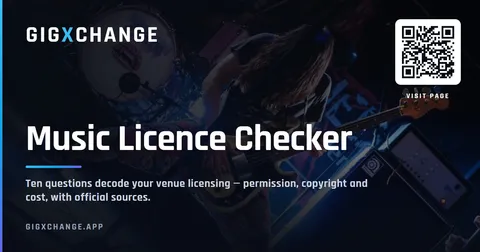
| For venuesLicensing CheckerTen questions decode your venue’s music licensing — permission, copyright and cost, with official sources. | |
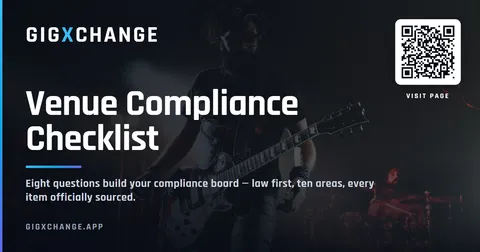
| For venuesCompliance ChecklistEight questions build your venue’s compliance board — law first, ten areas, every item linked to its official source. | |
| For venuesEvents PosterYour upcoming programme as a live what’s-on page in seven looks — status badges, ticket links and an embed for your own website. | |
| For venuesFind an ArtistPick the empty date, set a 60-second brief, and invite up to 5 ranked best-fit acts with real booking invites. |
What owners need to know once Martyn's Law comes up: whether it applies to a pub or venue, what the standard and enhanced tiers require, when to be ready, and what the readiness check's document does and doesn't cover.
| Compliance Checklist | |
| Licensing Checker | |
| UK live music licence guide | |
| GX Gig Rescue | |
| All free tools |
| Martyn's Law for small venues — the full guide |
| Statutory guidance (gov.uk) | |
| Martyn's Law (ProtectUK) | |
| The Act (legislation.gov.uk) |
| Create a free venue profile | |
| How it works |
Being the venue that was ready early takes one sitting: sign up free and run the check, and your tier, your duties and the procedures draft are waiting in your venue dashboard to share with your team.

A new law is coming for every 200+ venue. Be ready early
Martyn's Law reaches venues holding 200 or more people from around 2027 — and most owners haven't heard of it. Six plain-English questions on GigXchange give your tier, your duties, and a first-draft written-procedures document. Free with every venue profile.




Last updated: 14 November 2026
Does Martyn's Law apply to your venue?
GIGXCHANGE Martyn's Law readiness check is a free tool that tells a UK venue whether Martyn's Law applies to it, and what to do, in six questions. Martyn's Law, the Terrorism (Protection of Premises) Act 2025, turns on how many people can be on your premises at once, staff and performers included. Under 200, you are out of scope. 200 to 799 is the standard tier: notify the regulator, the SIA, and keep written procedures for evacuation, invacuation, lockdown and communication. 800 or more is the enhanced tier, which adds public protection measures and a documented assessment. The duties are expected in force around 2027 — the Act allows at least 24 months from Royal Assent (3 April 2025) to prepare.
The check gives your tier, the duties that apply to you and an action plan, each linked to the Home Office statutory guidance or ProtectUK, and it drafts your written procedures. The worked example below runs three example venues through it, one for each outcome.
Walk the readiness check
The real Martyn's Law readiness check in the GigXchange app, step by step - from six questions to your tier, your duties and a first-draft procedures document.
Martyn's Law is the biggest change to venue law in a generation, and most owners have not heard of it yet. It reaches every room where 200 or more people may be present, and the duties are expected to bite from around 2027: notify the Security Industry Authority and have procedures for evacuating, sheltering, locking down and communicating in an attack.
The readiness check turns that into a short, practical list. Below is the real thing, screen by screen, for a 200-799 capacity pub that controls its own premises and hosts public events - the standard tier most grassroots venues land in.
- 01 / 05
Six questions
How many people can be present at once, what you run, whether you control the premises, whether you have written emergency procedures today, whether staff know them and whether you host public events.
- Capacity firstIncluding staff and performers - your fire-safety occupancy is the usual answer.
- Your premises or a hireWho controls the building changes who holds the duty.
- Where you are todaySay what you already have, so the list starts from there.
This venue answers 200-799, a pub or bar, its own premises, procedures partly in place and public events - which puts it in the standard tier.
- 02 / 05
Your tier
The verdict says which tier you are in and what that tier actually asks of you, with a readiness ring that fills as you put each duty in place.
- Standard or enhanced200-799 is standard, 800+ enhanced, under 200 out of scope.
- No kit mandatedThe standard tier asks for procedures, not equipment.
- A readiness scoreThree of five in place reads 60%.
Here the venue is in the standard tier and three of its five items are already in place, so the ring reads 60% - the remaining two are what stand between it and being ready.
- 03 / 05
Your duties
Each duty is a tickable item tagged with its tier and linked to the statutory guidance that explains it.
- Tagged by tierStandard-tier items and enhanced-tier items are labelled.
- The official linkEvery item links the official guidance behind it.
- Saves as you goTicks save to your venue account automatically.
Being ready to notify the Security Industry Authority and having procedures in place are ticked here; the next items are staff knowing the procedures and reviewing them when the venue or its events change.
- 04 / 05
The procedures draft
Five short answers - who leads, the evacuation routes and assembly point, where to move people inside, how staff alert each other and what responders need to know - become a printable procedures document.
- Five answersWho leads, where people go, how staff talk to each other.
- A PDF to signGenerate a draft with a sign-off line, or print it blank.
- Train against itWriting it down is the easiest way to brief every shift.
Writing the procedures down is a legal duty only at the enhanced tier, but a written version is how the rest of the team learns them - this draft gives you one in minutes to adapt to your building.
- 05 / 05
Every source, one list
The statutory guidance, ProtectUK, the Act itself and the Security Industry Authority, alongside the Compliance Checklist and the Licence Checker.
- The authoritiesHome Office guidance, ProtectUK and legislation.gov.uk.
- Where you will notifyThe Security Industry Authority, the Act's regulator.
- The wider pictureLinks on to the rest of your venue's compliance.
Every link is to the authority that owns the rule, so the answer to "says who?" is always the Home Office, ProtectUK or the Act itself.
How it works
The Martyn’s Law check takes a venue from “does this even apply to us?” to a signed-off procedures draft in minutes: answer the questions about your capacity and events, read your tier, then give five short answers and review the procedures draft it writes.
Six quick questions
Capacity (including staff — the detail venues get wrong), venue type, who controls the premises, what's written down today.
The verdict
Out of scope, standard tier (200–799) or enhanced (800+) — with what each one actually means, in plain English, linked to the statutory guidance.
Tick off your duties
Every obligation as a tickable item with a readiness score — SIA notification, written procedures, staff briefing. Saves to your venue automatically.
Generate your procedures
Five short answers become a written-procedures PDF with a sign-off line — the core standard-tier duty, drafted for you to review, adapt and train against.
Worked example
Three example venues, run through the readiness check itself: a pub under 200, a hired hall in the standard tier and a theatre in the enhanced tier. Pick one to see its answers in one sentence, its tier, the duties that apply and the steps.
A pub or bar for fewer than 200 people at once, that they control, with no written procedures, employing staff, hosting public events.
1
Martyn's Law duties don't apply to you
Premises where fewer than 200 people (including staff) are expected at once are outside the Act. The procedures it asks bigger venues to write are still good practice for any room with a crowd — and note that one-off events expecting 800 or more people have their own duties under the Act, whatever the venue’s usual capacity.
Martyn's Law overview (ProtectUK) →No duties under the Act below 200 people. The procedures it asks bigger venues to write are still good practice.
This is the readiness check's own answer for an example venue. Yours takes six questions.
Check your own venueEverything in the readiness check
Everything in the readiness check is built so a 250-capacity room can prepare for Martyn’s Law without hiring a security consultant: your tier, the duties that come with it and a procedures draft you can adapt.
Six questions, plain English
Capacity, venue type, who controls the premises, what you have written down today — and your tier verdict appears with the duties that actually apply.
200 is the magic number
Standard tier runs 200–799 people INCLUDING staff and performers; 800+ is enhanced. Under 200 you are out of scope — and the checker says so plainly.
A score you can move
Every duty is a tickable item — notify the SIA, written procedures, staff briefing — with a readiness ring that fills as you put things in place.
Your procedures, drafted for you
Five short answers — who leads, evacuation route, safe internal spot, staff alert method, responder info — become a written-procedures document with a sign-off line.
Two exportable PDFs
A readiness summary for the file, and the procedures draft to review, adapt and train against. Both branded, dated and stamped with the rules version.
In force around 2027
Royal Assent came on 3 April 2025 with at least 24 months to prepare. The venues that write their procedures now do it calmly; the rest will do it in a rush.
Official links only
The statutory guidance (published April 2026), ProtectUK and the Act itself — every claim links to the authority so you can verify everything.
Part of your compliance hub
Ticks and answers save to your venue record alongside the Licence Checker and Compliance Checklist — restored on any device, re-checkable any time.
The biggest venue-law change in a generation
Martyn’s Law is the biggest change to venue law in a generation. This is what it asks of small venues, which rooms it reaches, and why preparing early is the calm move rather than a rush before the deadline.
Where the law comes from
On 22 May 2017, a bomb was detonated at Manchester Arena as an Ariana Grande concert ended, killing 22 people. One of them was Martyn Hett. His mother, Figen Murray, campaigned for years for a law requiring venues to at least plan for the possibility of an attack — and on 3 April 2025 the Terrorism (Protection of Premises) Act 2025 received Royal Assent. Everyone calls it Martyn's Law.
Who it reaches
The Act turns on how many people — including staff and performers — it is reasonable to expect on the premises at once. Under 200, you're out of scope. From 200 to 799 you're standard tier: notify the regulator (the Security Industry Authority) and have public protection procedures in place - writing them down is recommended, not required, at this tier. From 800 you're enhanced tier, adding protective measures and a documented assessment. That standard tier is exactly where grassroots music venues, pub back rooms and community halls live — the rooms with no security consultant on retainer.
What "procedures" really means
Four things, in place and known by staff: how you'd evacuate, how you'd move people to safety inside (invacuation), how you'd lock down, and how you'd communicate during an incident. No mandated equipment, no structural works at the standard tier — the law asks that the people working your room know what to do. The Home Office published the full statutory guidance in April 2026, and it's the source our checker is built on.
Why act before 2027
The Act allows at least 24 months from Royal Assent before the duties bite — around 2027. Venues that write their procedures now do it calmly, fold it into staff onboarding, and are done; venues that wait will do it in a rush alongside everyone else. The procedures are also simply good practice from the day they exist — that's the point of them.
Where the readiness check fits
The check gives you your tier, your duties as a tickable readiness list, and a first-draft procedures document generated from five short answers — free, saved to your venue record beside the Licensing Checker and Compliance Checklist. It's guidance, not security advice: ProtectUK and the statutory guidance are the authorities, and every step links them. More on the venue side: GigXchange for venues.
Venues already on GigXchange
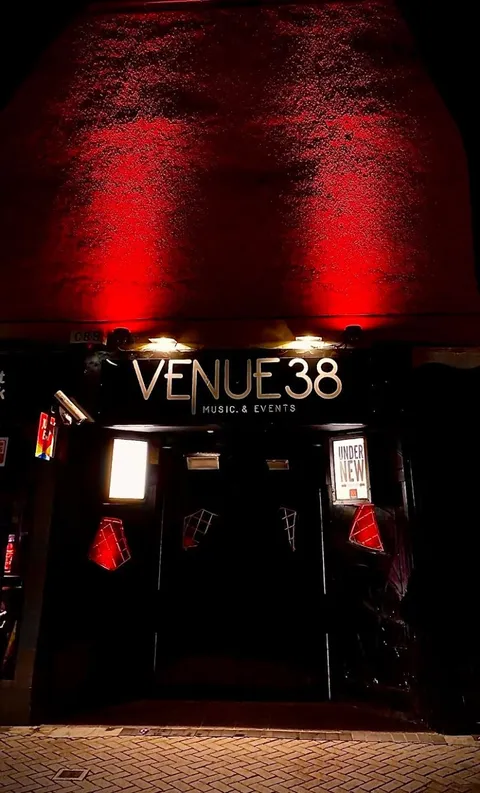
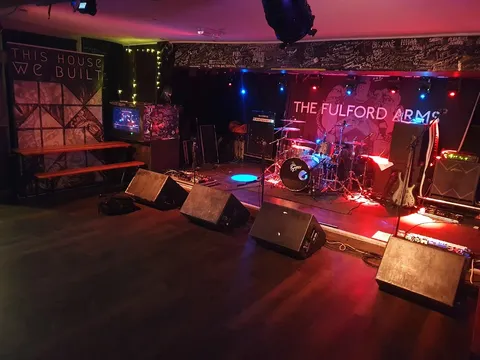
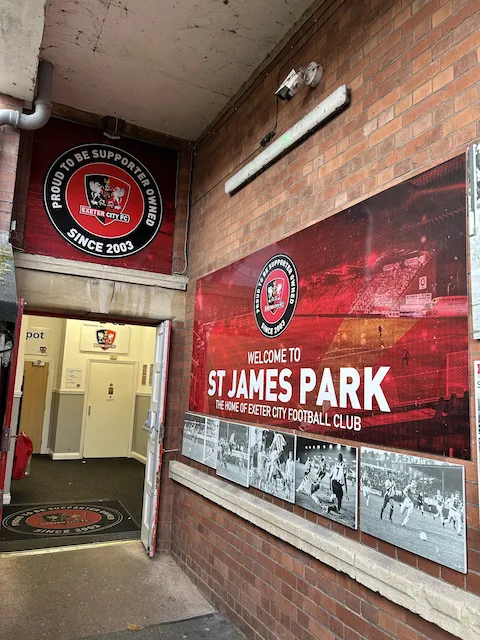
Martyn’s Law reaches rooms of 200 or more people, and every venue here can run the readiness check from the same free dashboard it books acts from, so the procedures sit alongside the programme.

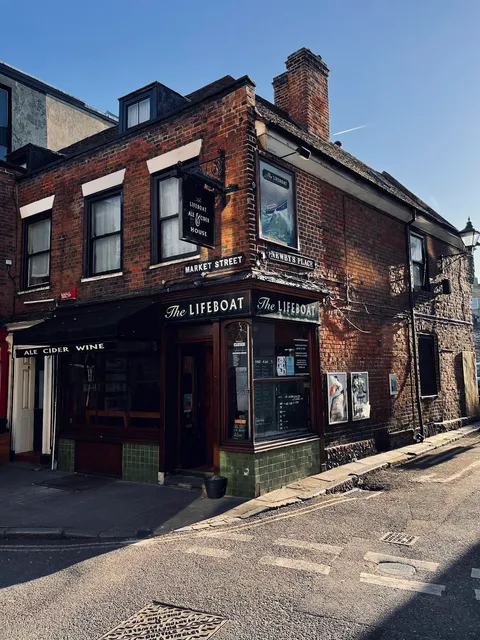
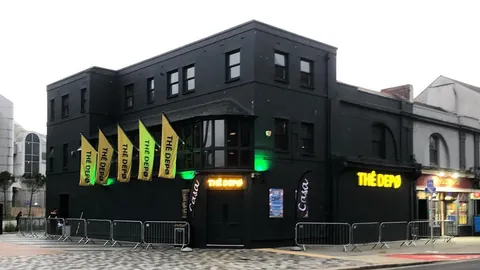

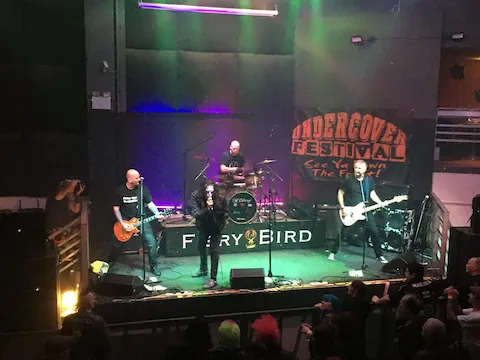


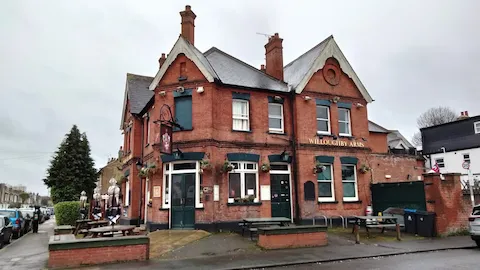





Browse the UK venue directory · GigXchange for venues · Create a free venue profile






More free tools for venues
6 more tools for running a venue, all free with a venue profile, including the Post a Gig, GX Gig Rescue and Licensing Checker. None of them needs a card, a trial or a paid plan, and each one is built around how UK venues book, promote and run live music.
Post a Gig
List an open slot in two minutes and take applications from gig-ready artists — full profiles and verified reviews attached.
GX Gig Rescue
Act dropped out? Broadcast an urgent booking invite to up to 25 available acts — first to accept is booked.
Licensing Checker
Ten questions decode your venue’s music licensing — permission, copyright and cost, with official sources.
Compliance Checklist
Eight questions build your venue’s compliance board — law first, ten areas, every item linked to its official source.
Events Poster
Your upcoming programme as a live what’s-on page in seven looks — status badges, ticket links and an embed for your own website.
Find an Artist
Pick the empty date, set a 60-second brief, and invite up to 5 ranked best-fit acts with real booking invites.
Frequently asked questions
What owners need to know once Martyn's Law comes up: whether it applies to a pub or venue, what the standard and enhanced tiers require, when to be ready, and what the readiness check's document does and doesn't cover.
Be the venue that was ready early
Being the venue that was ready early takes one sitting: sign up free and run the check, and your tier, your duties and the procedures draft are waiting in your venue dashboard to share with your team.