

09 — The print edition
The latest issue is live
Flip through all 11 pages below, or download the PDF.
The latest issue is live
Flip through all 11 pages below, or download the PDF.
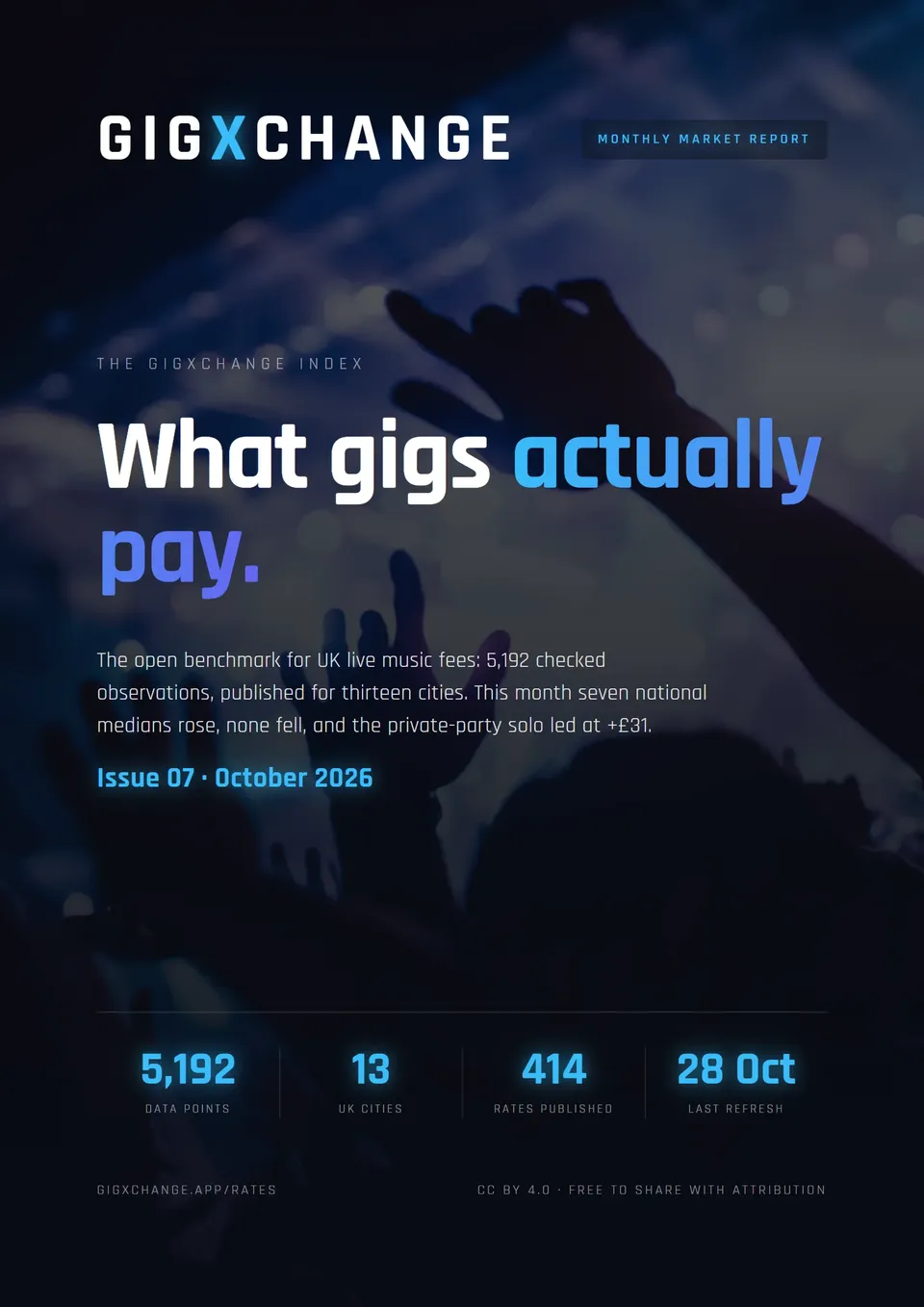


The GigXchange Index · Issue 07
The GigXchange Index is the UK's open benchmark of live music fees. In October 2026 a 3–4 piece wedding band's median fee was £1,000, from 5,192 checked observations across 13 cities.
Last updated: 1 November 2026
5,192 weighted observations — nine sources, quality-firewalled, rebuilt nightly. Where these numbers come from — the pipeline in plain English
5,192 weighted observations in this issue
Nine source classes, each with a published ceiling on how much of a cell it can own
A ceiling binds where other sources have the evidence to take up the rest - the method history says where it does not yet
A quality firewall before any row can land — a re-sighted listing never counts twice
A regional layer fills thin cells; real data always wins
Rebuilt nightly at 05:00 UTC, with the whole method published in the open
| Full methodology | |
| UK market statistics | |
| Find out more | |
| Full methodology |
13 UK cities with enough data to publish. Which cities this issue can publish a rate for, and why
13 cities publish the same 23-cell grid
A cell publishes once it clears the sample floor, and every figure carries its n
Thin cells fall back to region, then the UK baseline
Every cell says which level actually answered it
Coverage grows wherever artists and venues sign up
City league tables run right through the report
| All UK cities | |
| Read the report | |
| Find out more | |
| Browse city directories |
414 rate cells published — free to cite, quote and redistribute. How many rate cells published — and how to reuse every one of them
414 rate cells published this issue
Each cell is one place × gig type × band size
Four percentiles per cell — p25/p50/p75/p90, never an average
All artist take-home, agency commission normalised out
Raw CSV behind every figure, DOI-registered on Zenodo, mirrored on Hugging Face and Kaggle
CC BY 4.0 — cite it, quote it, redistribute it, even commercially
| Download CSV | |
| Zenodo DOI | |
| Hugging Face | |
| Find out more | |
| Use the calculator |
October 2026 — free, 11 pages, CC BY 4.0. Read the October 2026 issue in-browser, or take the PDF away
11 pages — city league tables, methodology notes and honest limits
Built from 5,192 weighted observations across 13 UK cities
Read in-browser, page by page, or download the PDF
A fresh issue in the third week of every month
Every back issue kept online and citable — plus the annual Yearbook and earnings specials
Free to read, free to cite, no signup, no paywall
| Read the report | |
| All reports | |
| Previous issue | |
| Find out more | |
| Download PDF |
The figure that defines this issue. The headline medians from this issue, and what moved them
Wedding, corporate, pub and city-level medians
Artist take-home — agency commission normalised out
Percentiles p25/p50/p75/p90, never a flat average
Compared issue-on-issue so you can see the trend
Benchmark your own quote against it
Every figure free to cite under CC BY 4.0
| What gigs pay | |
| Issue FAQ | |
| Find out more | |
| Use the calculator |
In October 2026 a 3–4 piece wedding band's median fee was £1,000 and a pub booking £350, from 5,192 checked observations across 13 UK cities.
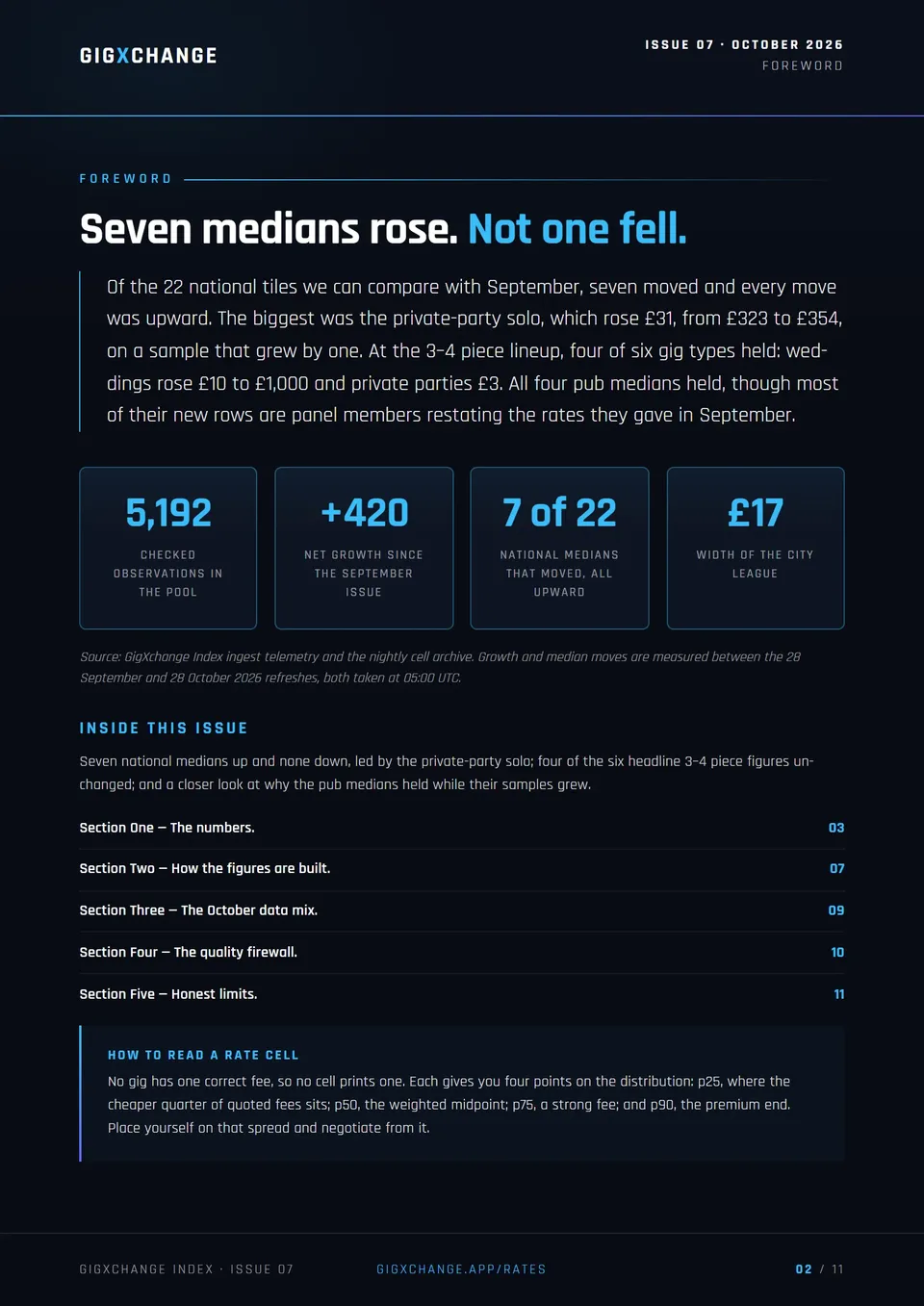
Of the 22 national tiles we can compare with September, seven moved and every move was upward. The biggest was the private-party solo, which rose £31, from £323 to £354, on a sample that grew by one. At the 3–4 piece lineup, four of six gig types held: weddings rose £10 to £1,000 and private parties £3. All four pub medians held, though most of their new rows are panel members restating the rates they gave in September.
Source: GigXchange Index ingest telemetry and the nightly cell archive. Growth and median moves are measured between the 28 September and 28 October 2026 refreshes, both taken at 05:00 UTC.
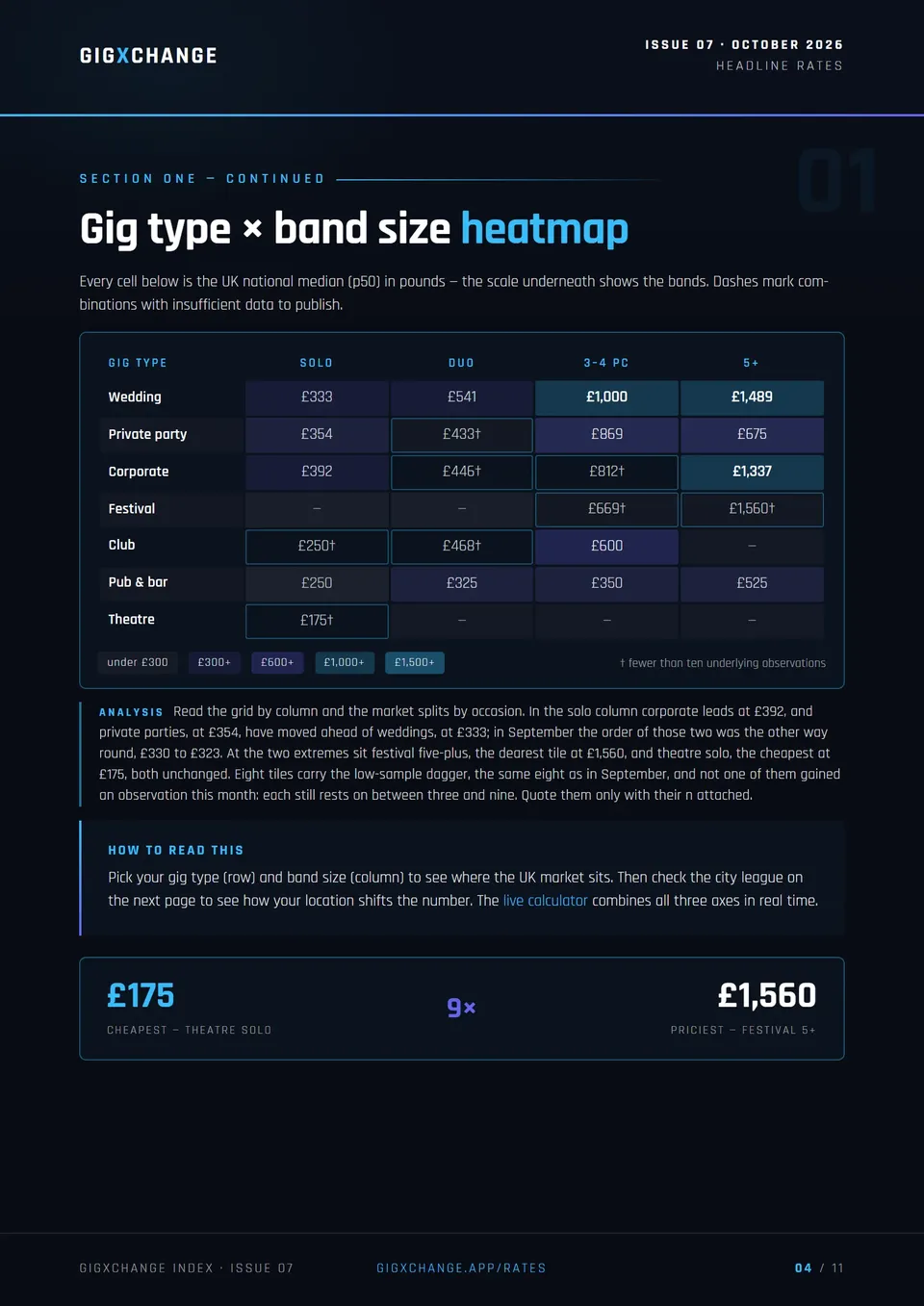
Pick a gig type and band size for the full range a UK act was paid in October 2026: the lower quarter, the median, a strong booking and the top tenth, with how many fees stand behind it.
| Gig type | Solo | Duo | 3–4 piece | 5+ |
|---|---|---|---|---|
| Wedding | ||||
| Private party | ||||
| Corporate | ||||
| Festival | – | – | ||
| Club | – | |||
| Pub & bar | ||||
| Theatre | – | – | – |
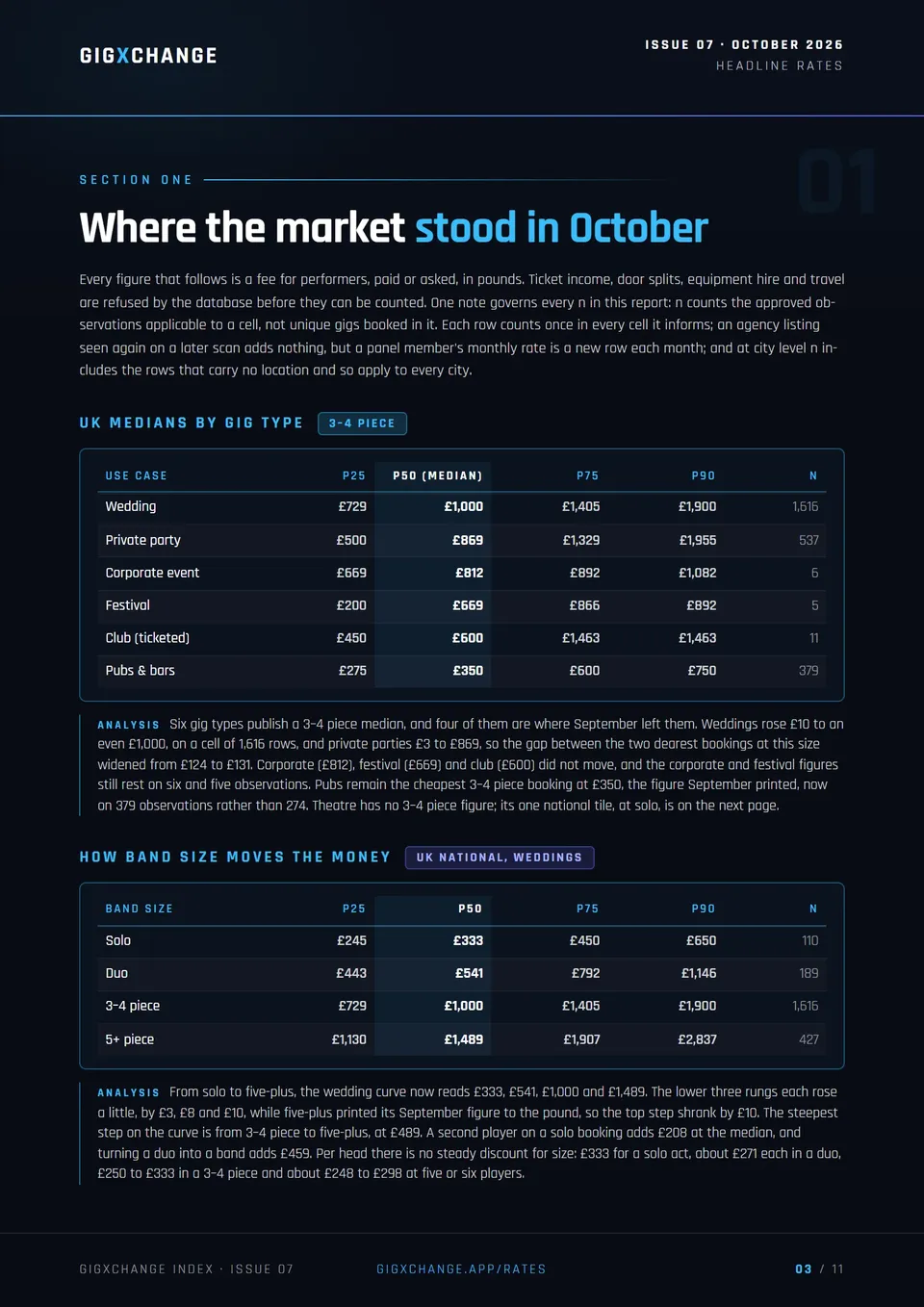
Every figure that follows is a fee for performers, paid or asked, in pounds. Ticket income, door splits, equipment hire and travel are refused by the database before they can be counted. One note governs every n in this report: n counts the approved observations applicable to a cell, not unique gigs booked in it. Each row counts once in every cell it informs; a published-rate listing seen again on a later refresh adds nothing, but a panel member's monthly rate is a new row each month; and at city level n includes the rows that carry no location and so apply to every city.
Six gig types publish a 3–4 piece median, and four of them are where September left them. Weddings rose £10 to an even £1,000, on a cell of 1,616 rows, and private parties £3 to £869, so the gap between the two dearest bookings at this size widened from £124 to £131. Corporate (£812), festival (£669) and club (£600) did not move, and the corporate and festival figures still rest on six and five observations. Pubs remain the cheapest 3–4 piece booking at £350, the figure September printed, now on 379 observations rather than 274. Theatre has no 3–4 piece figure; its one national tile, at solo, is on the next page.
From solo to five-plus, the wedding curve now reads £333, £541, £1,000 and £1,489. The lower three rungs each rose a little, by £3, £8 and £10, while five-plus printed its September figure to the pound, so the top step shrank by £10. The steepest step on the curve is from 3–4 piece to five-plus, at £489. A second player on a solo booking adds £208 at the median, and turning a duo into a band adds £459. Per head there is no steady discount for size: £333 for a solo act, about £271 each in a duo, £250 to £333 in a 3–4 piece and about £248 to £298 at five or six players.
Read the grid by column and the market splits by occasion. In the solo column corporate leads at £392, and private parties, at £354, have moved ahead of weddings, at £333; in September the order of those two was the other way round, £330 to £323. At the two extremes sit festival five-plus, the dearest tile at £1,560, and theatre solo, the cheapest at £175, both unchanged. Eight tiles carry the low-sample dagger, the same eight as in September, and not one of them gained an observation this month: each still rests on between three and nine. Quote them only with their n attached.
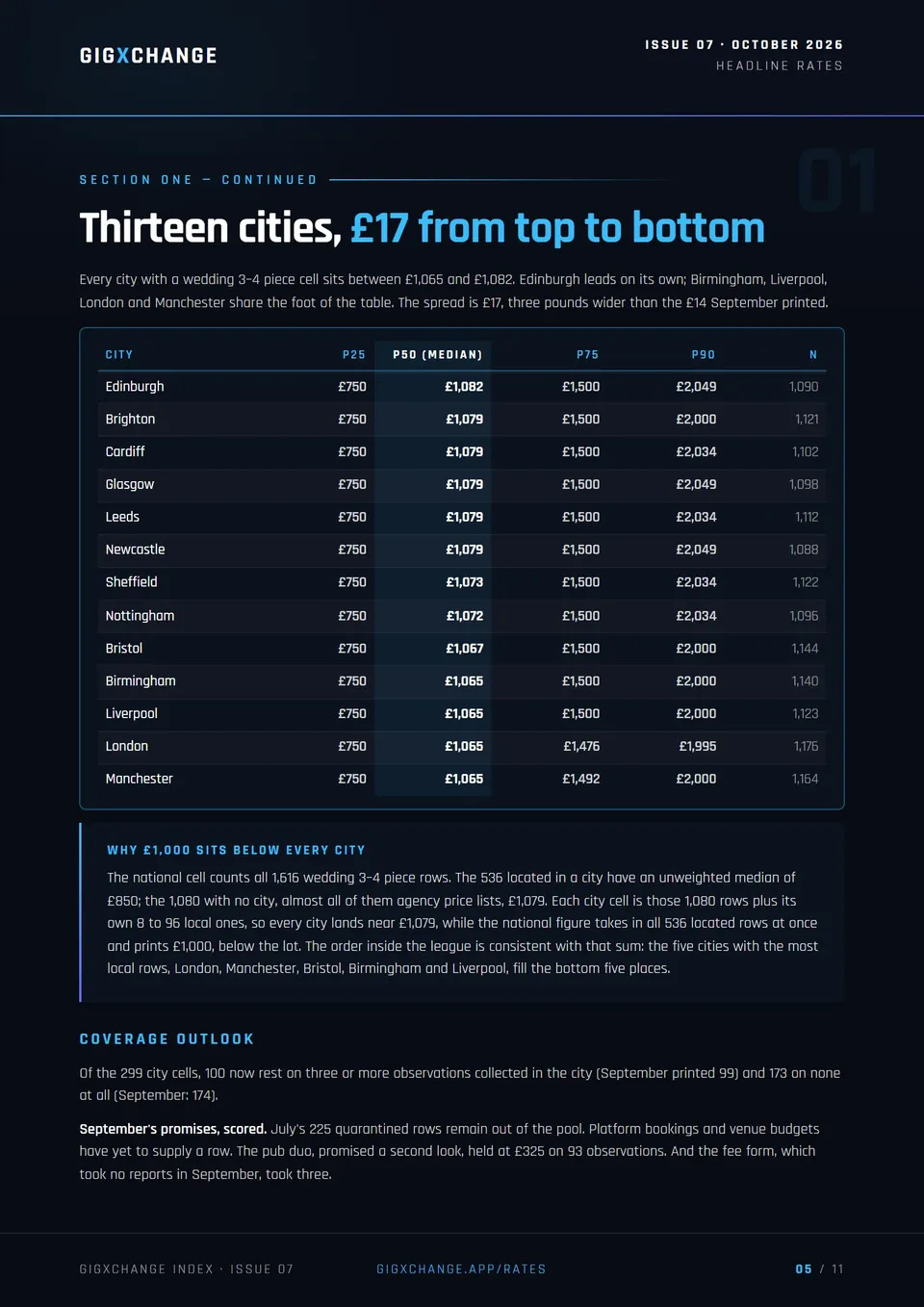
Across 13 UK cities a 3–4 piece wedding band's median ran from £1,065 in Manchester to £1,082 in Edinburgh - £17 apart, against £1,000 for the UK as a whole.
Wedding, 3–4 piece: median and middle half by city, October 2026. "Local" = observations collected in the city; "UK-wide" = location-less evidence every city shares.
| # | City | Median | Middle half | UK-wide | Local |
|---|---|---|---|---|---|
| 1 | Edinburgh | £1,082 | £750–£1,500 | 1,080 | 10 |
| 2 | Brighton | £1,079 | £750–£1,500 | 1,080 | 41 |
| 3 | Leeds | £1,079 | £750–£1,500 | 1,080 | 32 |
| 4 | Cardiff | £1,079 | £750–£1,500 | 1,080 | 22 |
| 5 | Glasgow | £1,079 | £750–£1,500 | 1,080 | 18 |
| 6 | Newcastle | £1,079 | £750–£1,500 | 1,080 | 8 |
| 7 | Sheffield | £1,073 | £750–£1,500 | 1,080 | 42 |
| 8 | Nottingham | £1,072 | £750–£1,500 | 1,080 | 16 |
| 9 | Bristol | £1,067 | £750–£1,500 | 1,080 | 64 |
| 10 | London | £1,065 | £750–£1,476 | 1,080 | 96 |
| 11 | Manchester | £1,065 | £750–£1,492 | 1,080 | 84 |
| 12 | Birmingham | £1,065 | £750–£1,500 | 1,080 | 60 |
| 13 | Liverpool | £1,065 | £750–£1,500 | 1,080 | 43 |
Every city with a wedding 3–4 piece cell sits between £1,065 and £1,082. Edinburgh leads on its own; Birmingham, Liverpool, London and Manchester share the foot of the table. The spread is £17, three pounds wider than the £14 September printed.
Of the 299 city cells, 100 now rest on three or more observations collected in the city (September printed 99) and 173 on none at all (September: 174).
September's promises, scored. July's 225 quarantined rows remain out of the pool. Platform bookings and venue budgets have yet to supply a row. The pub duo, promised a second look, held at £325 on 93 observations. And the fee form, which took no reports in September, took three.
15 of the comparable national medians held from September 2026 and 7 moved; the biggest move was the private-party solo, £323 to £354.
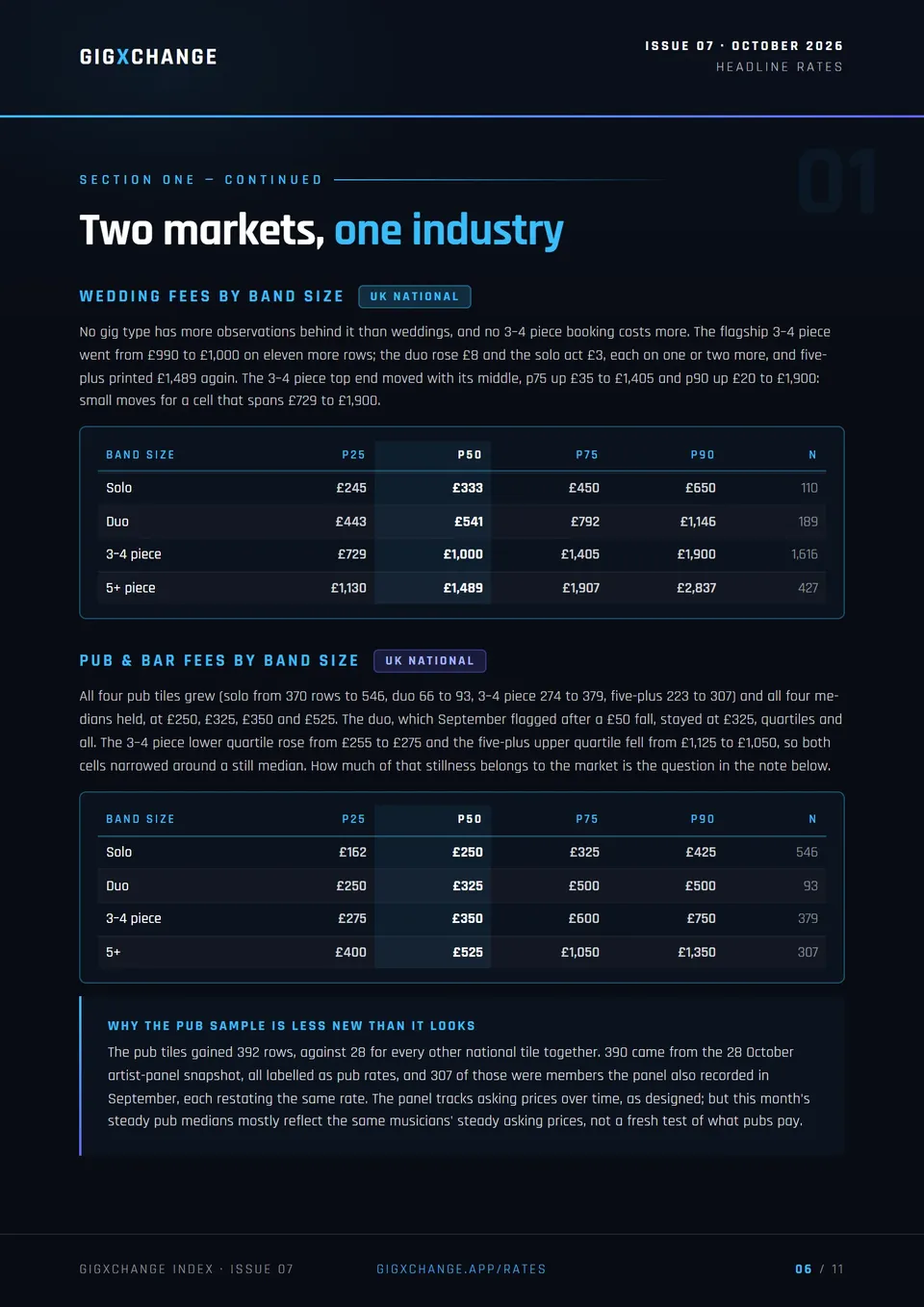
No gig type has more observations behind it than weddings, and no 3–4 piece booking costs more. The flagship 3–4 piece went from £990 to £1,000 on eleven more rows; the duo rose £8 and the solo act £3, each on one or two more, and five-plus printed £1,489 again. The 3–4 piece top end moved with its middle, p75 up £35 to £1,405 and p90 up £20 to £1,900: small moves for a cell that spans £729 to £1,900.
All four pub tiles grew (solo from 370 rows to 546, duo 66 to 93, 3–4 piece 274 to 379, five-plus 223 to 307) and all four medians held, at £250, £325, £350 and £525. The duo, which September flagged after a £50 fall, stayed at £325, quartiles and all. The 3–4 piece lower quartile rose from £255 to £275 and the five-plus upper quartile fell from £1,125 to £1,050, so both cells narrowed around a still median. How much of that stillness belongs to the market is the question in the note below.
Every figure is a percentile of real fees paid or asked, from 6 live sources, each capped at a share of any cell, with 243 rows refused this window by the quality gates.
Built with Method v5 - method history and corrections policy.
How an observed fee becomes a percentile you can quote across a table. October ran on the rules August and September ran on: no source weight and no range bound has changed.
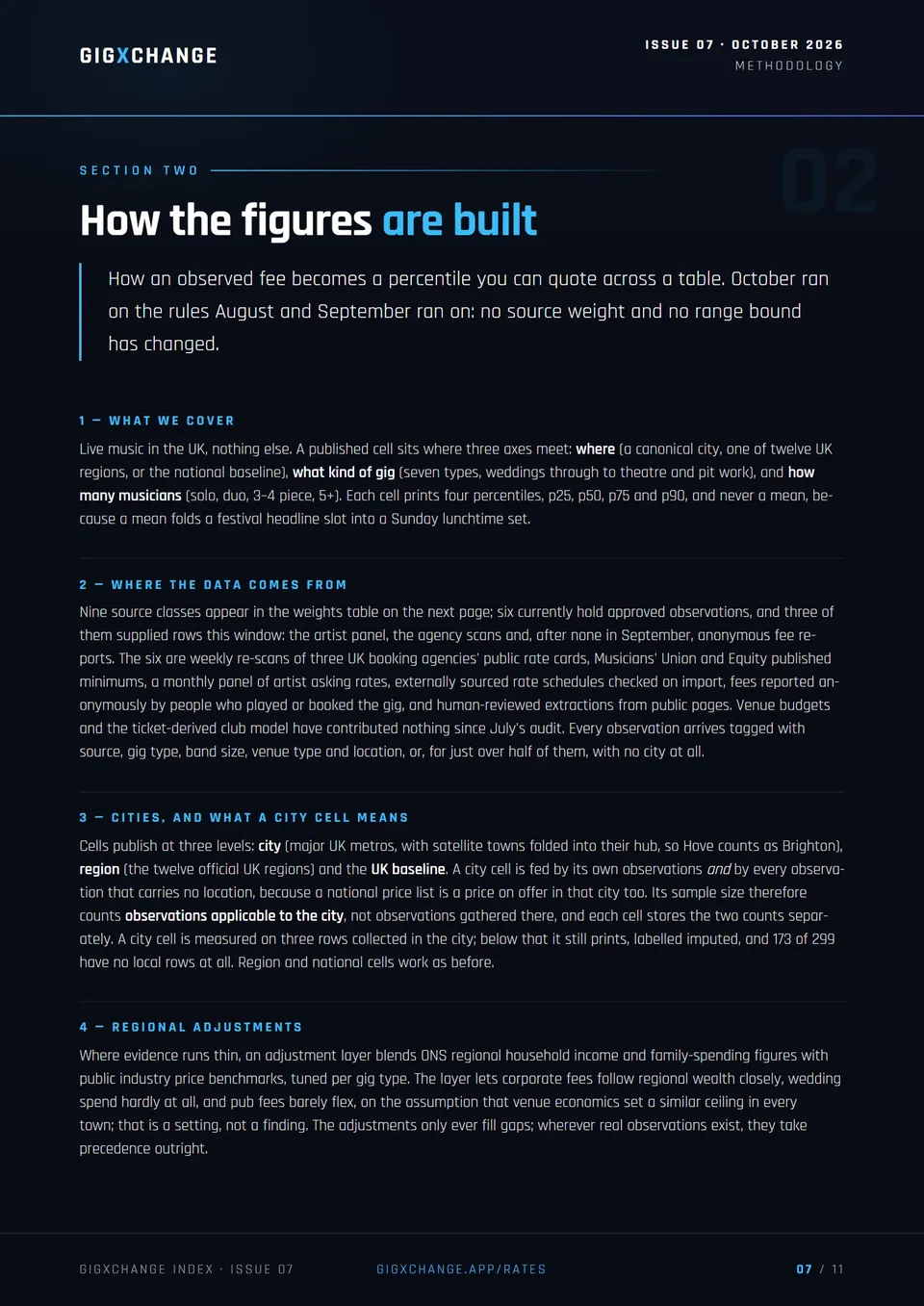
Live music in the UK, nothing else. A published cell sits where three axes meet: where (a canonical city, one of twelve UK regions, or the national baseline), what kind of gig (seven types, weddings through to theatre and pit work), and how many musicians (solo, duo, 3–4 piece, 5+). Each cell prints four percentiles, p25, p50, p75 and p90, and never a mean, because a mean folds a festival headline slot into a Sunday lunchtime set.
Nine source classes appear in the weights table on the next page; six currently hold approved observations, and three of them supplied rows this window: the artist panel, the weekly published-rate refresh and, after none in September, anonymous fee reports. The six are weekly refreshes of published UK market rates, Musicians' Union and Equity published minimums, a monthly panel of artist asking rates, externally sourced rate schedules checked on import, fees reported anonymously by people who played or booked the gig, and human-reviewed extractions from public pages. Venue budgets and the ticket-derived club model have contributed nothing since July's audit. Every observation arrives tagged with source, gig type, band size, venue type and location, or, for just over half of them, with no city at all.
Cells publish at three levels: city (major UK metros, with satellite towns folded into their hub, so Hove counts as Brighton), region (the twelve official UK regions) and the UK baseline. A city cell is fed by its own observations and by every observation that carries no location, because a national price list is a price on offer in that city too. Its sample size therefore counts observations applicable to the city, not observations gathered there, and each cell stores the two counts separately. A city cell is measured on three rows collected in the city; below that it still prints, labelled imputed, and 173 of 299 have no local rows at all. Region and national cells work as before.
Where evidence runs thin, an adjustment layer blends ONS regional household income and family-spending figures with public industry price benchmarks, tuned per gig type. The layer lets corporate fees follow regional wealth closely, wedding spend hardly at all, and pub fees barely flex, on the assumption that venue economics set a similar ceiling in every town; that is a setting, not a finding. The adjustments only ever fill gaps; wherever real observations exist, they take precedence outright.
Every city publishes the same grid of cells, so the cities we know least about still answer the same questions as the ones we know best. The count is now 414 cells: 299 city, 93 regional and 22 national. The regional layer shows the thin spots most plainly: London and the North West publish twelve cells each, Northern Ireland two.
Cells rebuild every night at 05:00 UTC; published market rates refresh each Monday; the artist panel snapshots on the 28th; approved submissions flow in daily. Each rebuild is archived, never overwritten, so one issue can be compared with the last. This issue covers 28 September to 28 October; its figures are the 28 October 05:00 UTC refresh.
A record of what the UK market paid or asked over the observation window, and no more. It is not a price recommendation, not a regulated benchmark and not financial advice, and a perfectly fair fee can fall outside every range in it. Free to reuse under CC BY 4.0.
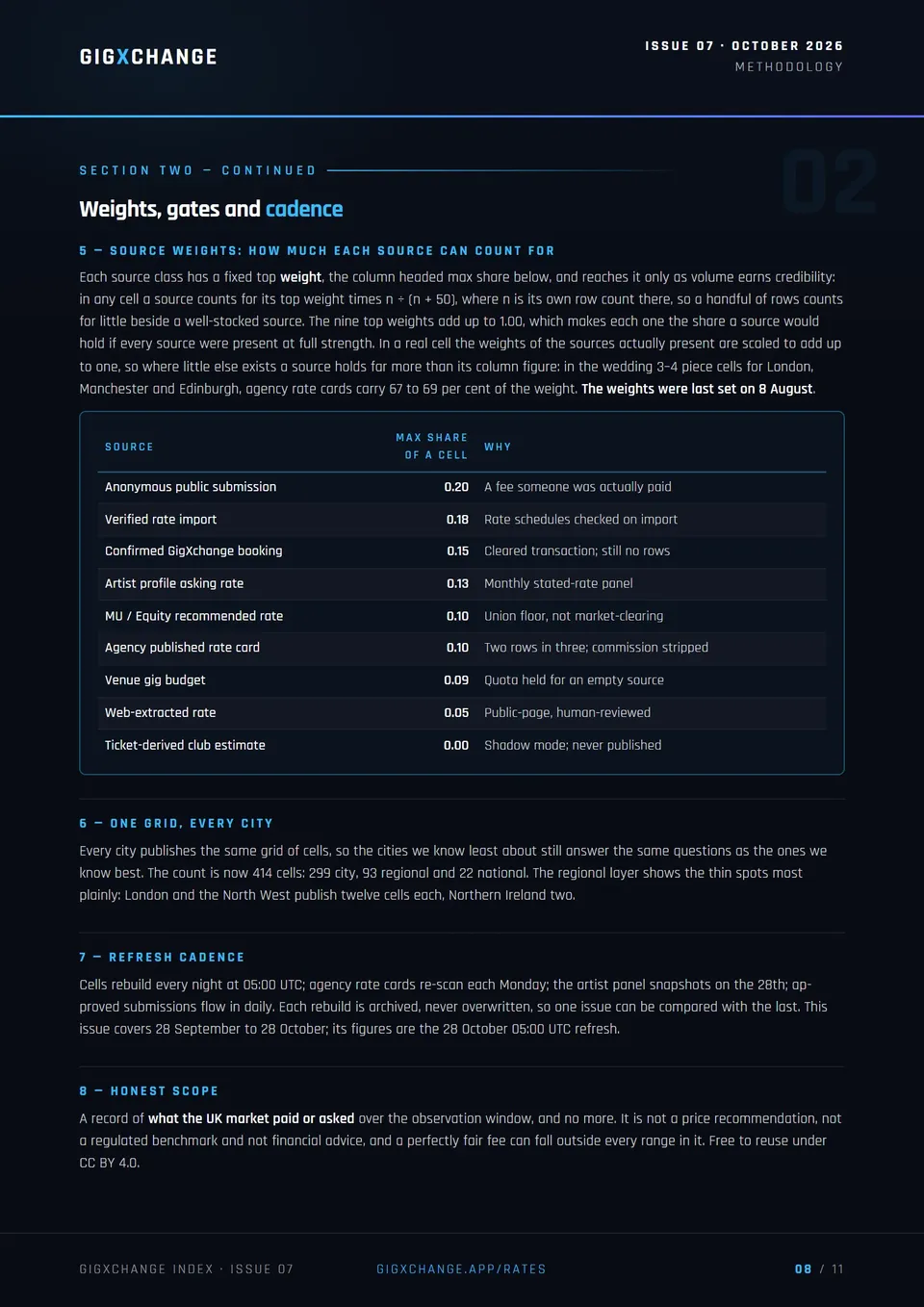
Each source class has a fixed top weight, the column headed max share below, and reaches it only as volume earns credibility: in any cell a source counts for its top weight times n ÷ (n + 50), where n is its own row count there, so a handful of rows counts for little beside a well-stocked source. The nine top weights add up to 1.00, which makes each one the share a source would hold if every source were present at full strength. In a real cell the weights of the sources actually present are scaled to add up to one, so where little else exists a source holds far more than its column figure: in the wedding 3–4 piece cells for London, Manchester and Edinburgh, published market rates carry 67 to 69 per cent of the weight. The weights were last set on 8 August.
| Source | Observations | Max share | Why |
|---|---|---|---|
| Published market rate | 3,562 | 0.10 | Asking price; commission stripped at ingest |
| Artist profile asking rate | 1,236 | 0.13 | Monthly stated-rate panel |
| Reviewed public rate | 173 | 0.05 | Extracted from public pages; human-reviewed |
| MU / Equity published rate | 143 | 0.10 | Authoritative floor, not market-clearing |
| Anonymous / unverified submission | 39 | 0.20 | Pending review; low intrinsic signal |
| Verified rate import | 39 | 0.18 | Externally sourced rate schedule, checked on import |
| Confirmed booking | 0 | 0.15 | Cleared transaction; strongest signal per row |
| Venue gig budget | 0 | 0.09 | Pre-negotiation target, not transacted |
| Ticket-derived club estimate | 0 | 0.00 | Four-archetype grassroots model (MVT-grounded) |
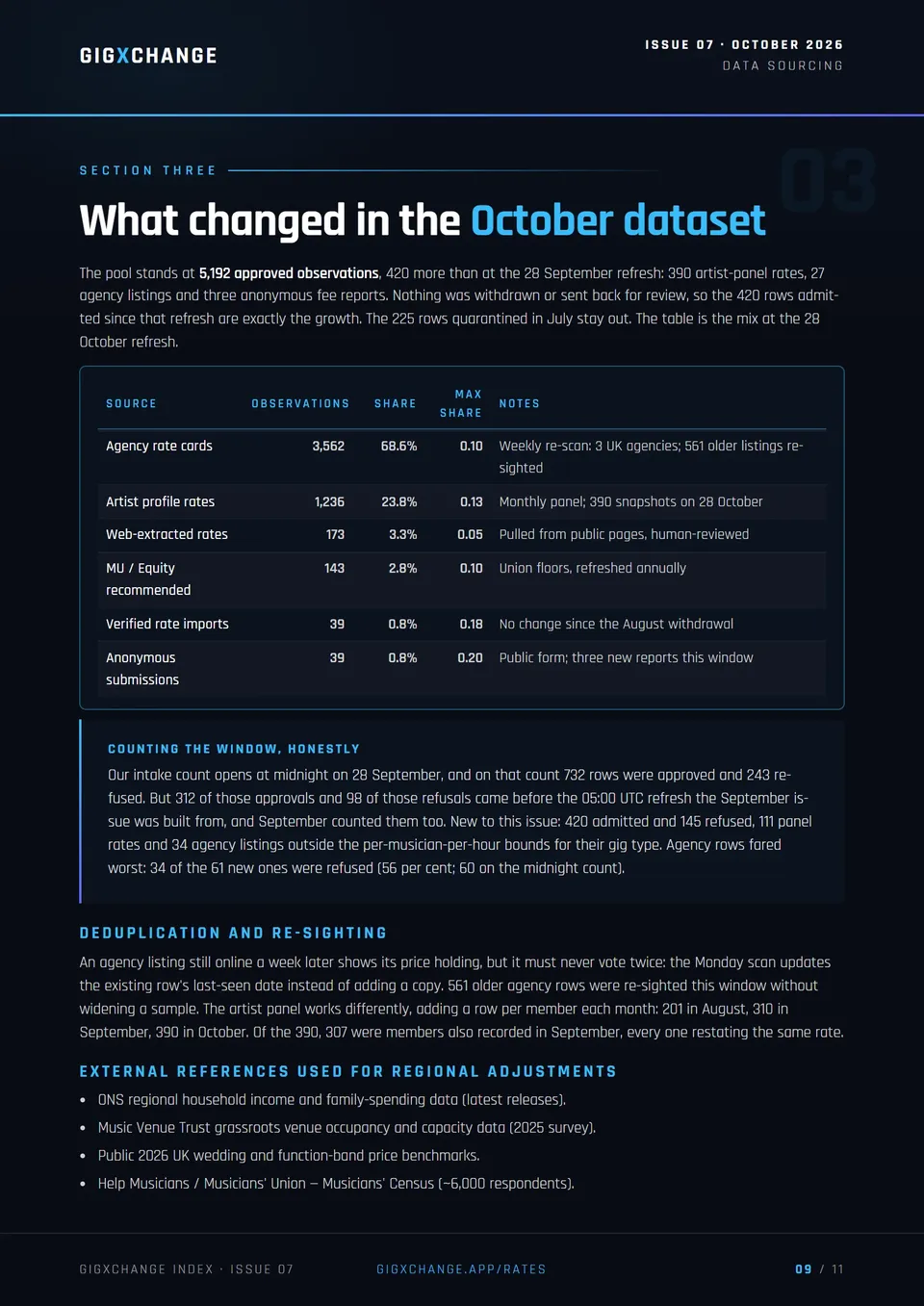
The pool stands at 5,192 approved observations, 420 more than at the 28 September refresh: 390 artist-panel rates, 27 published-rate listings and three anonymous fee reports. Nothing was withdrawn or sent back for review, so the 420 rows admitted since that refresh are exactly the growth. The 225 rows quarantined in July stay out. The table is the mix at the 28 October refresh.
A published-rate listing still online a week later shows its price holding, but it must never vote twice: the Monday refresh updates the existing row's last-seen date instead of adding a copy. 561 older published-rate rows were re-sighted this window without widening a sample. The artist panel works differently, adding a row per member each month: 201 in August, 310 in September, 390 in October. Of the 390, 307 were members also recorded in September, every one restating the same rate.
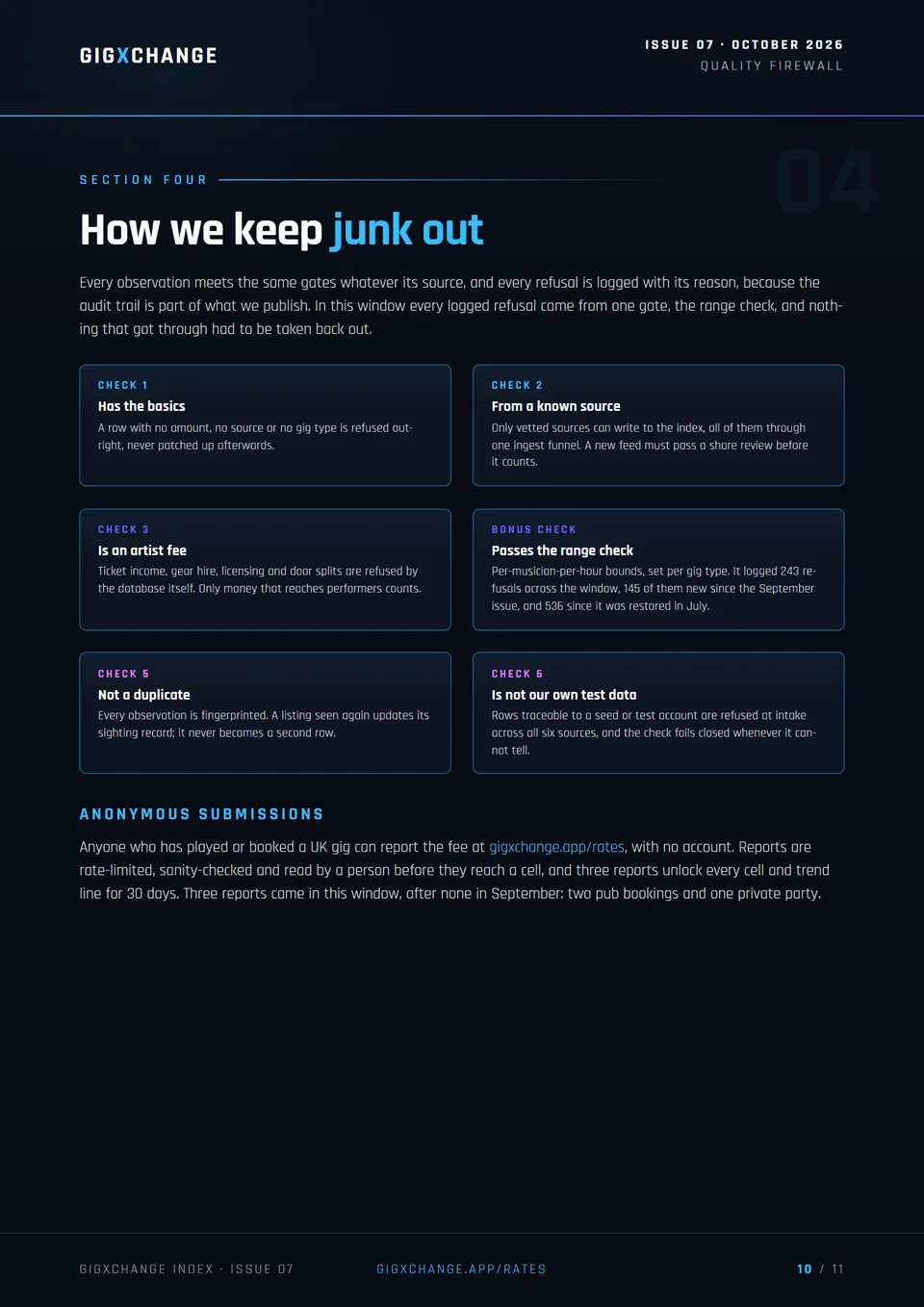
Every observation meets the same gates whatever its source, and every refusal is logged with its reason, because the audit trail is part of what we publish. In this window every logged refusal came from one gate, the range check, and nothing that got through had to be taken back out.
Anyone who has played or booked a UK gig can report the fee at gigxchange.app/rates, with no account. Reports are rate-limited, sanity-checked and read by a person before they reach a cell, and three reports unlock every cell and trend line for 30 days. Three reports came in this window, after none in September: two pub bookings and one private party.
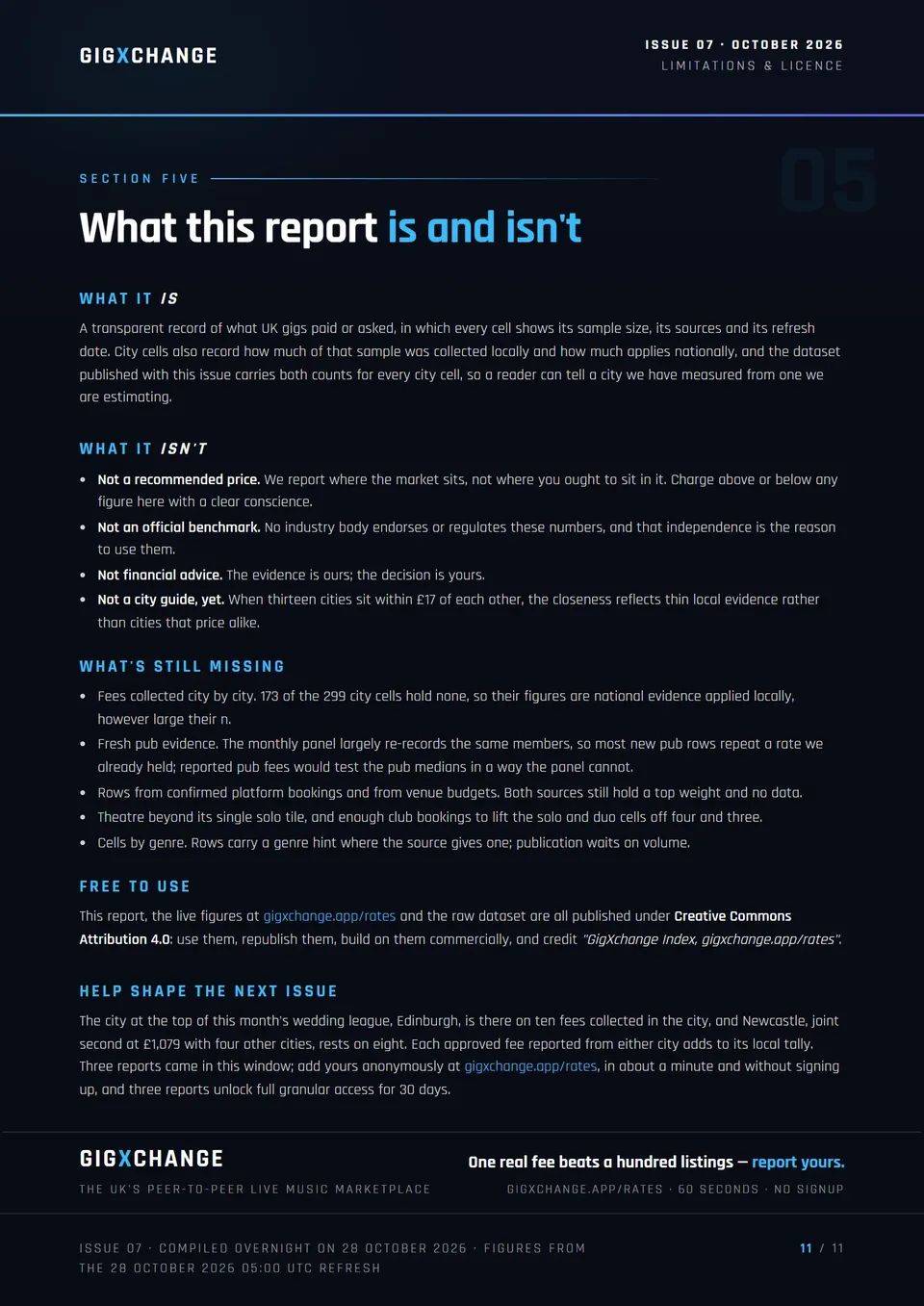
The GX Index is a record of what the UK market paid or asked - not a recommended price, an official benchmark or financial advice. Here is what it still cannot tell you.
A transparent record of what UK gigs paid or asked, in which every cell shows its sample size, its sources and its refresh date. City cells also record how much of that sample was collected locally and how much applies nationally, and the dataset published with this issue carries both counts for every city cell, so a reader can tell a city we have measured from one we are estimating.
This report, the live figures at gigxchange.app/rates and the raw dataset are all published under Creative Commons Attribution 4.0: use them, republish them, build on them commercially, and credit "GigXchange Index, gigxchange.app/rates".
The city at the top of this month's wedding league, Edinburgh, is there on ten fees collected in the city, and Newcastle, joint second at £1,079 with four other cities, rests on eight. Each approved fee reported from either city adds to its local tally. Three reports came in this window; add yours anonymously at gigxchange.app/rates, in about a minute and without signing up, and three reports unlock full granular access for 30 days.
1 revision to the October 2026 issue since it was published, the latest on 31 October 2026. The PDF is kept as issued; open a revision to see what was printed, what it should say and why.

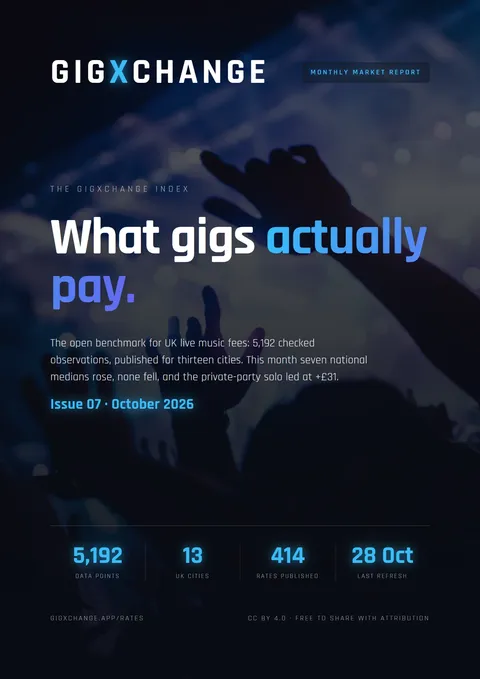
The GigXchange Index is the UK's open benchmark of live music fees. In October 2026 a 3–4 piece wedding band's median fee was £1,000, from 5,192 checked observations across 13 cities.
Last updated: 1 November 2026
In October 2026 a 3–4 piece wedding band's median fee was £1,000 and a pub booking £350, from 5,192 checked observations across 13 UK cities.
Of the 22 national tiles we can compare with September, seven moved and every move was upward. The biggest was the private-party solo, which rose £31, from £323 to £354, on a sample that grew by one. At the 3–4 piece lineup, four of six gig types held: weddings rose £10 to £1,000 and private parties £3. All four pub medians held, though most of their new rows are panel members restating the rates they gave in September.
Source: GigXchange Index ingest telemetry and the nightly cell archive. Growth and median moves are measured between the 28 September and 28 October 2026 refreshes, both taken at 05:00 UTC.
Pick a gig type and band size for the full range a UK act was paid in October 2026: the lower quarter, the median, a strong booking and the top tenth, with how many fees stand behind it.
| Gig type | Solo | Duo | 3–4 piece | 5+ |
|---|---|---|---|---|
| Wedding | ||||
| Private party | ||||
| Corporate | ||||
| Festival | – | – | ||
| Club | – | |||
| Pub & bar | ||||
| Theatre | – | – | – |
Every figure that follows is a fee for performers, paid or asked, in pounds. Ticket income, door splits, equipment hire and travel are refused by the database before they can be counted. One note governs every n in this report: n counts the approved observations applicable to a cell, not unique gigs booked in it. Each row counts once in every cell it informs; a published-rate listing seen again on a later refresh adds nothing, but a panel member's monthly rate is a new row each month; and at city level n includes the rows that carry no location and so apply to every city.
Six gig types publish a 3–4 piece median, and four of them are where September left them. Weddings rose £10 to an even £1,000, on a cell of 1,616 rows, and private parties £3 to £869, so the gap between the two dearest bookings at this size widened from £124 to £131. Corporate (£812), festival (£669) and club (£600) did not move, and the corporate and festival figures still rest on six and five observations. Pubs remain the cheapest 3–4 piece booking at £350, the figure September printed, now on 379 observations rather than 274. Theatre has no 3–4 piece figure; its one national tile, at solo, is on the next page.
From solo to five-plus, the wedding curve now reads £333, £541, £1,000 and £1,489. The lower three rungs each rose a little, by £3, £8 and £10, while five-plus printed its September figure to the pound, so the top step shrank by £10. The steepest step on the curve is from 3–4 piece to five-plus, at £489. A second player on a solo booking adds £208 at the median, and turning a duo into a band adds £459. Per head there is no steady discount for size: £333 for a solo act, about £271 each in a duo, £250 to £333 in a 3–4 piece and about £248 to £298 at five or six players.
Read the grid by column and the market splits by occasion. In the solo column corporate leads at £392, and private parties, at £354, have moved ahead of weddings, at £333; in September the order of those two was the other way round, £330 to £323. At the two extremes sit festival five-plus, the dearest tile at £1,560, and theatre solo, the cheapest at £175, both unchanged. Eight tiles carry the low-sample dagger, the same eight as in September, and not one of them gained an observation this month: each still rests on between three and nine. Quote them only with their n attached.
Across 13 UK cities a 3–4 piece wedding band's median ran from £1,065 in Manchester to £1,082 in Edinburgh - £17 apart, against £1,000 for the UK as a whole.
Wedding, 3–4 piece: median and middle half by city, October 2026. "Local" = observations collected in the city; "UK-wide" = location-less evidence every city shares.
| # | City | Median | Middle half | UK-wide | Local |
|---|---|---|---|---|---|
| 1 | Edinburgh | £1,082 | £750–£1,500 | 1,080 | 10 |
| 2 | Brighton | £1,079 | £750–£1,500 | 1,080 | 41 |
| 3 | Leeds | £1,079 | £750–£1,500 | 1,080 | 32 |
| 4 | Cardiff | £1,079 | £750–£1,500 | 1,080 | 22 |
| 5 | Glasgow | £1,079 | £750–£1,500 | 1,080 | 18 |
| 6 | Newcastle | £1,079 | £750–£1,500 | 1,080 | 8 |
| 7 | Sheffield | £1,073 | £750–£1,500 | 1,080 | 42 |
| 8 | Nottingham | £1,072 | £750–£1,500 | 1,080 | 16 |
| 9 | Bristol | £1,067 | £750–£1,500 | 1,080 | 64 |
| 10 | London | £1,065 | £750–£1,476 | 1,080 | 96 |
| 11 | Manchester | £1,065 | £750–£1,492 | 1,080 | 84 |
| 12 | Birmingham | £1,065 | £750–£1,500 | 1,080 | 60 |
| 13 | Liverpool | £1,065 | £750–£1,500 | 1,080 | 43 |
Every city with a wedding 3–4 piece cell sits between £1,065 and £1,082. Edinburgh leads on its own; Birmingham, Liverpool, London and Manchester share the foot of the table. The spread is £17, three pounds wider than the £14 September printed.
Of the 299 city cells, 100 now rest on three or more observations collected in the city (September printed 99) and 173 on none at all (September: 174).
September's promises, scored. July's 225 quarantined rows remain out of the pool. Platform bookings and venue budgets have yet to supply a row. The pub duo, promised a second look, held at £325 on 93 observations. And the fee form, which took no reports in September, took three.
15 of the comparable national medians held from September 2026 and 7 moved; the biggest move was the private-party solo, £323 to £354.
No gig type has more observations behind it than weddings, and no 3–4 piece booking costs more. The flagship 3–4 piece went from £990 to £1,000 on eleven more rows; the duo rose £8 and the solo act £3, each on one or two more, and five-plus printed £1,489 again. The 3–4 piece top end moved with its middle, p75 up £35 to £1,405 and p90 up £20 to £1,900: small moves for a cell that spans £729 to £1,900.
All four pub tiles grew (solo from 370 rows to 546, duo 66 to 93, 3–4 piece 274 to 379, five-plus 223 to 307) and all four medians held, at £250, £325, £350 and £525. The duo, which September flagged after a £50 fall, stayed at £325, quartiles and all. The 3–4 piece lower quartile rose from £255 to £275 and the five-plus upper quartile fell from £1,125 to £1,050, so both cells narrowed around a still median. How much of that stillness belongs to the market is the question in the note below.
Every figure is a percentile of real fees paid or asked, from 6 live sources, each capped at a share of any cell, with 243 rows refused this window by the quality gates.
Built with Method v5 - method history and corrections policy.
How an observed fee becomes a percentile you can quote across a table. October ran on the rules August and September ran on: no source weight and no range bound has changed.
Live music in the UK, nothing else. A published cell sits where three axes meet: where (a canonical city, one of twelve UK regions, or the national baseline), what kind of gig (seven types, weddings through to theatre and pit work), and how many musicians (solo, duo, 3–4 piece, 5+). Each cell prints four percentiles, p25, p50, p75 and p90, and never a mean, because a mean folds a festival headline slot into a Sunday lunchtime set.
Nine source classes appear in the weights table on the next page; six currently hold approved observations, and three of them supplied rows this window: the artist panel, the weekly published-rate refresh and, after none in September, anonymous fee reports. The six are weekly refreshes of published UK market rates, Musicians' Union and Equity published minimums, a monthly panel of artist asking rates, externally sourced rate schedules checked on import, fees reported anonymously by people who played or booked the gig, and human-reviewed extractions from public pages. Venue budgets and the ticket-derived club model have contributed nothing since July's audit. Every observation arrives tagged with source, gig type, band size, venue type and location, or, for just over half of them, with no city at all.
Cells publish at three levels: city (major UK metros, with satellite towns folded into their hub, so Hove counts as Brighton), region (the twelve official UK regions) and the UK baseline. A city cell is fed by its own observations and by every observation that carries no location, because a national price list is a price on offer in that city too. Its sample size therefore counts observations applicable to the city, not observations gathered there, and each cell stores the two counts separately. A city cell is measured on three rows collected in the city; below that it still prints, labelled imputed, and 173 of 299 have no local rows at all. Region and national cells work as before.
Where evidence runs thin, an adjustment layer blends ONS regional household income and family-spending figures with public industry price benchmarks, tuned per gig type. The layer lets corporate fees follow regional wealth closely, wedding spend hardly at all, and pub fees barely flex, on the assumption that venue economics set a similar ceiling in every town; that is a setting, not a finding. The adjustments only ever fill gaps; wherever real observations exist, they take precedence outright.
Every city publishes the same grid of cells, so the cities we know least about still answer the same questions as the ones we know best. The count is now 414 cells: 299 city, 93 regional and 22 national. The regional layer shows the thin spots most plainly: London and the North West publish twelve cells each, Northern Ireland two.
Cells rebuild every night at 05:00 UTC; published market rates refresh each Monday; the artist panel snapshots on the 28th; approved submissions flow in daily. Each rebuild is archived, never overwritten, so one issue can be compared with the last. This issue covers 28 September to 28 October; its figures are the 28 October 05:00 UTC refresh.
A record of what the UK market paid or asked over the observation window, and no more. It is not a price recommendation, not a regulated benchmark and not financial advice, and a perfectly fair fee can fall outside every range in it. Free to reuse under CC BY 4.0.
Each source class has a fixed top weight, the column headed max share below, and reaches it only as volume earns credibility: in any cell a source counts for its top weight times n ÷ (n + 50), where n is its own row count there, so a handful of rows counts for little beside a well-stocked source. The nine top weights add up to 1.00, which makes each one the share a source would hold if every source were present at full strength. In a real cell the weights of the sources actually present are scaled to add up to one, so where little else exists a source holds far more than its column figure: in the wedding 3–4 piece cells for London, Manchester and Edinburgh, published market rates carry 67 to 69 per cent of the weight. The weights were last set on 8 August.
Sources in the pool at the October 2026 refresh, and the most of any cell each one can own.
| Source | Observations | Max share | Why |
|---|---|---|---|
| Published market rate | 3,562 | 0.10 | Asking price; commission stripped at ingest |
| Artist profile asking rate | 1,236 | 0.13 | Monthly stated-rate panel |
| Reviewed public rate | 173 | 0.05 | Extracted from public pages; human-reviewed |
| MU / Equity published rate | 143 | 0.10 | Authoritative floor, not market-clearing |
| Anonymous / unverified submission | 39 | 0.20 | Pending review; low intrinsic signal |
| Verified rate import | 39 | 0.18 | Externally sourced rate schedule, checked on import |
| Confirmed booking | 0 | 0.15 | Cleared transaction; strongest signal per row |
| Venue gig budget | 0 | 0.09 | Pre-negotiation target, not transacted |
| Ticket-derived club estimate | 0 | 0.00 | Four-archetype grassroots model (MVT-grounded) |
The pool stands at 5,192 approved observations, 420 more than at the 28 September refresh: 390 artist-panel rates, 27 published-rate listings and three anonymous fee reports. Nothing was withdrawn or sent back for review, so the 420 rows admitted since that refresh are exactly the growth. The 225 rows quarantined in July stay out. The table is the mix at the 28 October refresh.
A published-rate listing still online a week later shows its price holding, but it must never vote twice: the Monday refresh updates the existing row's last-seen date instead of adding a copy. 561 older published-rate rows were re-sighted this window without widening a sample. The artist panel works differently, adding a row per member each month: 201 in August, 310 in September, 390 in October. Of the 390, 307 were members also recorded in September, every one restating the same rate.
Every observation meets the same gates whatever its source, and every refusal is logged with its reason, because the audit trail is part of what we publish. In this window every logged refusal came from one gate, the range check, and nothing that got through had to be taken back out.
Anyone who has played or booked a UK gig can report the fee at gigxchange.app/rates, with no account. Reports are rate-limited, sanity-checked and read by a person before they reach a cell, and three reports unlock every cell and trend line for 30 days. Three reports came in this window, after none in September: two pub bookings and one private party.
The GX Index is a record of what the UK market paid or asked - not a recommended price, an official benchmark or financial advice. Here is what it still cannot tell you.
A transparent record of what UK gigs paid or asked, in which every cell shows its sample size, its sources and its refresh date. City cells also record how much of that sample was collected locally and how much applies nationally, and the dataset published with this issue carries both counts for every city cell, so a reader can tell a city we have measured from one we are estimating.
This report, the live figures at gigxchange.app/rates and the raw dataset are all published under Creative Commons Attribution 4.0: use them, republish them, build on them commercially, and credit "GigXchange Index, gigxchange.app/rates".
The city at the top of this month's wedding league, Edinburgh, is there on ten fees collected in the city, and Newcastle, joint second at £1,079 with four other cities, rests on eight. Each approved fee reported from either city adds to its local tally. Three reports came in this window; add yours anonymously at gigxchange.app/rates, in about a minute and without signing up, and three reports unlock full granular access for 30 days.
1 revision to the October 2026 issue since it was published, the latest on 31 October 2026. The PDF is kept as issued; open a revision to see what was printed, what it should say and why.
Flip through all 11 pages below, or download the PDF.
Flip through all 11 pages below, or download the PDF.
GigXchange (2026). GigXchange Index — October 2026. Issue 07. Available at: gigxchange.app/rates/reports/october-2026. Licensed under CC BY 4.0.
Cite this report
GigXchange (2026). GigXchange Index — October 2026. Issue 07. Available at: gigxchange.app/rates/reports/october-2026. Licensed under CC BY 4.0.
DOI 10.5281/zenodo.23772529 · PDF · CSV · Hugging Face · Kaggle
| GX Index — September 2026Previous issue · 11 pages · PDF | |
| UK Festival Season 202731 Oct 2026 · Annual · 11 pages · PDF | |
| GIGXCHANGE Index — August 20263 Sept 2026 · Index · 11 pages · PDF | |
| State of the Circuit 20266 Aug 2026 · Annual · 11 pages · PDF | |
| GIGXCHANGE Index — July 202631 Jul 2026 · Index · 11 pages · PDF | |
| GIGXCHANGE Index — June 20264 Jul 2026 · Index · 11 pages · PDF | |
| GIGXCHANGE Index — May 202620 May 2026 · Index · 11 pages · PDF | |
| Browse all reports & datasets |
Benchmark your fee against the live UK rate index, refreshed nightly.
| Live rate calculator |
Add your real gig fees to the UK Gig Pay Survey — anonymous, ~60 seconds, and every entry sharpens the next GX Index.
| Take the survey |
| UK market statistics | |
| Gig directory |
Every gig you've done is a data point we need. Submit three rates anonymously and you unlock every figure for 30 days.
Everything artists, venues and event planners ask about UK gig fees in October 2026 — answered with real data from 5,192 observations across 13 cities.
Every gig you've done is a data point we need. Submit three rates anonymously and you unlock every figure for 30 days.
Real UK gig-fee data, not guesswork — built from actual bookings. Add yours and it gets sharper for everyone.