

02 — The report
The latest issue is live
Flip through all 11 pages below, or download the PDF.
The latest issue is live
Flip through all 11 pages below, or download the PDF.
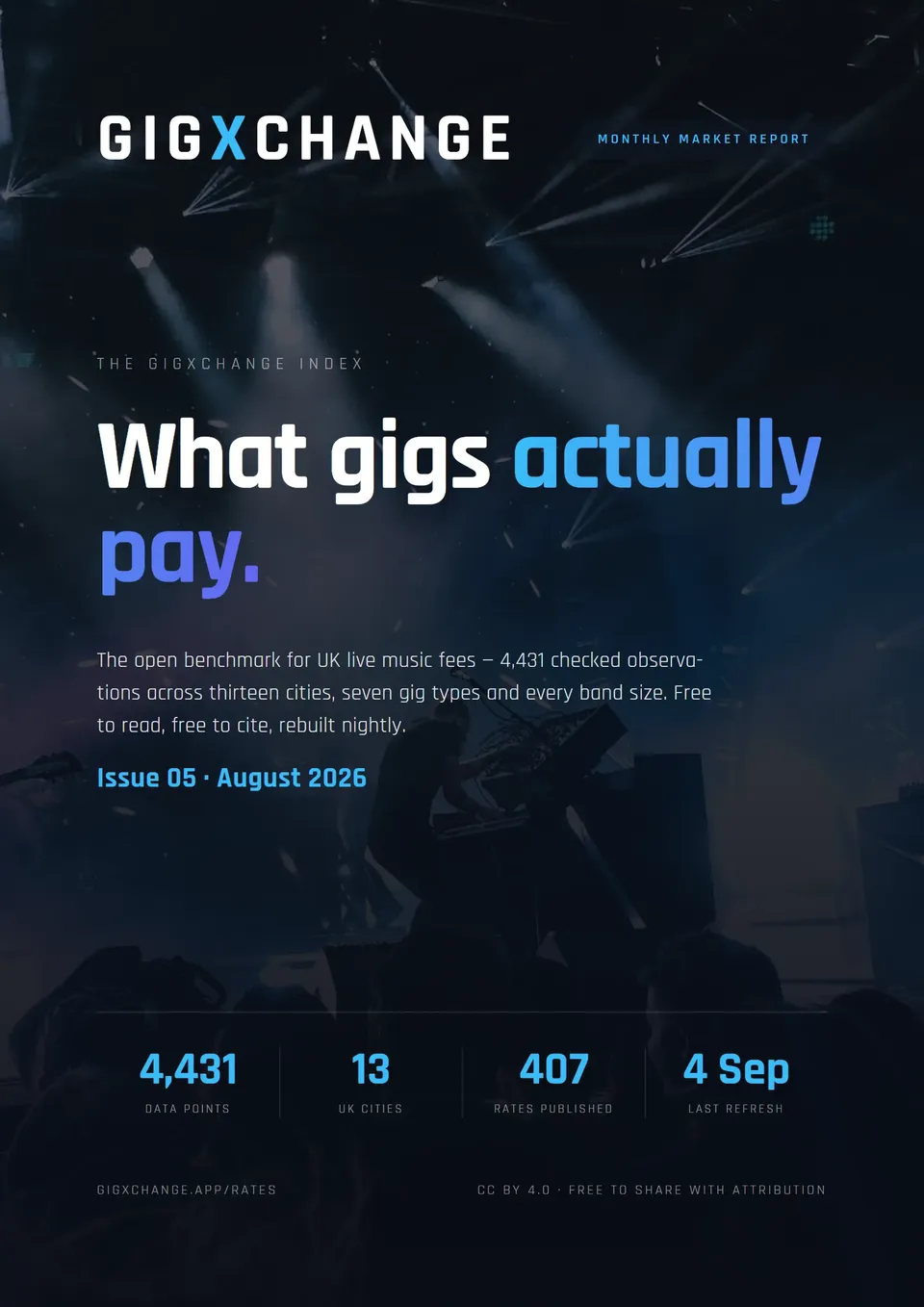
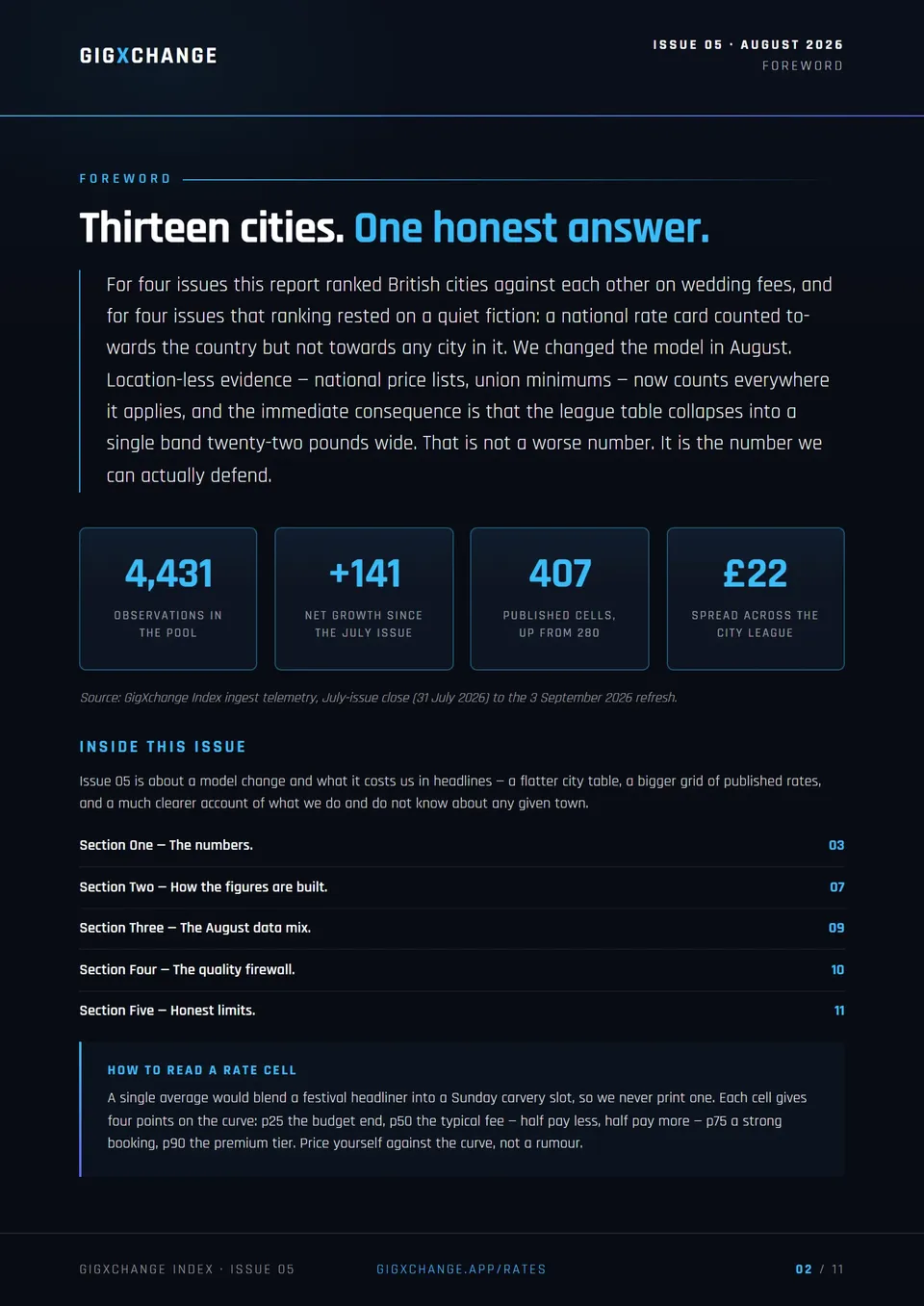
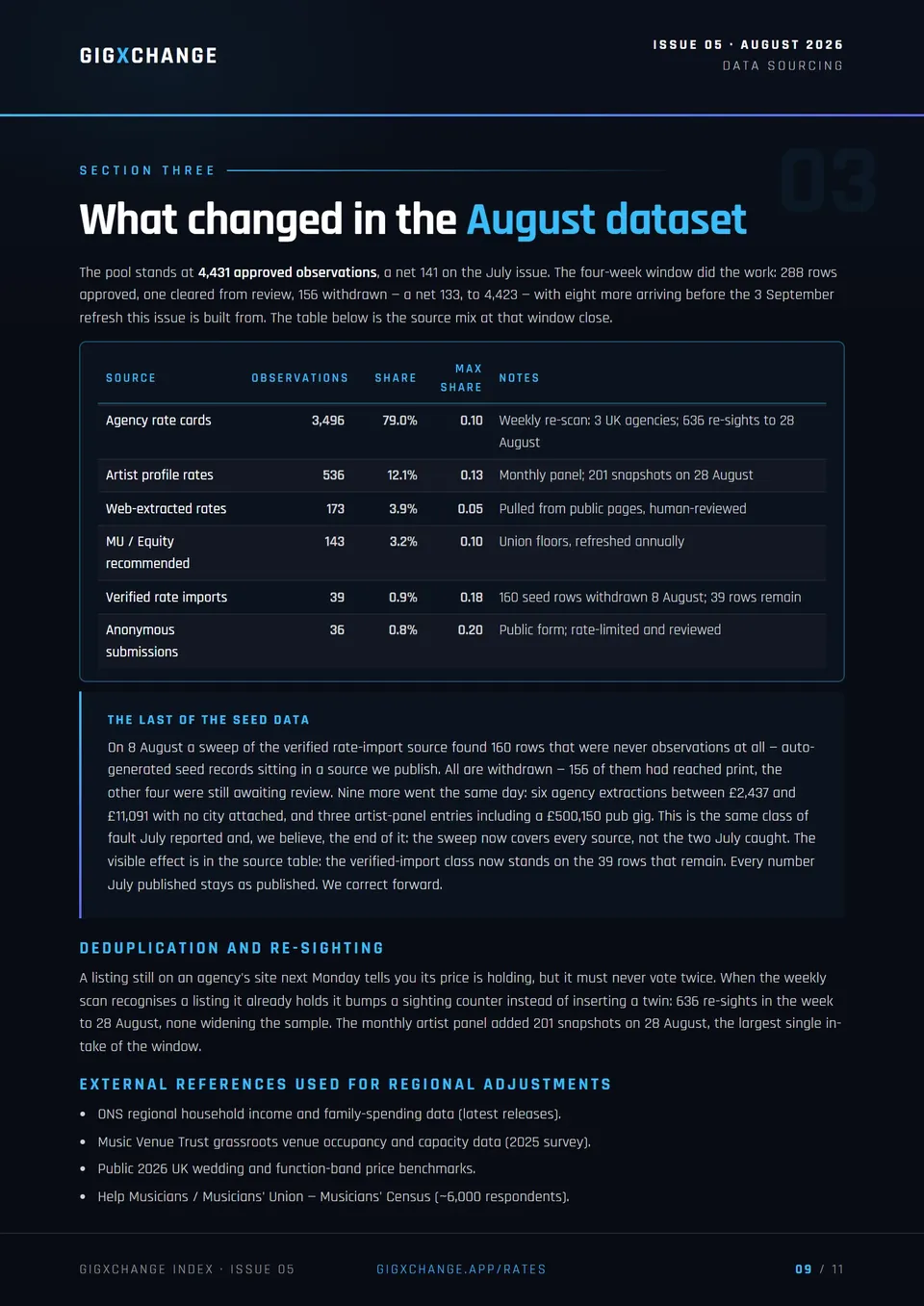
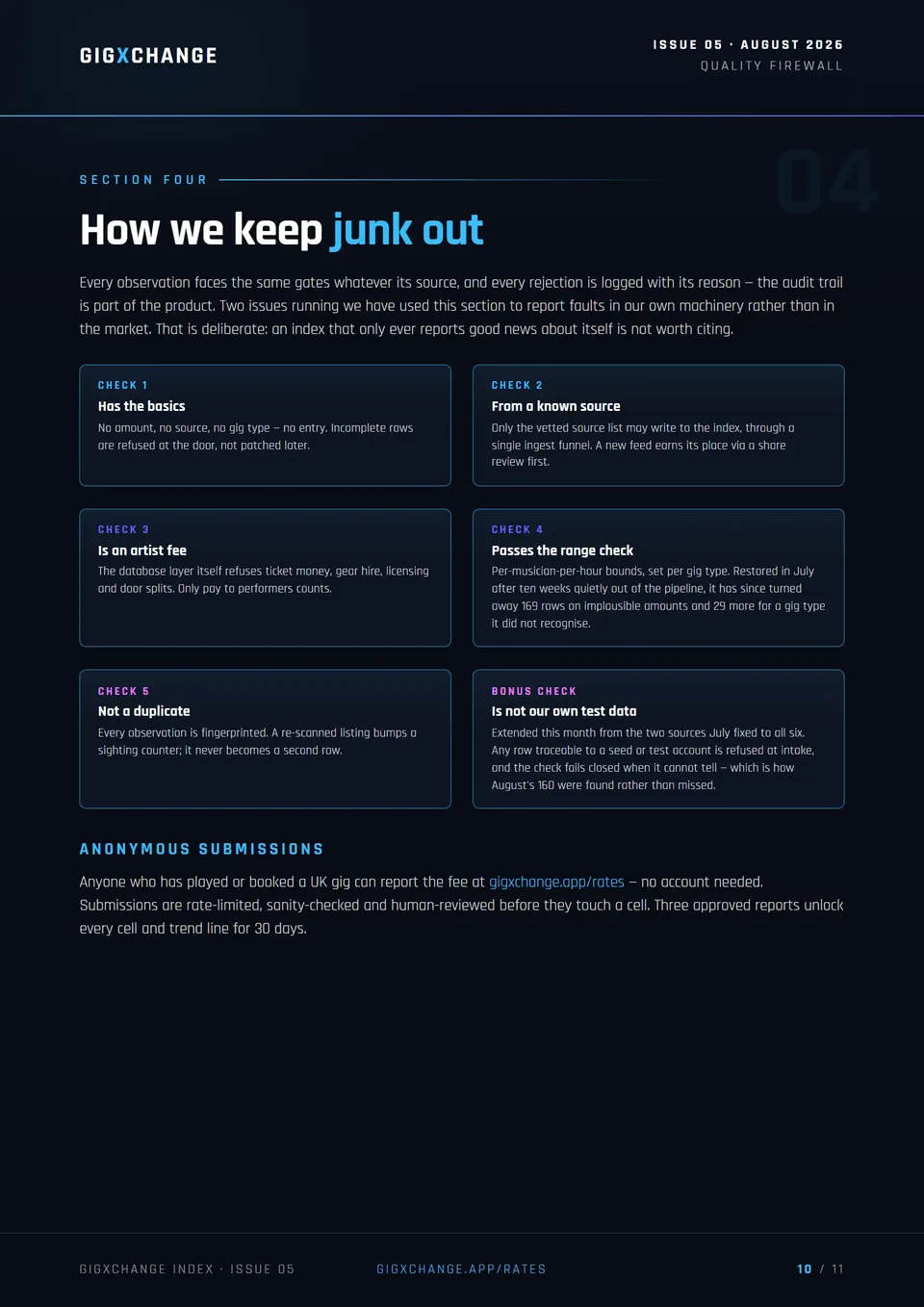
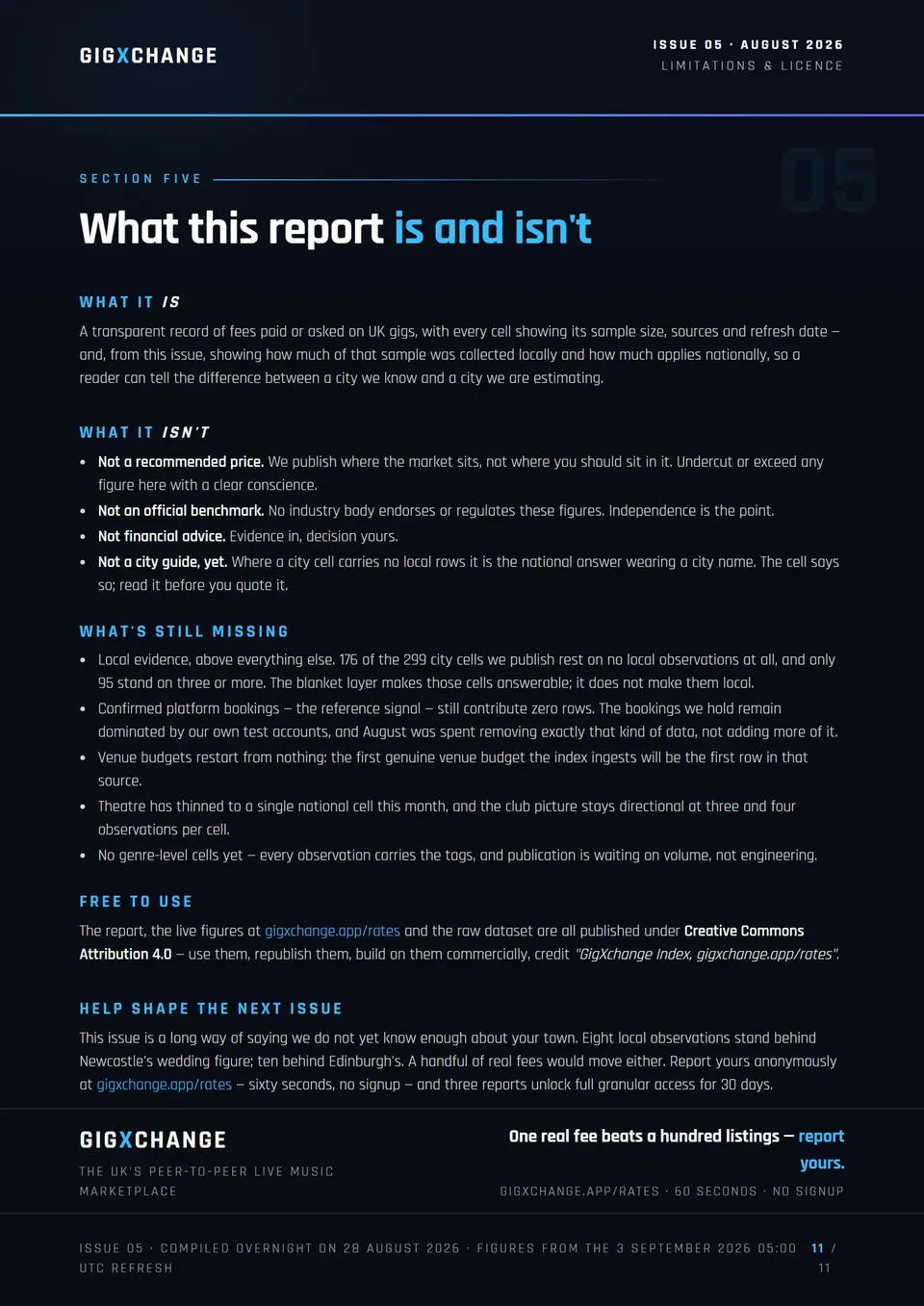
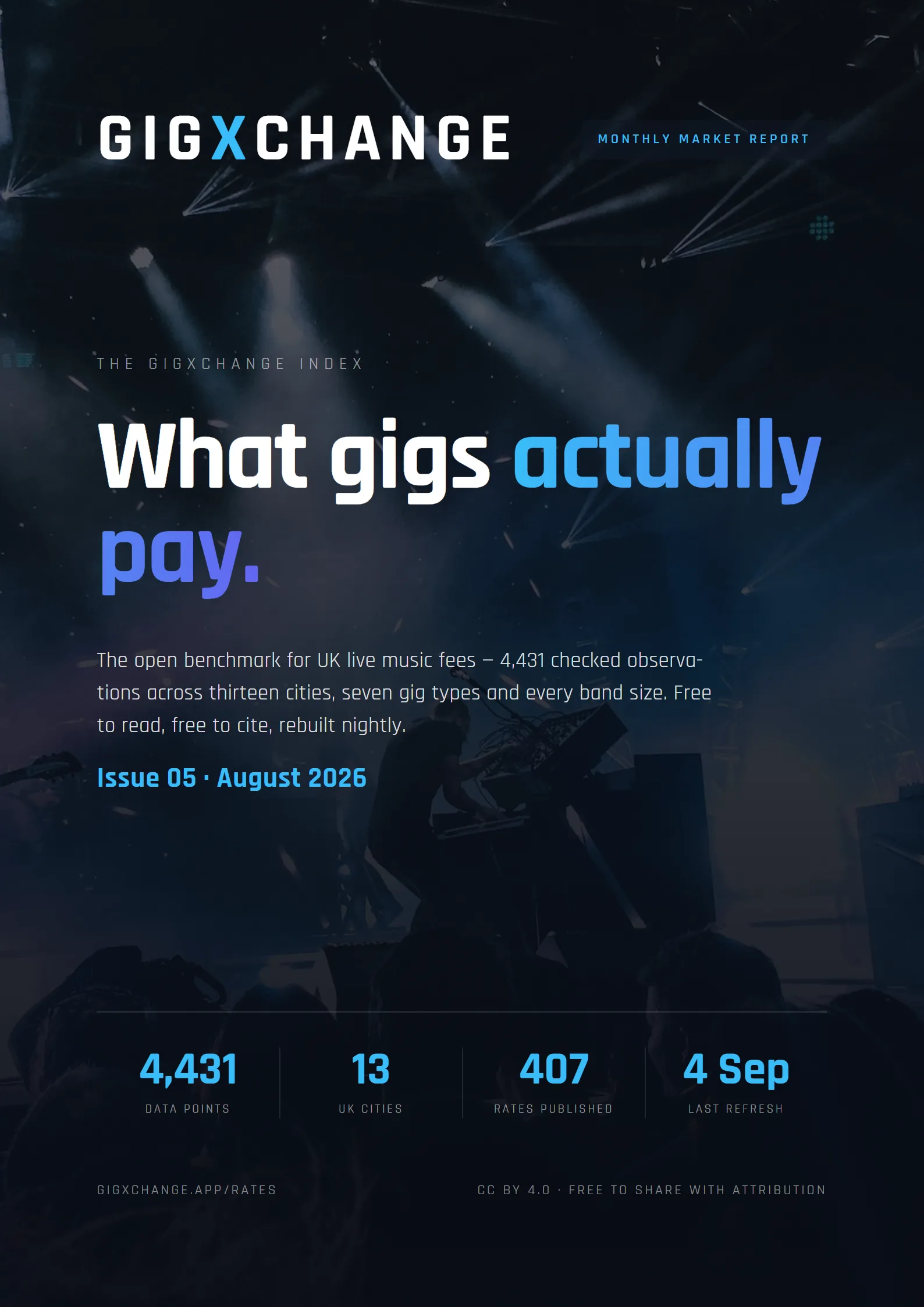
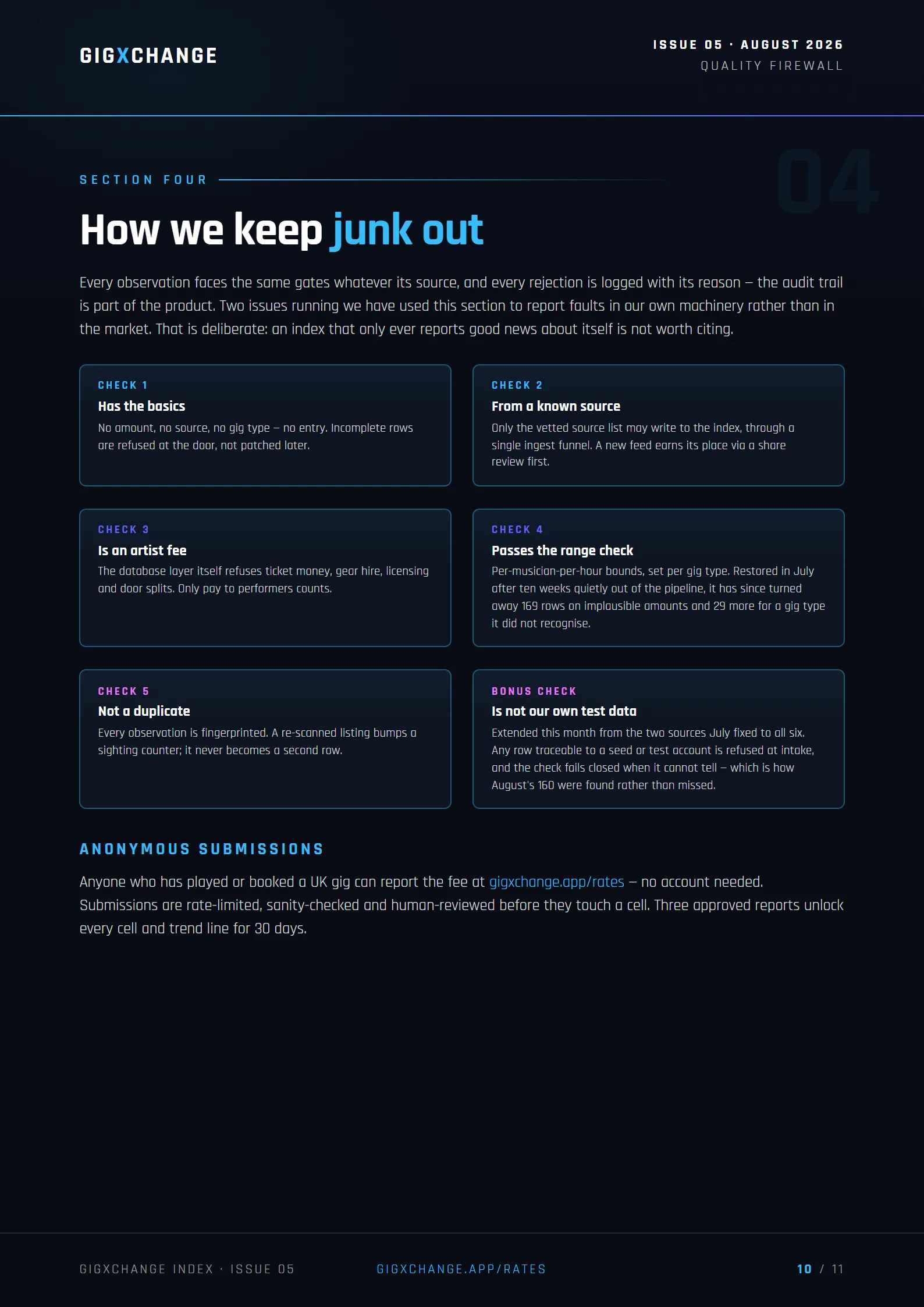
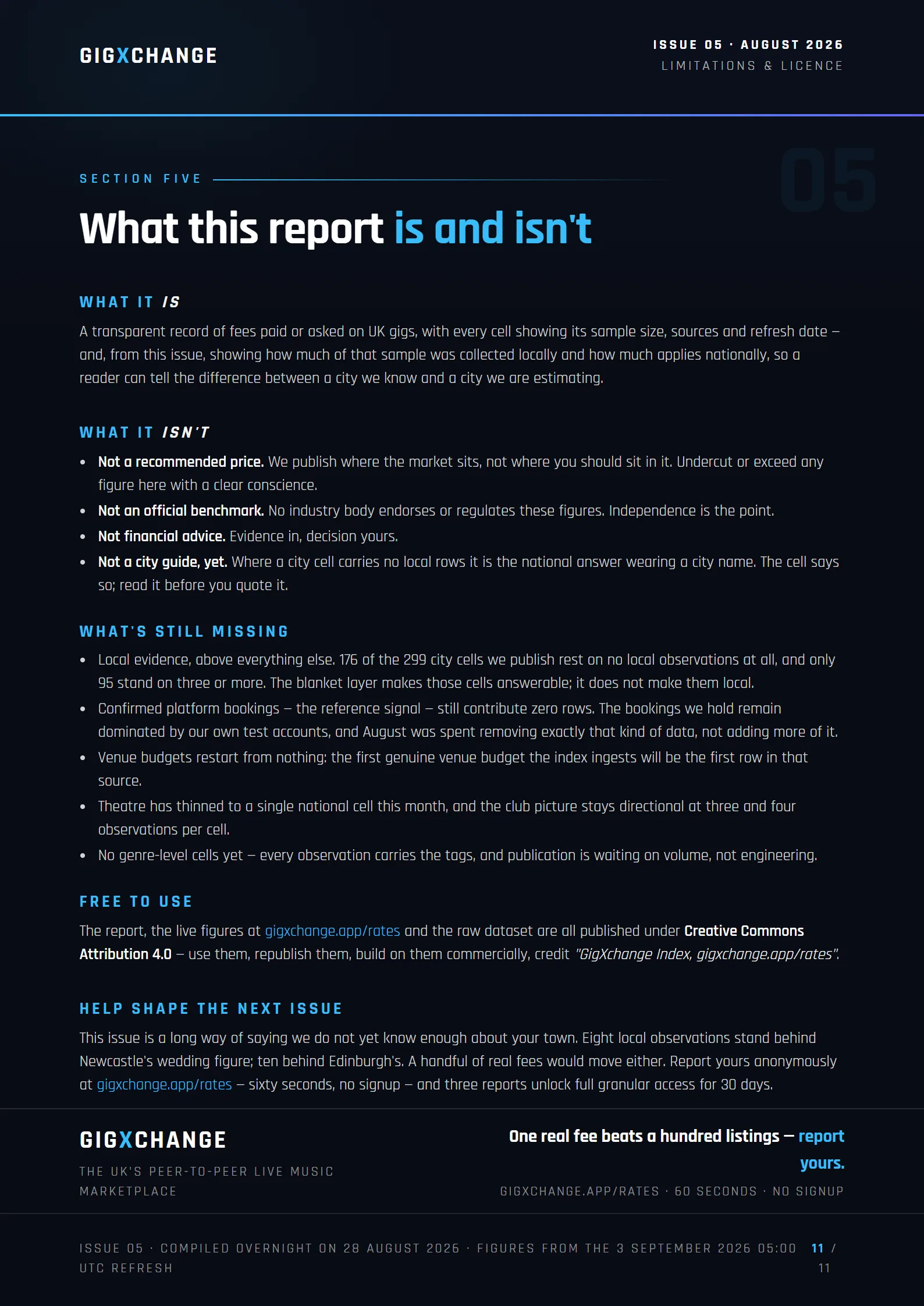
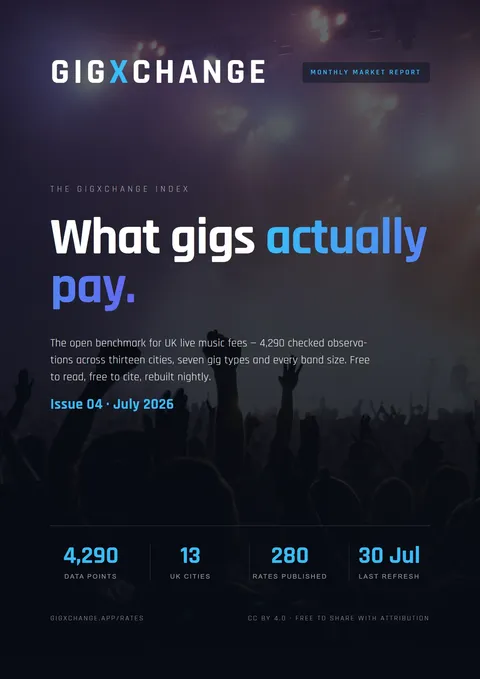
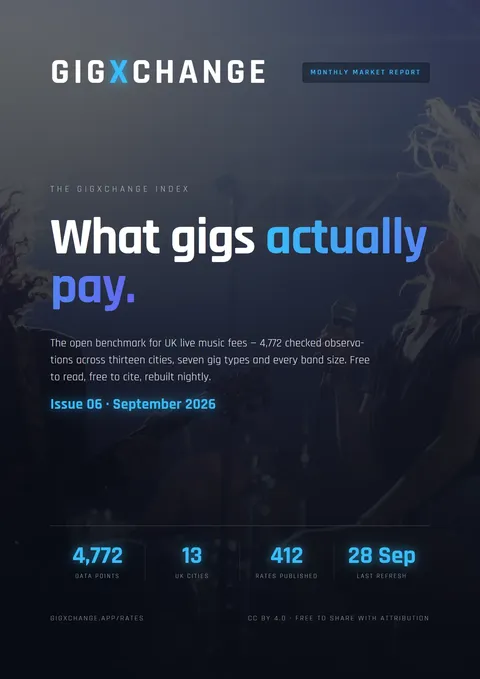
The GigXchange Index · Issue 05
What gigs actually pay across the UK this month — by city, gig type and band size.
Last updated: 3 September 2026
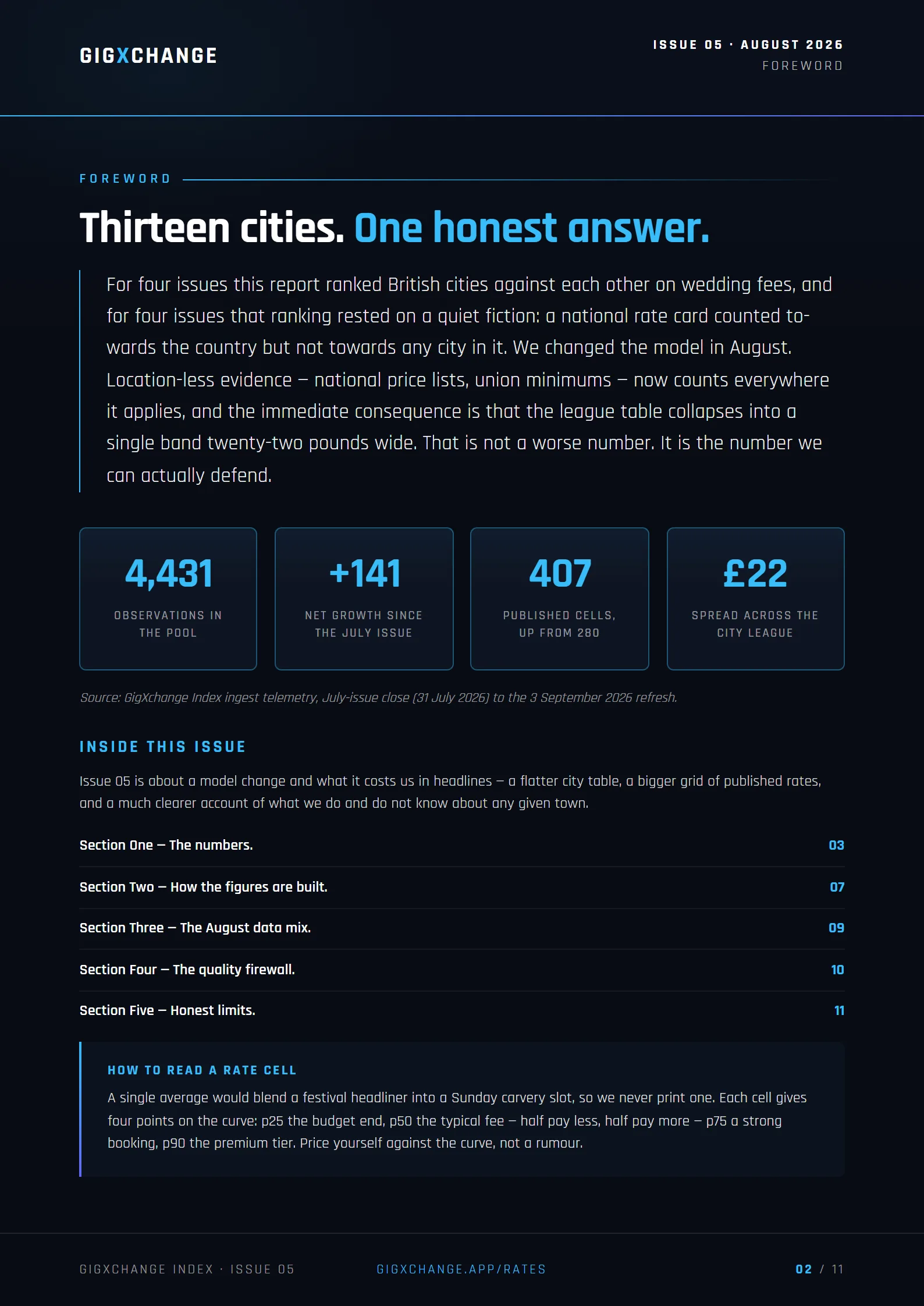
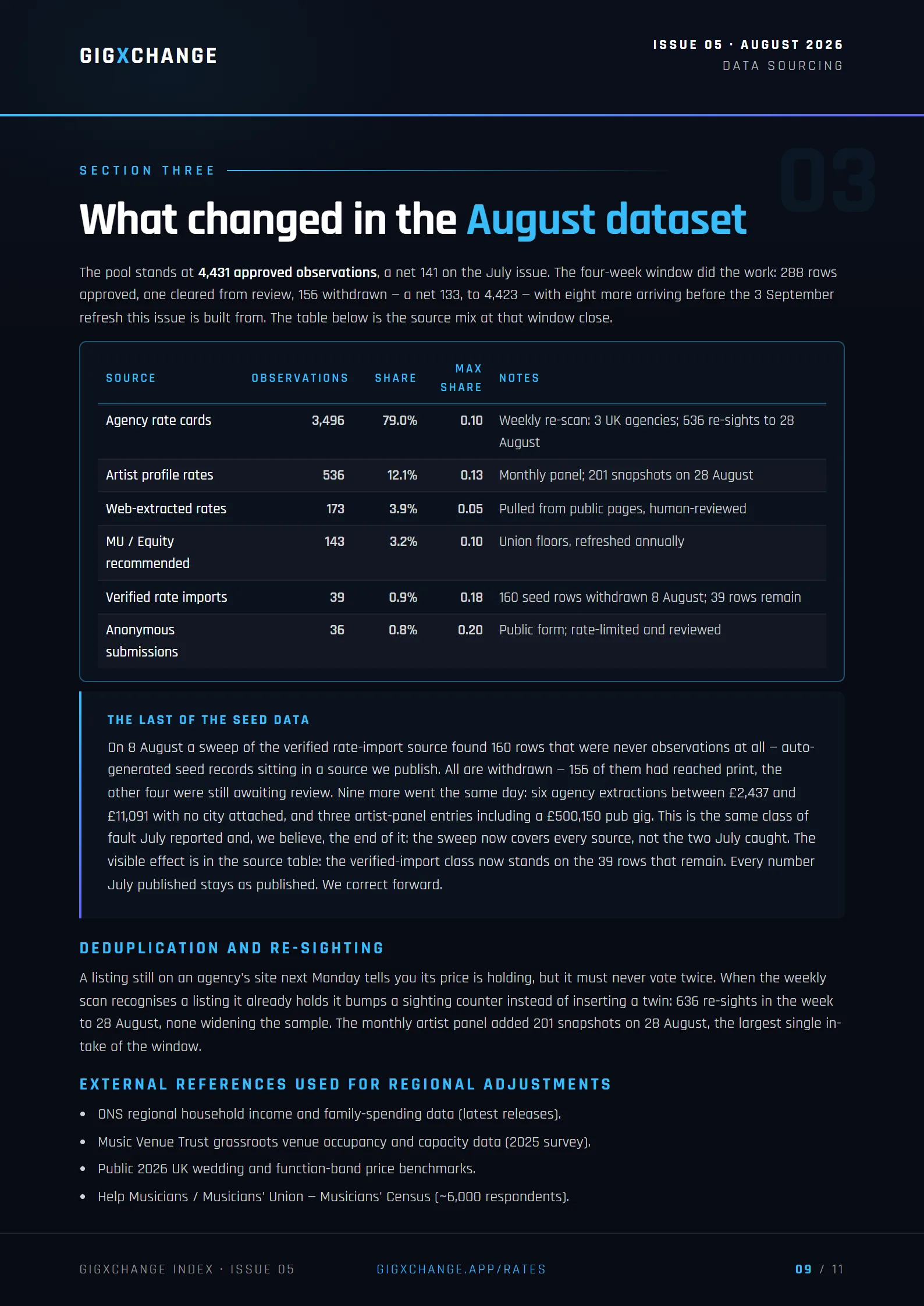
4,431 weighted observations — nine sources, quality-firewalled, rebuilt nightly. Where these numbers come from — the pipeline in plain English
4,431 weighted observations in this issue
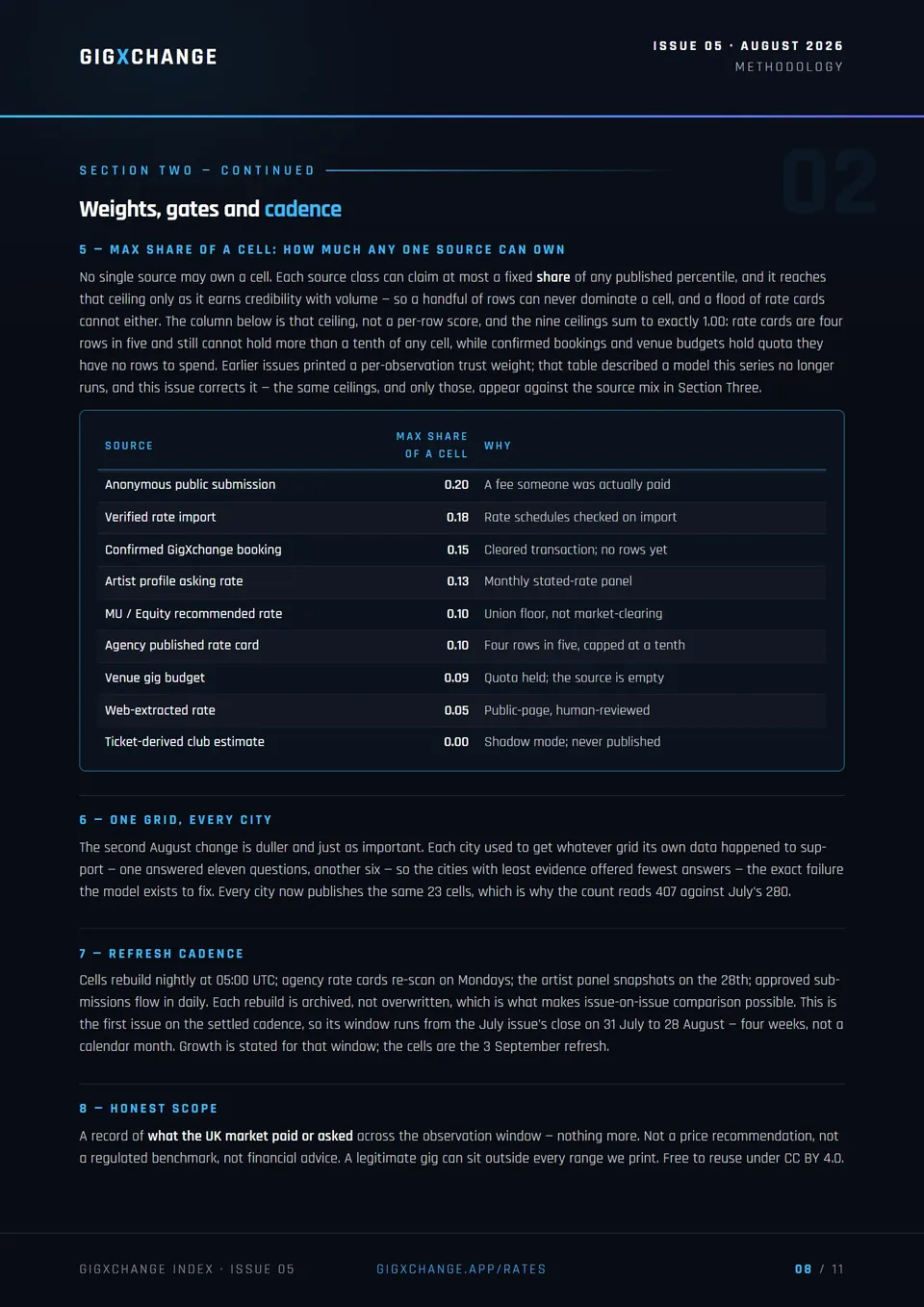
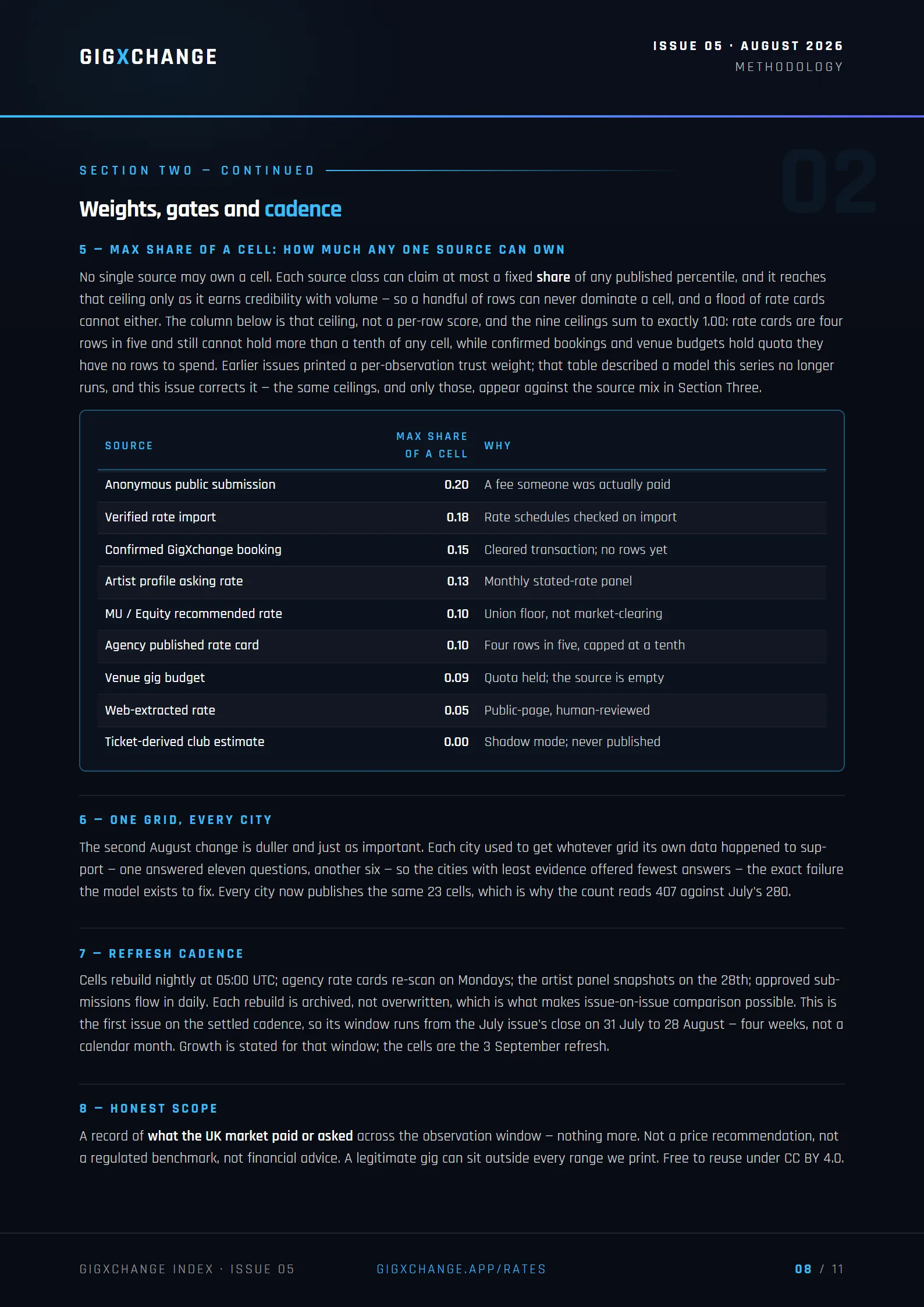
Nine source classes, each with a published ceiling on how much of a cell it can own
The ceilings sum to 1.00 — no single source can carry a figure on its own
A quality firewall before any row can land — a re-sighted listing never counts twice
A regional layer fills thin cells; real data always wins
Rebuilt nightly at 05:00 UTC, with the whole method published in the open
| Full methodology | |
| UK market statistics | |
| Find out more | |
| Full methodology |
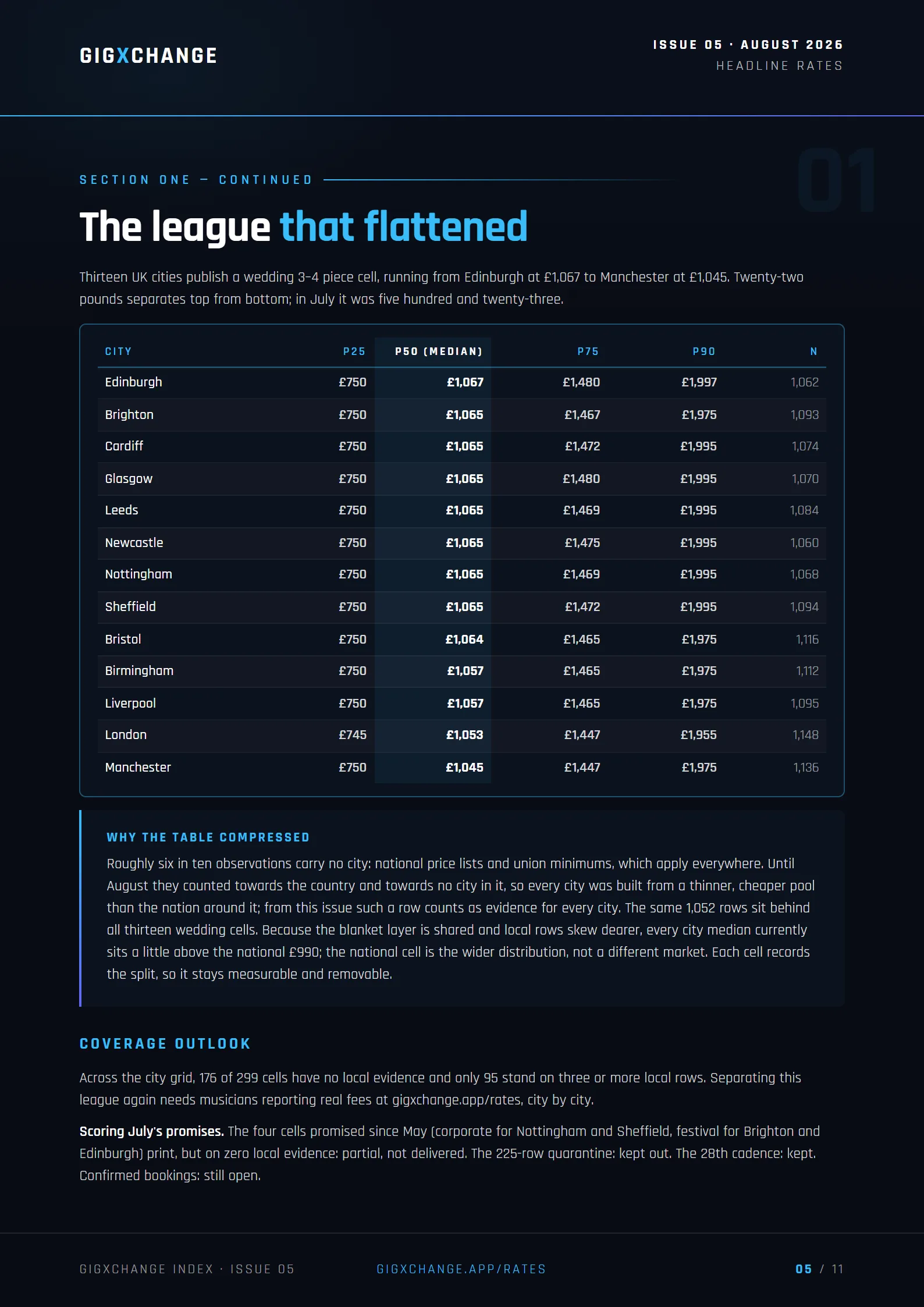
13 UK cities with enough data to publish. Which cities this issue can publish a rate for, and why
13 cities publish the same 23-cell grid
A cell publishes once it clears the sample floor, and every figure carries its n
Thin cells fall back to region, then the UK baseline
Every cell says which level actually answered it
Coverage grows wherever artists and venues sign up
City league tables run right through the report
| All UK cities | |
| Read the report | |
| Find out more | |
| Browse city directories |
407 rate cells published — free to cite, quote and redistribute. How many rate cells published — and how to reuse every one of them
407 rate cells published this issue
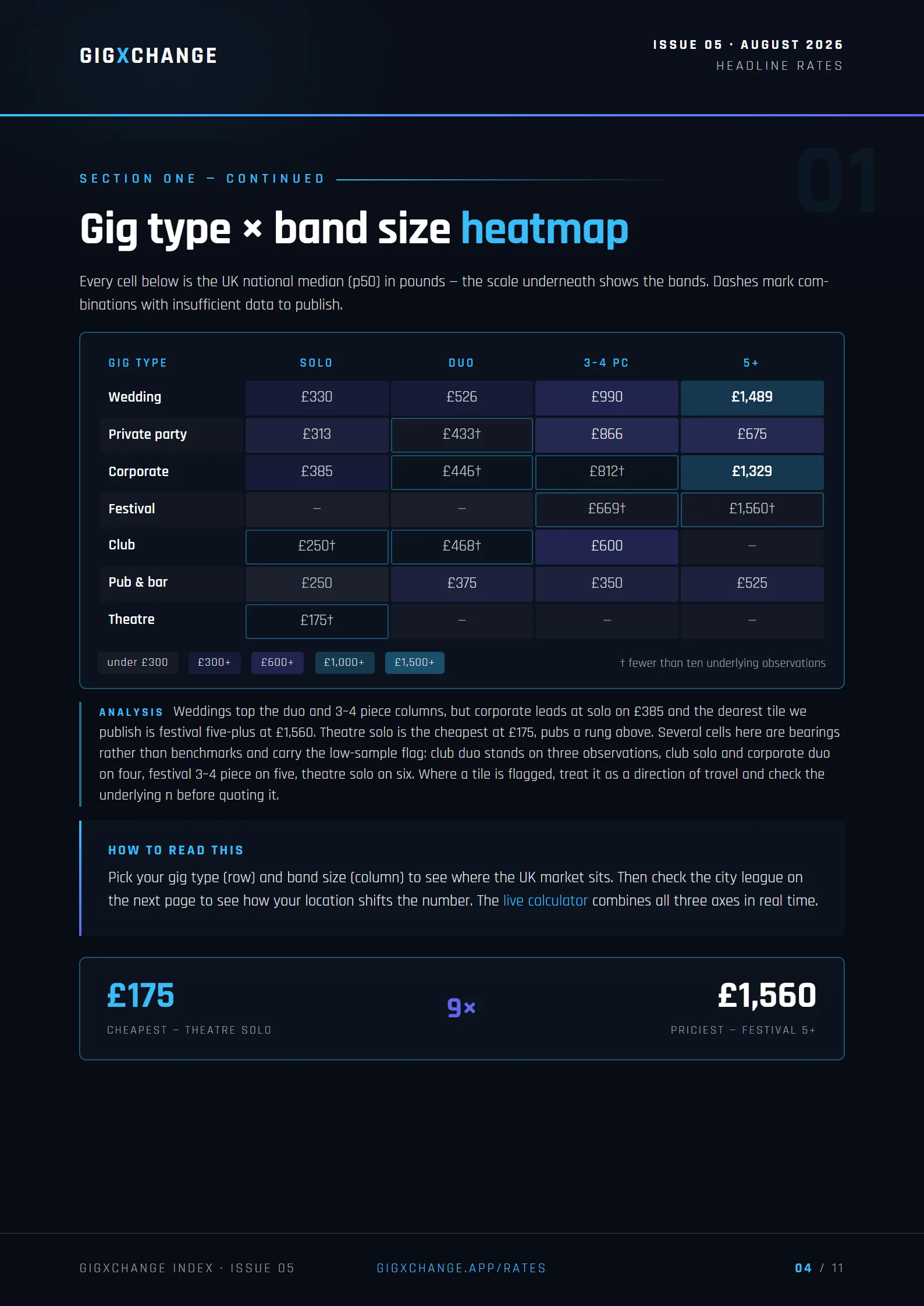
Each cell is one place × gig type × band size
Four percentiles per cell — p25/p50/p75/p90, never an average
All artist take-home, agency commission normalised out
Raw CSV behind every figure, DOI-registered on Zenodo, mirrored on Hugging Face and Kaggle
CC BY 4.0 — cite it, quote it, redistribute it, even commercially
| Download CSV | |
| Zenodo DOI | |
| Hugging Face | |
| Find out more | |
| Use the calculator |
August 2026 — free, 11 pages, CC BY 4.0. Read the August 2026 issue in-browser, or take the PDF away
11 pages — city league tables, methodology notes and honest limits
Built from 4,431 weighted observations across 13 UK cities
Read in-browser, page by page, or download the PDF
A fresh issue in the third week of every month
Every back issue kept online and citable — plus the annual Yearbook and earnings specials
Free to read, free to cite, no signup, no paywall
| Read the report | |
| All reports | |
| Previous issue | |
| Next issue | |
| Find out more | |
| Download PDF |
The figure that defines this issue. The headline medians from this issue, and what moved them
Wedding, corporate, pub and city-level medians
Artist take-home — agency commission normalised out
Percentiles p25/p50/p75/p90, never a flat average
Compared issue-on-issue so you can see the trend
Benchmark your own quote against it
Every figure free to cite under CC BY 4.0
| Key figures | |
| Issue FAQ | |
| Find out more | |
| Use the calculator |

What gigs actually pay across the UK this month — by city, gig type and band size.
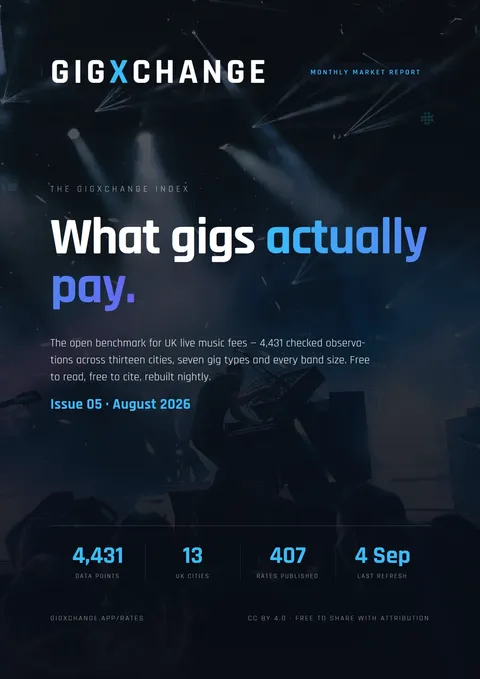
Last updated: 3 September 2026
Flip through all 11 pages below, or download the PDF.
Flip through all 11 pages below, or download the PDF.
GigXchange (2026). GigXchange Index — August 2026. Issue 05. Available at: gigxchange.app/rates/reports/august-2026. Licensed under CC BY 4.0.
Cite this report
GigXchange (2026). GigXchange Index — August 2026. Issue 05. Available at: gigxchange.app/rates/reports/august-2026. Licensed under CC BY 4.0.
DOI 10.5281/zenodo.22389294 · PDF · CSV · Hugging Face · Kaggle
A free, monthly benchmark built from 4,431 real data points across 13 UK cities — for bands pricing gigs, venues setting budgets, agents benchmarking rate cards, and couples sanity-checking wedding quotes.
| AudienceWho reads this issuePerformers deciding what to quote for a function. Venues and promoters building an entertainment budget that will actually be accepted. Agents sense-checking a rate card. Couples and event planners weighing a quote. Reporters and researchers who need a UK live-music figure they can footnote. |
| CoverageWhat August coversSeven gig types — wedding, private party, corporate, festival, ticketed club, theatre/pit and pub & bar — across thirteen UK cities and four band sizes, at 407 published cells. Every cell prints four percentiles, never a single average. |
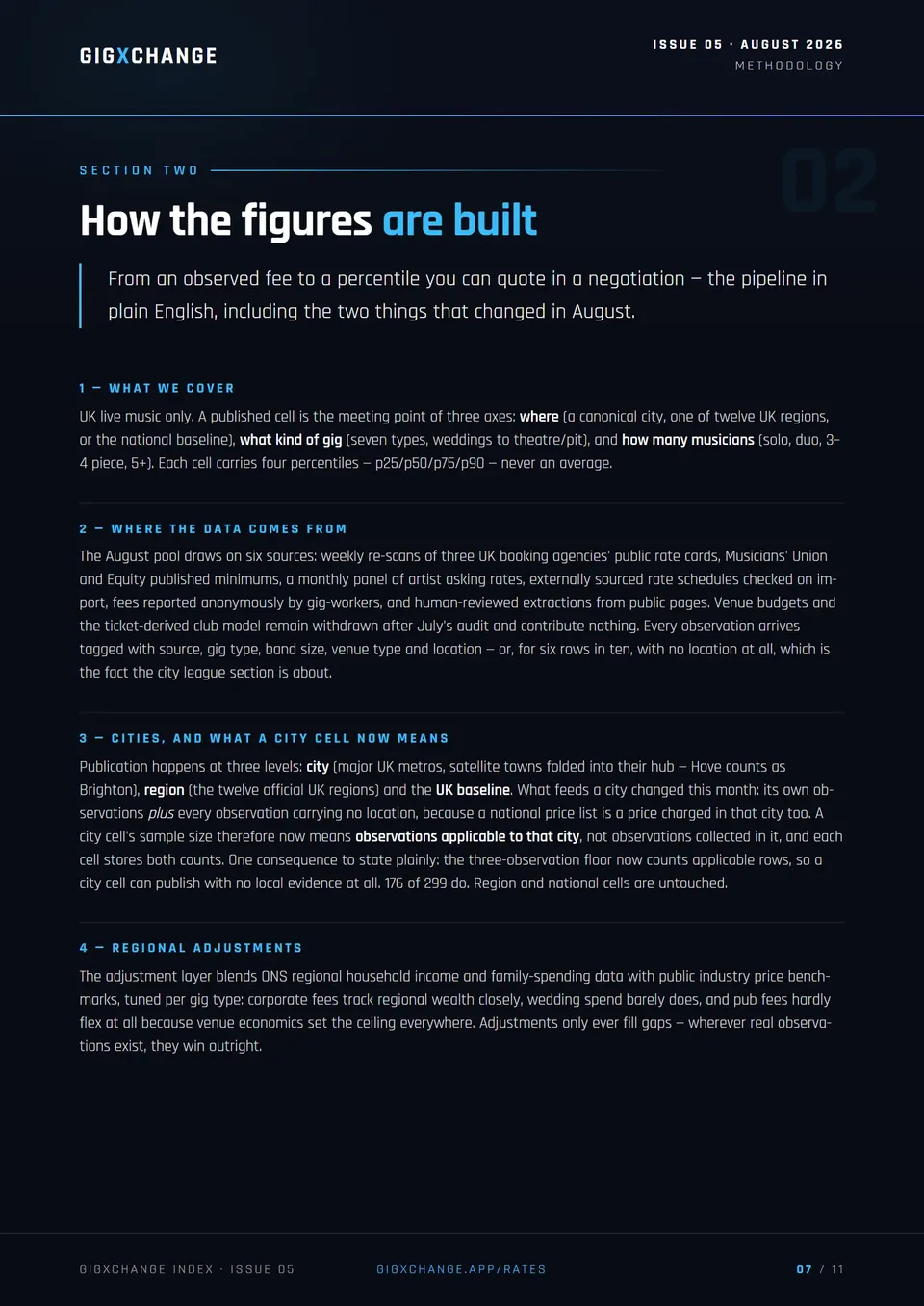
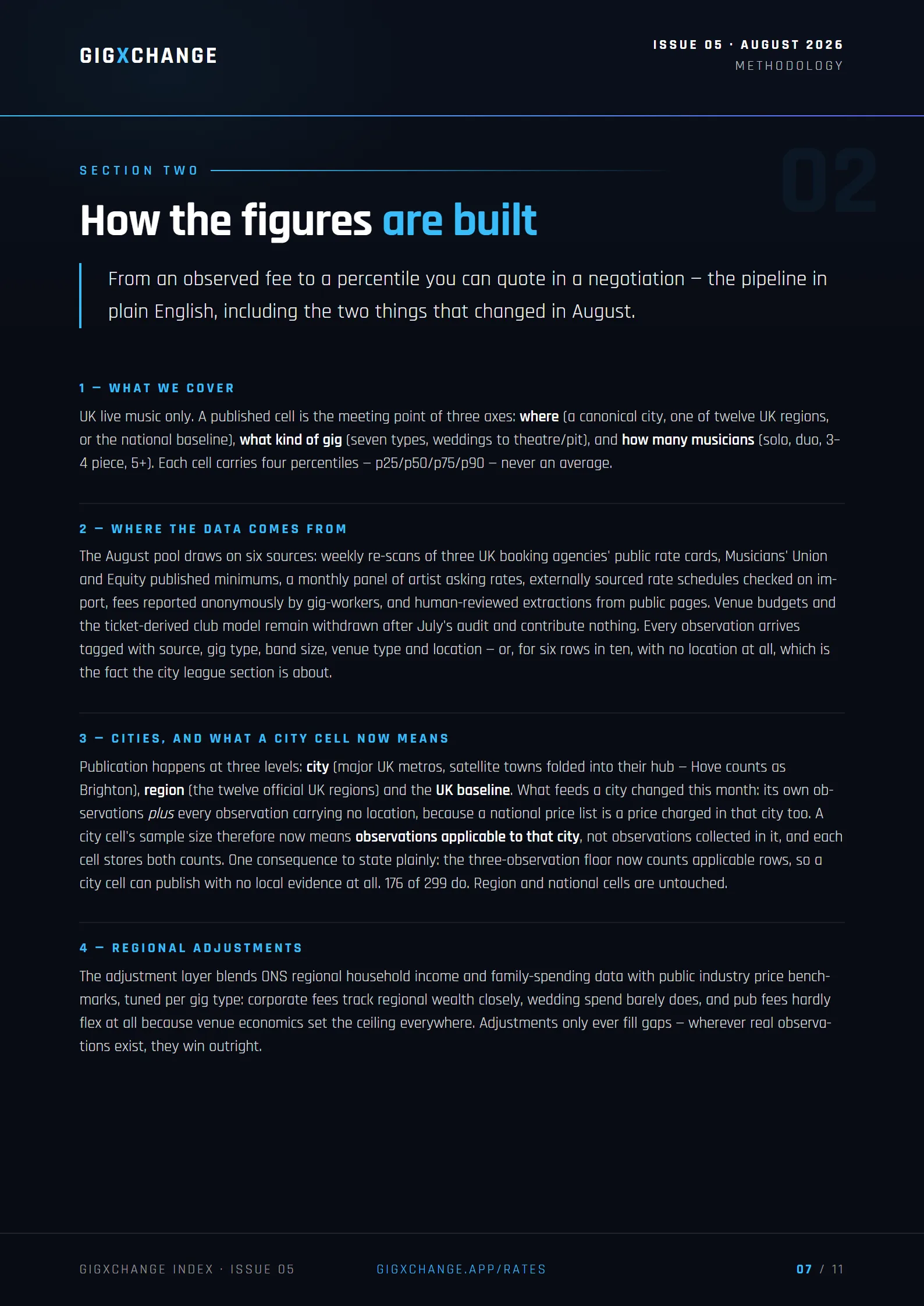
| MethodologyWhat changed this monthTwo model changes, both announced in print. Evidence carrying no location — national price lists and union minimums, roughly six rows in ten — now counts towards every city rather than towards none of them, and every city publishes the same grid. Each cell still records how much of its sample was collected locally, so the national layer stays visible and removable. Full detail in the methodology. |
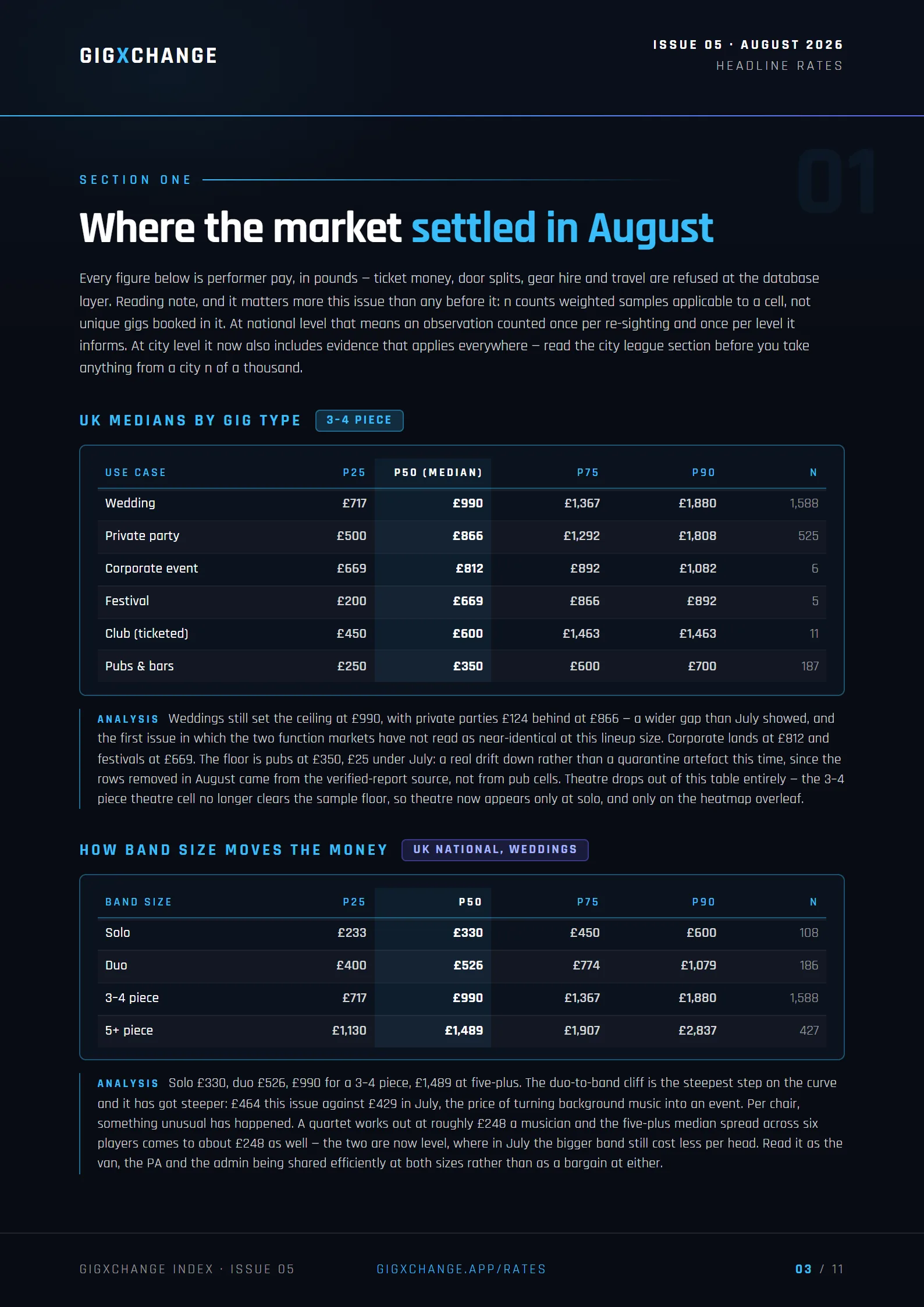
The headline numbers from the August 2026 issue — wedding, corporate, pub and city-level medians drawn from 4,431 weighted observations.
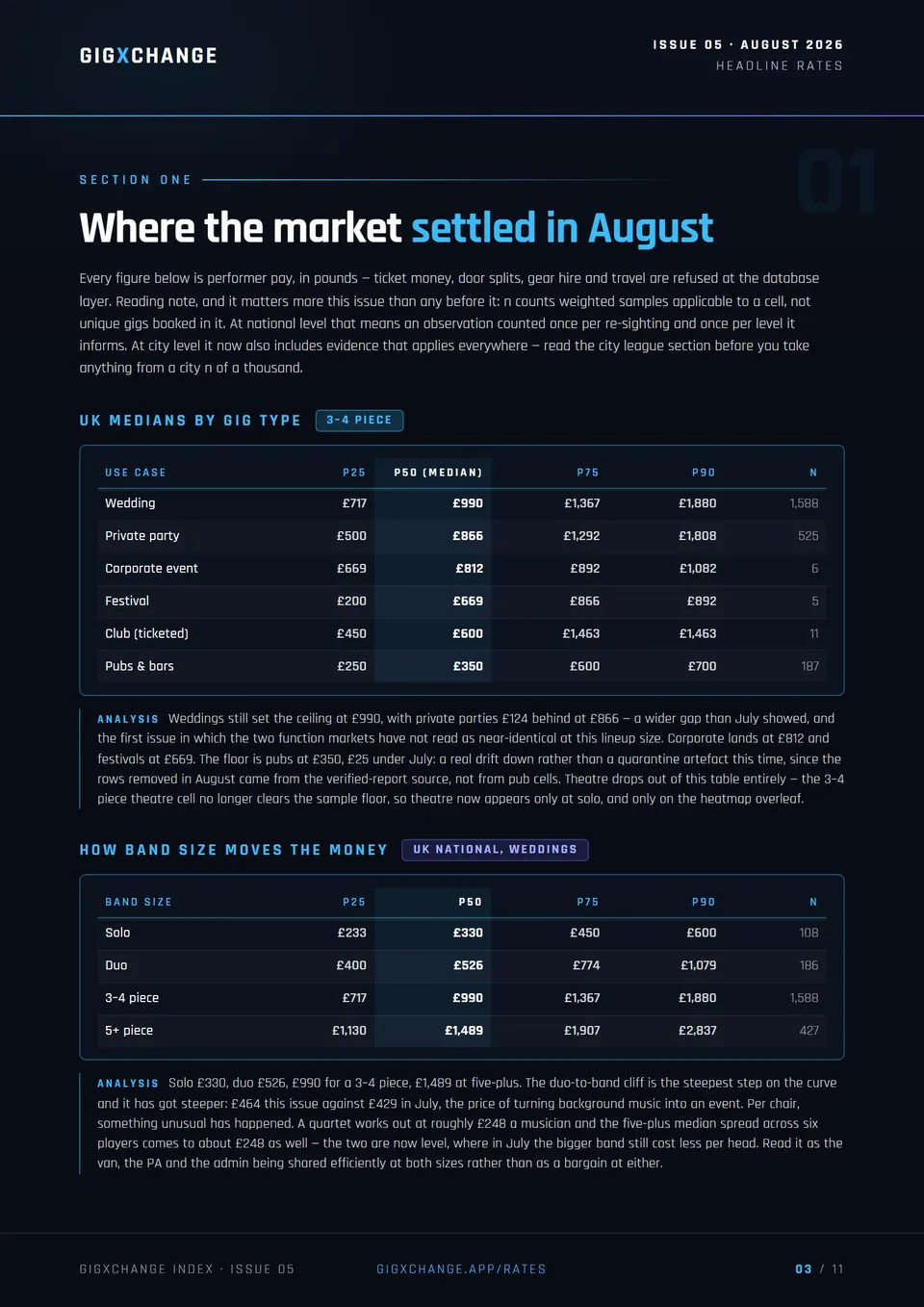
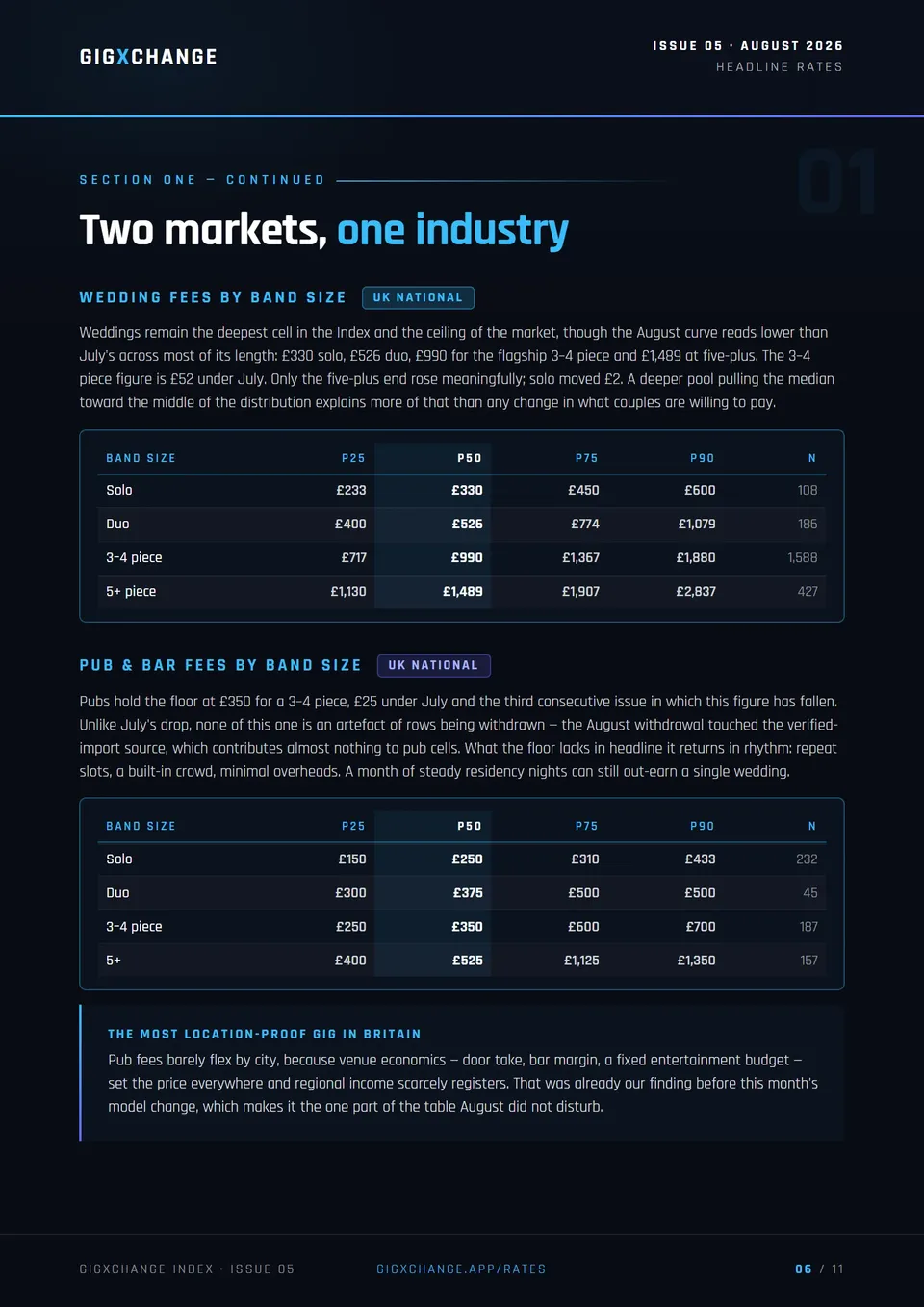
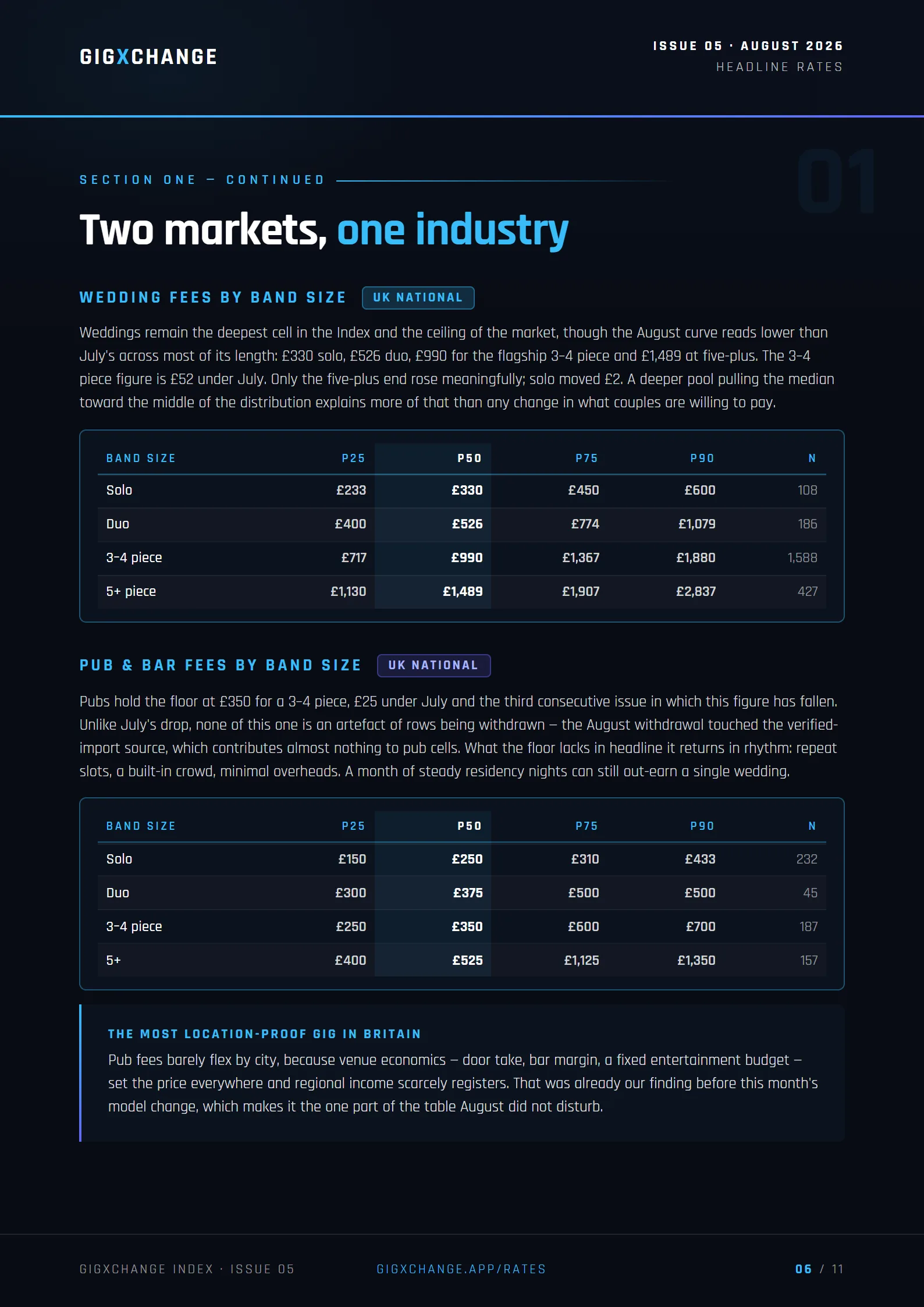
| Wedding band fees, UK nationalA 3–4 piece wedding band typically takes £990 in August 2026, £52 below July. The middle half of bookings land between £717 and £1,367, with the premium tier at £1,880. | |
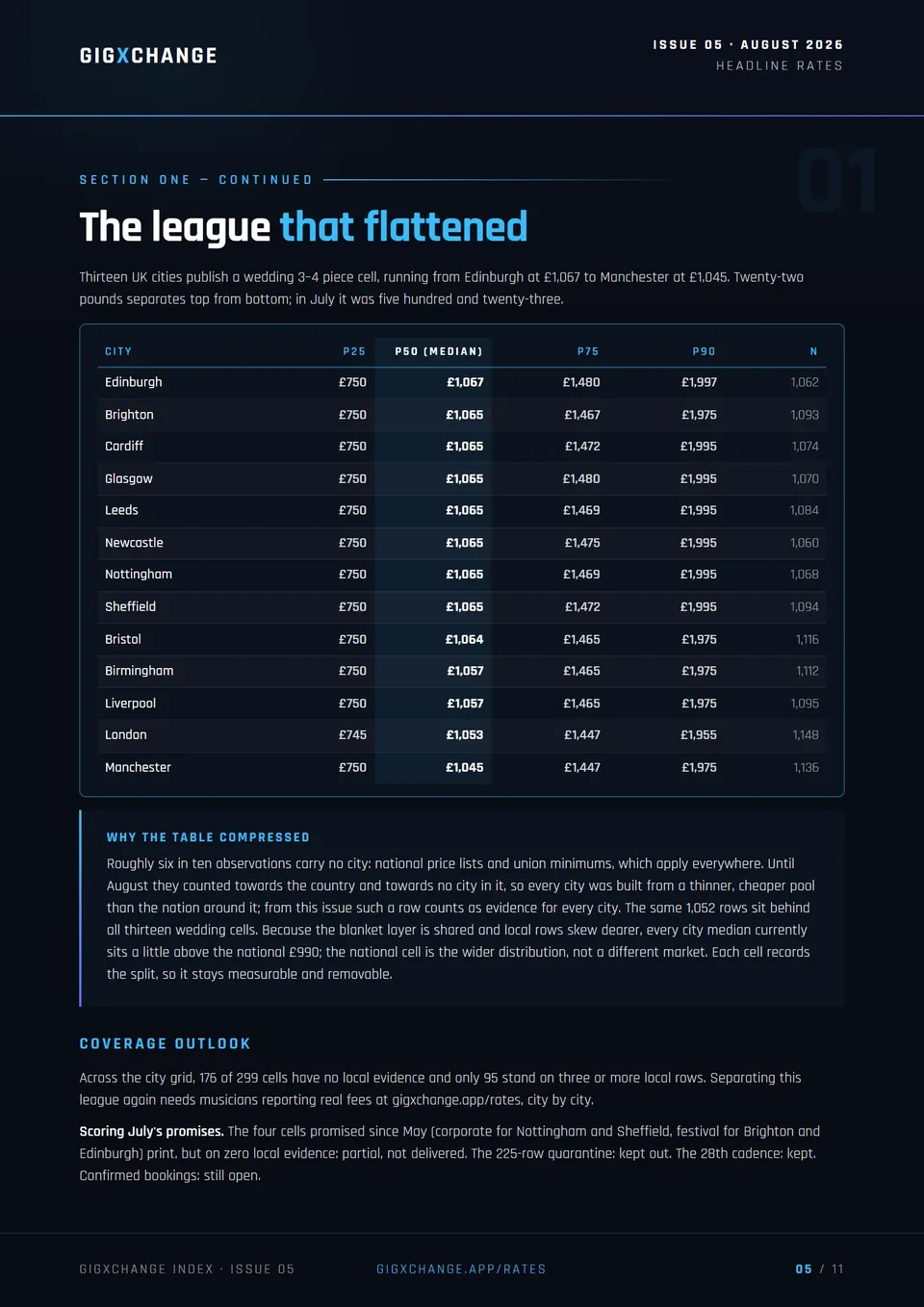
| The league that flattenedThirteen cities now run from Edinburgh at £1,067 to Manchester at £1,045 — a spread of £22 where July showed £523. Nothing moved in the market; the model changed underneath it. | |
| 407 cells, one grid for every cityPublished rate cells rise to 407 from July’s 280, because every city now answers the same 23 questions instead of only the ones its own data could reach. That is a coverage decision, not a surge in evidence. | |
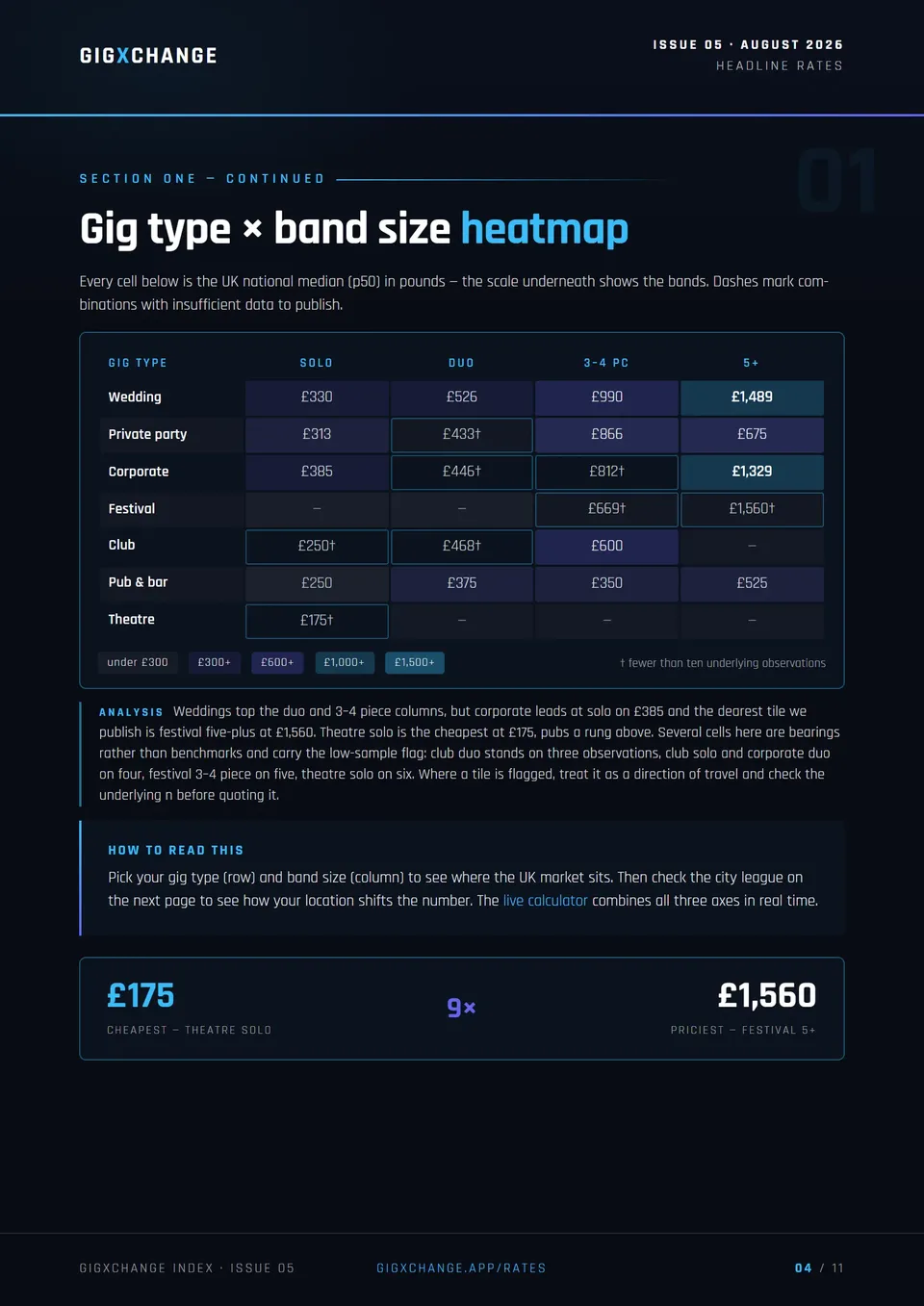
| Pub & bar gigs hold the floorA 3–4 piece pub gig pays £350, most between £250 and £600 — £25 under July. Solo pub work sits at £250, a duo at £375 and a five-plus lineup at £525. | |
| Function work below the wedding linePrivate parties pay £866 for a 3–4 piece and corporate £812, putting them £124 and £178 behind weddings. The two function markets have stopped reading as interchangeable at this lineup size. | |
| What band size is worthThe wedding curve runs £330 solo, £526 duo, £990 for a 3–4 piece and £1,489 at five-plus. Per player a quartet and a six-piece both work out near £248. Compare rates on artist profiles. |
| GX Index — July 2026Previous issue · 11 pages · PDF | |
| GX Index — September 2026Next issue · 11 pages · PDF | |
| State of the Circuit 20266 Aug 2026 · Annual · 11 pages · PDF | |
| GIGXCHANGE Index — June 20264 Jul 2026 · Index · 11 pages · PDF | |
| GIGXCHANGE Index — May 202620 May 2026 · Index · 11 pages · PDF | |
| UK Musician Earnings 202623 Apr 2026 · Special · 11 pages · PDF | |
| GIGXCHANGE Index — April 202620 Apr 2026 · Index · 11 pages · PDF | |
| UK Live Music Yearbook 202615 Mar 2026 · Annual · 12 pages · PDF | |
| Browse all reports & datasets |
Benchmark your fee against the live UK rate index, refreshed nightly.
| Live rate calculator |
Add your real gig fees to the UK Gig Pay Survey — anonymous, ~60 seconds, and every entry sharpens the next GX Index.
| Take the survey |
| UK market statistics | |
| Gig directory |
Every gig you've done is a data point we need. Submit three rates anonymously and you unlock every figure for 30 days.
A free, monthly benchmark built from 4,431 real data points across 13 UK cities — for bands pricing gigs, venues setting budgets, agents benchmarking rate cards, and couples sanity-checking wedding quotes.
Performers deciding what to quote for a function. Venues and promoters building an entertainment budget that will actually be accepted. Agents sense-checking a rate card. Couples and event planners weighing a quote. Reporters and researchers who need a UK live-music figure they can footnote.
Seven gig types — wedding, private party, corporate, festival, ticketed club, theatre/pit and pub & bar — across thirteen UK cities and four band sizes, at 407 published cells. Every cell prints four percentiles, never a single average.
Two model changes, both announced in print. Evidence carrying no location — national price lists and union minimums, roughly six rows in ten — now counts towards every city rather than towards none of them, and every city publishes the same grid. Each cell still records how much of its sample was collected locally, so the national layer stays visible and removable. Full detail in the methodology.
The headline numbers from the August 2026 issue — wedding, corporate, pub and city-level medians drawn from 4,431 weighted observations.
A 3–4 piece wedding band typically takes £990 in August 2026, £52 below July. The middle half of bookings land between £717 and £1,367, with the premium tier at £1,880.
Thirteen cities now run from Edinburgh at £1,067 to Manchester at £1,045 — a spread of £22 where July showed £523. Nothing moved in the market; the model changed underneath it.
Published rate cells rise to 407 from July’s 280, because every city now answers the same 23 questions instead of only the ones its own data could reach. That is a coverage decision, not a surge in evidence.
A 3–4 piece pub gig pays £350, most between £250 and £600 — £25 under July. Solo pub work sits at £250, a duo at £375 and a five-plus lineup at £525.
Private parties pay £866 for a 3–4 piece and corporate £812, putting them £124 and £178 behind weddings. The two function markets have stopped reading as interchangeable at this lineup size.
The wedding curve runs £330 solo, £526 duo, £990 for a 3–4 piece and £1,489 at five-plus. Per player a quartet and a six-piece both work out near £248. Compare rates on artist profiles.
Everything artists, venues and event planners ask about UK gig fees in August 2026 — answered with real data from 4,431 observations across 13 cities.
Help us make the next issue better
Every gig you've done is a data point we need. Submit three rates anonymously and you unlock every figure for 30 days.
Real UK gig-fee data, not guesswork — built from actual bookings. Add yours and it gets sharper for everyone.