


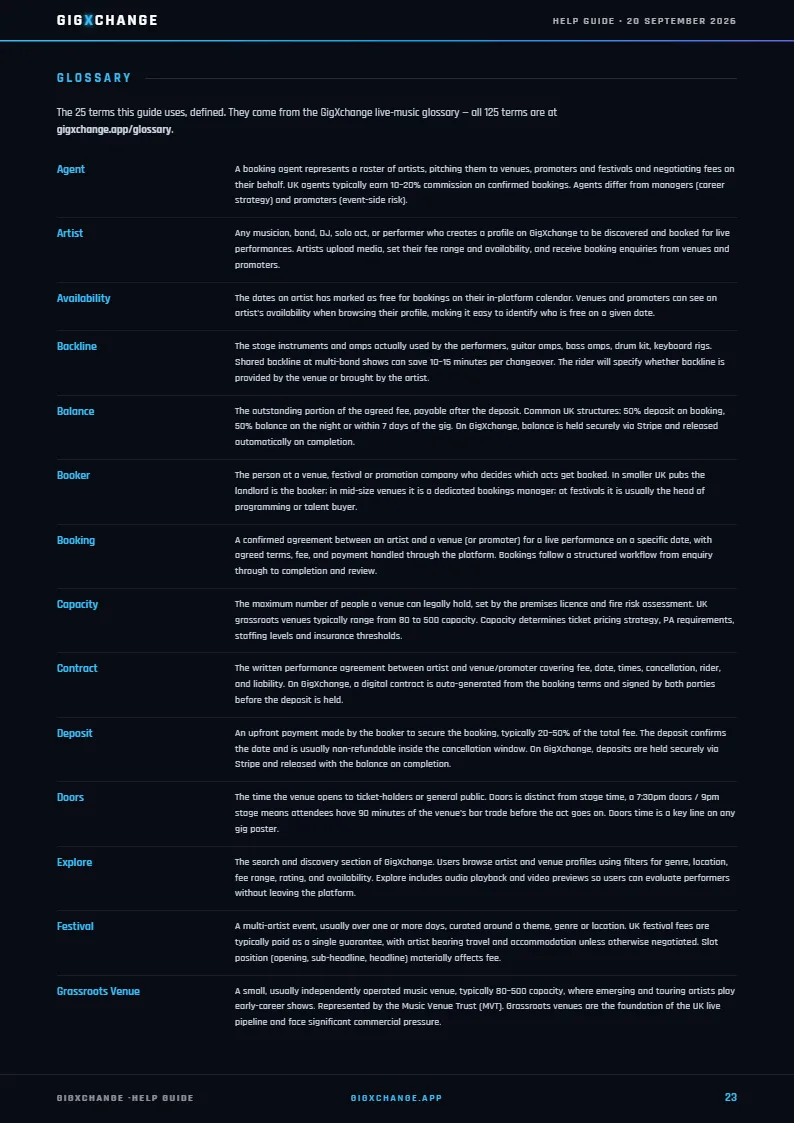
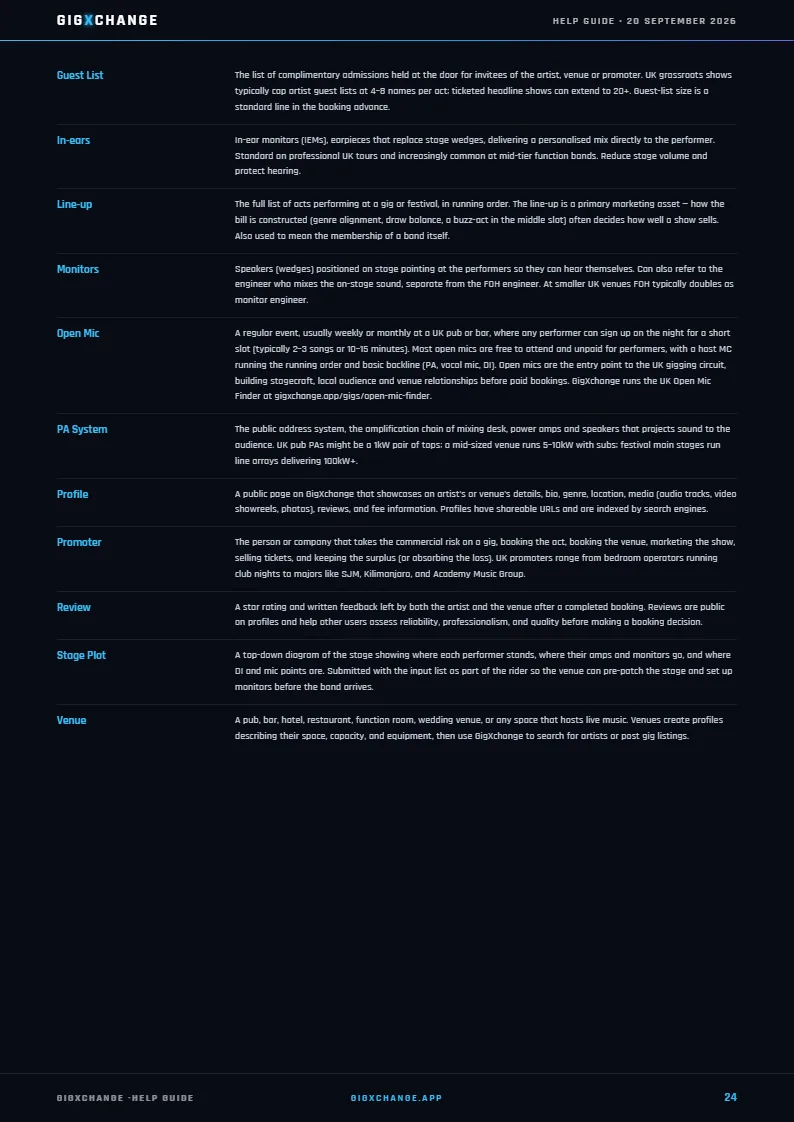
The Whole Guide, In One File
Every answer on this page as one document — a quick start, all 51 answers and a glossary. Flip through all 24 pages below, or download the PDF.
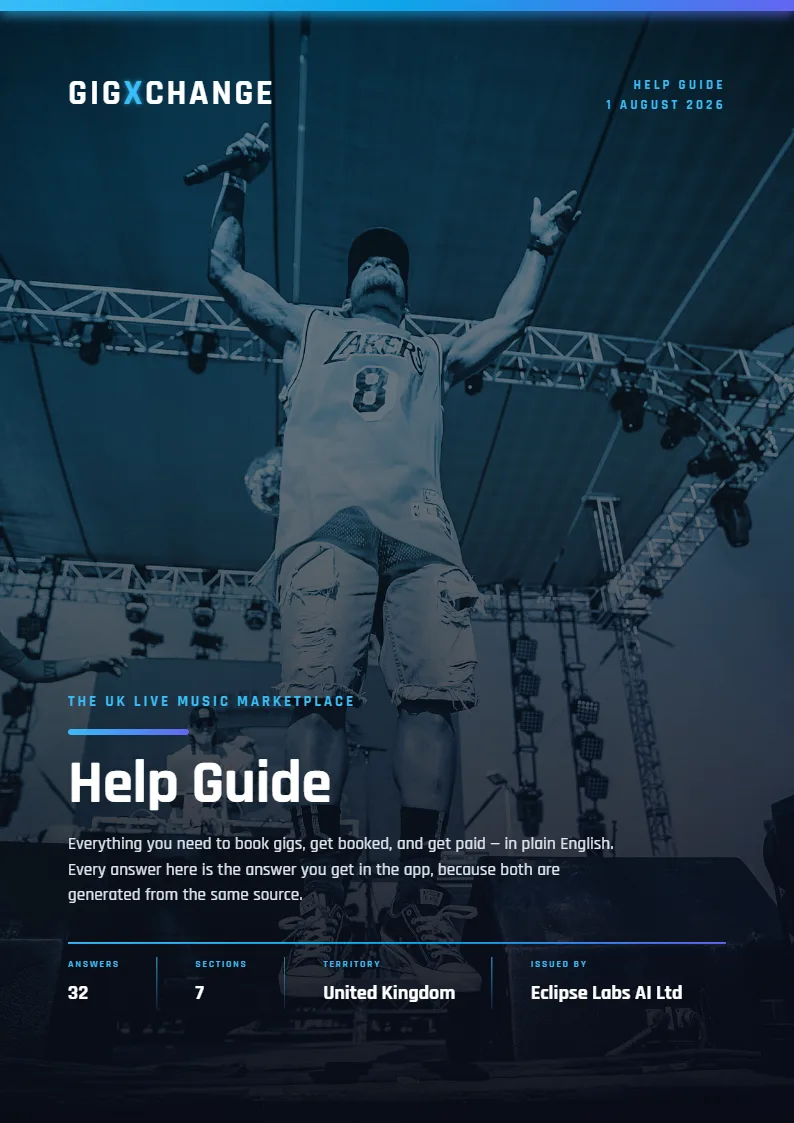
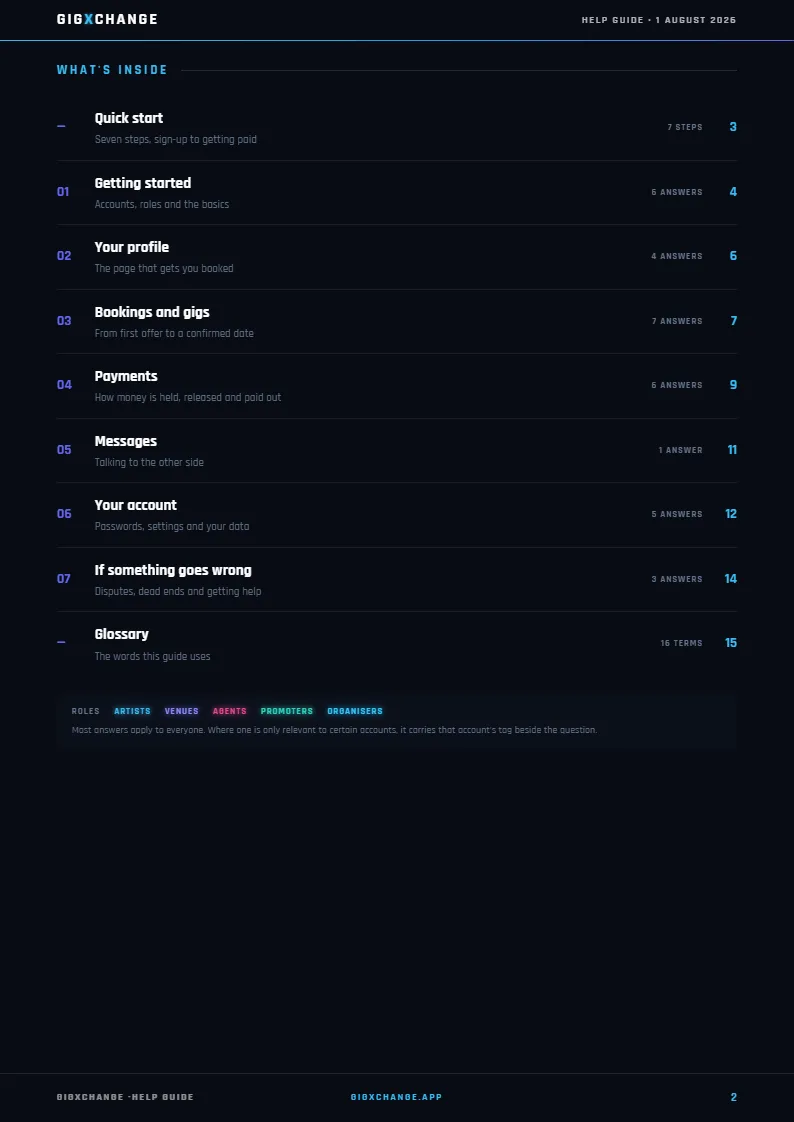
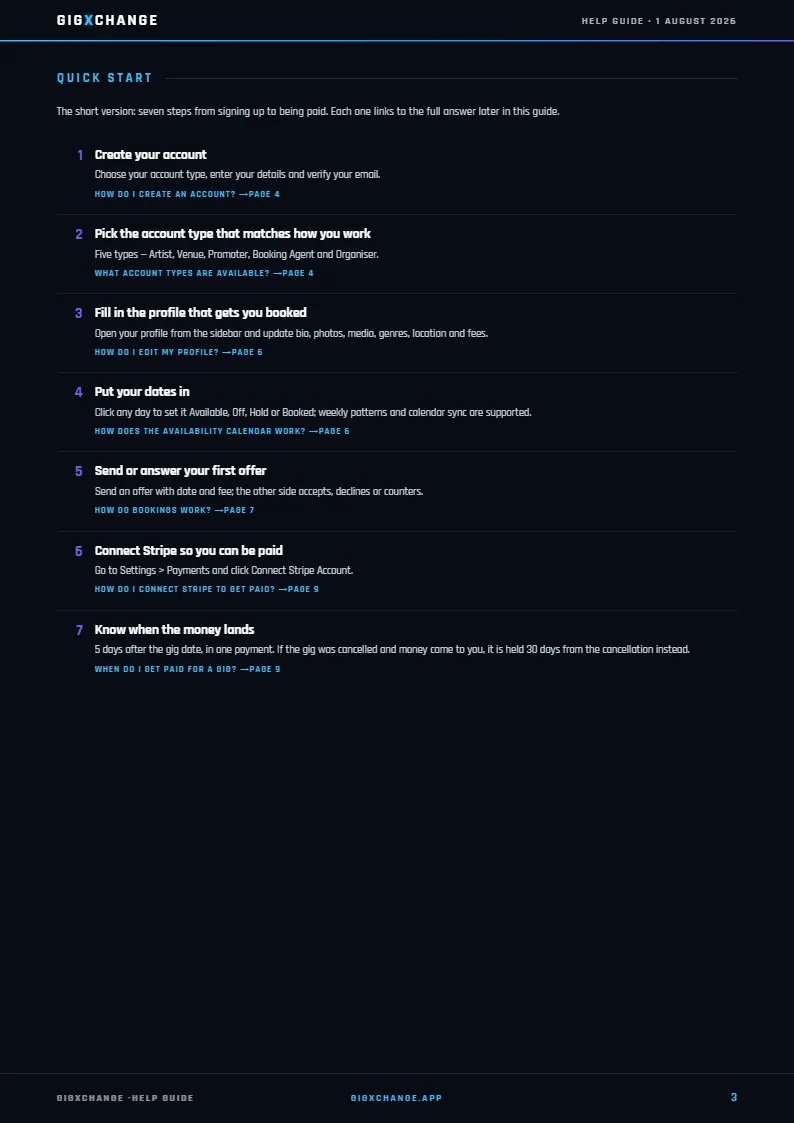
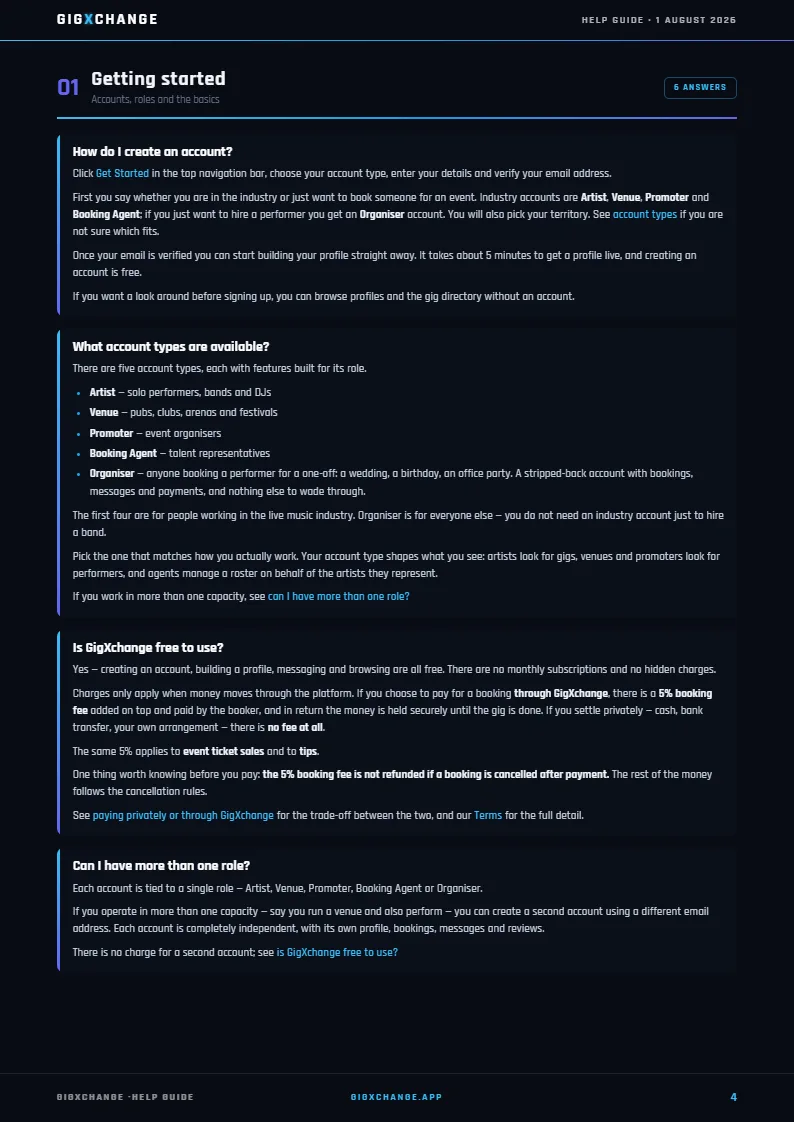


Everything you need to get started, book gigs, manage payments, and make the most of GigXchange. Can't find your answer? Get in touch.
Search every help answer, guide and walkthrough — answers open exactly where you need them.
Last updated: 9 September 2026
51 answers across accounts, profiles, bookings, payments and more — whether you're an artist looking for your first gig, a venue searching for live acts, a booking agent managing a roster, or a promoter building a lineup.
Sign up as an artist, venue, agent or promoter — you’re live and discoverable in about 5 minutes.
Message, agree the fee, sign the auto-generated contract and secure it with a Stripe deposit — no middlemen, no agency markup.
The balance releases 5 days after the gig date — every step tracked in one place.
GigXchange is the UK's peer-to-peer live music marketplace — direct bookings between artists, venues, agents, and promoters across 40+ cities. No middlemen, no agency markup, Stripe-secured payments. Browse member profiles, explore the Gig Directory, or check live rate benchmarks on the GX Index.
Create your account, choose your role, and find your feet.
Click Get Started in the top navigation bar, choose your account type, enter your details and verify your email address.
First you say whether you are in the industry or just want to book someone for an event. Industry accounts are Artist, Venue, Promoter and Agent; if you just want to hire a performer you get an Organiser account. You will also pick Your territory. See account types if you are not sure which fits.
Once your email is verified you can start building your profile straight away. It takes about 5 minutes to get a profile live, and creating an account is free.
If you want a look around before signing up, you can browse profiles and the gig directory without an account.
There are five account types, each with features built for its role.
The first four are for people working in the live music industry. Organiser is for everyone else — you do not need an industry account just to hire a band.
Pick the one that matches how you actually work. Your account type shapes what you see: artists look for gigs, venues and promoters look for performers, and agents manage a roster on behalf of the artists they represent.
If you work in more than one capacity, see can I have more than one role?
Yes — creating an account, building a profile, messaging and browsing are all free. There are no monthly subscriptions and no hidden charges.
Charges only apply when money moves through the platform. If you choose to pay for a booking through GigXchange, there is a 5% booking fee added on top and paid by the booker, and in return the money is held securely until the gig is done. If you settle privately — cash, bank transfer, your own arrangement — there is no fee at all.
The same 5% applies to event ticket sales and to tips.
One thing worth knowing before you pay: the 5% booking fee is not refunded if a booking is cancelled after payment. The rest of the money follows the cancellation rules.
See paying privately or through GigXchange for the trade-off between the two, and our Terms for the full detail.
Each account is tied to a single role — Artist, Venue, Promoter, Booking Agent or Organiser.
If you operate in more than one capacity — say you run a venue and also perform — you can create a second account using a different email address. Each account is completely independent, with its own profile, bookings, messages and reviews.
There is no charge for a second account; see is GigXchange free to use?
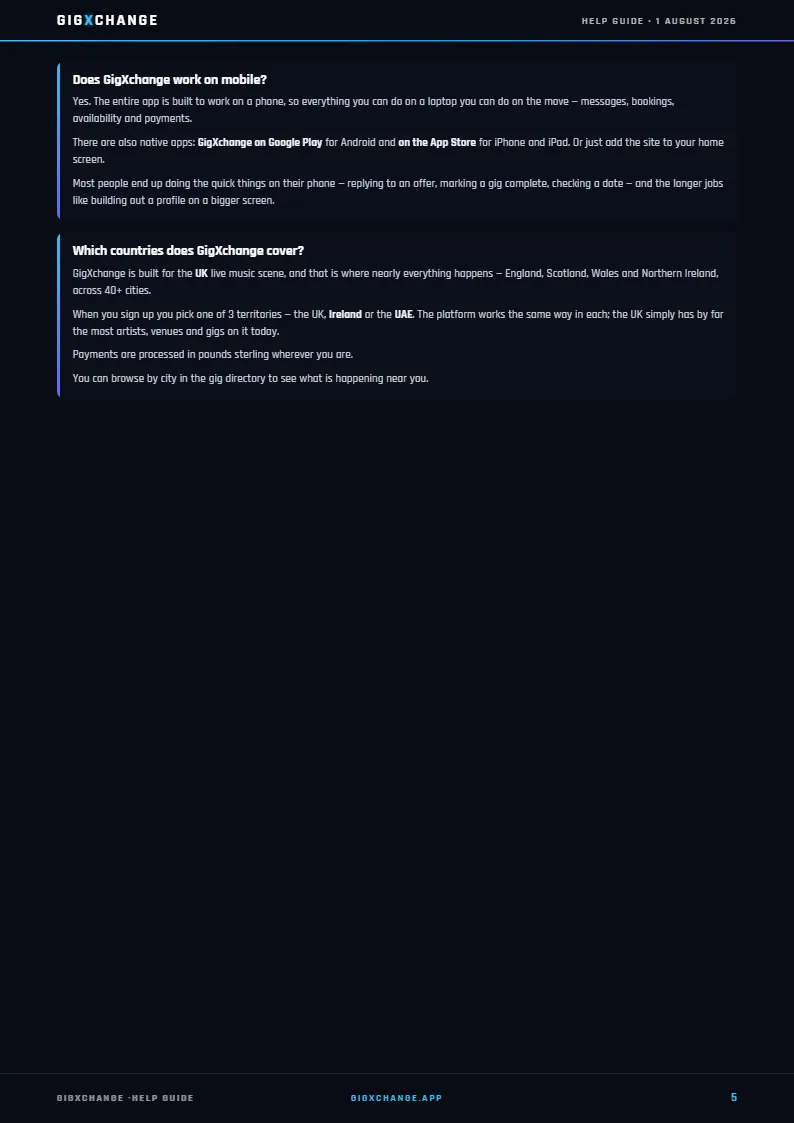
Yes. The entire app is built to work on a phone, so everything you can do on a laptop you can do on the move — messages, bookings, availability and payments.
There are also native apps: GigXchange on Google Play for Android and on the App Store for iPhone and iPad. Or just add the site to your home screen.
Most people end up doing the quick things on their phone — replying to an offer, marking a gig complete, checking a date — and the longer jobs like building out a profile on a bigger screen.
Most UK grassroots venues already have a page in the GigXchange directory, built from public listings rather than by the venue. If one of them is yours, you can take it over.
Find your venue in the directory and open its page. In the booking panel you will see Is this your venue? — press Claim This Venue. That takes you to venue signup with the listing already attached, so the page becomes yours as soon as the account is made. It is a free account, no card needed, and takes about 30 seconds.
Once it is yours you can:
A claimed page says Claimed to visitors, and the details on it are credited to the venue rather than to us. That is the whole point of claiming — a page nobody has claimed is only as good as the public information behind it.
If something on an unclaimed page is simply wrong, you do not have to claim it to fix it: use Send a Correction on the page.
New to GigXchange entirely? Start at how do I create an account?
They are three different things, and one leads to the next.
A gig is a request for a performer. A venue, promoter or agent posts it ("we need an act for Saturday 14th, budget £300"), and artists apply. Artists never post gigs - they advertise on their profile and apply to gigs instead. Use Post a Gig to list one.
A booking is the deal itself. When a venue accepts an application, or someone sends a booking offer directly from a profile, a booking is created between the two members. It carries the date, the fee, the contract and the payment, and it moves through its own stages (pending, accepted, confirmed, completed). Every booking starts with an offer - see how bookings work.
An event is the public listing. Once a booking is agreed, the venue or promoter can turn it into an event with Publish as Event - the page fans see, with the line-up, the time and, if you want, tickets. A gig and an event are never linked directly; the booking in the middle is what connects them.
You do not have to use all three. A venue can post a gig and never publish an event; an artist can be booked straight from their profile with no gig at all; and an event can be created on its own for a night that was arranged elsewhere.
GigXchange is built for the UK live music scene, and that is where nearly everything happens — England, Scotland, Wales and Northern Ireland, across 40+ cities.
When you sign up you pick one of 3 territories — the UK, Ireland or the UAE. The platform works the same way in each; the UK simply has by far the most artists, venues and gigs on it today.
Payments are processed in pounds sterling wherever you are.
You can browse by city in the gig directory to see what is happening near you.
The page that gets you booked — and how to make it work harder.
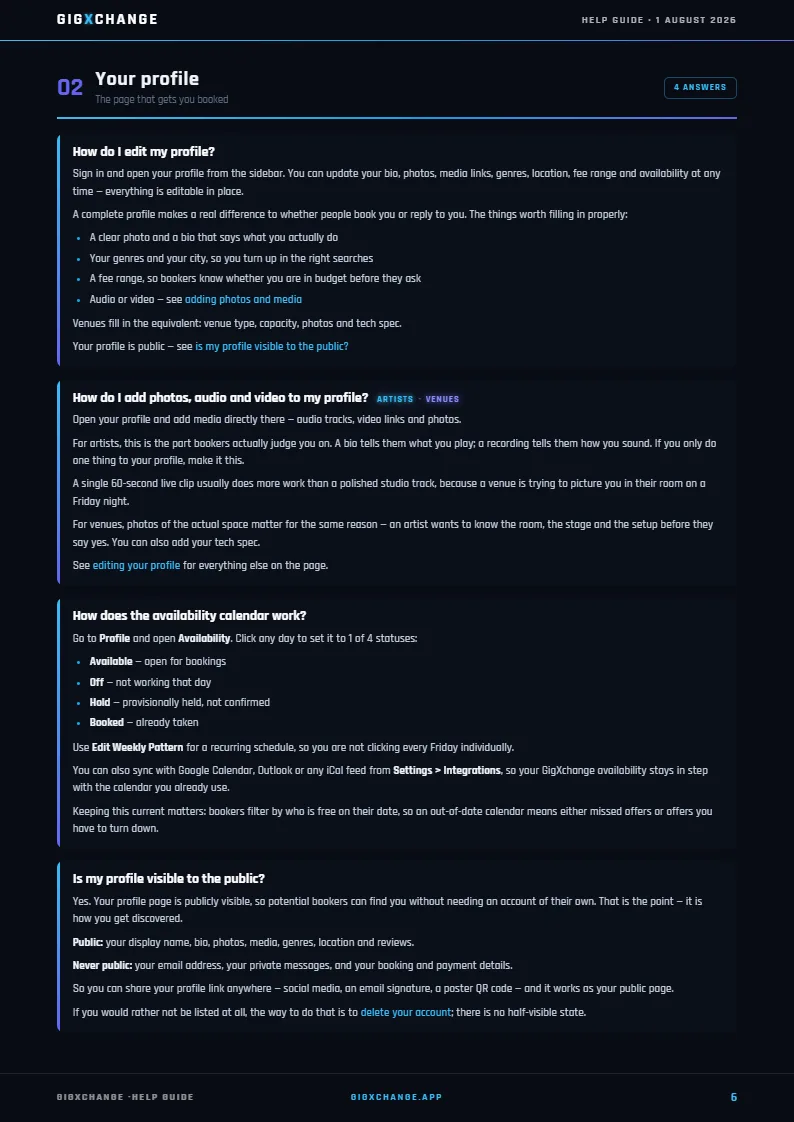
Sign in and open your profile from the sidebar. You can update your bio, photos, media links, genres, location, fee range and availability at any time — everything is editable in place.
A complete profile makes a real difference to whether people book you or reply to you. The things worth filling in properly:
Venues fill in the equivalent: venue type, capacity, photos and tech spec.
Your profile is public — see is my profile visible to the public?
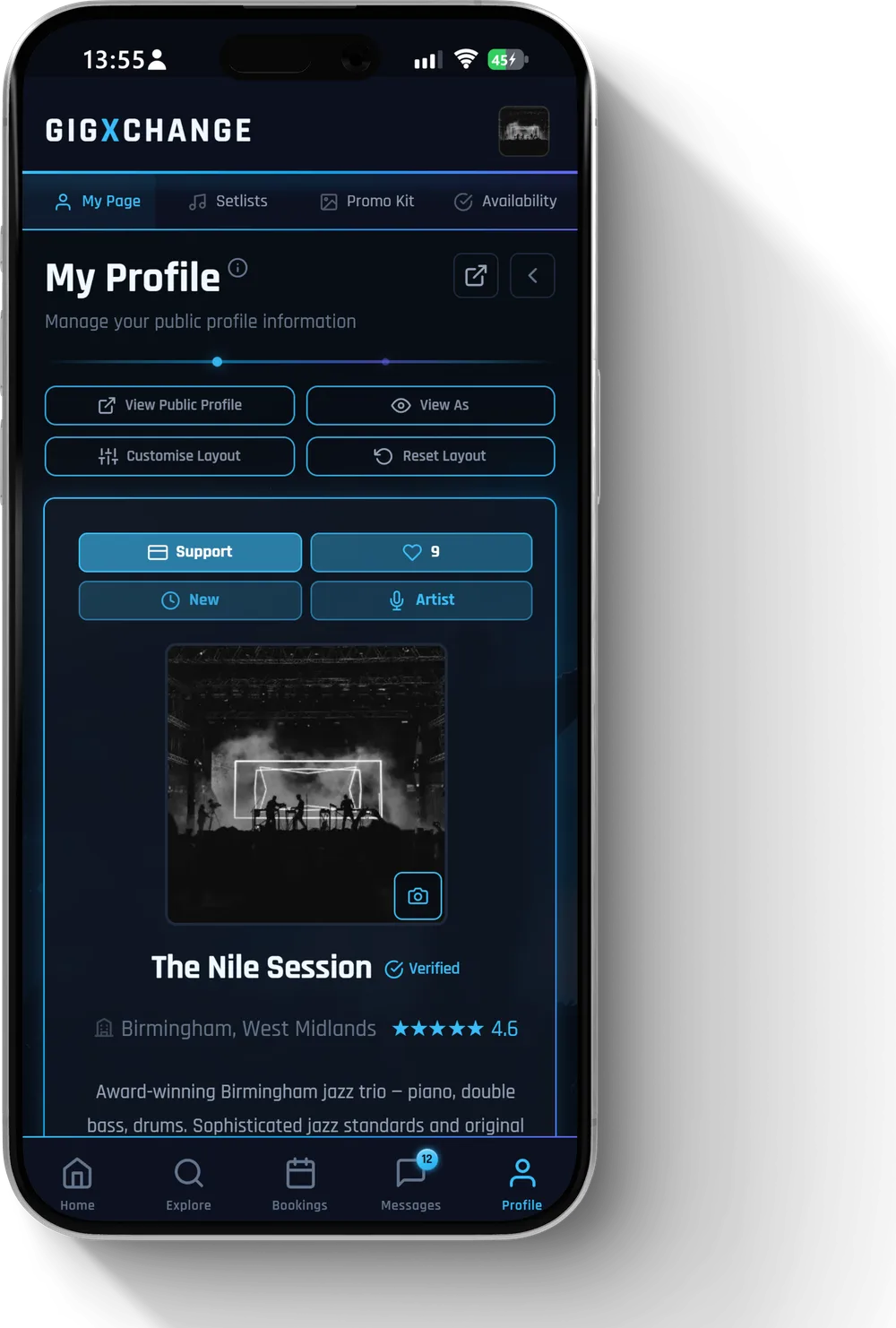 See it in the app Your profile — bio, genres, fee range and media, all editable in place
 Open your profile and add media directly there — audio tracks, video links and photos.
For artists, this is the part bookers actually judge you on. A bio tells them what you play; a recording tells them how you sound. If you only do one thing to your profile, make it this.
A single 60-second live clip usually does more work than a polished studio track, because a venue is trying to picture you in their room on a Friday night.
For venues, photos of the actual space matter for the same reason — an artist wants to know the room, the stage and the setup before they say yes. You can also fill in your Equipment details, such as whether the room has a PA System.
See editing your profile for everything else on the page.
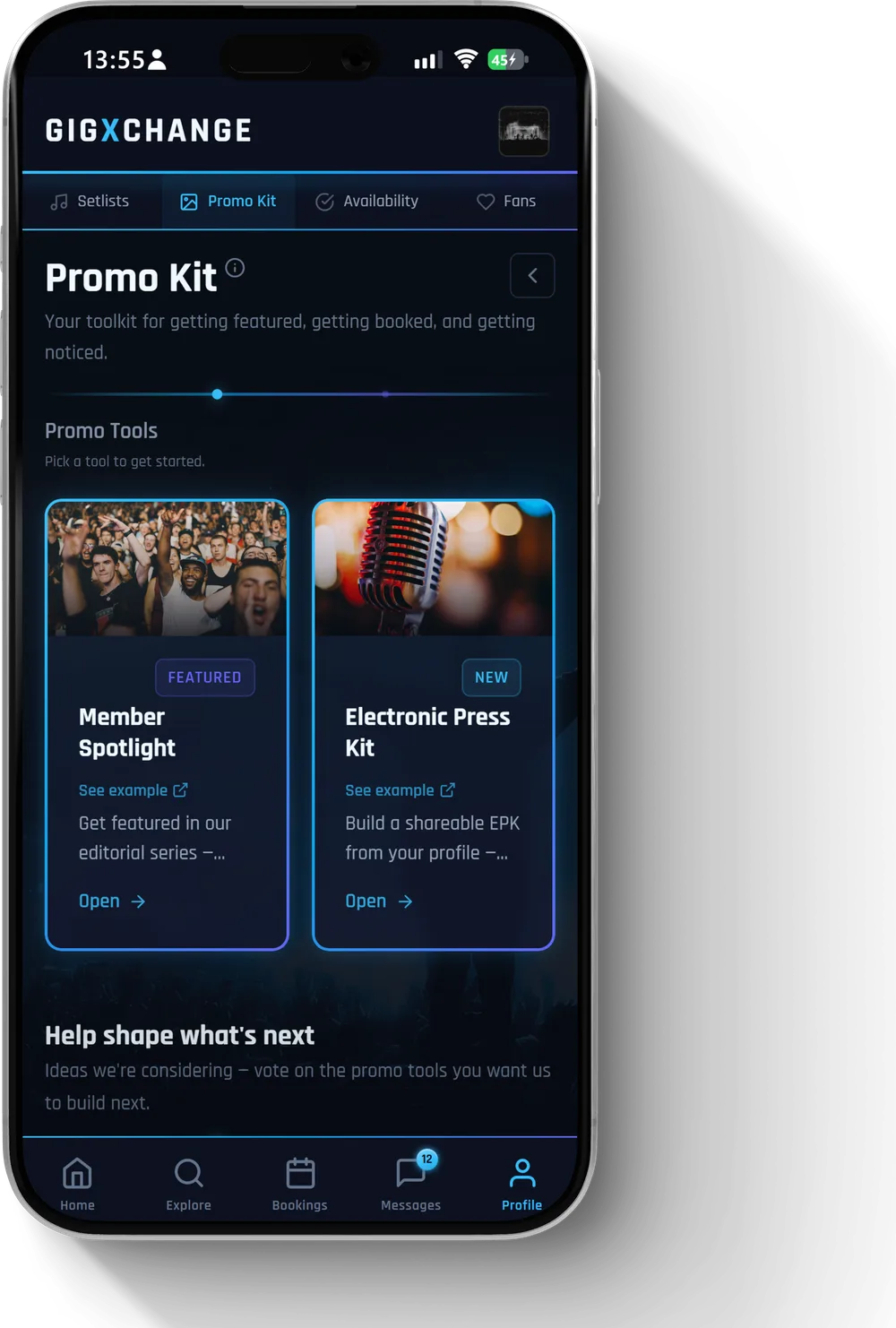 See it in the app Promo Kit — where your press kit, flyers and posters live
 Yes. Open Settings, choose Integrations, then the Calendar tab. It works in both directions.
Bringing your own calendar in: press Connect Google Calendar or Connect Outlook, sign in and approve, and you are done. Busy dates from your own calendar then block automatically on GigXchange, so nobody can book you on a day you are not free. Changes reach GigXchange within seconds, and we only ever read the dates you are busy — never event names, guests or locations.
Using Apple, iCloud or another calendar? Choose Connect by link and paste your calendar's ICS feed address — the feed address, not the page you view your calendar on. Link connections are checked hourly rather than instantly.
Sending your bookings out: Calendar Feed Export gives you a URL to subscribe to your GigXchange bookings from Google Calendar, Apple Calendar or any iCal-compatible app, so confirmed gigs appear in the diary you already use.
Everything you have connected is listed under Connected Calendars, where you can sync on demand or disconnect — disconnecting removes the connection, the dates it imported, and our access to your calendar.
Blocked dates feed straight into your availability — see how does the availability calendar work?
Yes. If you already have a press kit as a PDF, you can upload it and it takes over your EPK link. Your GigXchange EPK stays exactly as it is underneath, so nothing is lost.
Open Profile, choose Promo Kit, then open the EPK Builder. Press the upload button in the header, labelled Import your own EPK. A dialog opens; press Choose file and pick your PDF.
From then on, visitors to your EPK link see your uploaded file instead of the GigXchange page — every page of it, with Previous page and Next page controls, a full-screen reader, and a Download button so they can keep a copy. The builder tells you which file is live and reminds you that your GigXchange EPK is saved underneath.
To change your mind, press the same upload button. The dialog now says Your uploaded EPK is live and offers two choices: Replace file to swap in a newer PDF, or Use GigXchange EPK to switch back to the page you built here. Switching back is instant, and you can switch again later.
For building the GigXchange version itself, see adding media to your profile.
Fans is your own mailing list, kept in your account. Open Profile and choose Fans.
People add themselves. Anyone looking at your public profile can press Become a Fan, give their name and email, and they land on your list — so sharing your profile link is the main way it grows. Until someone does, the page tells you the list is empty rather than showing you nothing.
Already have a list somewhere else? Press Import CSV and upload a file with a Name and an Email column. There is a template to download if you want the right shape, and anyone already on your list is skipped rather than added twice. Before it imports you see exactly which rows will go in and which are being left out, and why.
You can search the list, and tick anyone you want to take off it. Export CSV gives you the whole list back as a file, so it is yours to take with you.
To write to the people on it, see how do I send an update to my fans?
Open Profile, choose Fans, and press Send update. That opens Compose Update.
Start by choosing who gets it: All fans, or Pick individually to choose from your list by name. The recipient count sits next to the send button so you always know how many people you are about to write to.
Then write a Subject and a Message. Keep it personal — these are people who chose to hear from you, not a cold list.
You can attach things to the email rather than describing them. Upcoming events appear as their own row, and picking one puts the show, its date and its cover image into the message. You can also attach images from your profile. A Live preview on the right shows the email as your fan will receive it, updating as you type, so nothing goes out looking different from what you expected.
You can send one update every 24 hours. If you try again sooner, GigXchange tells you how long is left rather than sending it.
To grow the list first, see how do I build a mailing list of my fans?
Go to Profile and open Availability. Click any day to set it to 1 of 4 statuses:
Use Edit Weekly Pattern for a recurring schedule, so you are not clicking every Friday individually.
You can also sync with Google Calendar, Outlook or any iCal feed from Settings > Integrations, so your GigXchange availability stays in step with the calendar you already use.
Keeping this current matters: bookers filter by who is free on their date, so an out-of-date calendar means either missed offers or offers you have to turn down.
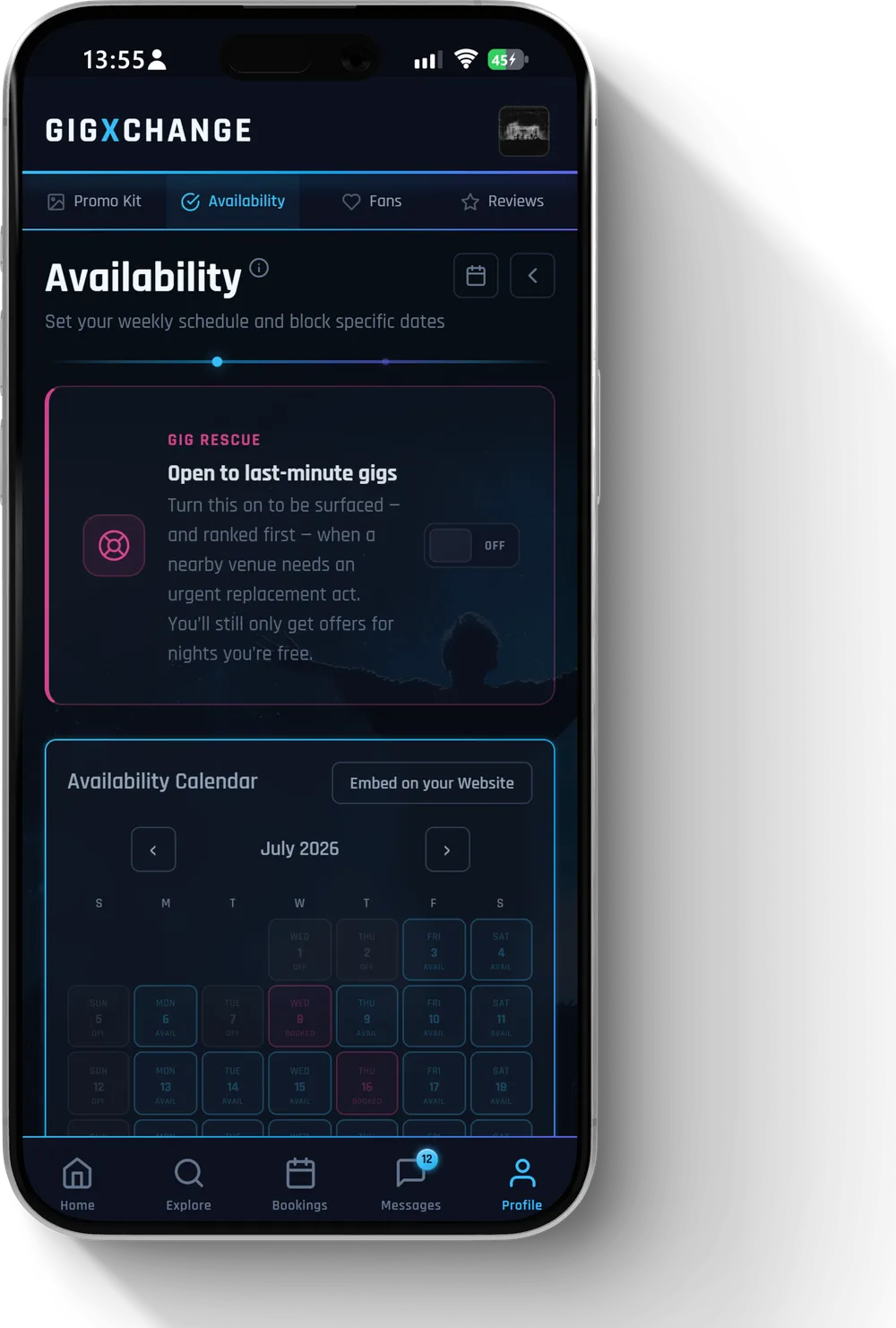 See it in the app The availability calendar — set each day Available, Off, Hold or Booked
 Yes. Your profile page is publicly visible, so potential bookers can find you without needing an account of their own. That is the point — it is how you get discovered.
Public: your display name, bio, photos, media, genres, location and reviews.
Never public: your email address, your private messages, and your booking and payment details.
So you can share your profile link anywhere — social media, an email signature, a poster QR code — and it works as your public page.
If you would rather not be listed at all, the way to do that is to delete your account; there is no half-visible state.
Every venue page carries its city's league table: the rooms in that city with the most gigs on the calendar for the next 30 days, with the venue you are looking at marked as This venue. Each row shows the gig count, and an arrow for movement against roughly a week ago.
It counts one thing and nothing else: gigs listed in the next 30 days. Not how long you have been on GigXchange, not whether you have an account, not anything you can pay for. A busy room with nothing listed will sit below a quieter one that lists everything.
So if your venue is missing, or lower than you expect, there are only two things to check:
The table rebuilds every night, so a gig added today counts tomorrow.
If the city has no gigs listed for the next 30 days at all, there is no table — the page says so, and the first venue to list one starts it.
Not yet listed as a venue? See how do I claim my venue's page?
From first offer to a confirmed date, and what happens if plans change.
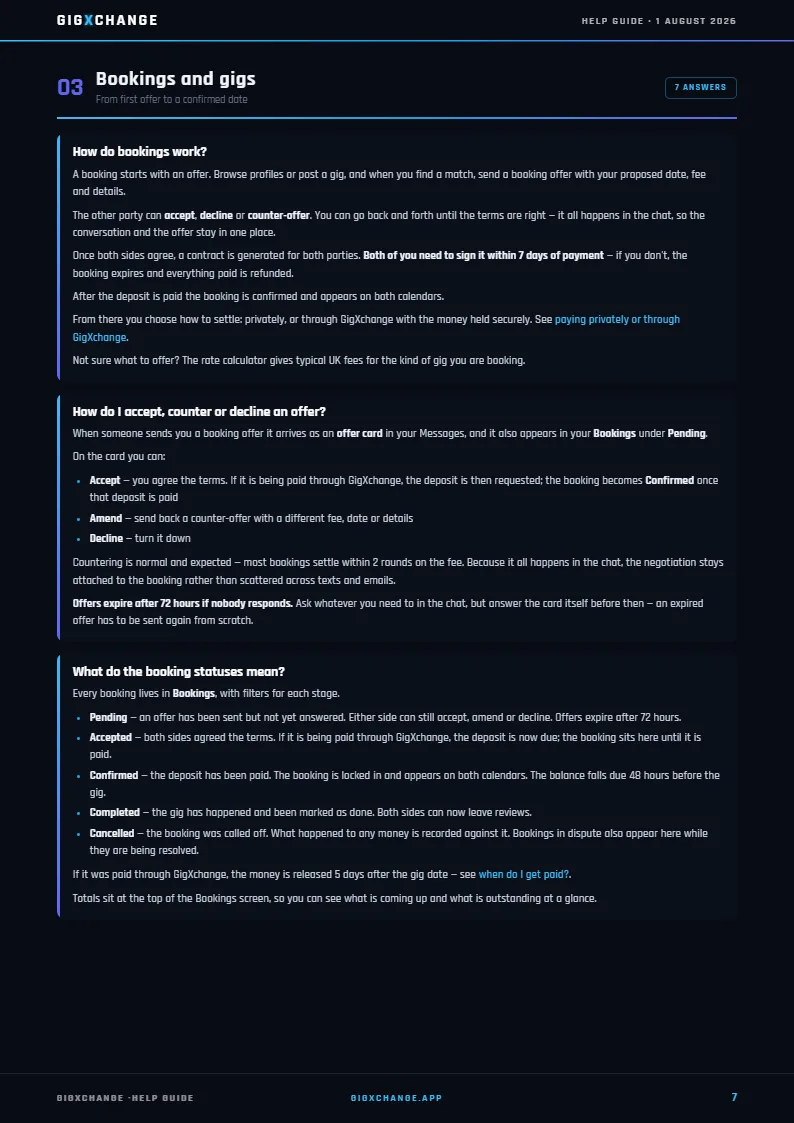
A booking starts with an offer. Browse profiles or post a gig, and when you find a match, send a booking offer with your proposed date, fee and details.
The other party can Accept, Decline or Amend (send back a counter-offer). You can go back and forth until the terms are right — it all happens in the chat, so the conversation and the offer stay in one place.
Once both sides agree, a contract is generated for both parties. Both of you need to sign it within 7 days of payment — if you don't, the booking expires and everything paid is refunded.
After the deposit is paid the booking is confirmed and appears on both calendars.
From there you choose how to settle: privately, or through GigXchange with the money held securely. See paying privately or through GigXchange.
Not sure what to offer? The rate calculator gives typical UK fees for the kind of gig you are booking.
When someone sends you a booking offer it arrives as an offer card in your Messages, and it also appears in your Bookings under Pending.
On the card you can:
Countering is normal and expected — most bookings settle within 2 rounds on the fee. Because it all happens in the chat, the negotiation stays attached to the booking rather than scattered across texts and emails.
Offers stay open until the gig date — if the gig day passes with nobody responding, the offer expires. Ask whatever you need to in the chat, but answer the card itself before the day of the gig — an expired offer has to be sent again from scratch.
Every booking lives in Bookings, with filters for each stage.
If it was paid through GigXchange, the money is released 5 days after the gig date — see when do I get paid?.
Totals sit at the top of the Bookings screen, so you can see what is coming up and what is outstanding at a glance.
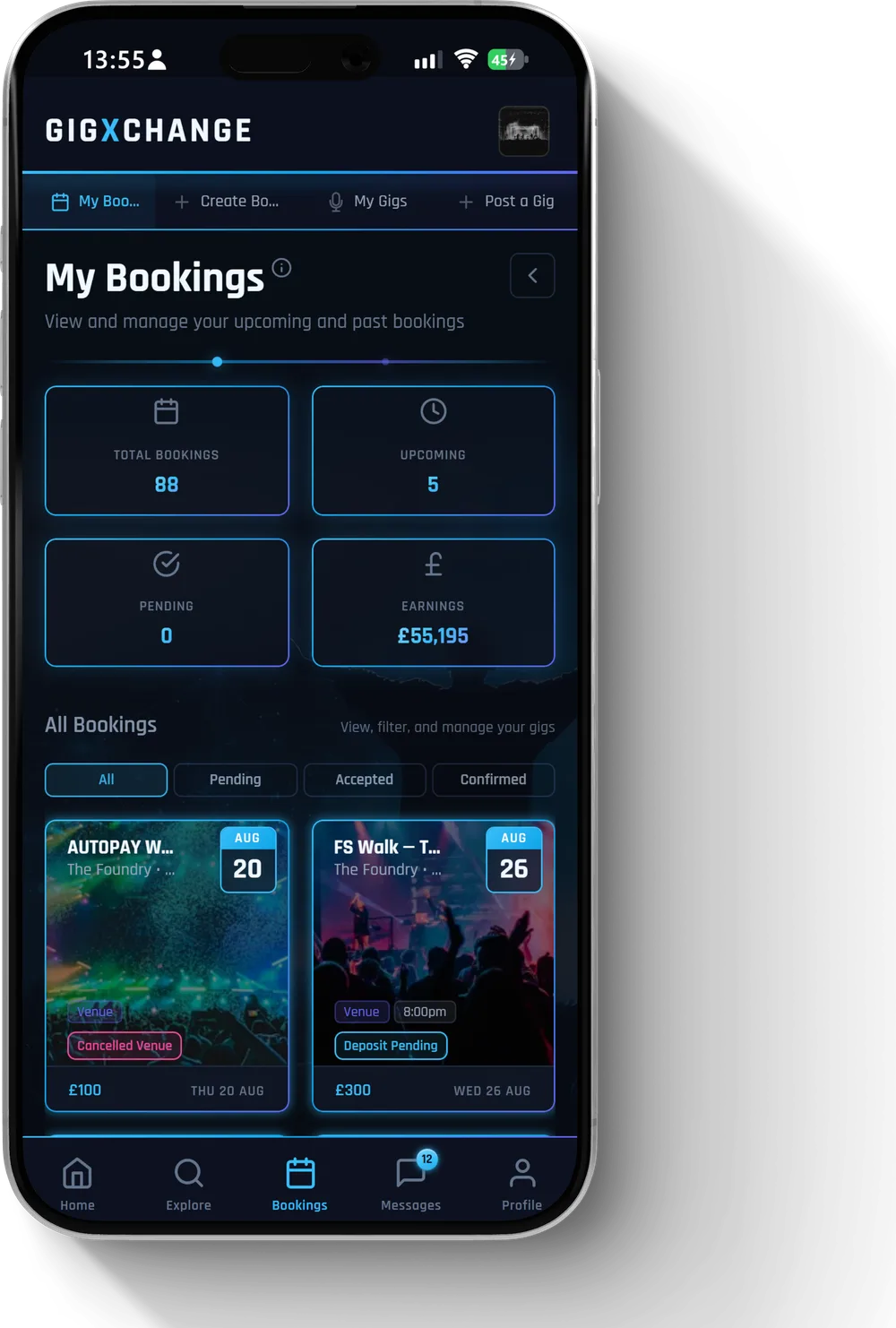 See it in the app Your bookings, filtered by stage, with totals at the top
 Yes. The venue directory lists venues across the UK, including many that have not joined GigXchange yet. Where a venue's card shows a Contact button, you can introduce yourself even though they are not a member.
Open Find Venues from Explore, find the venue, and choose Contact. Write a personal note under Your message — who you are, what you play, why you would suit their room — then Send message.
We pass your note to the venue by email, along with a link to your profile, and it is free for the venue to join and reply. If they do join, you will be notified.
A personal note is required, and there is a daily limit on how many venues you can contact — so make each one count. A specific, genuine message about their venue lands far better than a copy-paste.
Venues that are already members do not need this route — you simply message them directly or send a booking offer.
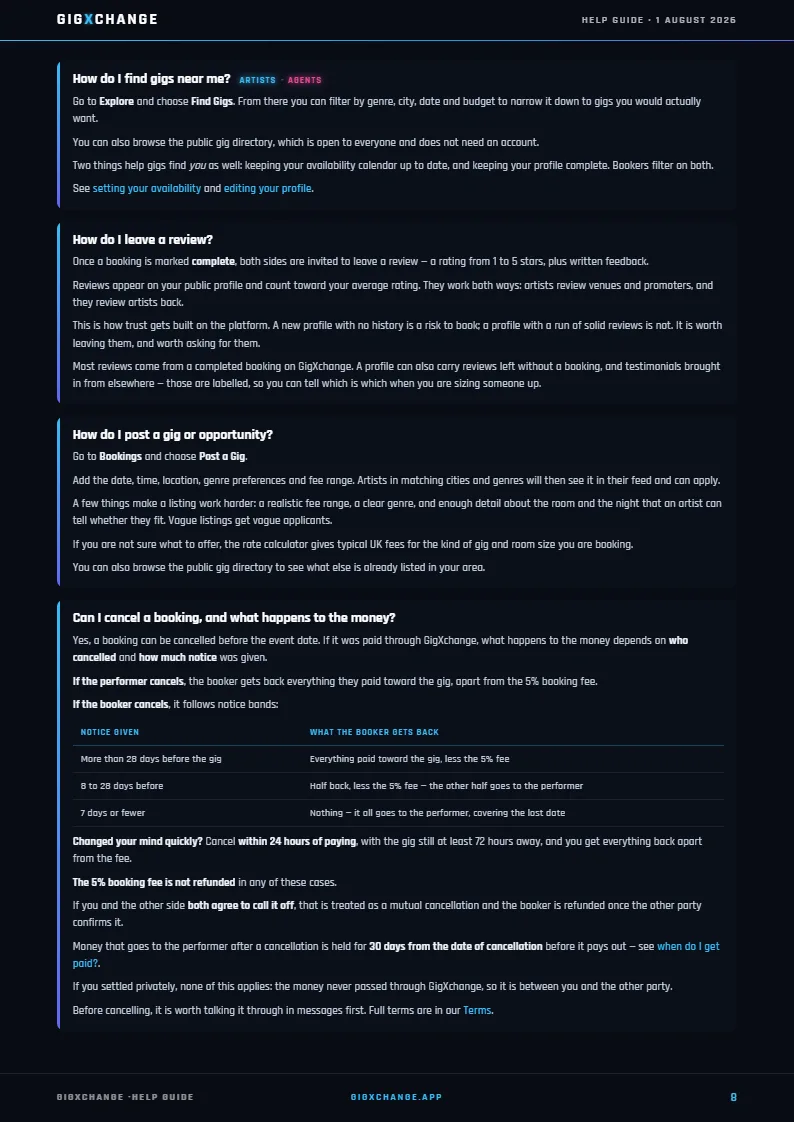
Go to Explore and choose Find Gigs. From there you can filter by genre, city, date and budget to narrow it down to gigs you would actually want.
You can also browse the public gig directory, which is open to everyone and does not need an account.
Two things help gigs find you as well: keeping your availability calendar up to date, and keeping your profile complete. Bookers filter on both.
See setting your availability and editing your profile.
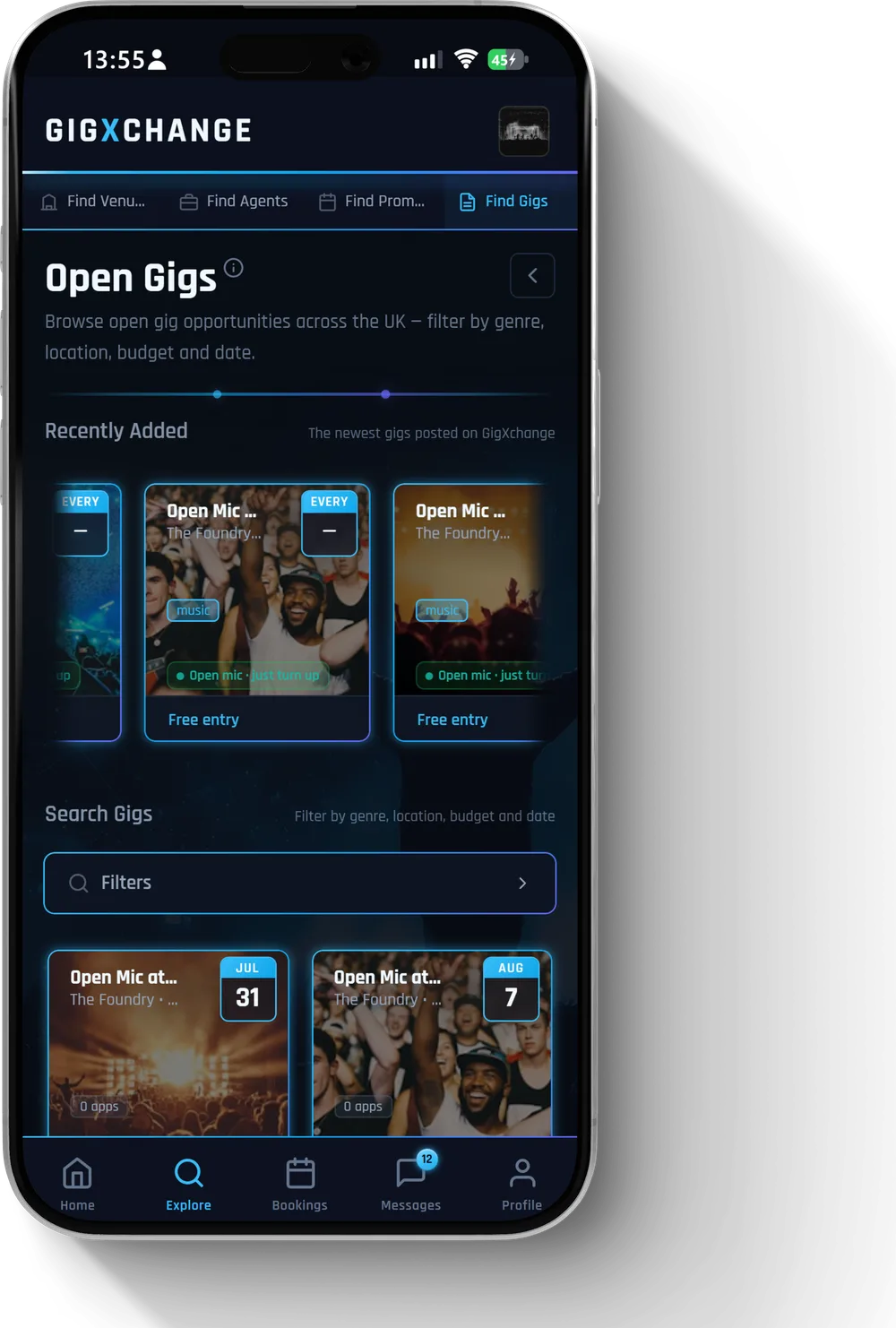 See it in the app Find Gigs — filter by genre, city, date and budget
 Use Classifieds — the noticeboard where artists find each other, fill openings, and get found.
It is switched off by default. To turn it on, open Settings, choose Add-ons, and switch on Classifieds — it then appears in your Explore menu.
On the board you can browse ads from other artists, or post your own with Post an ad. An ad is one of two kinds:
Each ad carries the role, the commitment, the city and a short detail line, so you can tell at a glance whether it fits. Filter by role, city and kind to narrow the board down.
Replying to an ad starts an ordinary GigXchange chat with the poster — posters are real profiles, so you can check their media and reviews before you commit to anything.
Want the board to come to you? Set a Match alert — save a role and city once, and you will be notified when a new ad matches.
When a conversation turns into an actual gig, see how do bookings work?
Once a booking is marked complete, both sides are invited to leave a review — a rating from 1 to 5 stars, plus written feedback.
Reviews appear on your public profile and count toward your average rating. They work both ways: artists review venues and promoters, and they review artists back.
This is how trust gets built on the platform. A new profile with no history is a risk to book; a profile with a run of solid reviews is not. It is worth leaving them, and worth asking for them.
Most reviews come from a completed booking on GigXchange. A profile can also carry reviews left without a booking, and testimonials brought in from elsewhere — those are labelled, so you can tell which is which when you are sizing someone up.
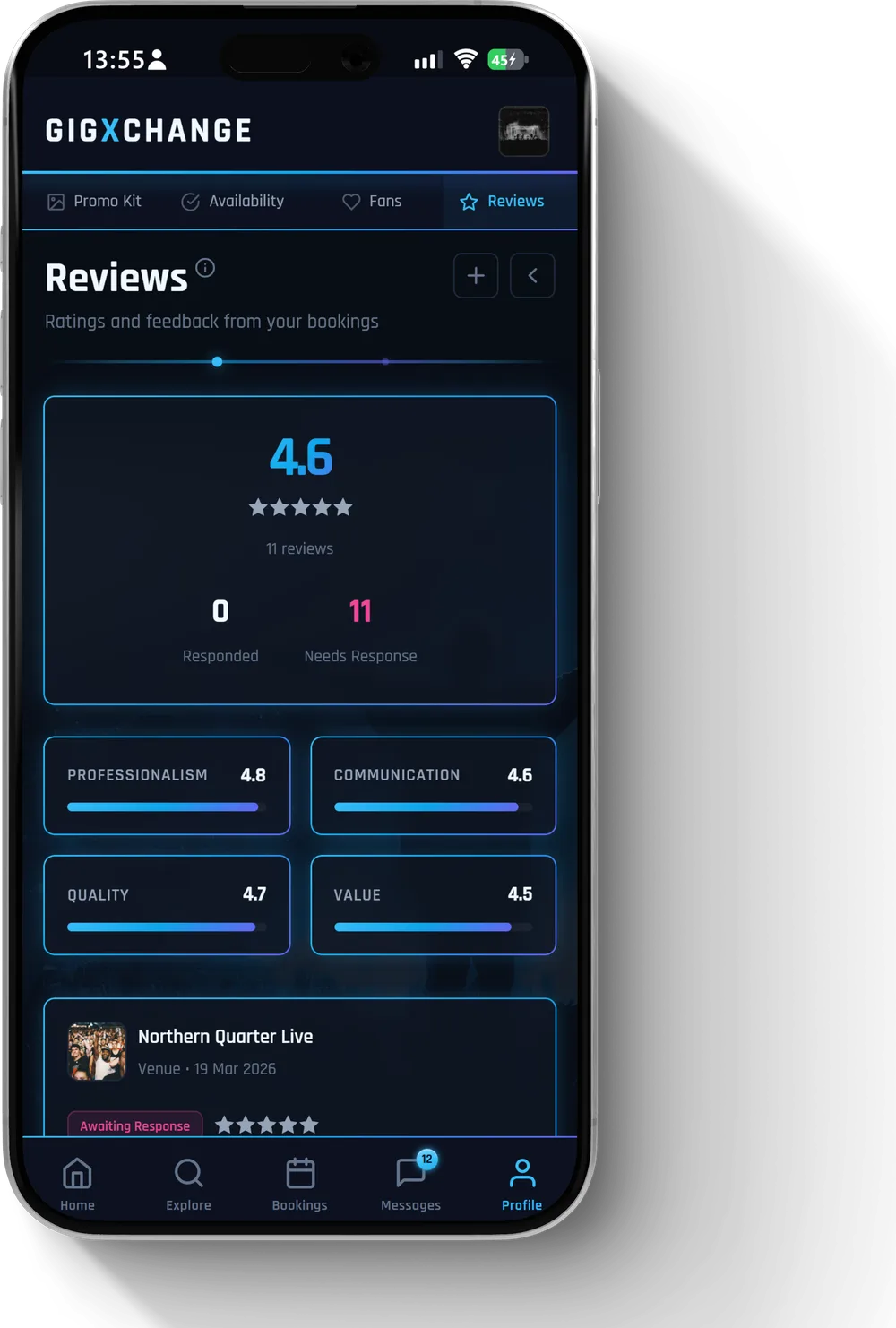 See it in the app Reviews on your profile, from real completed bookings
 Go to Bookings and choose Post a Gig.
Add the date, time, genre preferences and fee range. Every listing has to say what it pays — if the gig is unpaid (expenses, exposure or charity), switch on This gig is unpaid instead of entering a budget. Artists in matching cities and genres will then see it in their feed and can apply.
A few things make a listing work harder: a realistic fee range, a clear genre, and enough detail about the room and the night that an artist can tell whether they fit. Vague listings get vague applicants.
If you are not sure what to offer, the rate calculator gives typical UK fees for the kind of gig and room size you are booking.
You can also browse the public gig directory to see what else is already listed in your area.
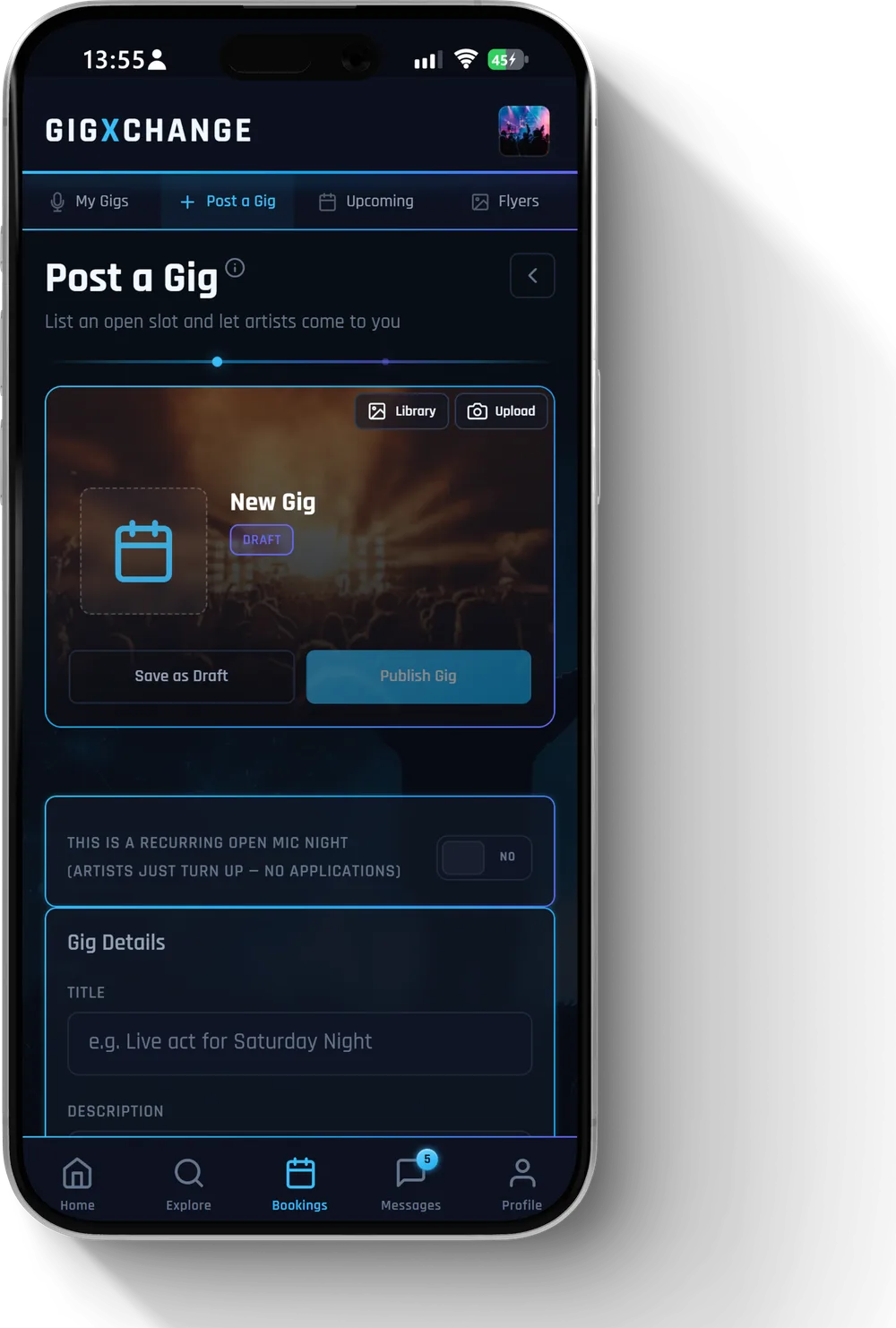 See it in the app Post a Gig — date, location, genre and fee range
 Your own ads live under My Ads on the Classifieds board — switch from Browse to My Ads at the top. An ad runs for 60 days, and each one shows its state: Live, Expired or Closed.
There is one exception, and it is the useful one. If your ad named a date — the gig you needed someone for, or the window you were free in — and that date has gone by, renewing on its own would put the ad back up invisible. So Renew opens the ad itself instead, keeps the old date on screen so you can see what needs changing, and asks you for a new one. Save it with Relist ad and the ad is live again for another 60 days, on the same link anyone you have already sent it to still has.
Relisting counts towards your live ads again. Simply editing an ad does not — it updates what readers see without restarting the 60 days.
To post an ad in the first place, see how do I find other musicians to play with?
Open My Gigs from Bookings and press My applications in the page header. That flips the page to the gigs you have applied to that are still waiting on a reply, newest first. Once a venue answers, the application leaves this view and becomes a booking. Press it again to go back to the gigs you have posted yourself.
Anywhere a gig appears that you have already applied for, it is marked Applied — so you cannot accidentally apply for the same one twice.
If nothing loads, the page tells you so rather than showing an empty list. Your applications are safe either way; give it a moment and try again.
When a venue says yes, the application becomes an ordinary booking — see how do bookings work?. To find more to apply for, see how do I find gigs near me?. If applications are going nowhere, see I am not getting any replies or bookings.
Yes, a booking can be cancelled before the event date. If it was paid through GigXchange, what happens to the money depends on who cancelled and how much notice was given.
If the performer cancels, the booker gets back everything they paid toward the gig, apart from the 5% booking fee.
If the booker cancels, it follows notice bands:
| Notice given | What the booker gets back |
|---|---|
| More than 28 days before the gig | Everything paid toward the gig, less the 5% fee |
| 8 to 28 days before | Half back, less the 5% fee — the other half goes to the performer |
| 7 days or fewer | Nothing — it all goes to the performer, covering the lost date |
Changed your mind quickly? Cancel within 24 hours of paying, with the gig still at least 72 hours away, and you get everything back apart from the fee.
The 5% booking fee is not refunded in any of these cases.
If you and the other side both agree to call it off, that is treated as a mutual cancellation and the booker is refunded once the other party confirms it.
Money that goes to the performer after a cancellation is held for 30 days from the date of cancellation before it pays out — see when do I get paid?.
If you settled privately, none of this applies: the money never passed through GigXchange, so it is between you and the other party.
Before cancelling, it is worth talking it through in messages first. Full terms are in our Terms.
How money is held, when it is released, and what the fee covers.
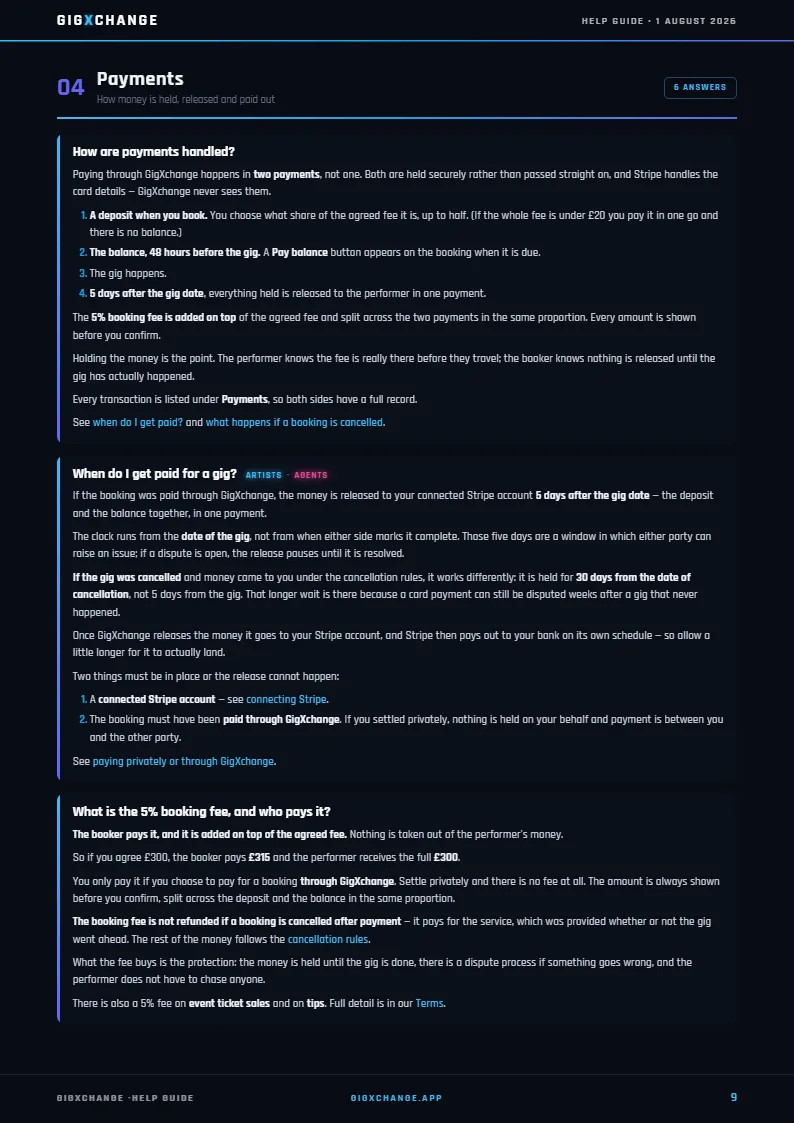
Paying through GigXchange happens in two payments, not one. Both are held securely rather than passed straight on, and Stripe handles the card details — GigXchange never sees them.
The 5% booking fee is added on top of the agreed fee and split across the two payments in the same proportion. Every amount is shown before you confirm.
Holding the money is the point. The performer knows the fee is really there before they travel; the booker knows nothing is released until the gig has actually happened.
Every transaction is listed under Payments, so both sides have a full record.
See when do I get paid? and what happens if a booking is cancelled.
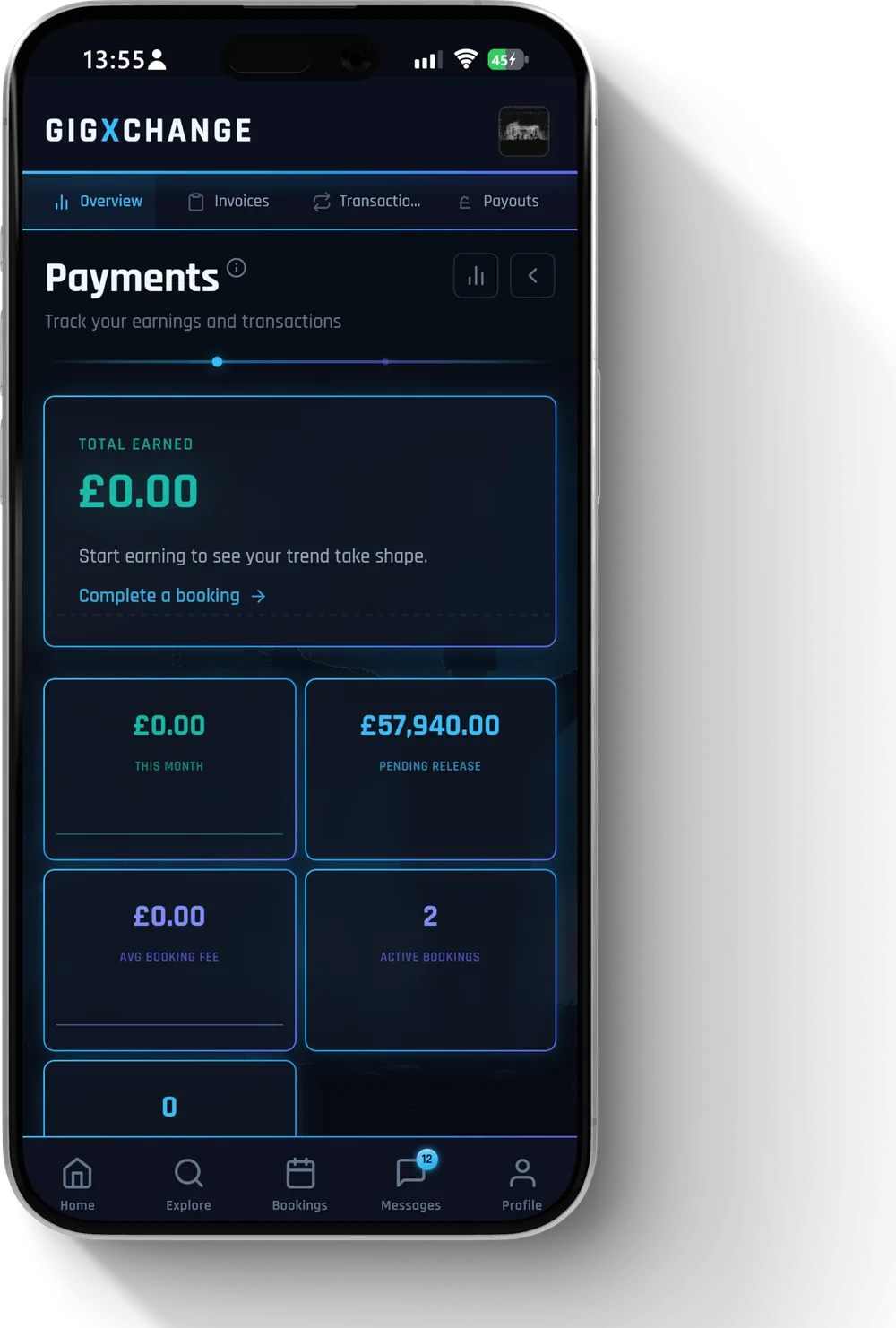 See it in the app Payments — transactions and pending releases in one place
 If the booking was paid through GigXchange, the money is released to your connected Stripe account 5 days after the gig date — the deposit and the balance together, in one payment.
The clock runs from the date of the gig, not from when either side marks it complete. Those five days are a window in which either party can raise an issue; if a dispute is open, the release pauses until it is resolved.
If the gig was cancelled and money came to you under the cancellation rules, it works differently: it is held for 30 days from the date of cancellation, not 5 days from the gig. That longer wait is there because a card payment can still be disputed weeks after a gig that never happened.
Once GigXchange releases the money it goes to your Stripe account, and Stripe then pays out to your bank on its own schedule — so allow a little longer for it to actually land.
Two things must be in place or the release cannot happen:
See paying privately or through GigXchange.
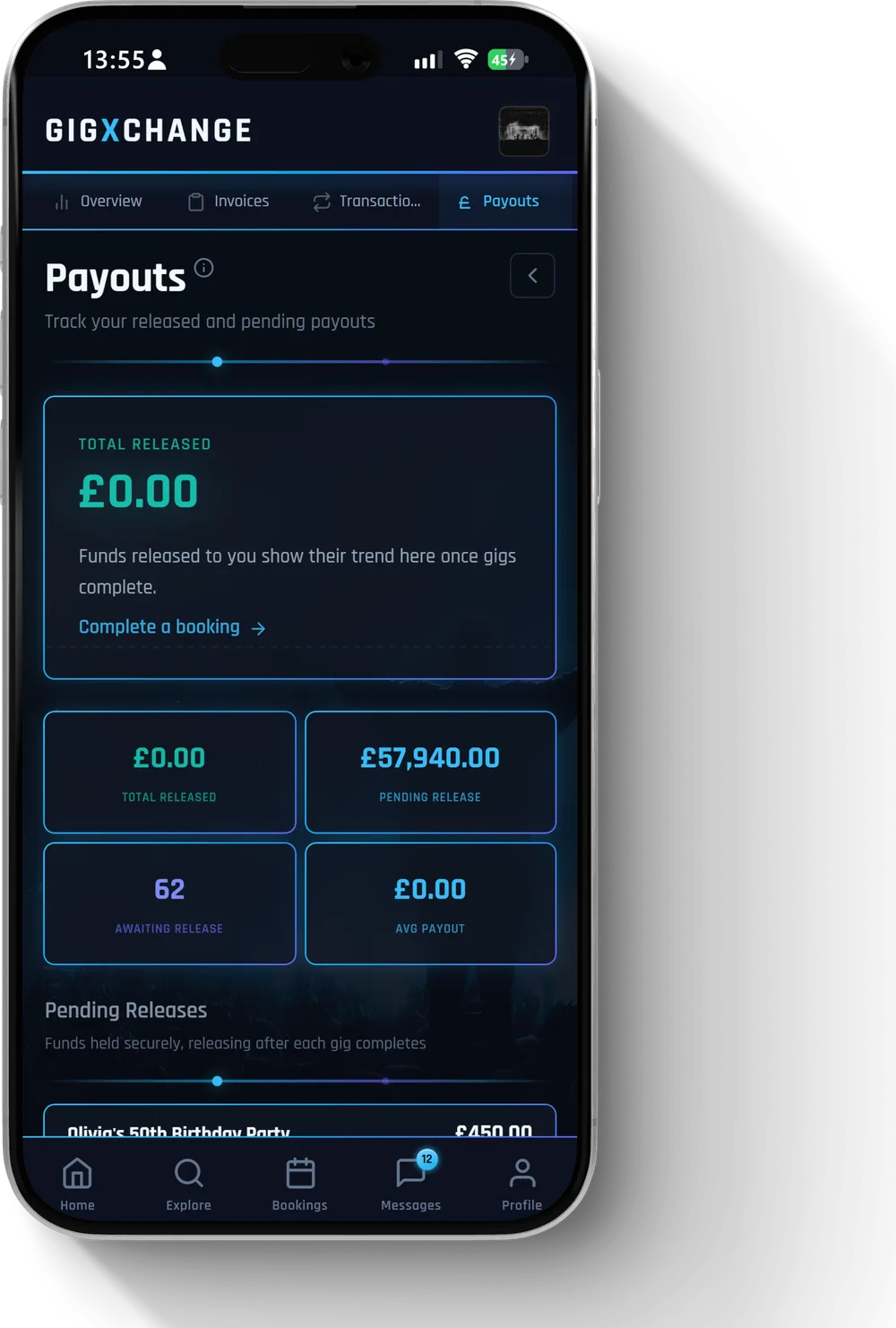 See it in the app Payouts — what has been released and what is still to come
 The booker pays it, and it is added on top of the agreed fee. Nothing is taken out of the performer's money.
So if you agree £300, the booker pays £315 and the performer receives the full £300.
You only pay it if you choose to pay for a booking through GigXchange. Settle privately and there is no fee at all. The amount is always shown before you confirm, split across the deposit and the balance in the same proportion.
The booking fee is not refunded if a booking is cancelled after payment — it pays for the service, which was provided whether or not the gig went ahead. The rest of the money follows the cancellation rules.
What the fee buys is the protection: the money is held until the gig is done, there is a dispute process if something goes wrong, and the performer does not have to chase anyone.
There is also a 5% fee on event ticket sales and on tips. Full detail is in our Terms.
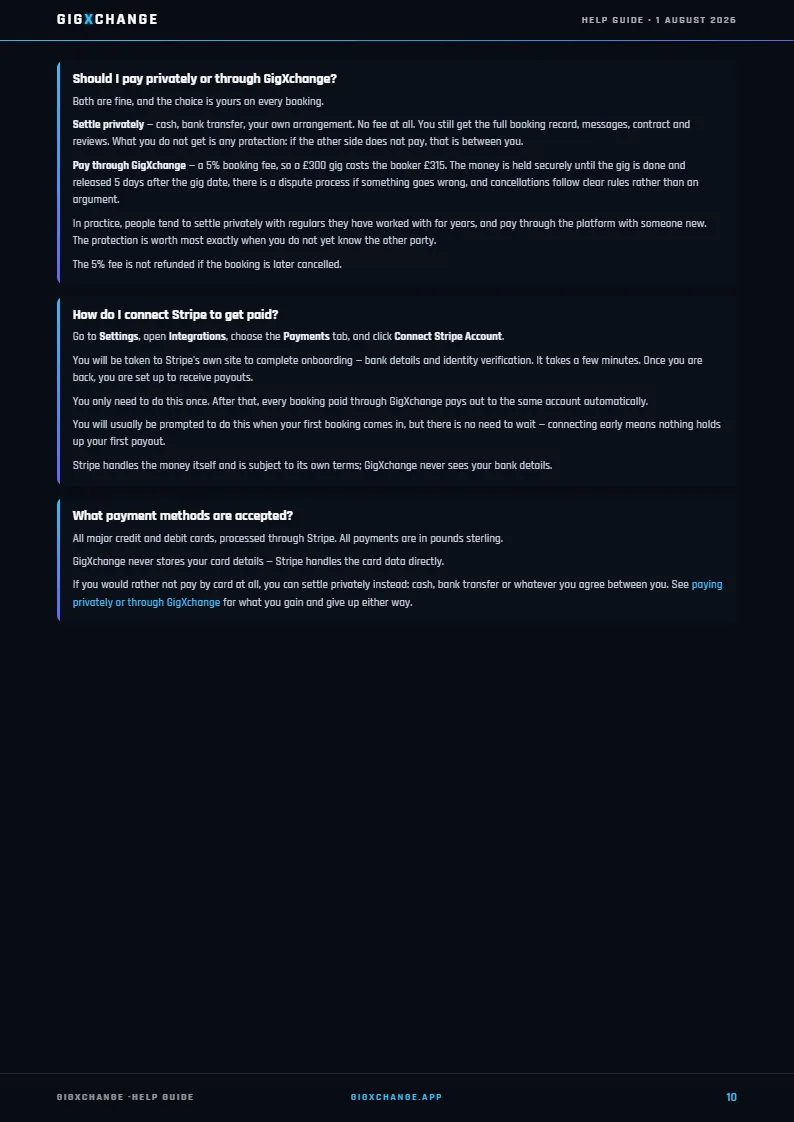
Both are fine, and the choice is yours on every booking.
Settle privately — cash, bank transfer, your own arrangement. No fee at all. You still get the full booking record, messages, contract and reviews. What you do not get is any protection: if the other side does not pay, that is between you.
Pay through GigXchange — a 5% booking fee, so a £300 gig costs the booker £315. The money is held securely until the gig is done and released 5 days after the gig date, there is a dispute process if something goes wrong, and cancellations follow clear rules rather than an argument.
In practice, people tend to settle privately with regulars they have worked with for years, and pay through the platform with someone new. The protection is worth most exactly when you do not yet know the other party.
The 5% fee is not refunded if the booking is later cancelled.
Go to Settings, open Integrations, choose the Payments tab, and click Connect Stripe Account.
You will be taken to Stripe's own site to complete onboarding — bank details and identity verification. It takes a few minutes. Once you are back, you are set up to receive payouts.
You only need to do this once. After that, every booking paid through GigXchange pays out to the same account automatically.
You will usually be prompted to do this when your first booking comes in, but there is no need to wait — connecting early means nothing holds up your first payout.
Stripe handles the money itself and is subject to its own terms; GigXchange never sees your bank details.
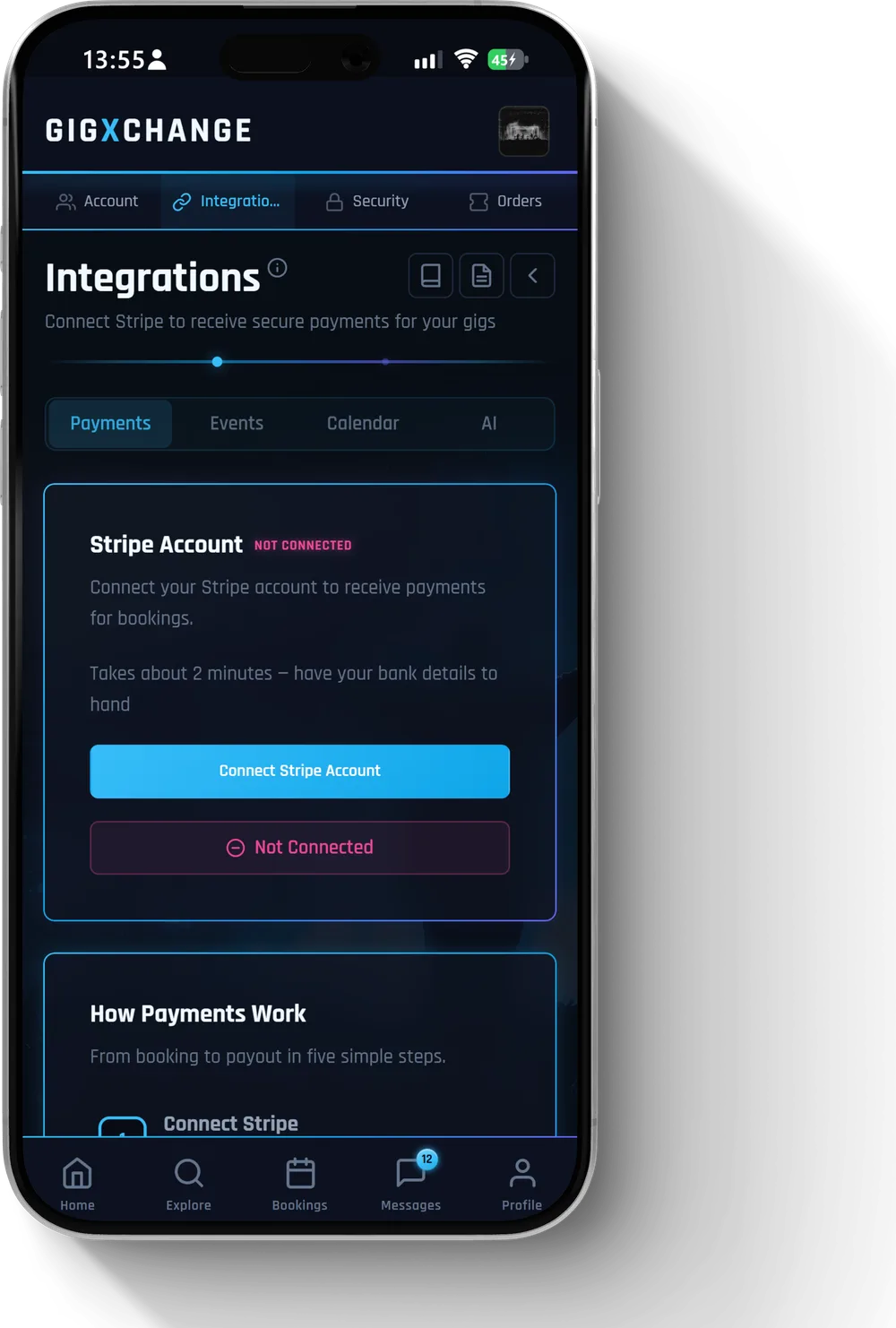 See it in the app Settings > Integrations — where you connect Stripe
 All major credit and debit cards, processed through Stripe. All payments are in pounds sterling.
GigXchange never stores your card details — Stripe handles the card data directly.
If you would rather not pay by card at all, you can settle privately instead: cash, bank transfer or whatever you agree between you. See paying privately or through GigXchange for what you gain and give up either way.
Talking to the other side, and sending offers in the chat.
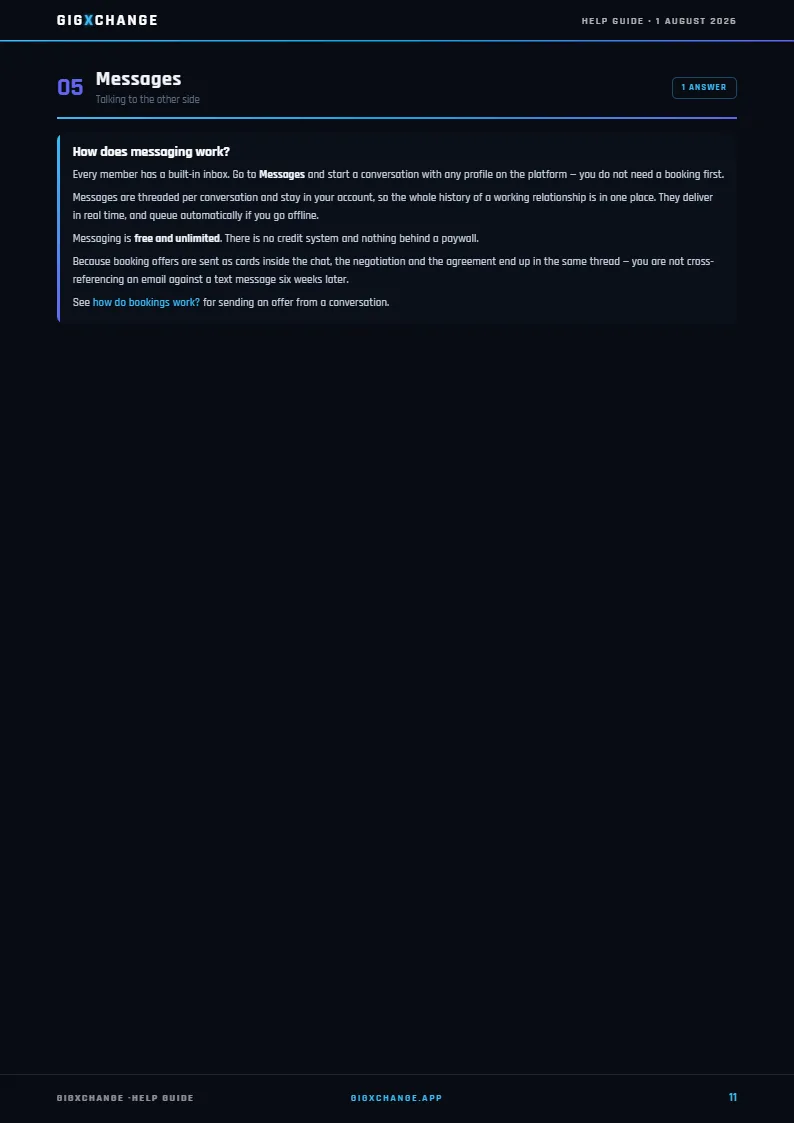
Every member has a built-in inbox. Go to Messages and start a conversation with any profile on the platform — you do not need a booking first.
Messages are threaded per conversation and stay in your account, so the whole history of a working relationship is in one place. They deliver in real time, and queue automatically if you go offline.
A small mark beside each message you send shows where it has got to: a hollow circle while it is Sending (or Queued if you are offline — it goes as soon as you are back online), one tick once it is delivered, two ticks once it has been read. If it is taking a while you will see Still sending. If a send fails, the bubble keeps your exact words and shows Not sent · Tap to retry — tap it to send again. Nothing you type is lost.
Messaging is free and unlimited. There is no credit system and nothing behind a paywall.
Because booking offers are sent as cards inside the chat, the negotiation and the agreement end up in the same thread — you are not cross-referencing an email against a text message six weeks later.
See how do bookings work? for sending an offer from a conversation.
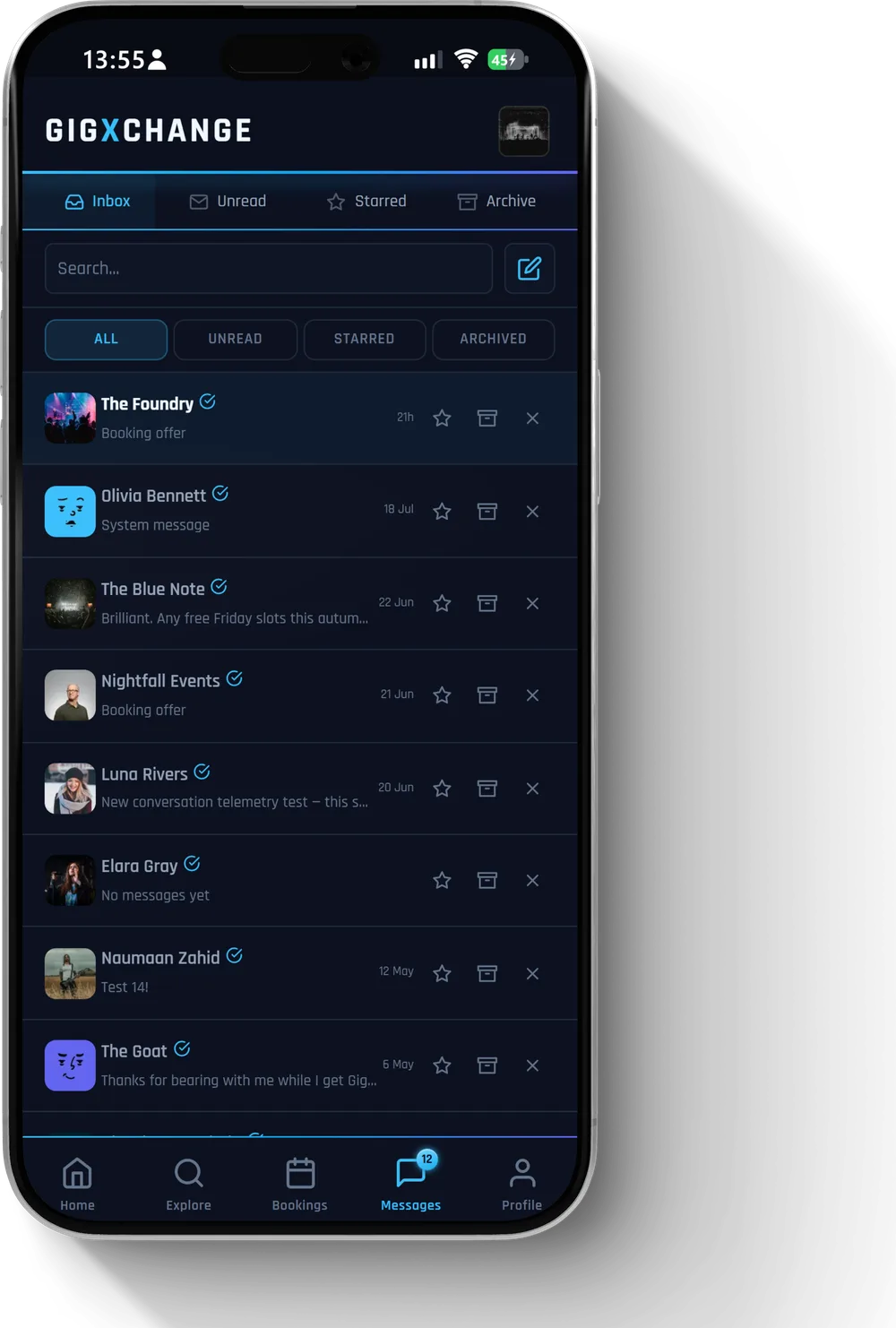 See it in the app Your inbox — every conversation in one list
 Listings, ticketing and your venue page.
Yes. First connect your account: open Settings, go to Integrations, and under Eventbrite press Connect Eventbrite. You sign in on Eventbrite's own site and are sent straight back — GigXchange never sees your Eventbrite password.
Once connected, open any of your events and press Push to Eventbrite. The event is created as a draft in your own Eventbrite account — you set the ticket prices and publish it over there. Tickets sell in your own Eventbrite account, and that money goes to you directly. After a push, the button becomes View on Eventbrite and takes you straight to it.
Before you push, it pays to have the event page complete: the description, end time, expected attendance and cover image all feed the Eventbrite draft — the description carries over, the end time sets the running time, and expected attendance sets the capacity. A complete event page lands as a complete draft.
You can disconnect Eventbrite at any time from the same Integrations screen.
No. When you create or edit an event, the Venue Location field searches our venue directory as you type, but you are never forced to pick from it.
If the venue is listed, choose it from the results. Your event is then linked to that venue's directory page, and the venue name on your event becomes a link to it. Picked the wrong one? Press Change and search again.
If the venue is not in the directory, keep typing — whatever you write is used as the venue name, exactly as you typed it. Picking from the list does not create new venue pages, and typing a name does not either; it simply labels your event.
If the directory search cannot be reached for a moment, your typed name is still saved, so you can carry on creating the event.
To announce the event to the public once it is booked, see listing a gig in the directory.
The public gig directory takes submissions from anyone. Open any directory or venue page and press the button to list a gig — the List your gig form opens. It is free, and you do not need an account.
You will need the act, the venue, the city and the date. Everything else helps but is optional: start and doors times, entry fee, ticket link, venue address and postcode. A description is required — a few lines on the line-up and the night, so someone deciding whether to come has something to go on.
Your email is required too. That is how we come back to you if something needs checking.
Submissions are reviewed before publishing, so a gig does not appear the instant you send it. Once it is live it sits in the directory alongside every other gig in that city, and on the venue's own page.
This is different from posting a gig inside GigXchange. The directory listing announces a gig that is already booked; posting a gig advertises an open slot for artists to apply to. If you have a night to fill, you want that one instead.
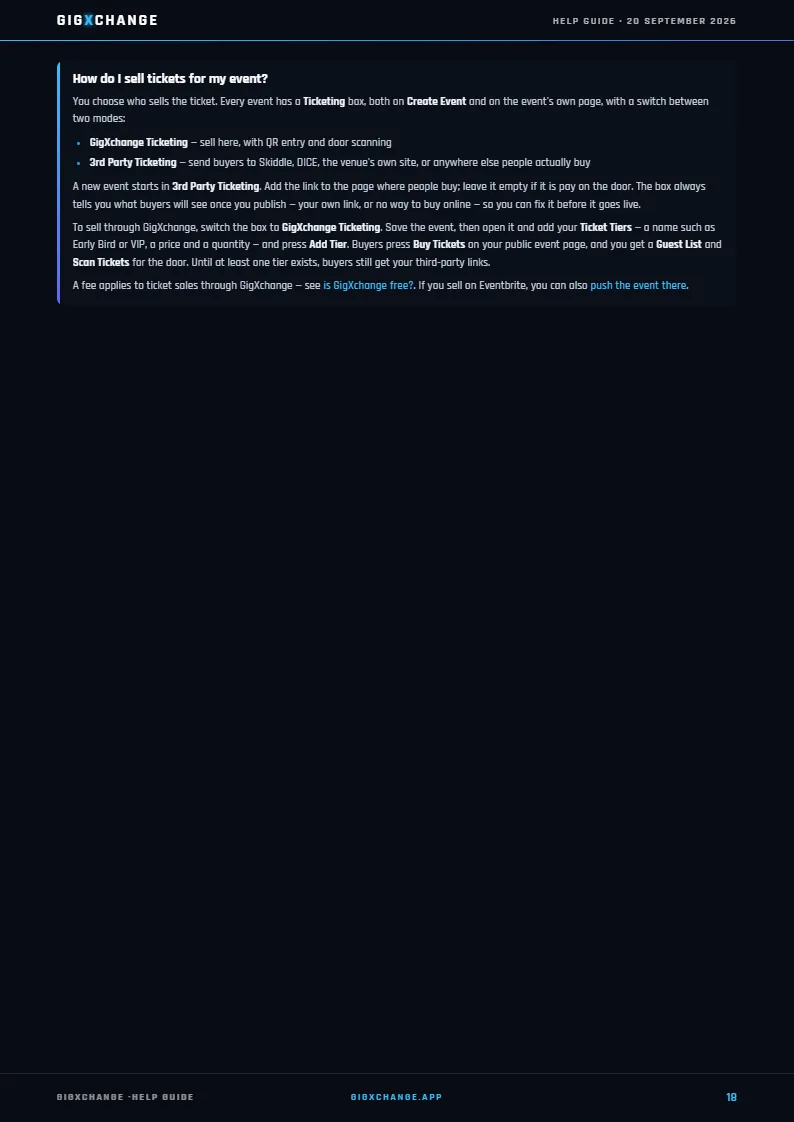
You choose who sells the ticket. Every event has a Ticketing box, both on Create Event and on the event's own page, with a switch between two modes:
A new event starts in 3rd Party Ticketing. Add the link to the page where people buy; leave it empty if it is pay on the door. The box always tells you what buyers will see once you publish — your own link, or no way to buy online — so you can fix it before it goes live.
To sell through GigXchange, switch the box to GigXchange Ticketing. Save the event, then open it and add your Ticket Tiers — a name such as Early Bird or VIP, a price and a quantity — and press Add Tier. Buyers press Buy Tickets on your public event page, and you get a Guest List and Scan Tickets for the door. Until at least one tier exists, buyers still get your third-party links.
A fee applies to ticket sales through GigXchange — see is GigXchange free?. If you sell on Eventbrite, you can also push the event there.
Passwords, settings, and control over your data.
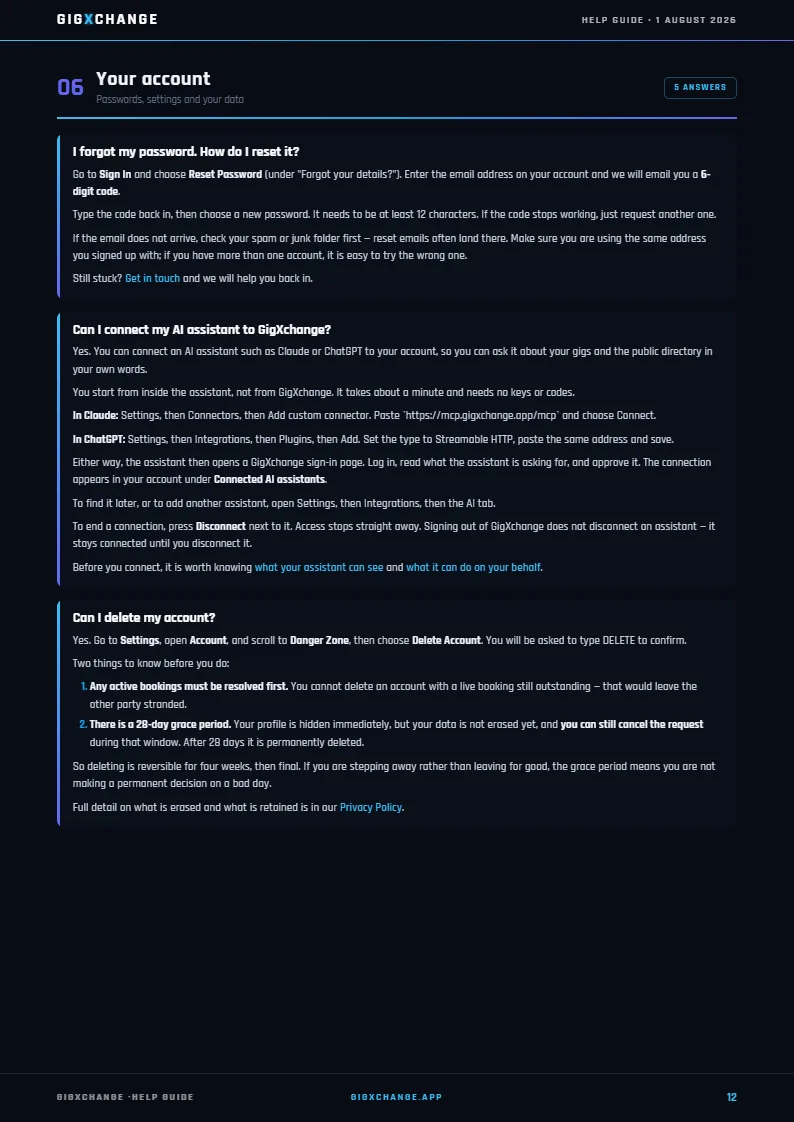
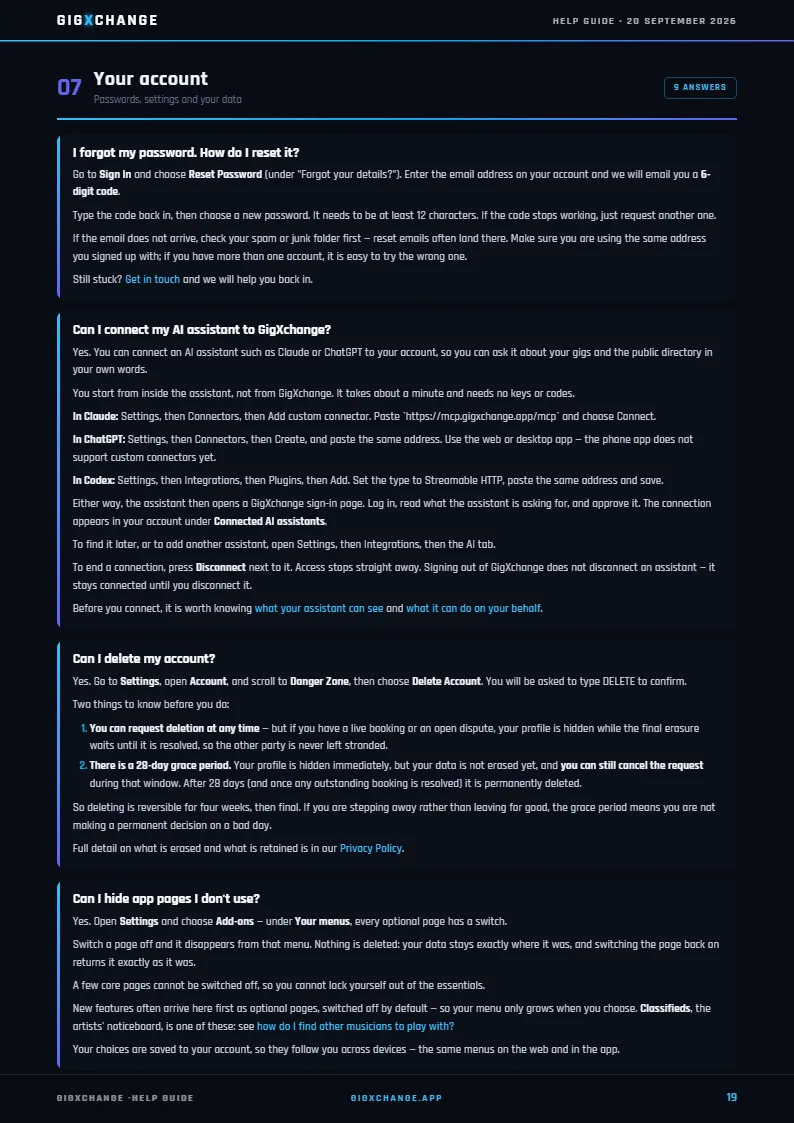
Go to Sign In and choose Reset Password (under "Forgot your details?"). Enter the email address on your account and we will email you a 6-digit code.
Type the code back in, then choose a new password. It needs to be at least 12 characters. If the code stops working, just request another one.
If the email does not arrive, check your spam or junk folder first — reset emails often land there. Make sure you are using the same address you signed up with; if you have more than one account, it is easy to try the wrong one.
Still stuck? Get in touch and we will help you back in.
Yes. You can connect an AI assistant such as Claude or ChatGPT to your account, so you can ask it about your gigs and the public directory in your own words.
You start from inside the assistant, not from GigXchange. It takes about a minute and needs no keys or codes.
In Claude: Settings, then Connectors, then Add custom connector. Paste `https://mcp.gigxchange.app/mcp` and choose Connect.
In ChatGPT: Settings, then Connectors, then Create, and paste the same address. Use the web or desktop app — the phone app does not support custom connectors yet.
In Codex: Settings, then Integrations, then Plugins, then Add. Set the type to Streamable HTTP, paste the same address and save.
Either way, the assistant then opens a GigXchange sign-in page. Log in, read what the assistant is asking for, and approve it. The connection appears in your account under Connected AI assistants.
To find it later, or to add another assistant, open Settings, then Integrations, then the AI tab.
To end a connection, press Disconnect next to it. Access stops straight away. Signing out of GigXchange does not disconnect an assistant — it stays connected until you disconnect it.
Before you connect, it is worth knowing what your assistant can see and what it can do on your behalf.
Yes. Go to Settings, open Account, and scroll to Danger Zone, then choose Delete Account. You will be asked to type DELETE to confirm.
Two things to know before you do:
So deleting is reversible for four weeks, then final. If you are stepping away rather than leaving for good, the grace period means you are not making a permanent decision on a bad day.
Full detail on what is erased and what is retained is in our Privacy Policy.
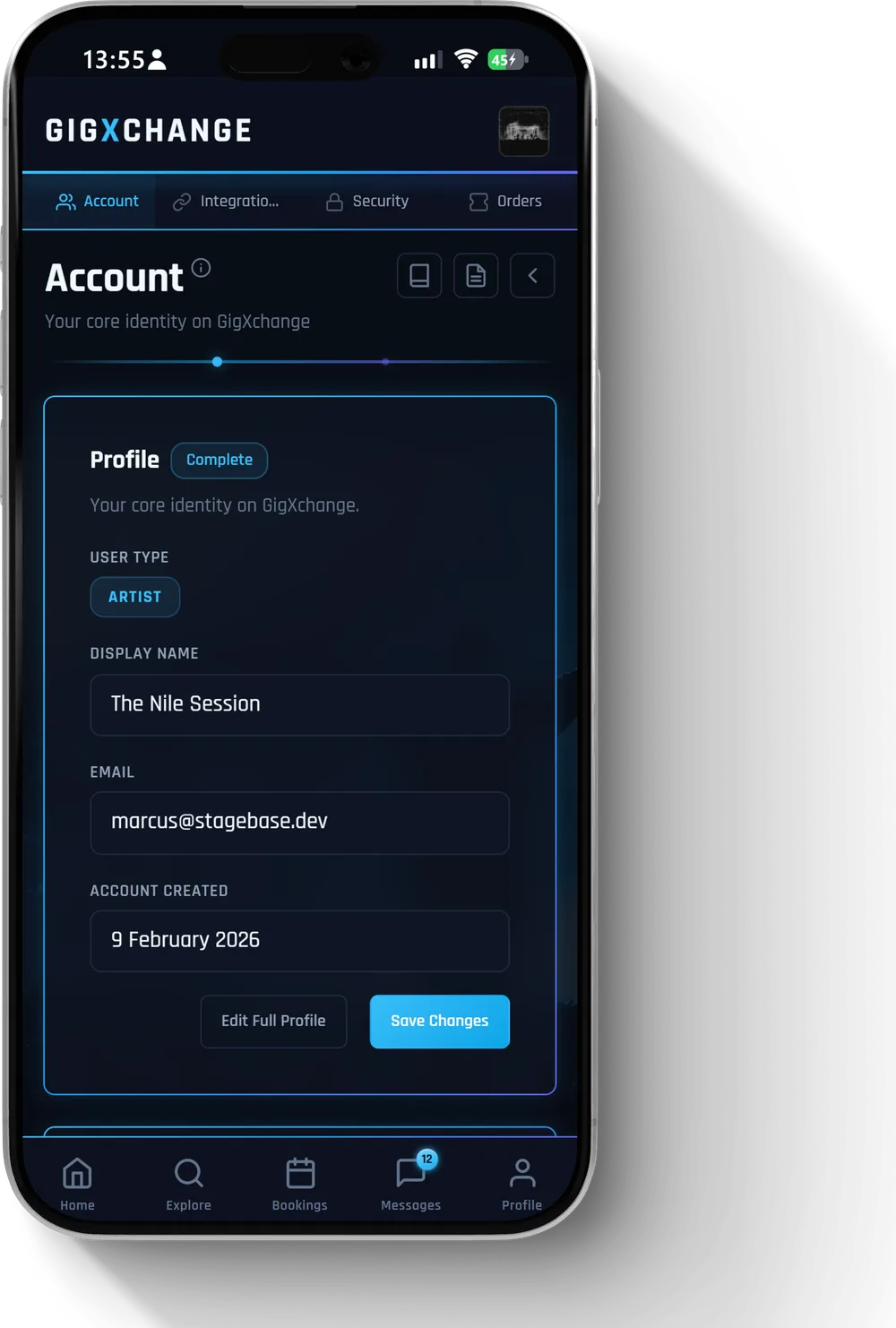 See it in the app Settings > Account, where the Danger Zone lives
 Yes. Open Settings and choose Add-ons — under Your menus, every optional page has a switch.
Switch a page off and it disappears from that menu. Nothing is deleted: your data stays exactly where it was, and switching the page back on returns it exactly as it was.
A few core pages cannot be switched off, so you cannot lock yourself out of the essentials.
New features often arrive here first as optional pages, switched off by default — so your menu only grows when you choose. Classifieds, the artists' noticeboard, is one of these: see how do I find other musicians to play with?
Your choices are saved to your account, so they follow you across devices — the same menus on the web and in the app.
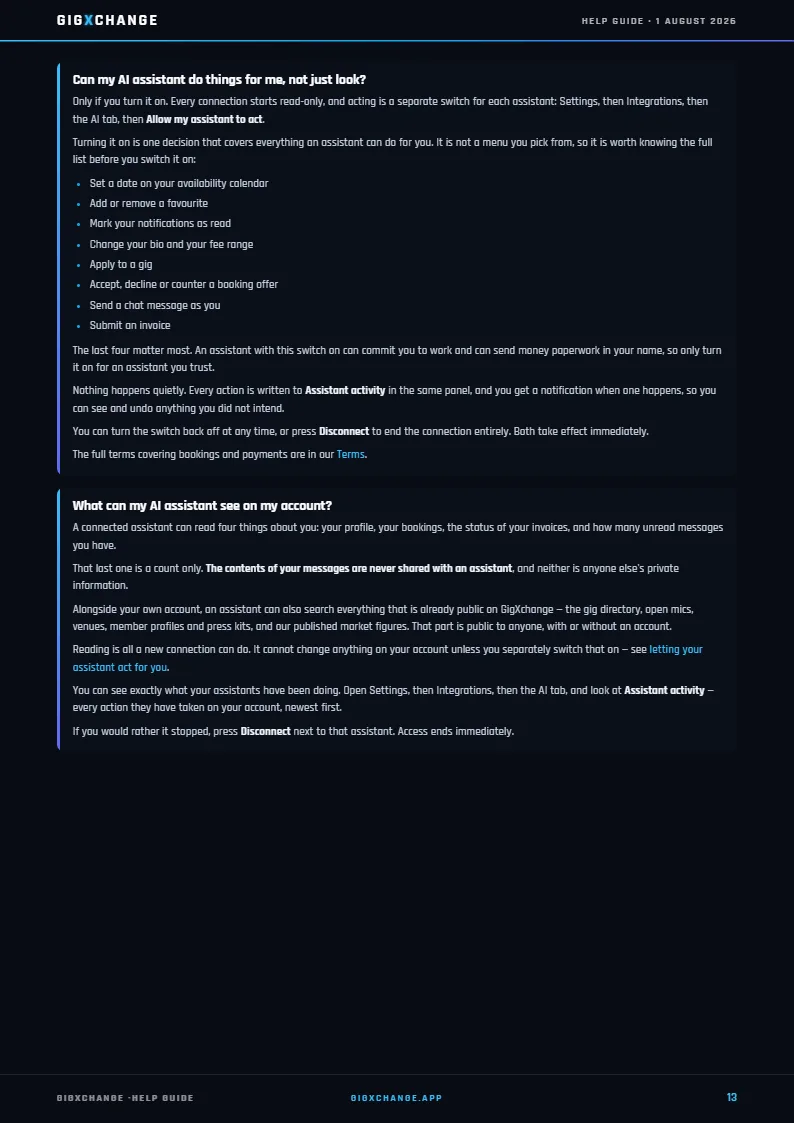
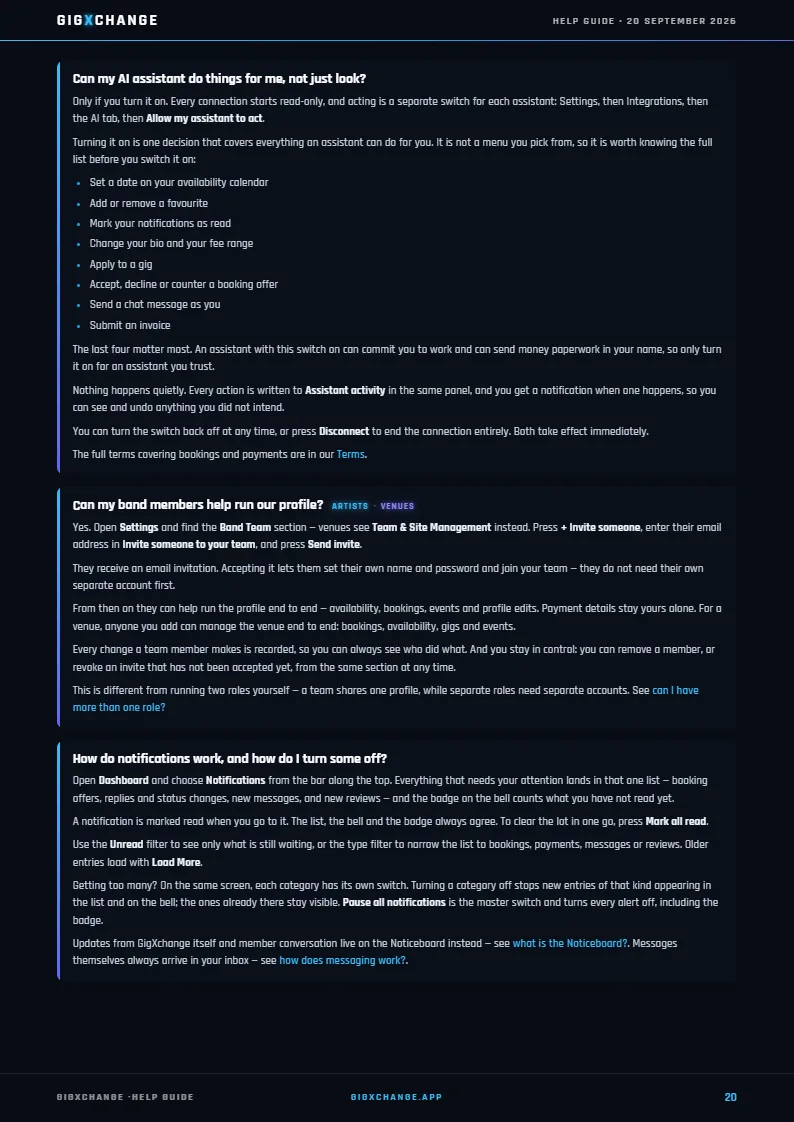
Only if you turn it on. Every connection starts read-only, and acting is a separate switch for each assistant: Settings, then Integrations, then the AI tab, then Allow my assistant to act.
Turning it on is one decision that covers everything an assistant can do for you. It is not a menu you pick from, so it is worth knowing the full list before you switch it on:
The last four matter most. An assistant with this switch on can commit you to work and can send money paperwork in your name, so only turn it on for an assistant you trust.
Nothing happens quietly. Every action is written to Assistant activity in the same panel, and you get a notification when one happens, so you can see and undo anything you did not intend.
You can turn the switch back off at any time, or press Disconnect to end the connection entirely. Both take effect immediately.
The full terms covering bookings and payments are in our Terms.
Yes. Open Settings and find the Band Team section — venues see Team & Site Management instead. Press + Invite someone, enter their email address in Invite someone to your team, and press Send invite.
They receive an email invitation. Accepting it lets them set their own name and password and join your team — they do not need their own separate account first.
From then on they can help run the profile end to end — availability, bookings, events and profile edits. Payment details stay yours alone. For a venue, anyone you add can manage the venue end to end: bookings, availability, gigs and events.
Every change a team member makes is recorded, so you can always see who did what. And you stay in control: you can remove a member, or revoke an invite that has not been accepted yet, from the same section at any time.
This is different from running two roles yourself — a team shares one profile, while separate roles need separate accounts. See can I have more than one role?
Open Dashboard and choose Notifications from the bar along the top. Everything that needs your attention lands in that one list — booking offers, replies and status changes, new messages, and new reviews — and the badge on the bell counts what you have not read yet.
A notification is marked read when you go to it. The list, the bell and the badge always agree. To clear the lot in one go, press Mark all read.
Use the Unread filter to see only what is still waiting, or the type filter to narrow the list to bookings, payments, messages or reviews. Older entries load with Load More.
Getting too many? On the same screen, each category has its own switch. Turning a category off stops new entries of that kind appearing in the list and on the bell; the ones already there stay visible. Pause all notifications is the master switch and turns every alert off, including the badge.
Updates from GigXchange itself and member conversation live on the Noticeboard instead — see what is the Noticeboard?. Messages themselves always arrive in your inbox — see how does messaging work?.
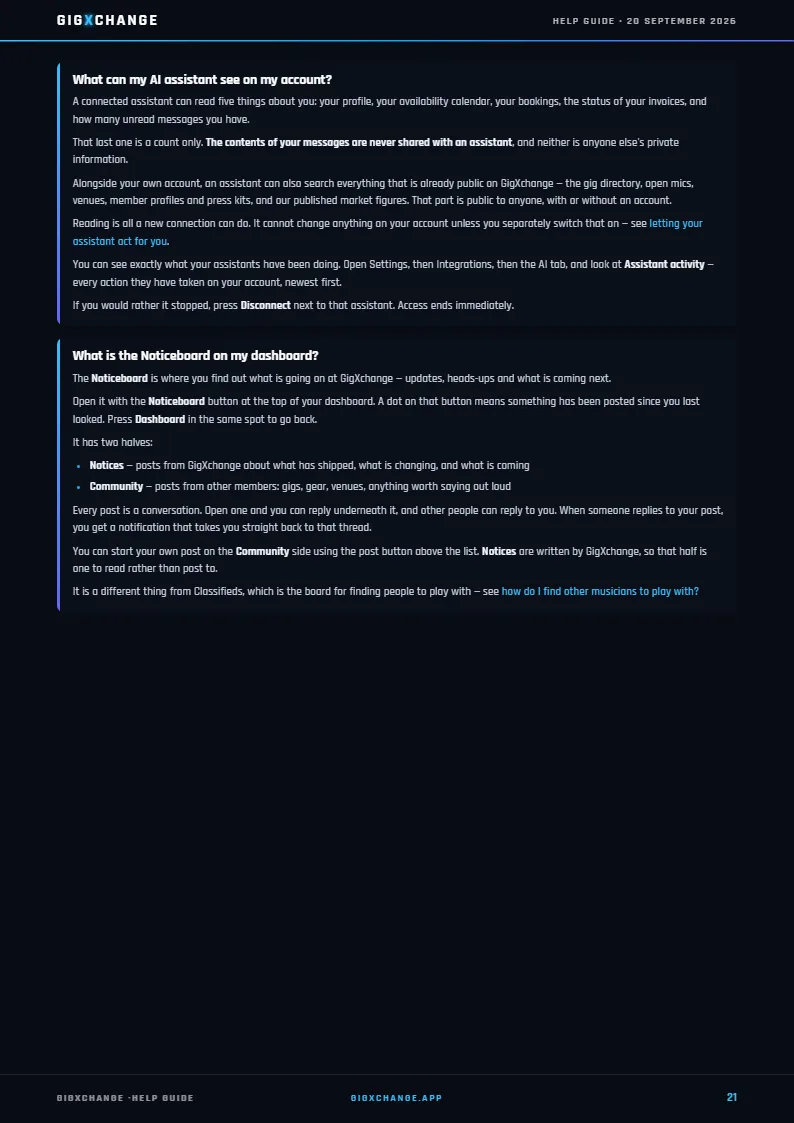
A connected assistant can read five things about you: your profile, your availability calendar, your bookings, the status of your invoices, and how many unread messages you have.
That last one is a count only. The contents of your messages are never shared with an assistant, and neither is anyone else's private information.
Alongside your own account, an assistant can also search everything that is already public on GigXchange — the gig directory, open mics, venues, member profiles and press kits, and our published market figures. That part is public to anyone, with or without an account.
Reading is all a new connection can do. It cannot change anything on your account unless you separately switch that on — see letting your assistant act for you.
You can see exactly what your assistants have been doing. Open Settings, then Integrations, then the AI tab, and look at Assistant activity — every action they have taken on your account, newest first.
If you would rather it stopped, press Disconnect next to that assistant. Access ends immediately.
The Noticeboard is where you find out what is going on at GigXchange — updates, heads-ups and what is coming next.
Open it with the Noticeboard button at the top of your dashboard. A dot on that button means something has been posted since you last looked. Press Dashboard in the same spot to go back.
It has two halves:
Every post is a conversation. Open one and you can reply underneath it, and other people can reply to you. When someone replies to your post, you get a notification that takes you straight back to that thread.
You can start your own post on the Community side using the post button above the list. Notices are written by GigXchange, so that half is one to read rather than post to.
It is a different thing from Classifieds, which is the board for finding people to play with — see how do I find other musicians to play with?
Disputes, dead ends, and how to reach us.
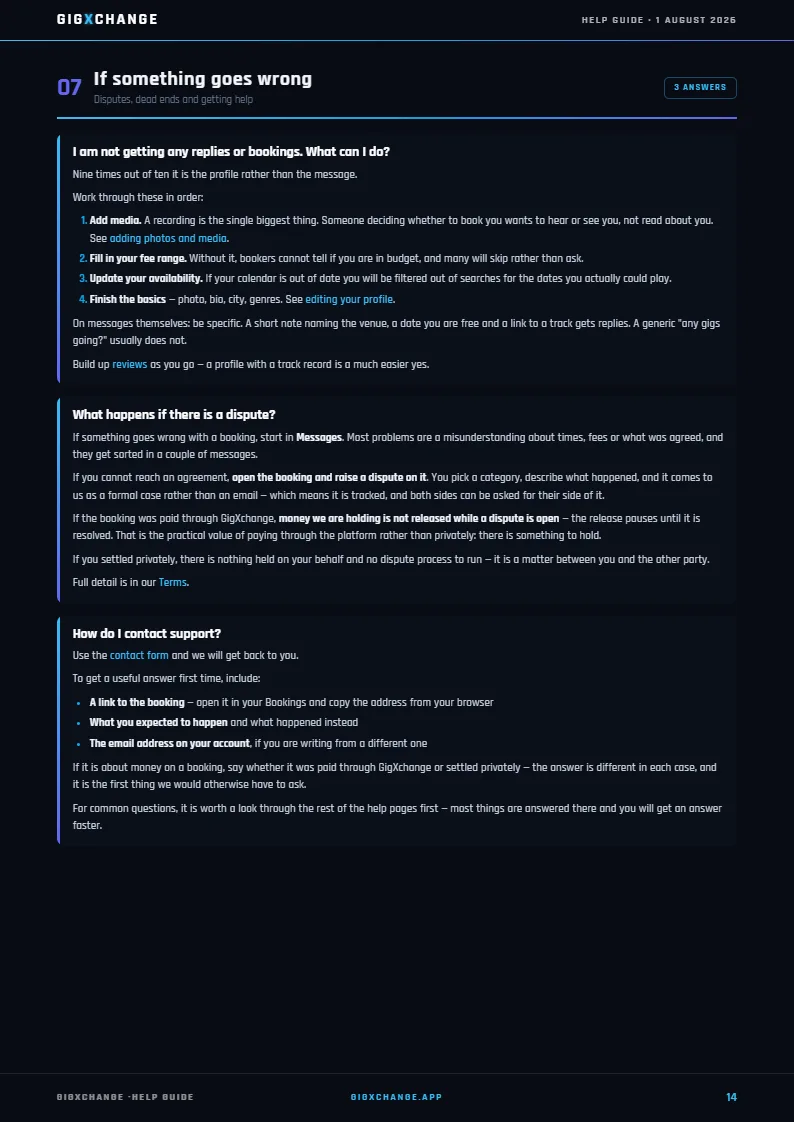
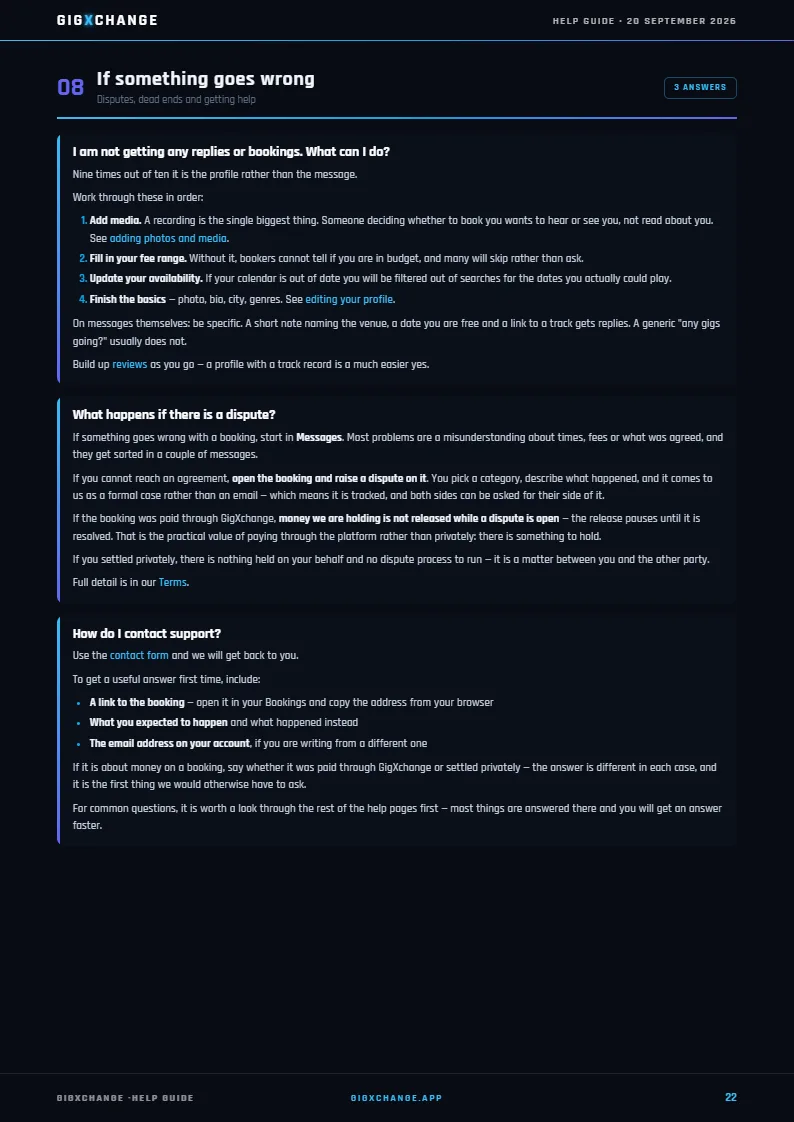
Nine times out of ten it is the profile rather than the message.
Work through these in order:
On messages themselves: be specific. A short note naming the venue, a date you are free and a link to a track gets replies. A generic "any gigs going?" usually does not.
Build up reviews as you go — a profile with a track record is a much easier yes.
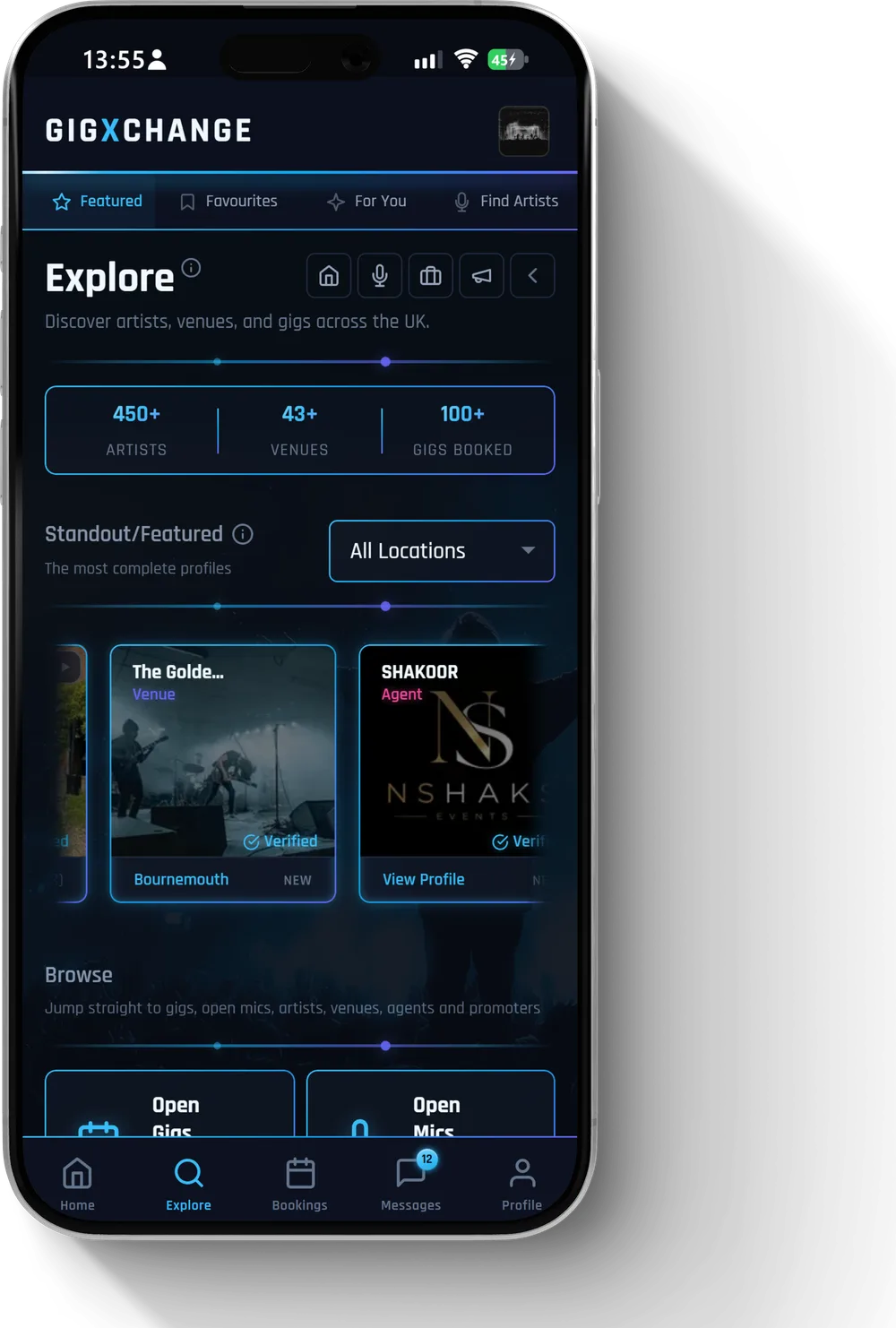 See it in the app Explore — how bookers browse, and what your card looks like to them
 If something goes wrong with a booking, start in Messages. Most problems are a misunderstanding about times, fees or what was agreed, and they get sorted in a couple of messages.
If you cannot reach an agreement, open the booking and raise a dispute on it. You pick a category, describe what happened, and it comes to us as a formal case rather than an email — which means it is tracked, and both sides can be asked for their side of it.
If the booking was paid through GigXchange, money we are holding is not released while a dispute is open — the release pauses until it is resolved. That is the practical value of paying through the platform rather than privately: there is something to hold.
If you settled privately, there is nothing held on your behalf and no dispute process to run — it is a matter between you and the other party.
Full detail is in our Terms.
Use the contact form and we will get back to you.
To get a useful answer first time, include:
If it is about money on a booking, say whether it was paid through GigXchange or settled privately — the answer is different in each case, and it is the first thing we would otherwise have to ask.
For common questions, it is worth a look through the rest of the help pages first — most things are answered there and you will get an answer faster.
Every answer on this page as one document — a quick start, all 51 answers and a glossary. Flip through all 24 pages below, or download the PDF.
More ways to get the most from GigXchange
Step-by-step guides and guided walkthroughs for artists, venues, agents, and promoters.
Find open opportunities near you across the UK.
Learn more about our mission and the platform.
What we’ve shipped, changed, and what’s coming next.
Our team is here to help — drop us a message and we'll get back to you as soon as possible.
Stuck on something? Start here. If the answer isn’t on the page, email me and I’ll sort it — then add it for the next person.