

02 — The report
The latest issue is live
Flip through all 11 pages below, or download the PDF.
The latest issue is live
Flip through all 11 pages below, or download the PDF.
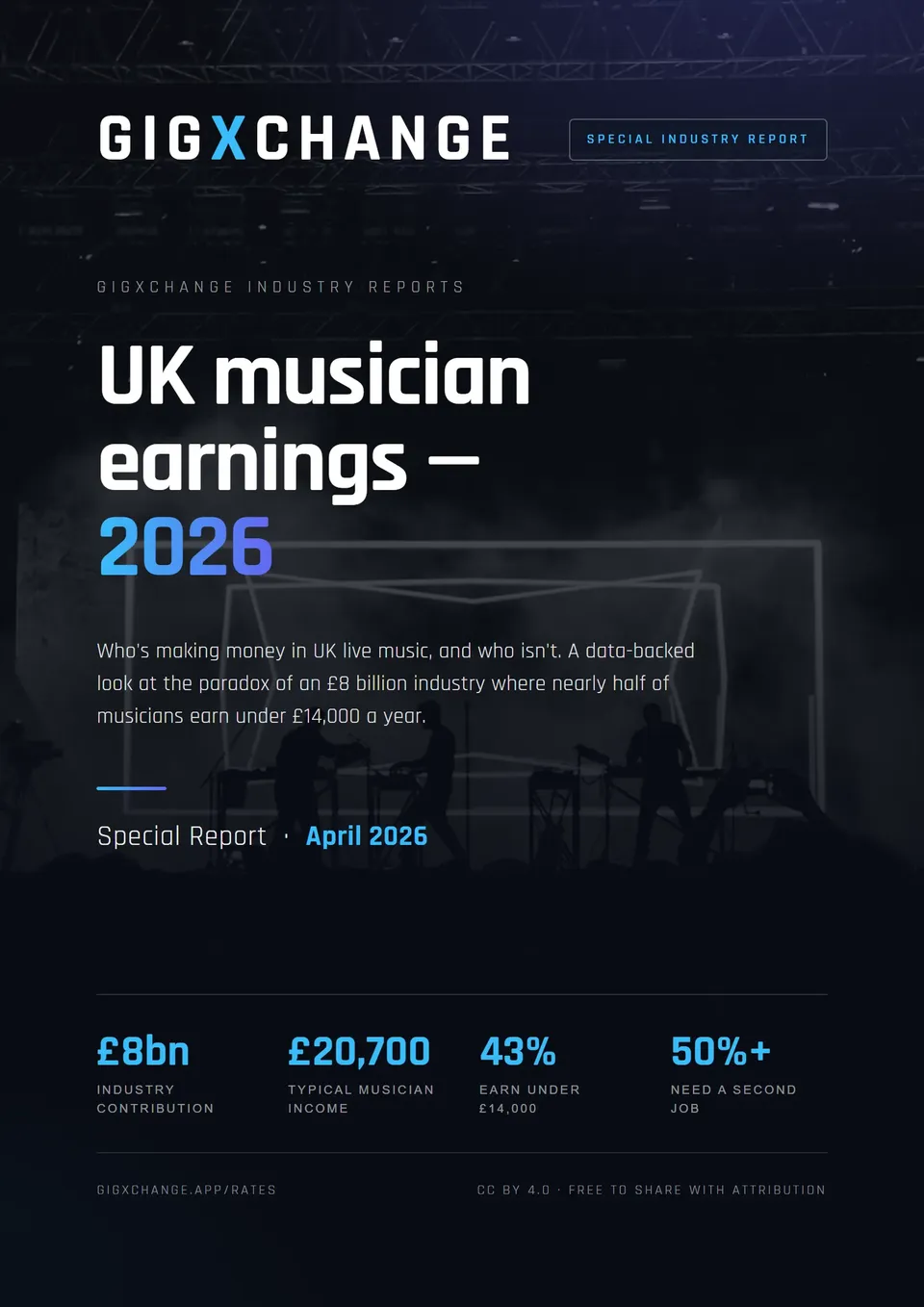



GigXchange Industry Reports · Special Edition · April 2026
An £8 billion industry where 43% of musicians earn under £14,000. A data-backed look at the paradox at the heart of UK live music.
Last updated: 25 October 2026
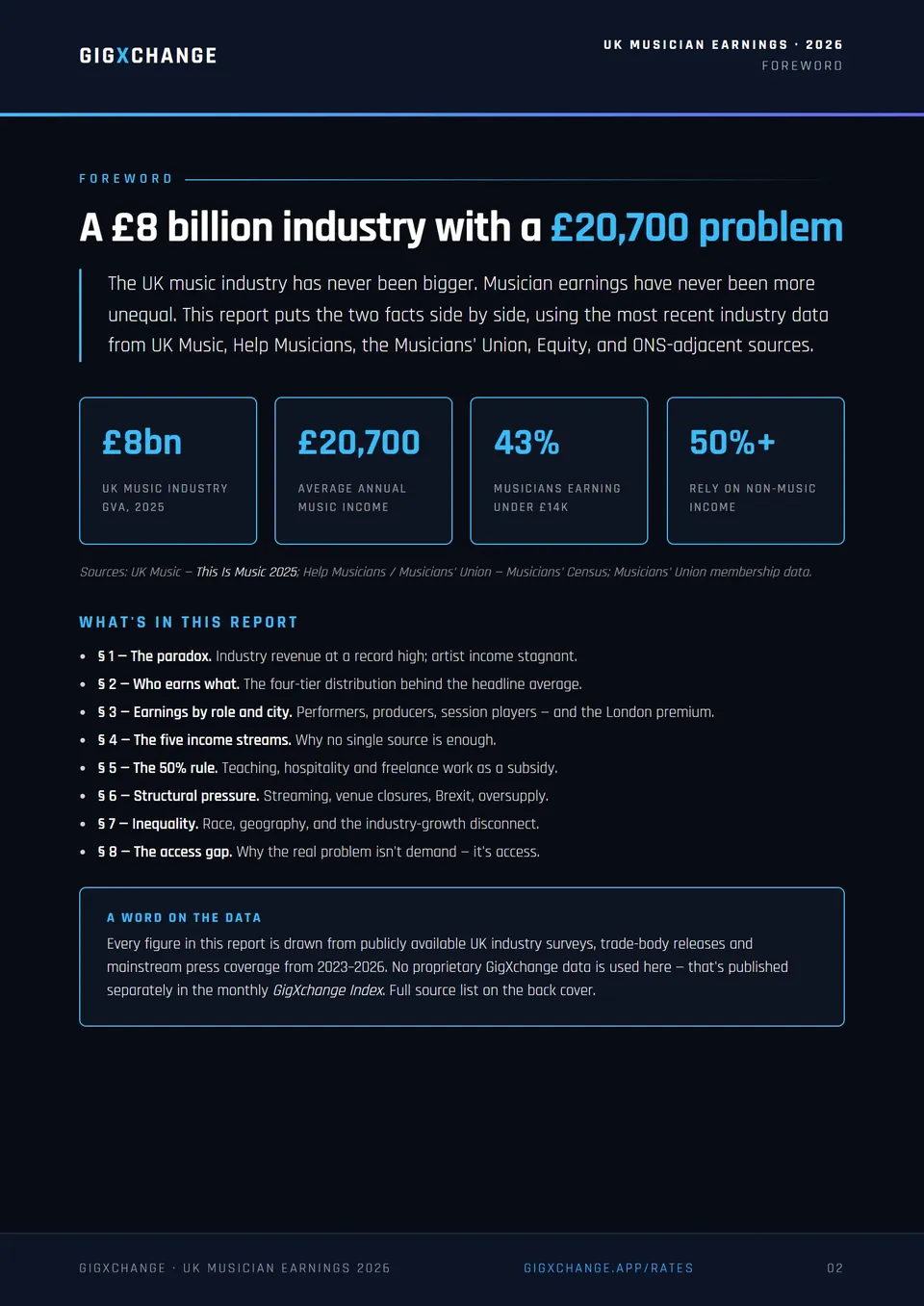
What UK music adds to the economy. UK music contributes about £8bn a year — the people who make it see little of it.
£8bn+ gross value added to the UK economy (UK Music)
Live music a large and growing share of it
Yet the median musician earns a fraction
Most of it flows to labels, publishers and platforms
The value gap is the story of this report
Free to cite under CC BY 4.0
| Read the full report | |
| UK market statistics | |
| Find out more | |
| Download PDF |
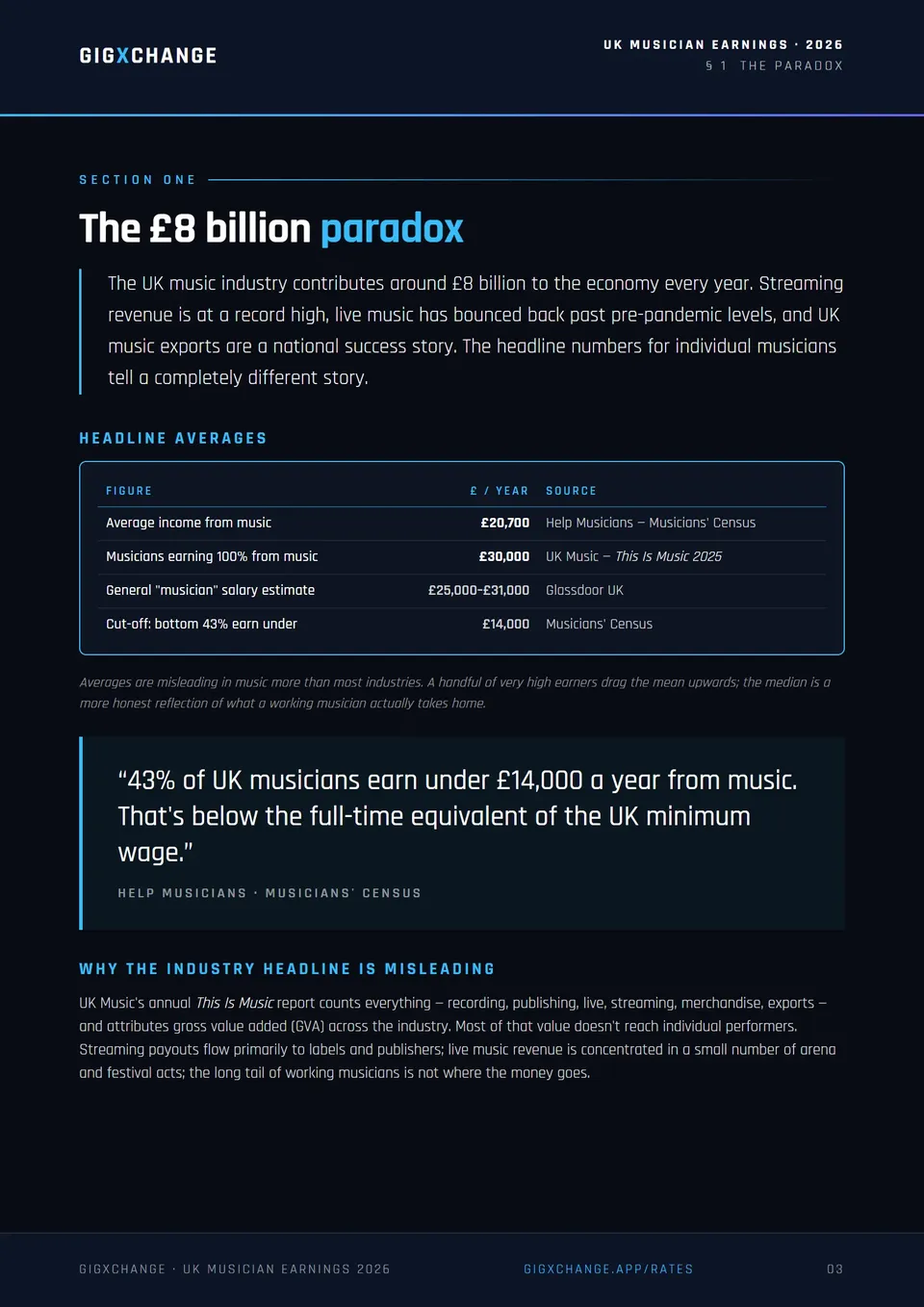
The typical UK musician income. The average working musician takes home about £20,700 a year from music.
£20,700 median music income (Musicians’ Census)
Below the median UK full-time wage
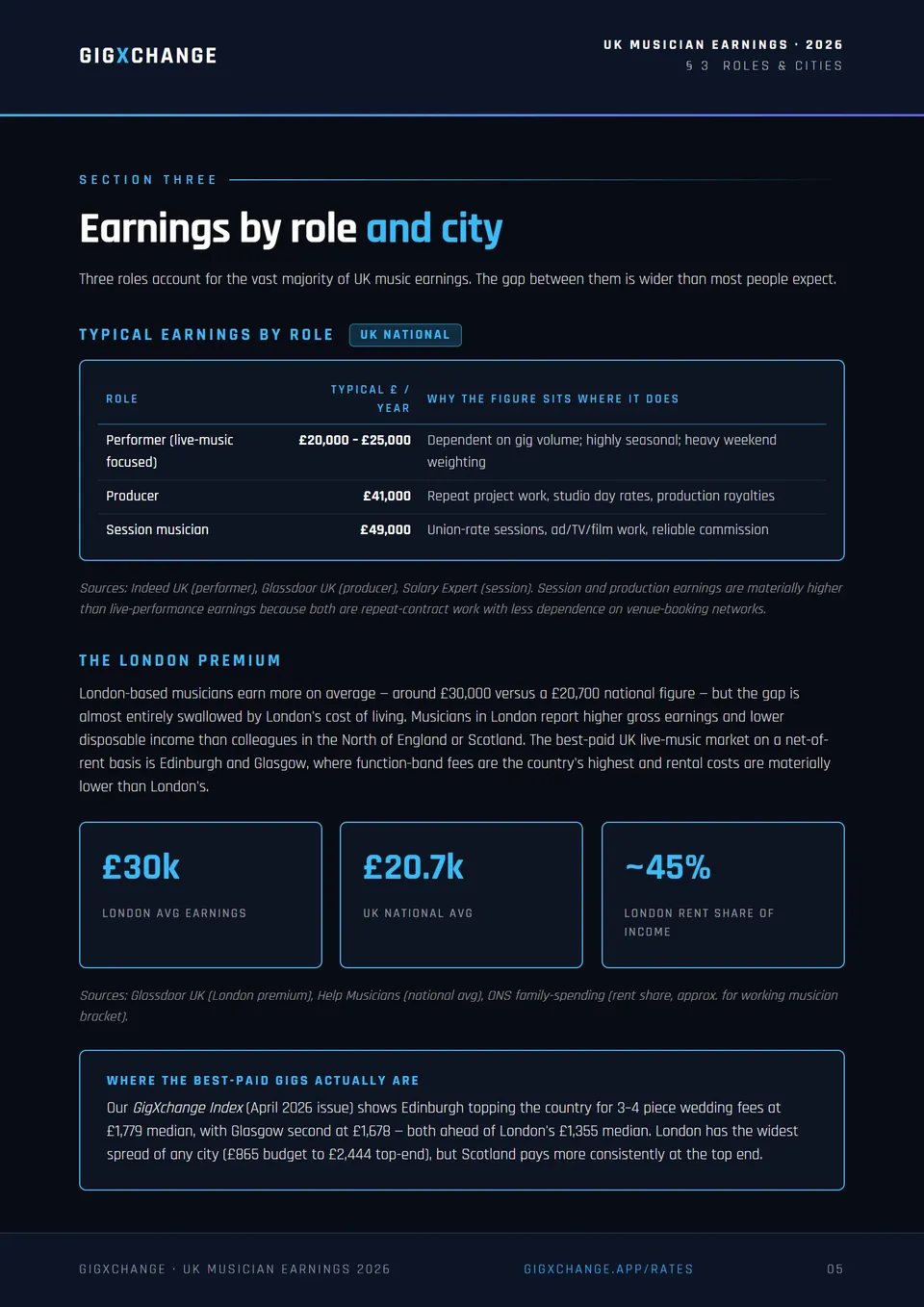
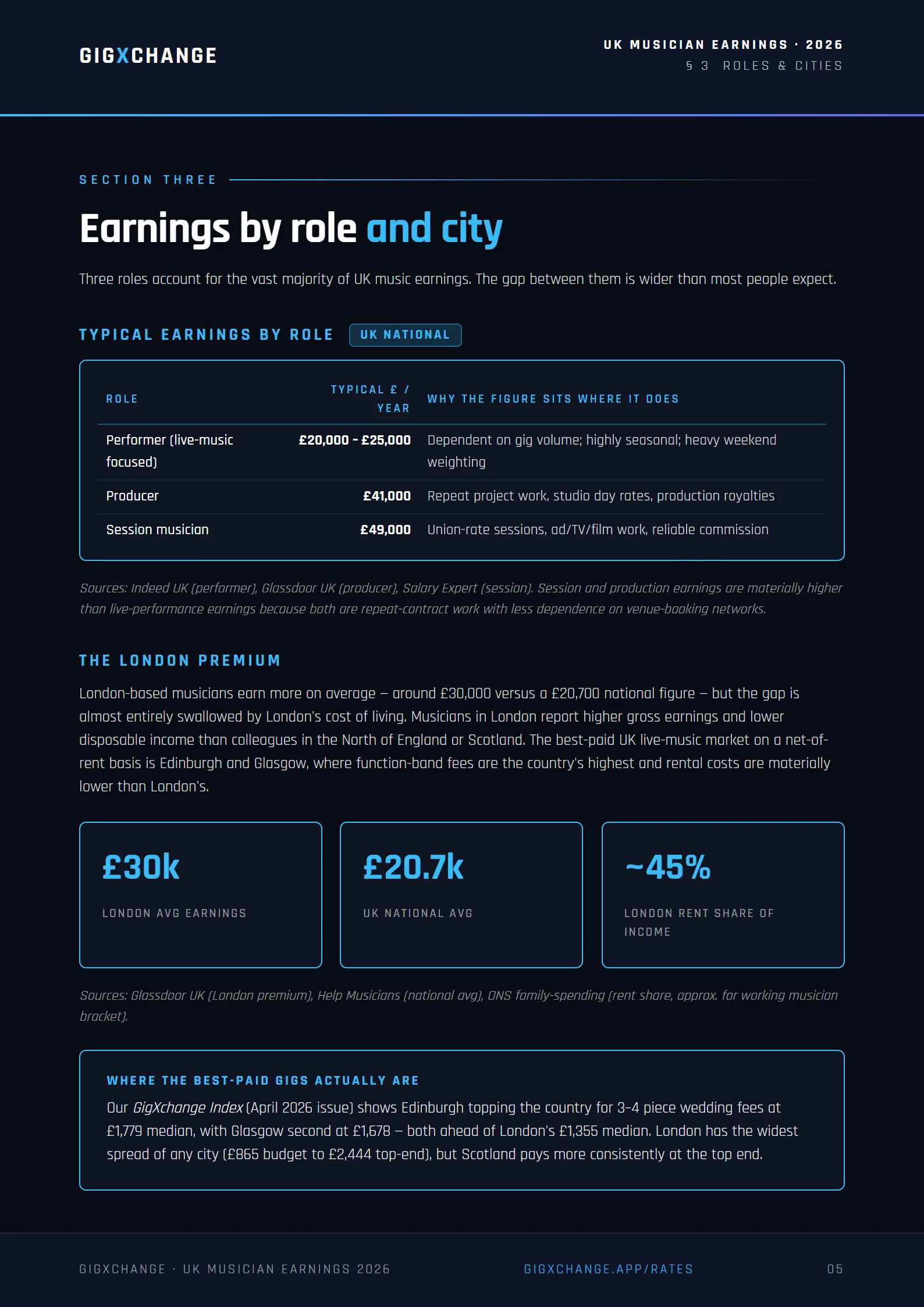
Session players ~£49k, producers ~£41k
Live performers sit at £20–25k
London ~£30k, but cost of living swallows it
The live GX Index tracks fees, refreshed nightly
| Read the full report | |
| Live GX Index | |
| Find out more | |
| Download PDF |
Nearly half below minimum-wage equivalent. 43% of UK musicians earn under £14,000 a year — below the full-time minimum-wage equivalent.
43% earn under £14k (Musicians’ Census)
The single most important figure of 2026
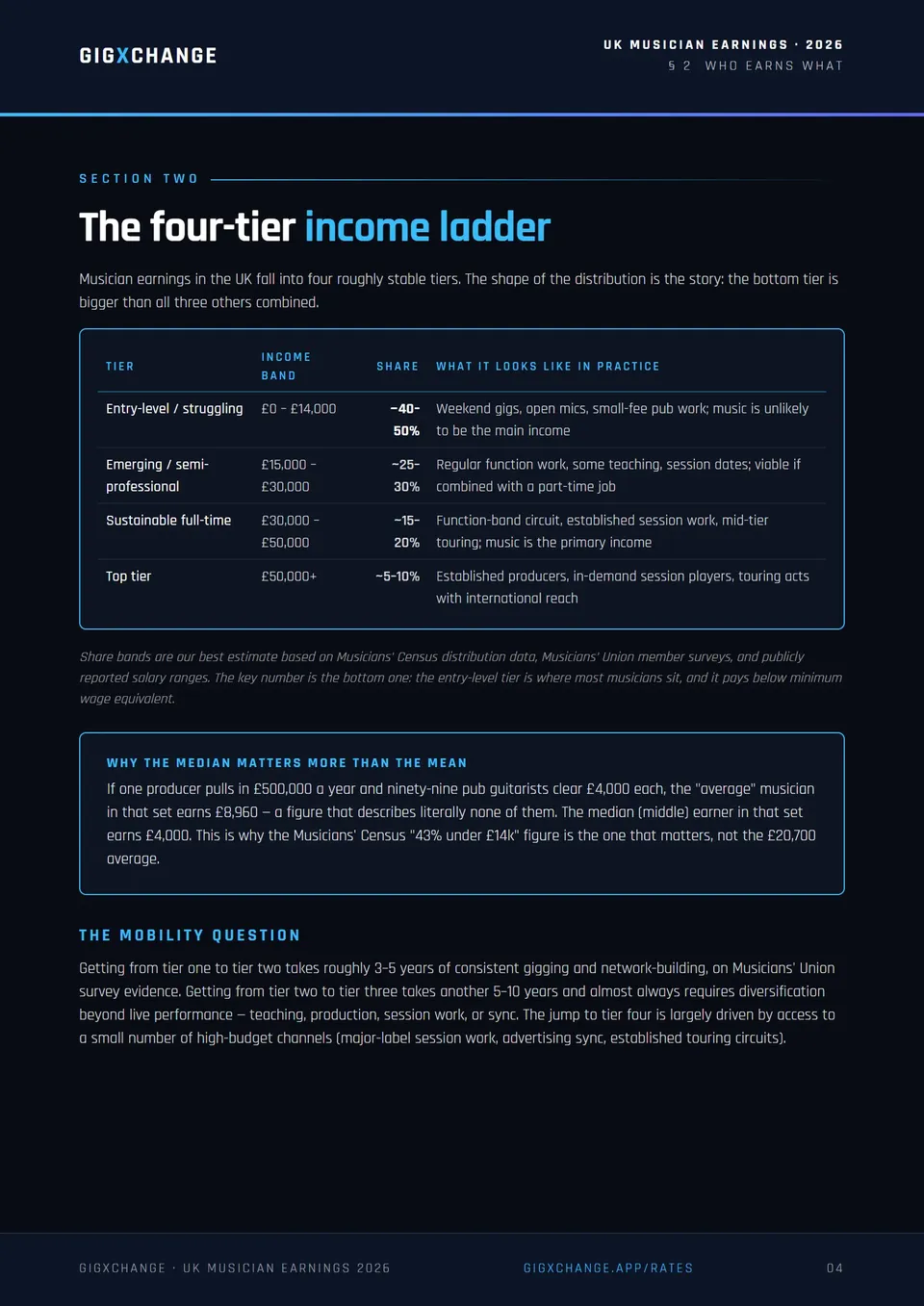
The bottom tier is bigger than the rest combined
The shape of the distribution is the story
An average hides a sharply unequal spread
See what gigs pay now on the live Index
| Read the full report | |
| Gig rate calculator | |
| Find out more | |
| Download PDF |
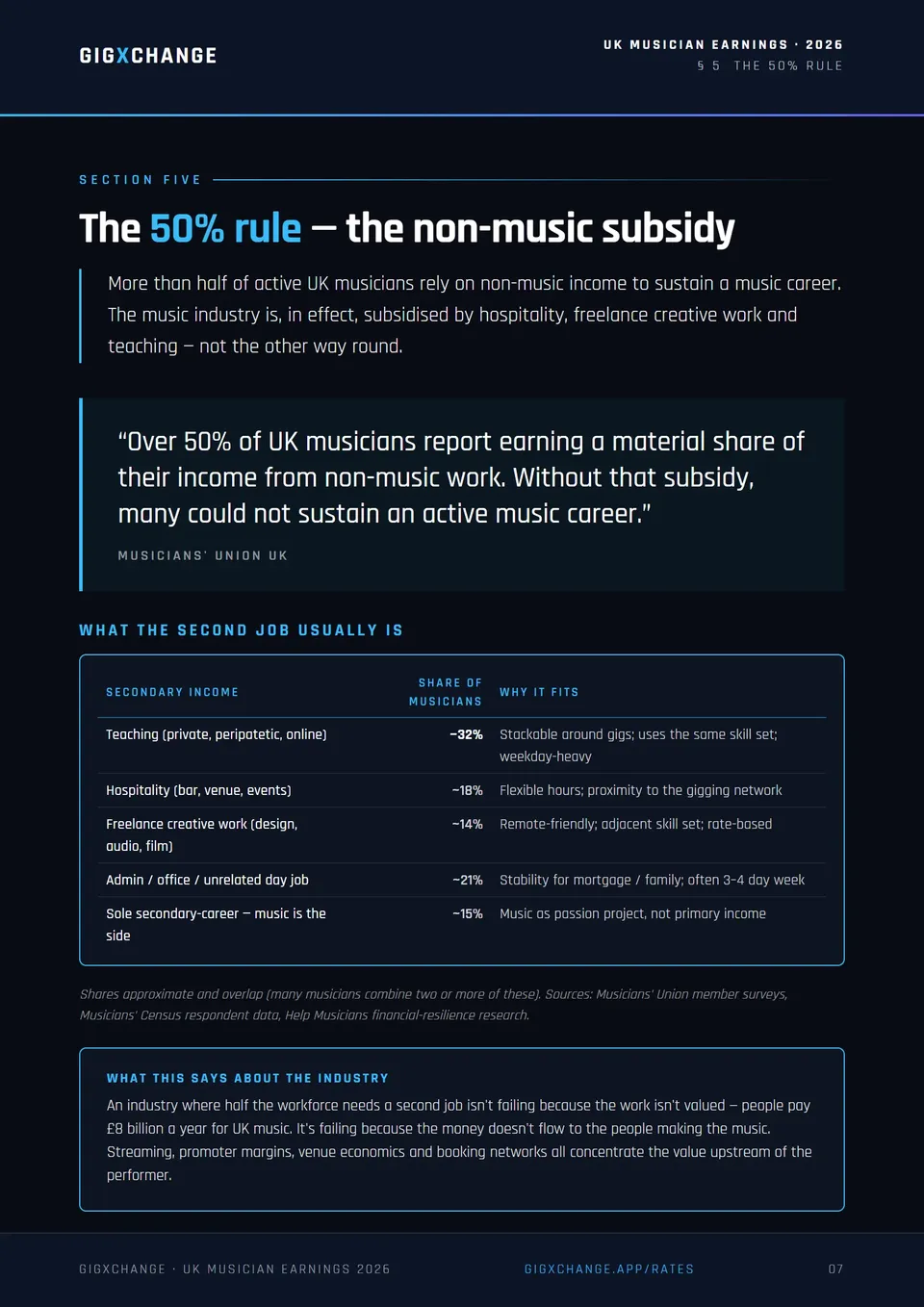
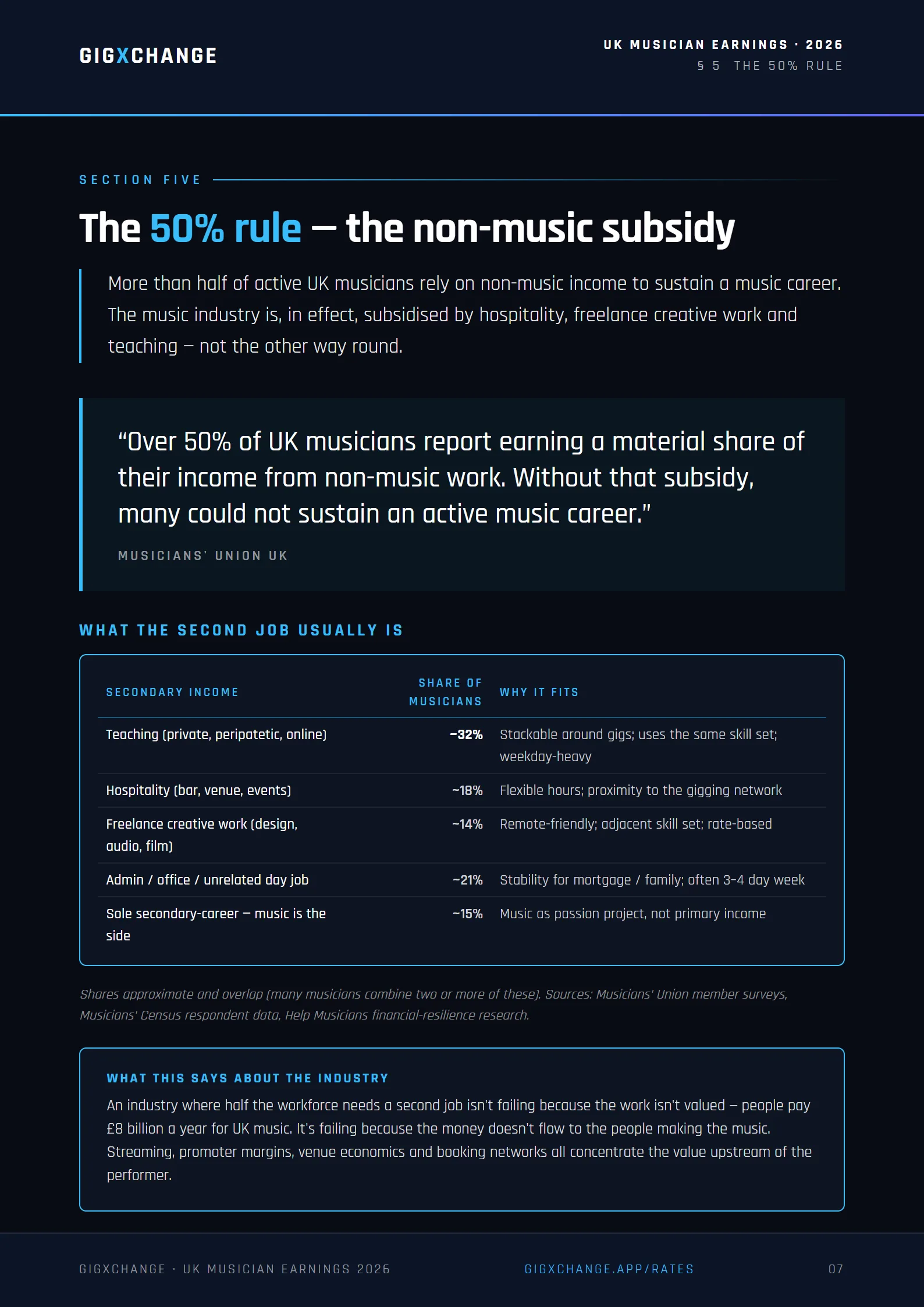
Most musicians need non-music income. Over half of UK musicians rely on non-music income to sustain a career.
50%+ hold a second job (Musicians’ Union)
Teaching ~32%, admin ~21%, hospitality ~18%
Many combine two or more
Live music is, in effect, subsidised by them
Structural headwinds keep fees down
How to lift the music share — in the report
| Read the full report | |
| Getting paid as a musician | |
| Find out more | |
| Download PDF |
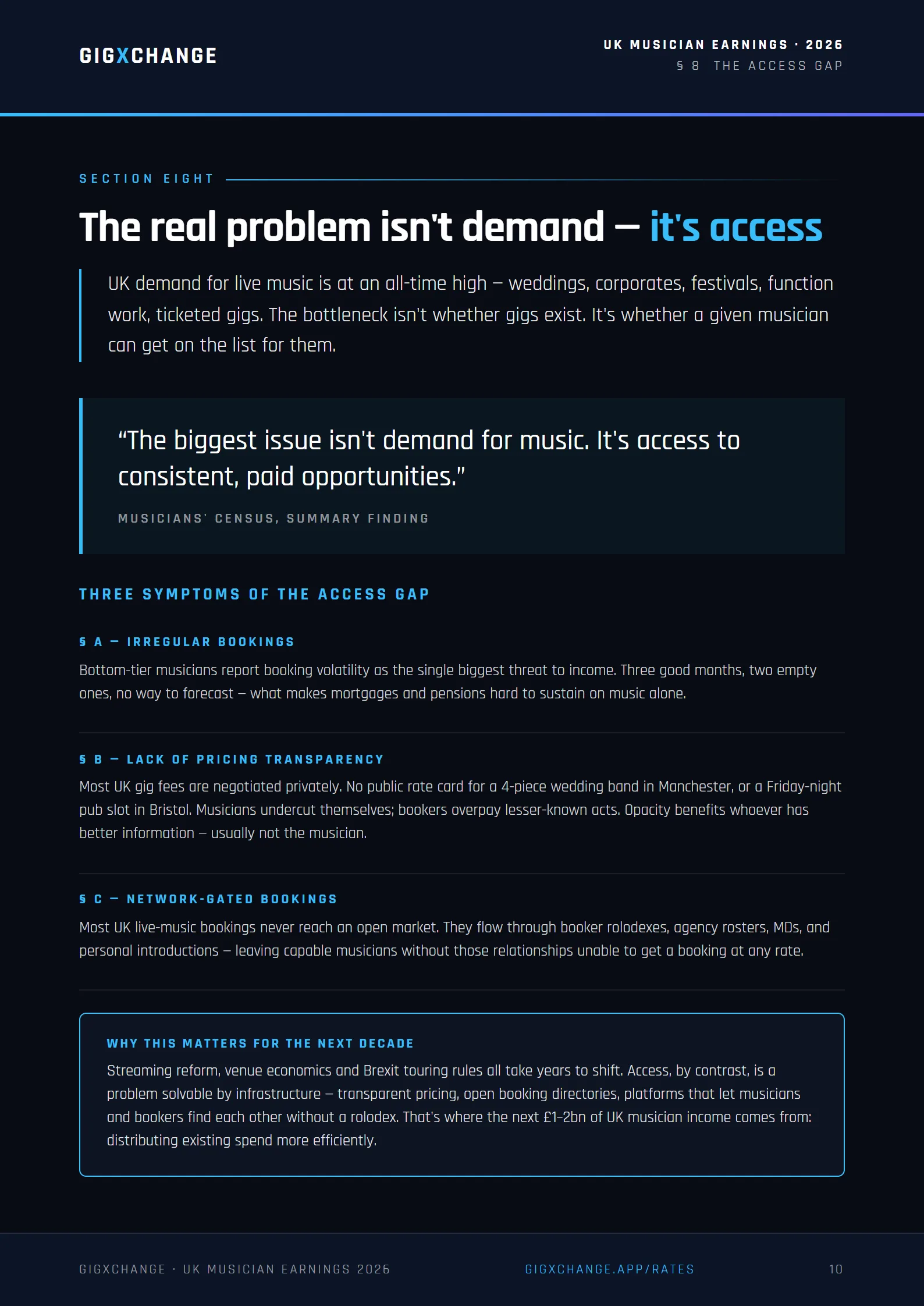
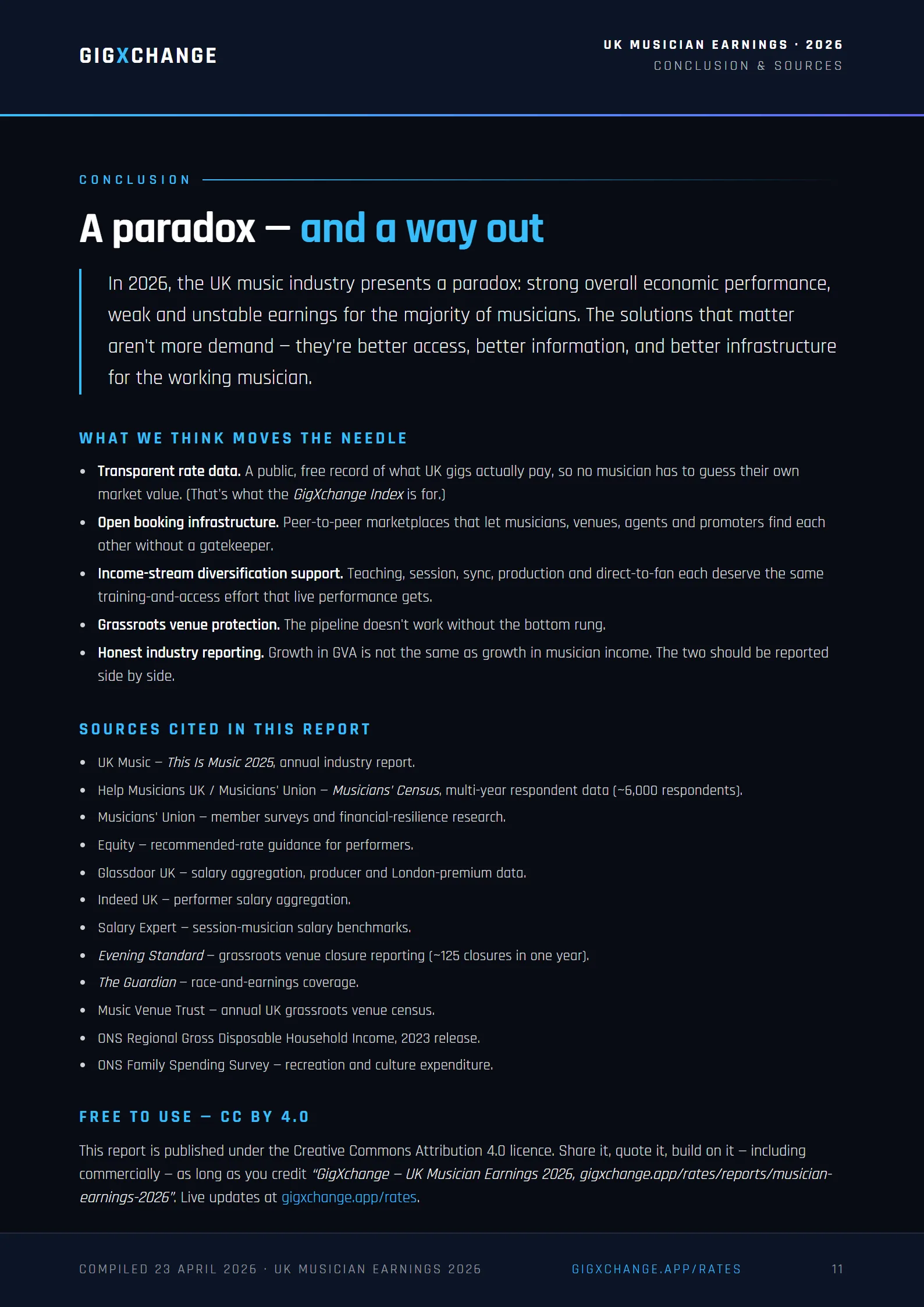
UK Musician Earnings 2026 — 11 pages. One honest, cross-referenced picture of what UK musicians actually earn.
11 pages, eight sections, free to read
Every mainstream UK source consolidated
Permanent DOI — 10.5281/zenodo.19732417
Open dataset on Hugging Face, Kaggle and Zenodo
Read in-browser or download the PDF
CC BY 4.0 — quote, adapt, build on it
| Read the full report | |
| Download the CSV | |
| Find out more | |
| Download PDF |

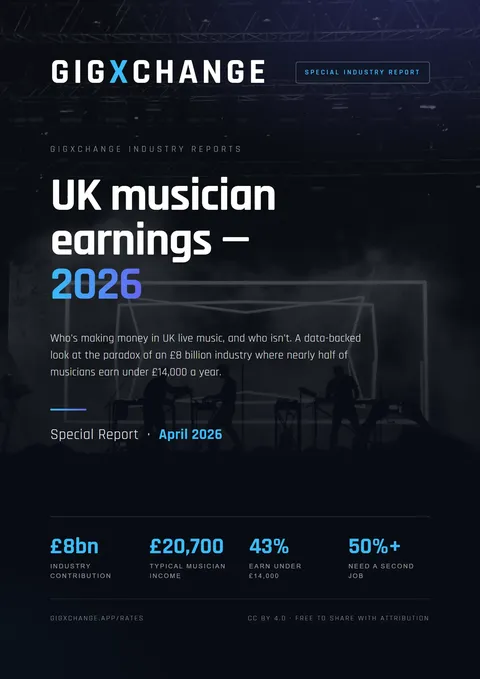
An £8 billion industry where 43% of musicians earn under £14,000. A data-backed look at the paradox at the heart of UK live music.
Last updated: 25 October 2026
Flip through all 11 pages below, or download the PDF.
Flip through all 11 pages below, or download the PDF.
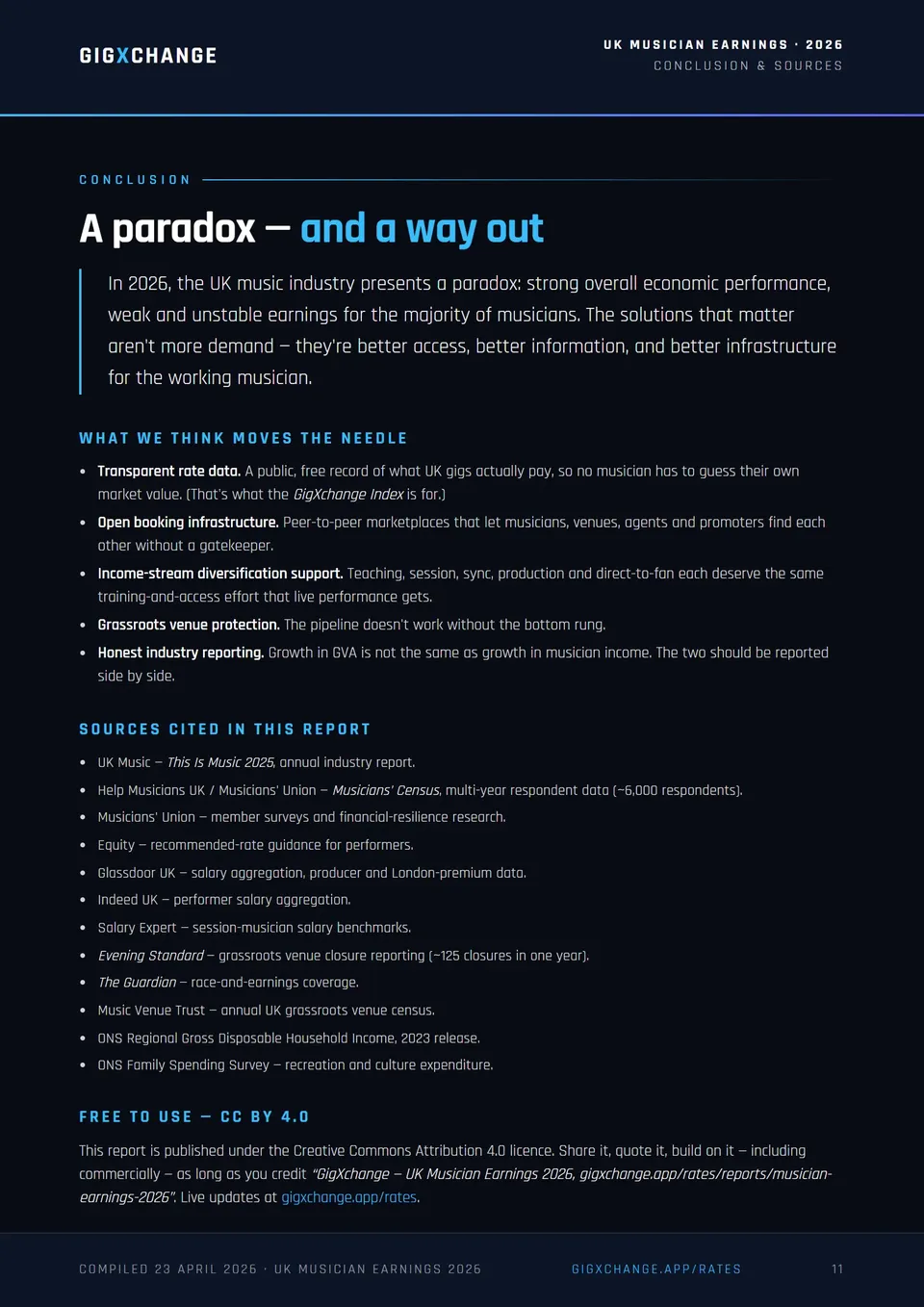
An honest, citation-backed picture of what UK musicians earn — who wins, who doesn’t, and why the gap between industry growth and artist income keeps widening.
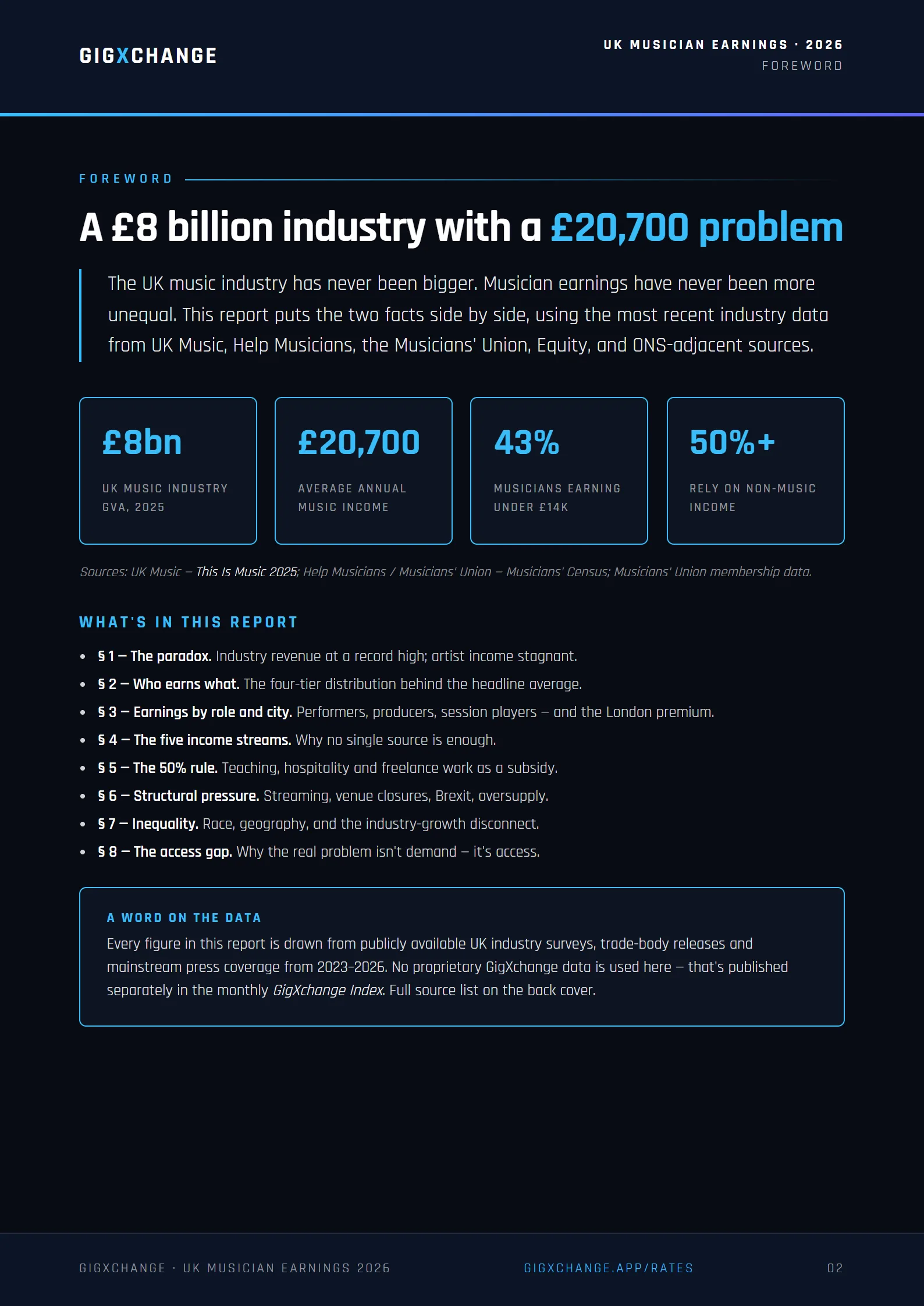
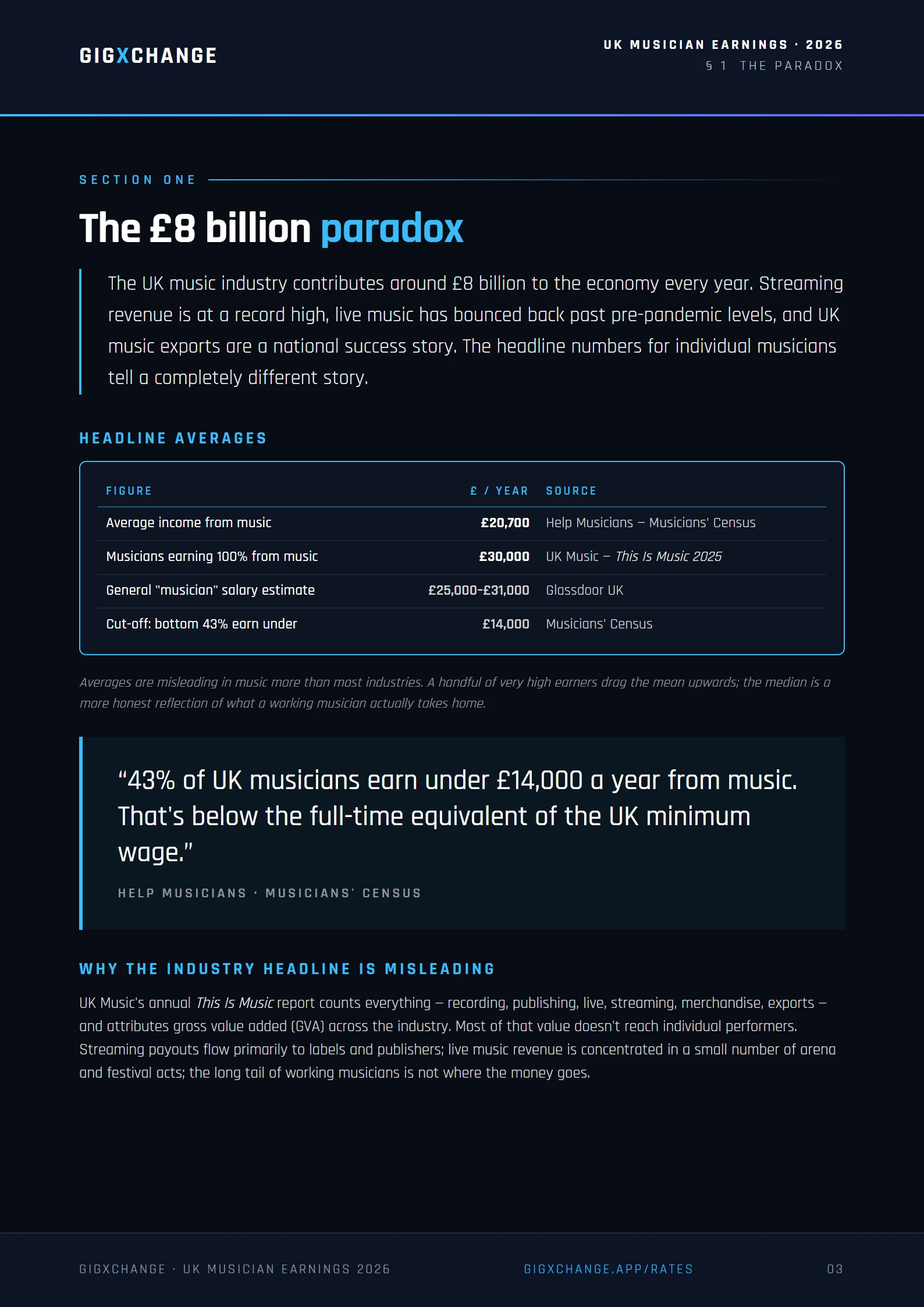
The UK music industry is worth around £8 billion a year. Streaming is at a record high, live has bounced past pre-pandemic levels, and UK music exports are a national success story. Against that backdrop, the average working musician earns £20,700 a year; the bottom 43% earn under £14,000; and more than half need a second job. This report joins the dots, sourced entirely from publicly available UK industry data.
| Who this report is forWorking musicians benchmarking their own income against the market. Music-industry journalists, researchers and policymakers needing a single citable source for UK earnings data. Music educators and careers advisors giving honest advice to students. Agents and venue operators understanding the economics of the acts they book. |
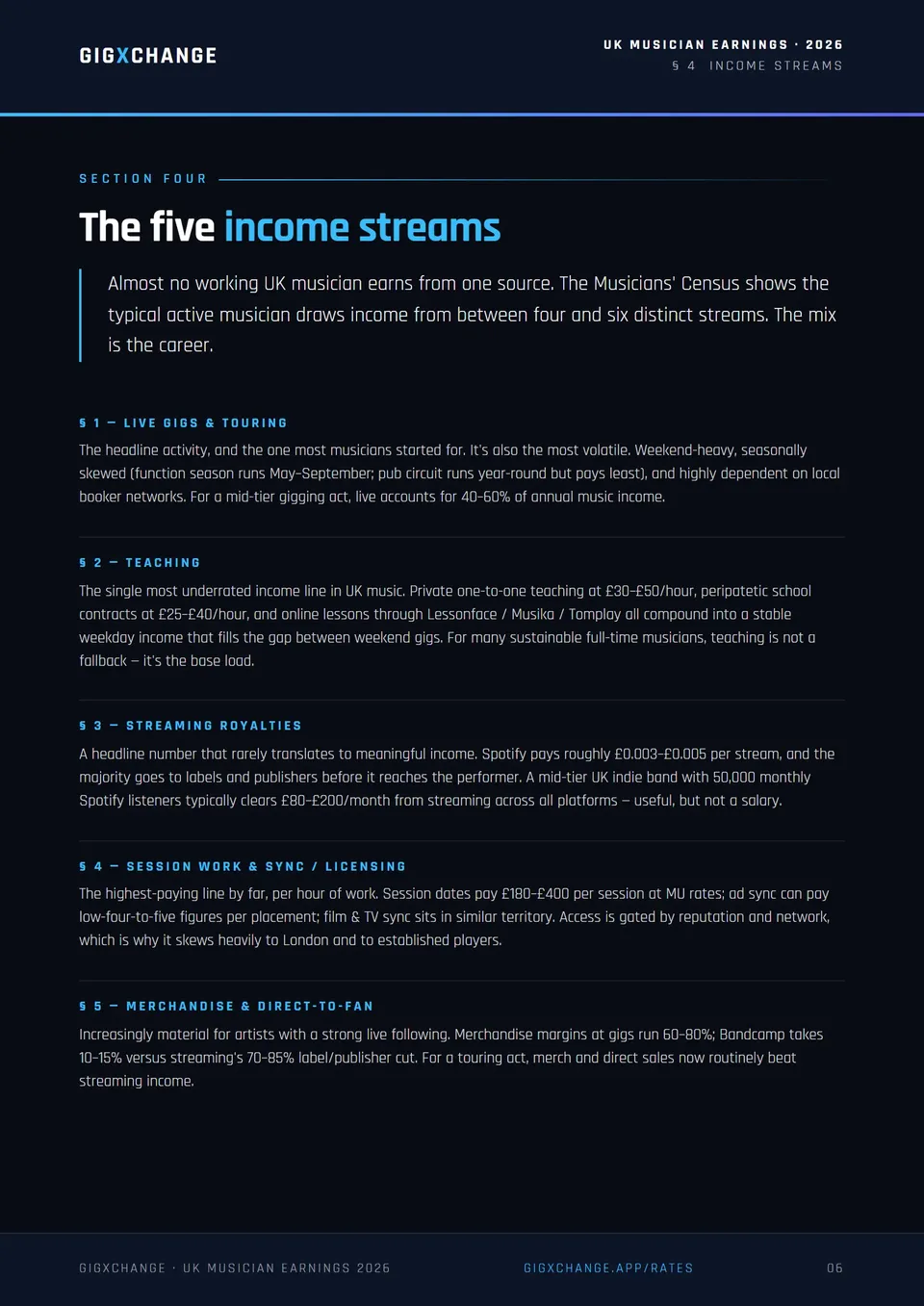
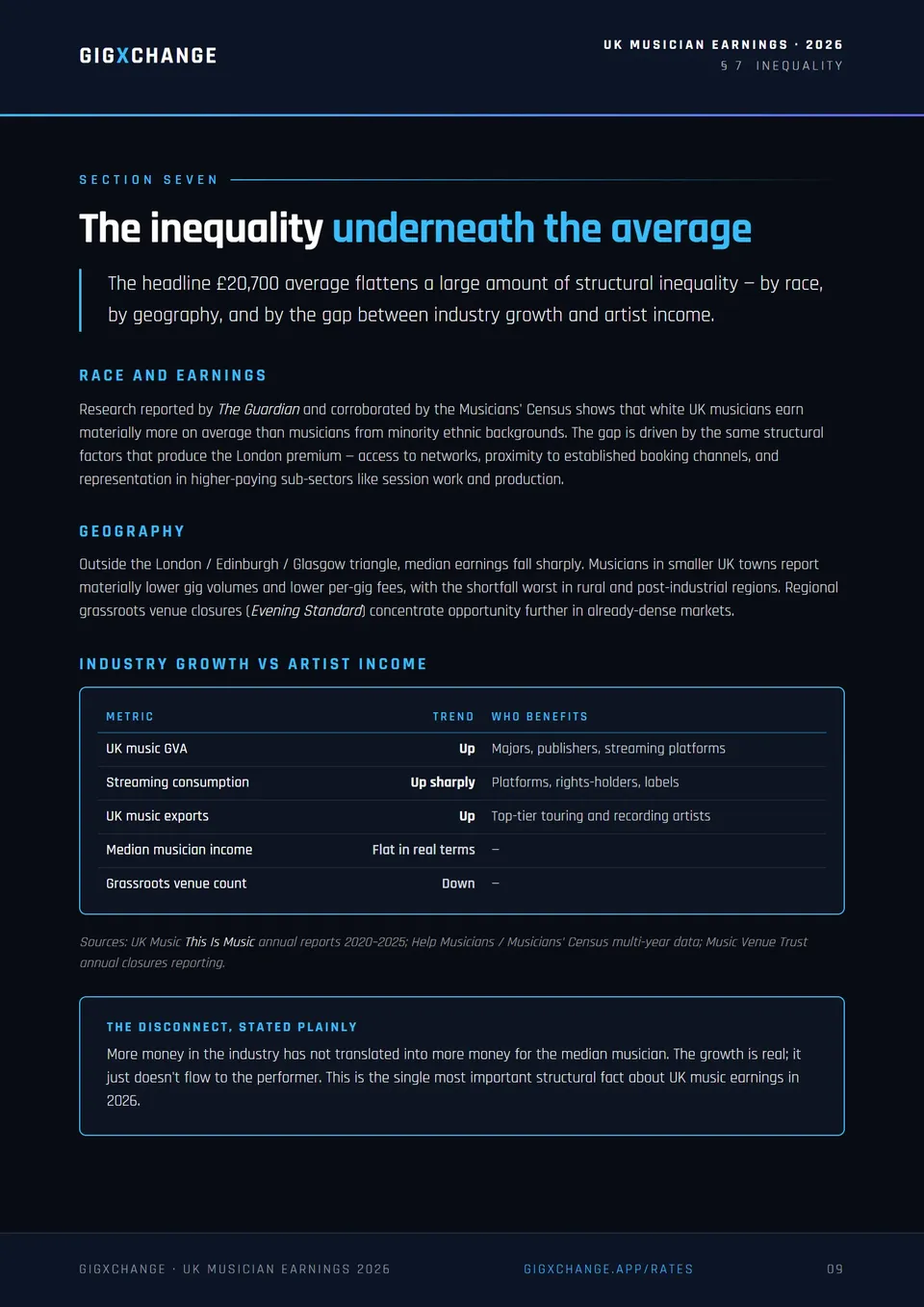
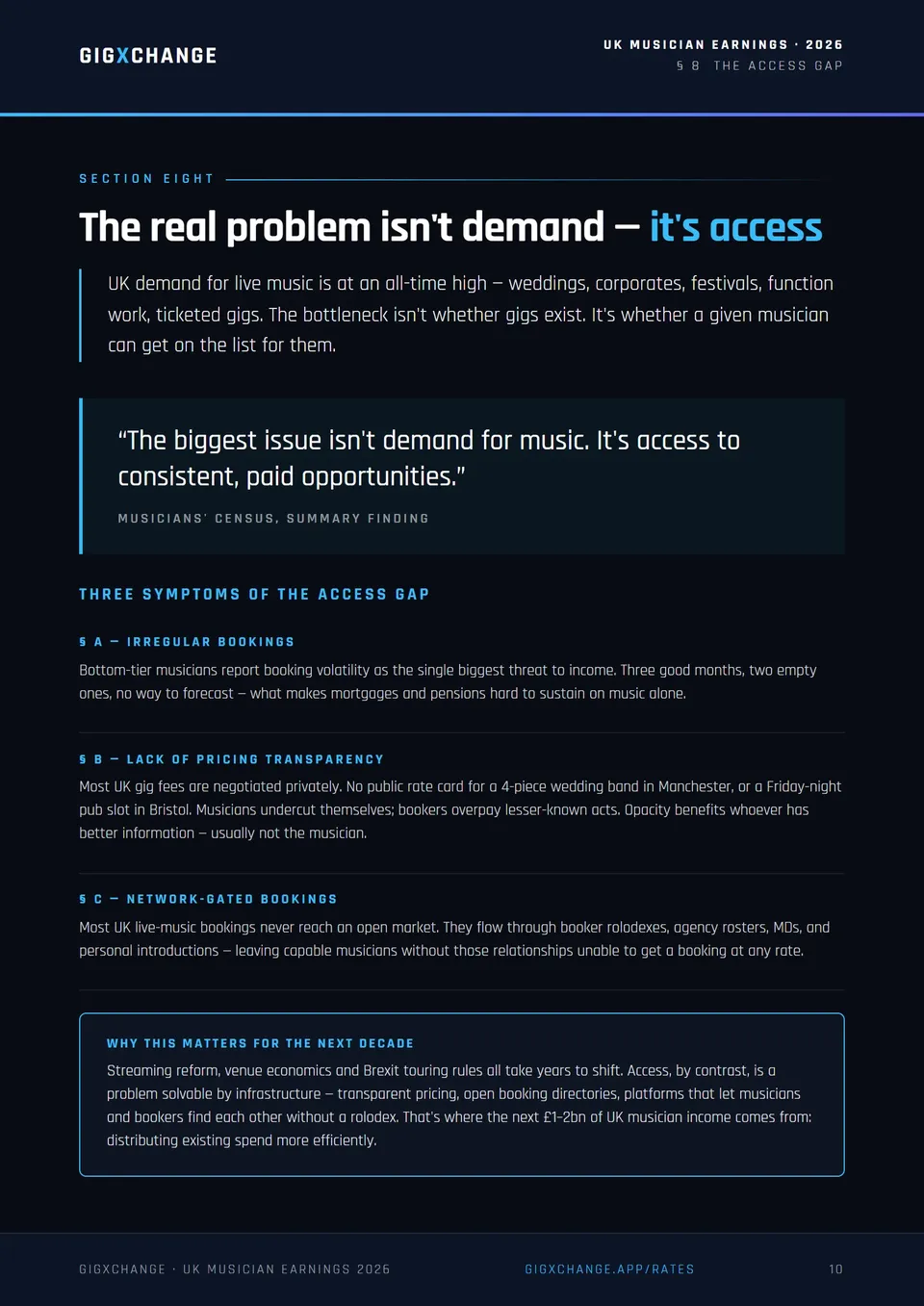
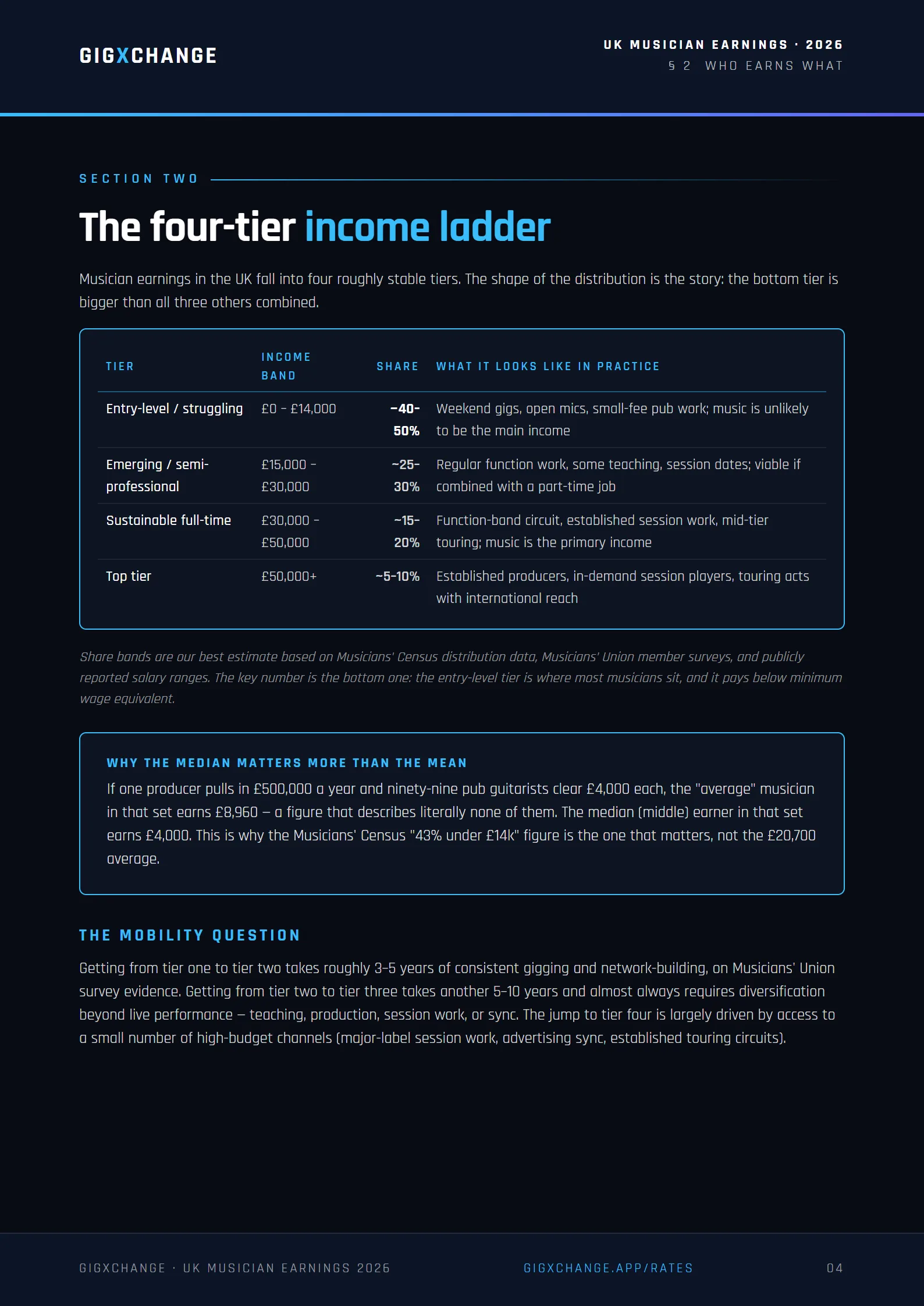
| What the report coversEight sections across 11 pages: the industry-vs-artist paradox, the four-tier income distribution, earnings by role (performer, producer, session), the London premium and Scotland’s higher live-music pay, the five working income streams, the 50% second-job rule, the four structural challenges (streaming, venue closures, Brexit, oversupply), inequality by race and geography, and the access gap behind it all. |
| How it differs from anything elseMost UK musician-pay content is either one trade-body press release (UK Music, MU) or one survey finding (Help Musicians) reported in isolation. This report consolidates every mainstream UK source — UK Music, Help Musicians’ Musicians’ Census, the Musicians’ Union, Equity, Glassdoor UK, Indeed UK, Salary Expert, The Guardian, Evening Standard, ONS, Music Venue Trust — into one honest, cross-referenced picture. Free under CC BY 4.0. |
Highlights from the 2026 report. Full sourcing, caveats and section-by-section breakdown are in the report above.
| The paradox — £8 billion industry, £20,700 musicianThe UK music industry contributes around £8 billion a year to the economy (UK Music, This Is Music 2025). The average working musician takes home £20,700 (Help Musicians’ Musicians’ Census). Most of the £8bn doesn’t reach the performer — it flows to labels, publishers, streaming platforms, and a small number of top-tier touring acts. | |
| Nearly half earn below minimum-wage equivalent43% of UK musicians earn under £14,000 a year from music (Help Musicians’ Musicians’ Census). That’s below the UK’s full-time minimum-wage equivalent. The bottom earning tier is bigger than the emerging, sustainable and top tiers combined — the shape of the distribution is the story. | |
| Session and production beat live, by a lotUK session musicians earn roughly £49,000 a year (Salary Expert). UK producers earn around £41,000 (Glassdoor UK). Live-focused performers sit at £20,000–25,000 (Indeed UK). The gap reflects repeat-contract work versus reliance on venue-booking networks. | |
| More than half of musicians need a second jobOver 50% of UK musicians rely on non-music income to sustain a music career (Musicians’ Union). The most common second jobs are teaching (~32%), admin/office (~21%), hospitality (~18%) and freelance creative (~14%). UK live music is, in effect, subsidised by hospitality and teaching — not the other way round. |
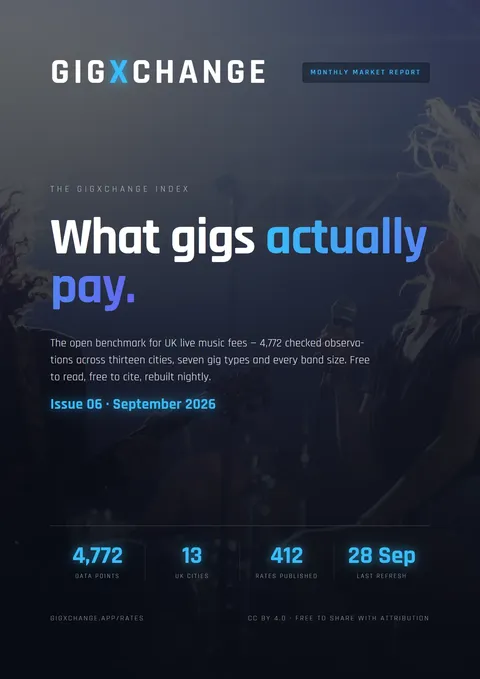
| GigXchange Index — September 20266 Oct 2026 · Index · 11 pages · PDF | |
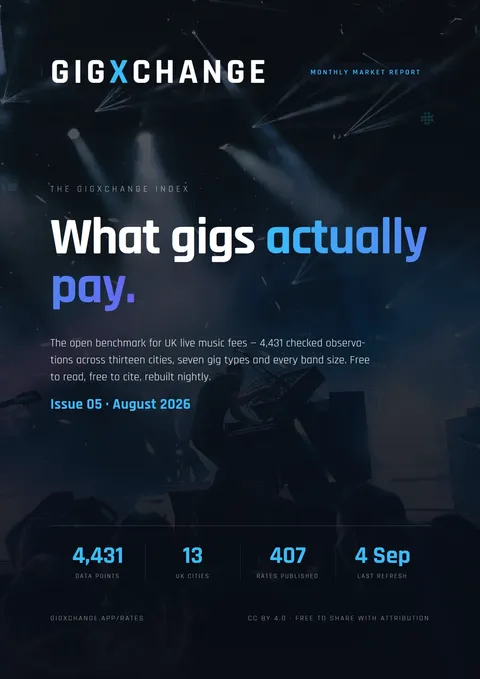
| GigXchange Index — August 20263 Sept 2026 · Index · 11 pages · PDF | |
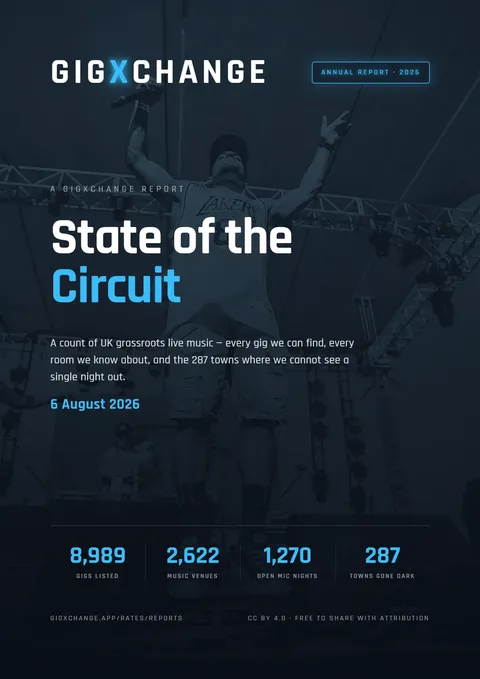
| State of the Circuit 20266 Aug 2026 · Annual · 11 pages · PDF | |
| GigXchange Index — July 202631 Jul 2026 · Index · 11 pages · PDF | |
| GigXchange Index — June 20264 Jul 2026 · Index · 11 pages · PDF | |
| GigXchange Index — May 202620 May 2026 · Index · 11 pages · PDF | |
| GigXchange Index — April 202620 Apr 2026 · Index · 11 pages · PDF | |
| UK Live Music Yearbook 202615 Mar 2026 · Annual · 12 pages · PDF | |
| Browse all reports & datasets |
Permanent DOI and the open dataset — free under CC BY 4.0.
| Zenodo DOI 10.5281/zenodo.19732417 | |
| Dataset on Hugging Face | |
| Dataset on Kaggle | |
| Download the CSV | |
| All our open data |
| GX Index — live rates | |
| UK Market Statistics |
| Getting paid as a musician |
Add your real gig fees to the UK Gig Pay Survey — anonymous, ~60 seconds, and every entry sharpens the next GX Index.
| Take the survey |
| For artists |
The earnings picture is annual. The GX Index is monthly, free, and rebuilt nightly from real booking data.
An honest, citation-backed picture of what UK musicians earn — who wins, who doesn’t, and why the gap between industry growth and artist income keeps widening.
The UK music industry is worth around £8 billion a year. Streaming is at a record high, live has bounced past pre-pandemic levels, and UK music exports are a national success story. Against that backdrop, the average working musician earns £20,700 a year; the bottom 43% earn under £14,000; and more than half need a second job. This report joins the dots, sourced entirely from publicly available UK industry data.
Working musicians benchmarking their own income against the market. Music-industry journalists, researchers and policymakers needing a single citable source for UK earnings data. Music educators and careers advisors giving honest advice to students. Agents and venue operators understanding the economics of the acts they book.
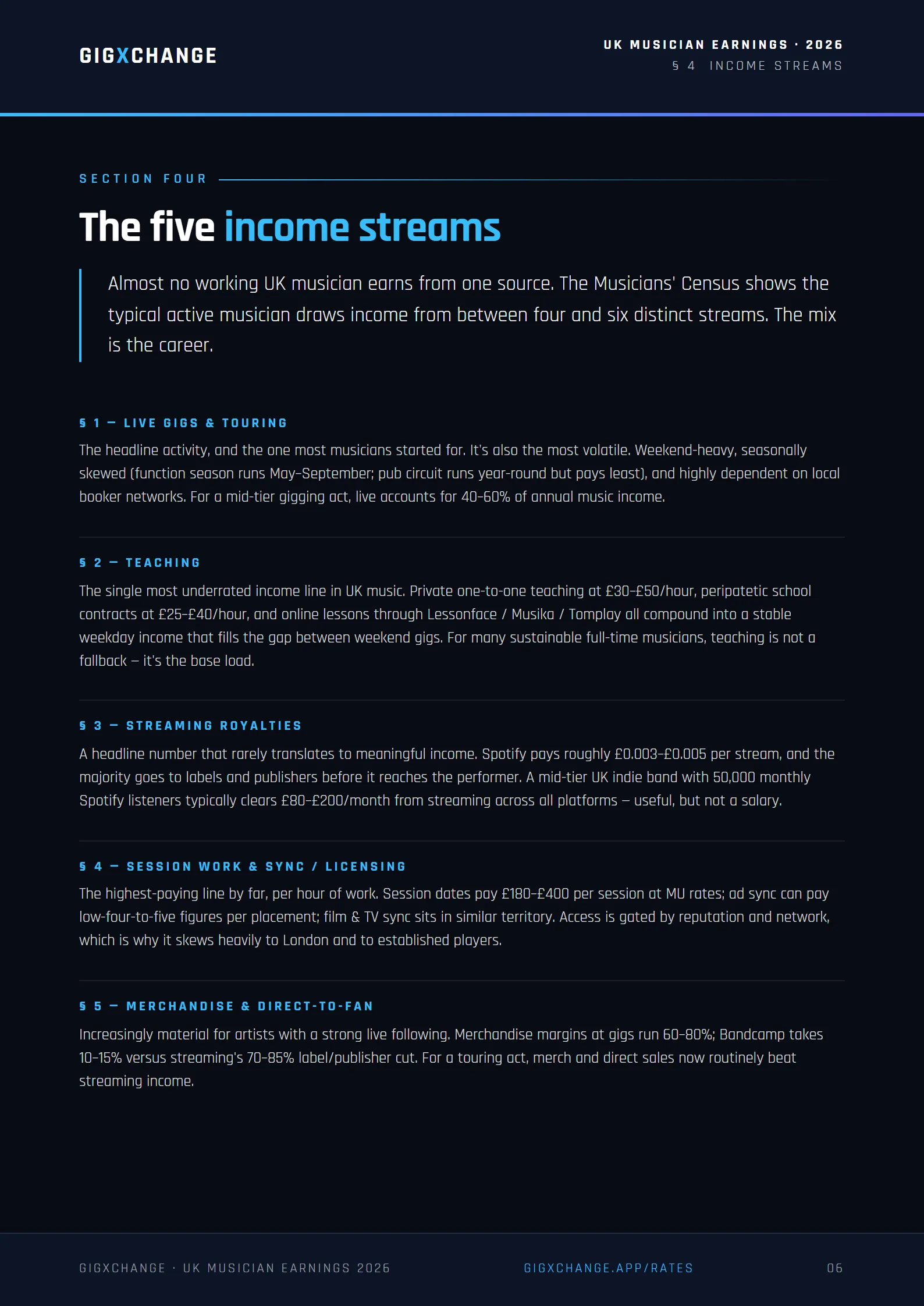
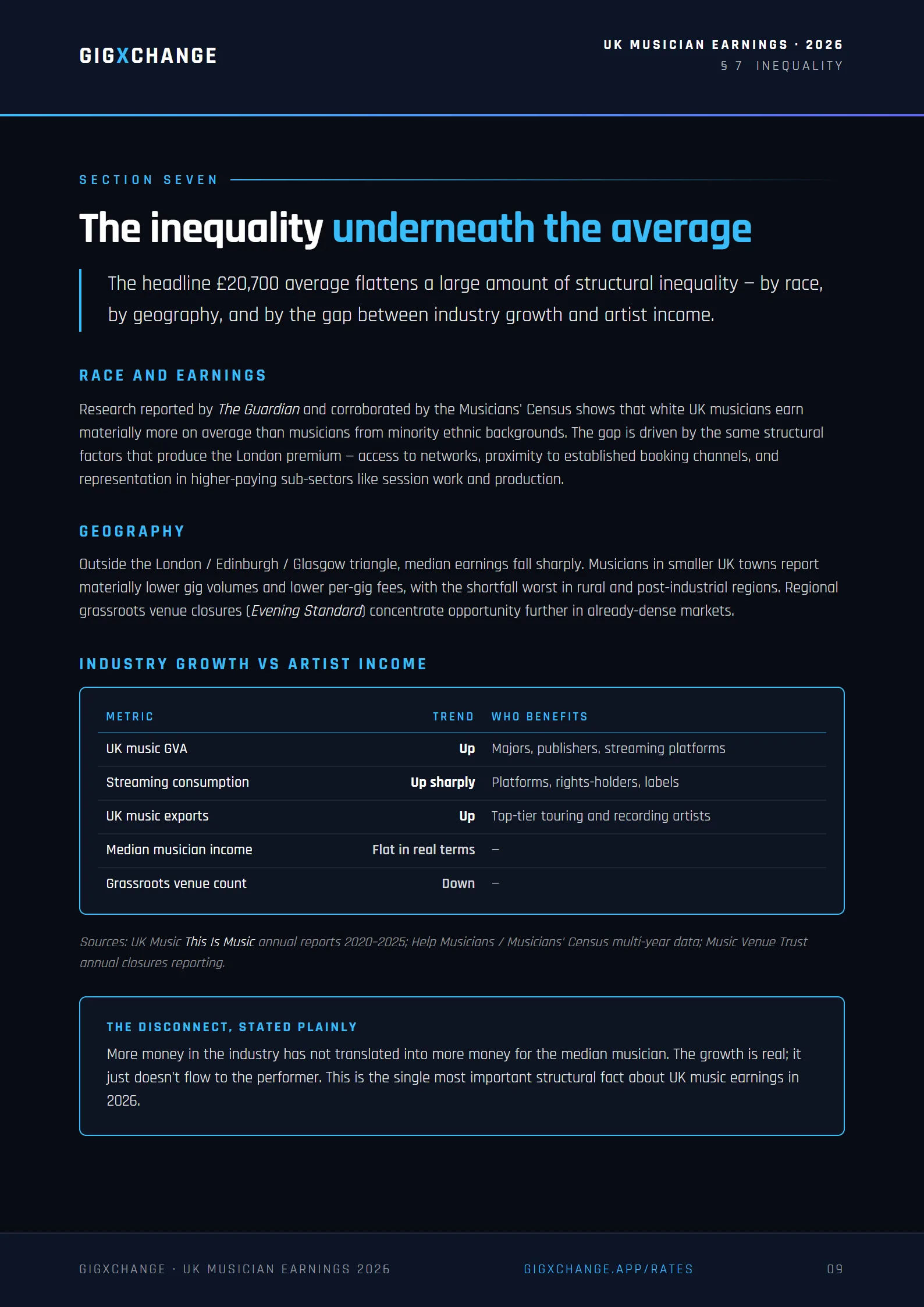
Eight sections across 11 pages: the industry-vs-artist paradox, the four-tier income distribution, earnings by role (performer, producer, session), the London premium and Scotland’s higher live-music pay, the five working income streams, the 50% second-job rule, the four structural challenges (streaming, venue closures, Brexit, oversupply), inequality by race and geography, and the access gap behind it all.
Most UK musician-pay content is either one trade-body press release (UK Music, MU) or one survey finding (Help Musicians) reported in isolation. This report consolidates every mainstream UK source — UK Music, Help Musicians’ Musicians’ Census, the Musicians’ Union, Equity, Glassdoor UK, Indeed UK, Salary Expert, The Guardian, Evening Standard, ONS, Music Venue Trust — into one honest, cross-referenced picture. Free under CC BY 4.0.
Highlights from the 2026 report. Full sourcing, caveats and section-by-section breakdown are in the report above.
The UK music industry contributes around £8 billion a year to the economy (UK Music, This Is Music 2025). The average working musician takes home £20,700 (Help Musicians’ Musicians’ Census). Most of the £8bn doesn’t reach the performer — it flows to labels, publishers, streaming platforms, and a small number of top-tier touring acts.
43% of UK musicians earn under £14,000 a year from music (Help Musicians’ Musicians’ Census). That’s below the UK’s full-time minimum-wage equivalent. The bottom earning tier is bigger than the emerging, sustainable and top tiers combined — the shape of the distribution is the story.
UK session musicians earn roughly £49,000 a year (Salary Expert). UK producers earn around £41,000 (Glassdoor UK). Live-focused performers sit at £20,000–25,000 (Indeed UK). The gap reflects repeat-contract work versus reliance on venue-booking networks.
Over 50% of UK musicians rely on non-music income to sustain a music career (Musicians’ Union). The most common second jobs are teaching (~32%), admin/office (~21%), hospitality (~18%) and freelance creative (~14%). UK live music is, in effect, subsidised by hospitality and teaching — not the other way round.
See what the live market is paying now
The earnings picture is annual. The GX Index is monthly, free, and rebuilt nightly from real booking data.
Real UK gig-fee data, not guesswork — built from actual bookings. Add yours and it gets sharper for everyone.