

The latest issue is live
Flip through all 11 pages below, or download the PDF.
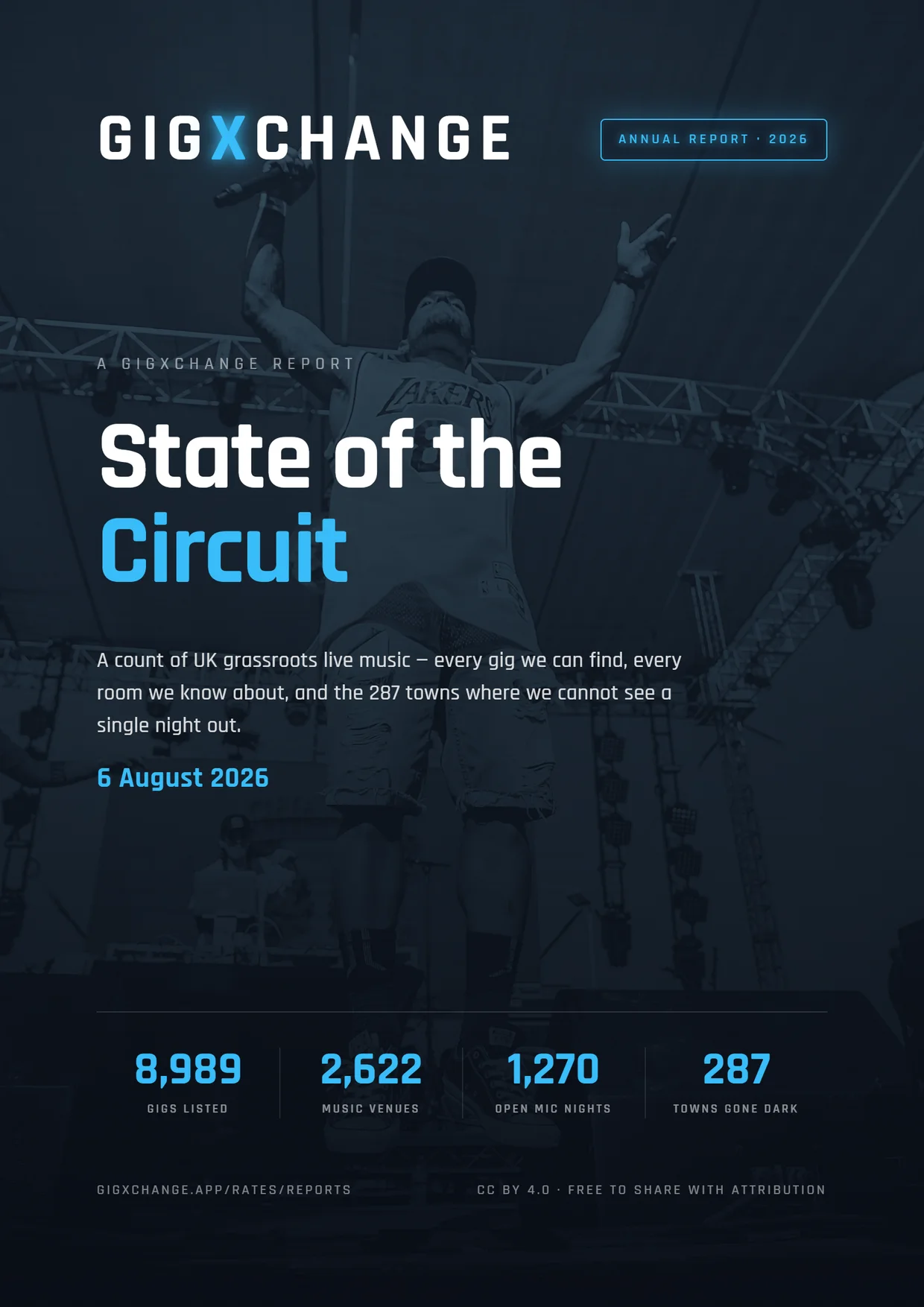



A dated census of UK grassroots live music, captured 6 August 2026: 8,989 upcoming gigs, 2,622 grassroots music venues across 433 towns, 5,946 artists and 1,270 open mic nights. And 287 UK towns that have a music venue with no gig listed anywhere we can see. Free to read and free to cite under CC BY 4.0.
Last updated: 6 August 2026
Flip through all 11 pages below, or download the PDF.
GigXchange (2026). State of the Circuit 2026: a census of UK grassroots live music. Captured 6 August 2026. gigxchange.app/rates/reports/state-of-the-circuit-2026
Everyone publishes how many UK grassroots music venues closed. Nobody publishes how many are still open. So we counted every gig, venue and open mic night in the UK grassroots live music circuit on a single day, 6 August 2026, and dated it so it can be cited.
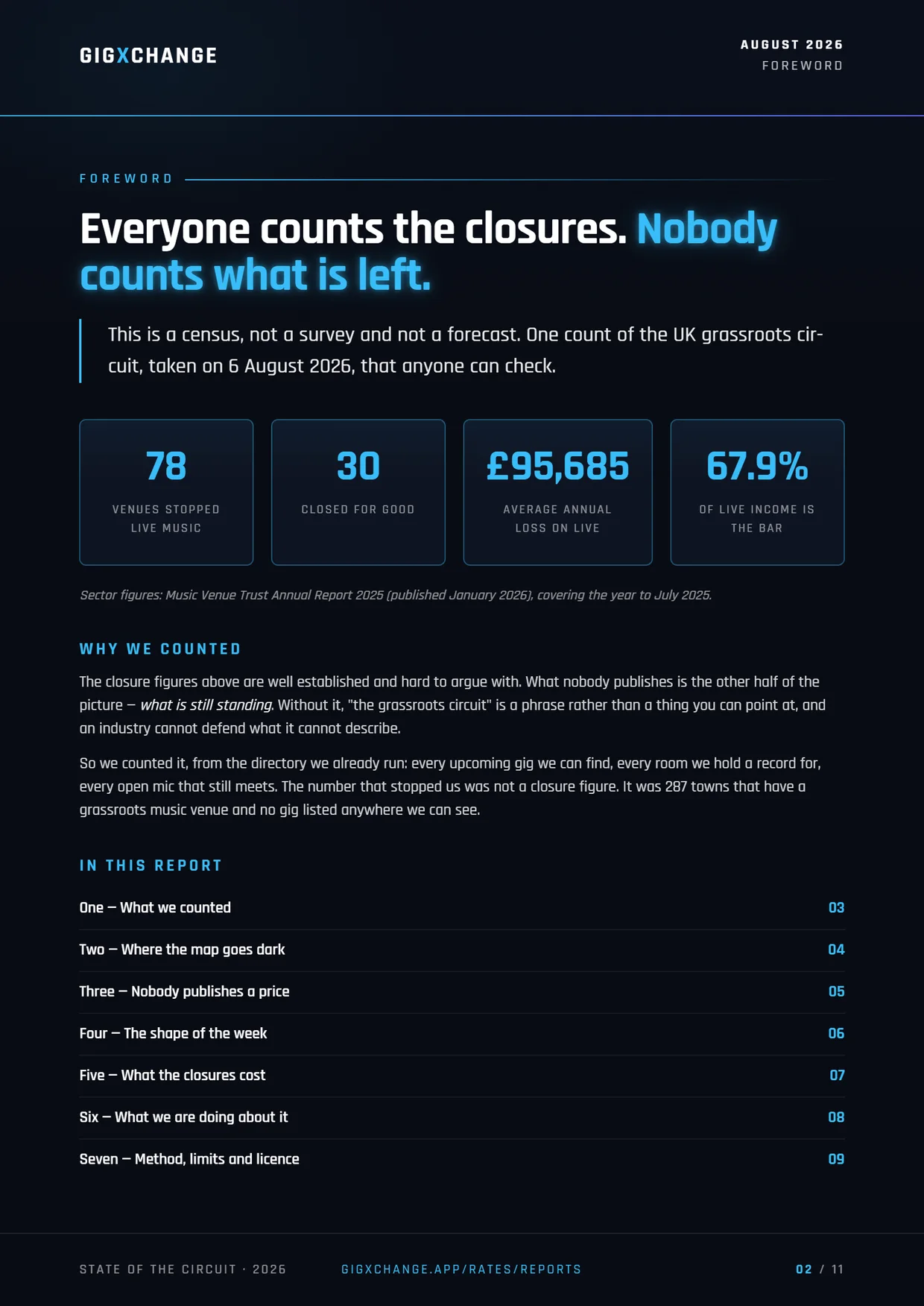
Everyone in live music agrees the grassroots end is in trouble. The Music Venue Trust counts it: 78 venues stopped putting on live music in the year to July 2025, 30 of them shutting for good.
So we counted it. Every gig we can find, every room we know about, every open mic that still runs. Not a survey and not a forecast — a count, taken on one day, that anyone can check.
It was not a closure figure. It was 287 towns where we hold a live venue record and cannot find a single gig listed anywhere. That is not proof those rooms are silent. It is proof they are invisible — and for a band looking for a stage, or a punter looking for a Tuesday night out, invisible and closed look exactly the same.
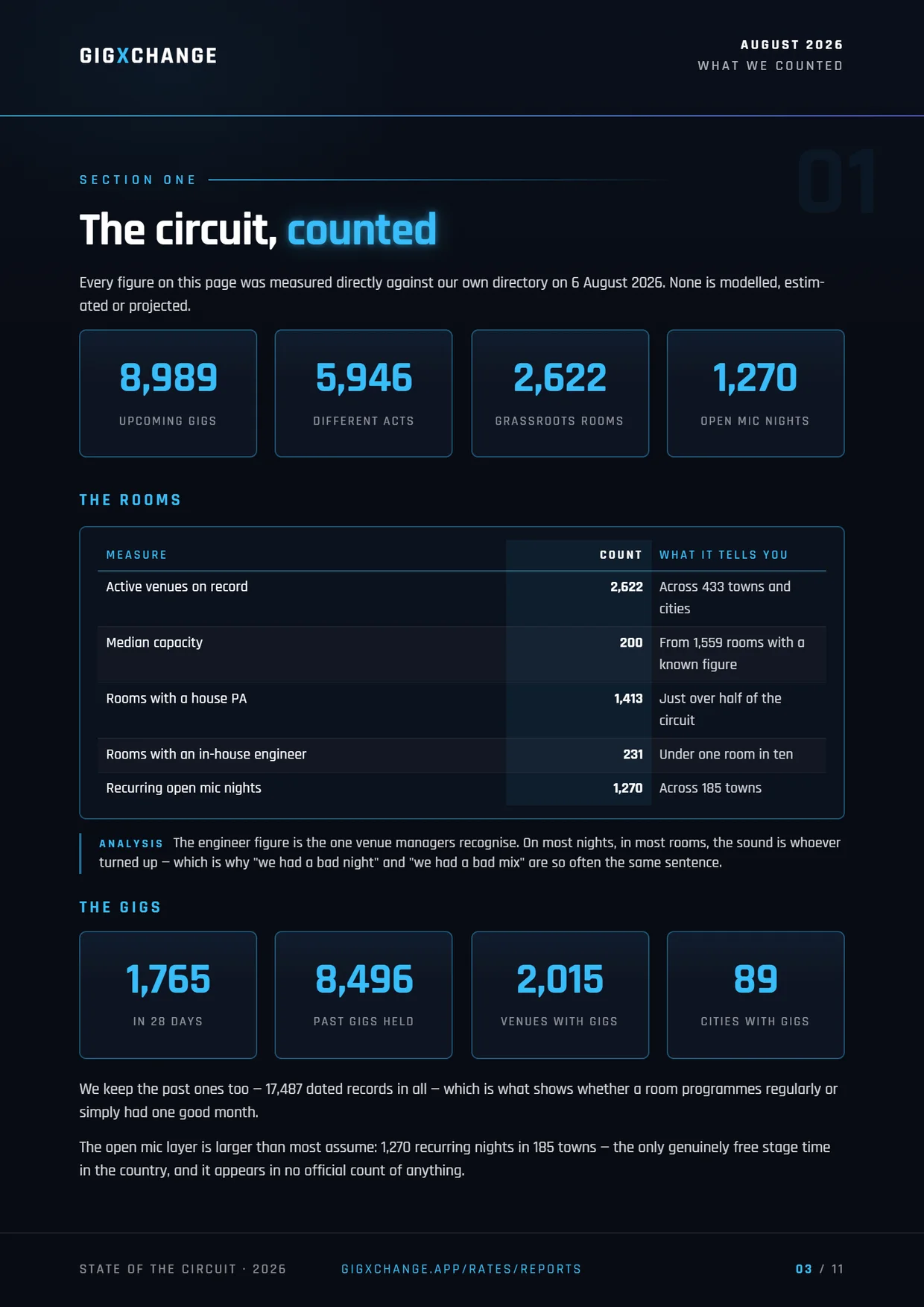
8,989 upcoming gigs, 2,622 grassroots music venues across 433 UK towns, 5,946 artists and 1,270 open mic nights, measured directly against our own directory on 6 August 2026. Nothing here is modelled, estimated or projected.
Every upcoming grassroots gig we hold, across 89 cities. 1,765 of them fall inside the next 28 days.
Distinct acts with at least one dated gig on record. The circuit is a payroll before it is anything else.
Those 2,622 rooms sit across 433 towns and cities. The median one holds 200 people. Just over half — 1,413 — have a PA you can plug into, and only 231 have someone in-house to run it. That last number is the one venue managers recognise: on most nights, in most rooms, the sound is whoever turned up.
Bigger than most people assume — 1,270 recurring nights across 185 towns. It is the only genuinely free stage time in the country, and it is where most working acts learn to hold a room.
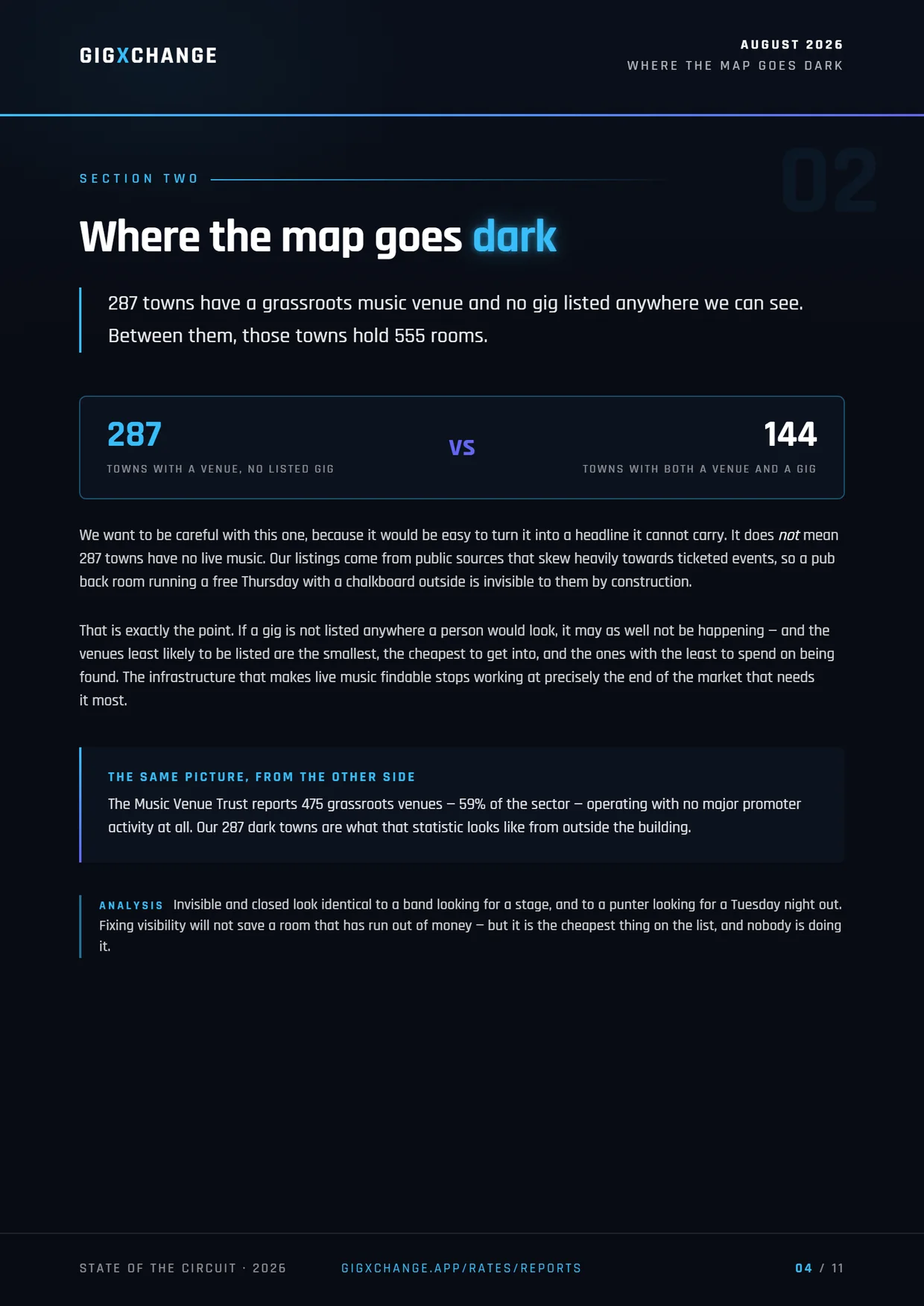
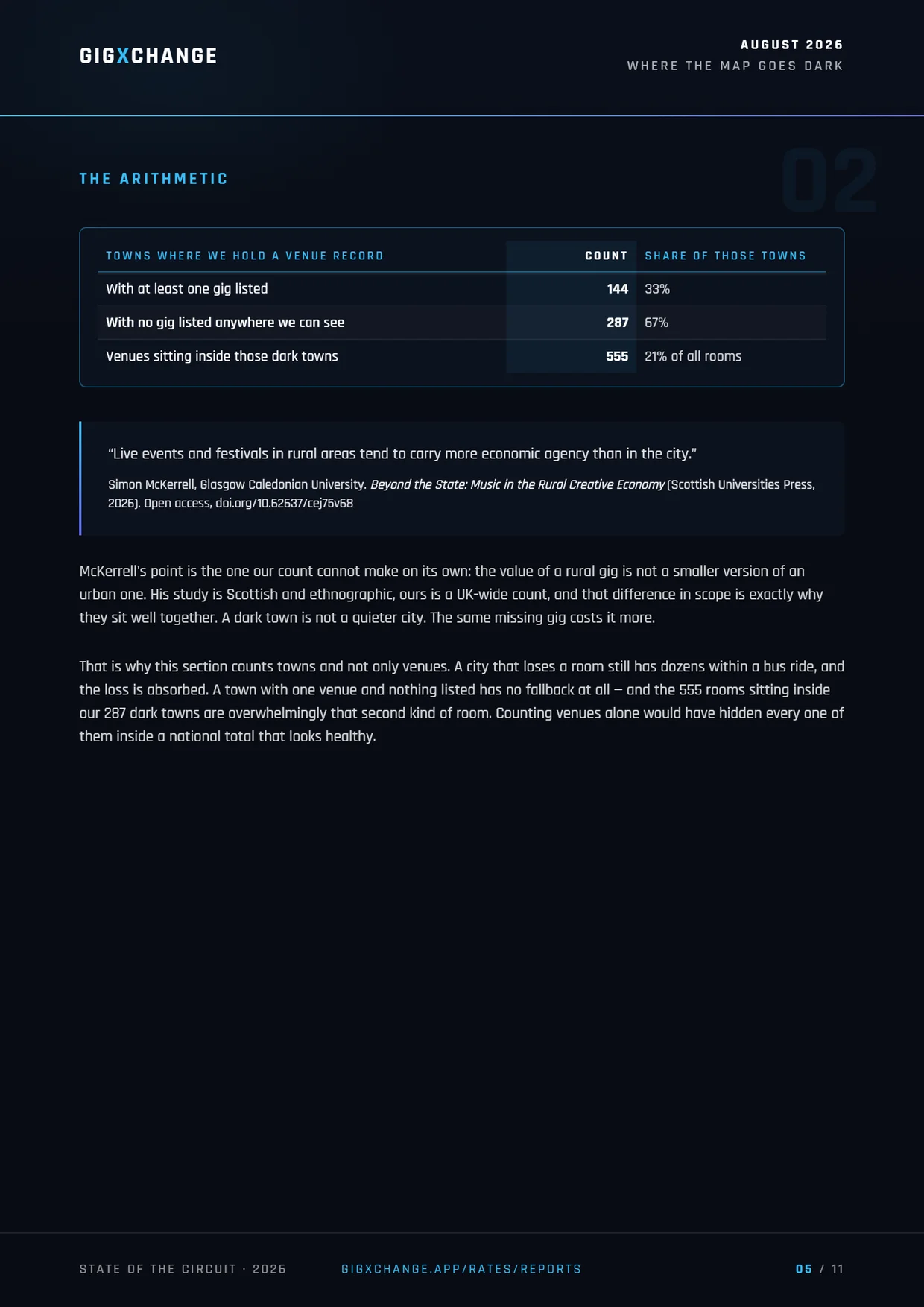
287 UK towns have a grassroots music venue and no gig listed anywhere we can see, holding 555 rooms between them. That is a claim about visibility, not silence, and the difference matters.
287 towns have a grassroots music venue and no gig listed anywhere we can see. Between them, those towns hold 555 rooms.
We want to be careful with this one, because it would be easy to turn it into a headline it cannot carry. It does not mean 287 towns have no live music. Our listings come from public sources that skew heavily towards ticketed events, so a pub back room running a free Thursday with a chalkboard outside is invisible to them by construction.
If a gig is not listed anywhere a person would look, it may as well not be happening — and the venues least likely to be listed are the smallest, the cheapest to get into, and the ones with the least to spend on being found. The infrastructure that makes live music findable stops working at precisely the end of the market that needs it most.
The MVT reports that 475 venues — 59% of grassroots rooms — operate with no major promoter activity at all. Our 287 towns are what that looks like from the outside.
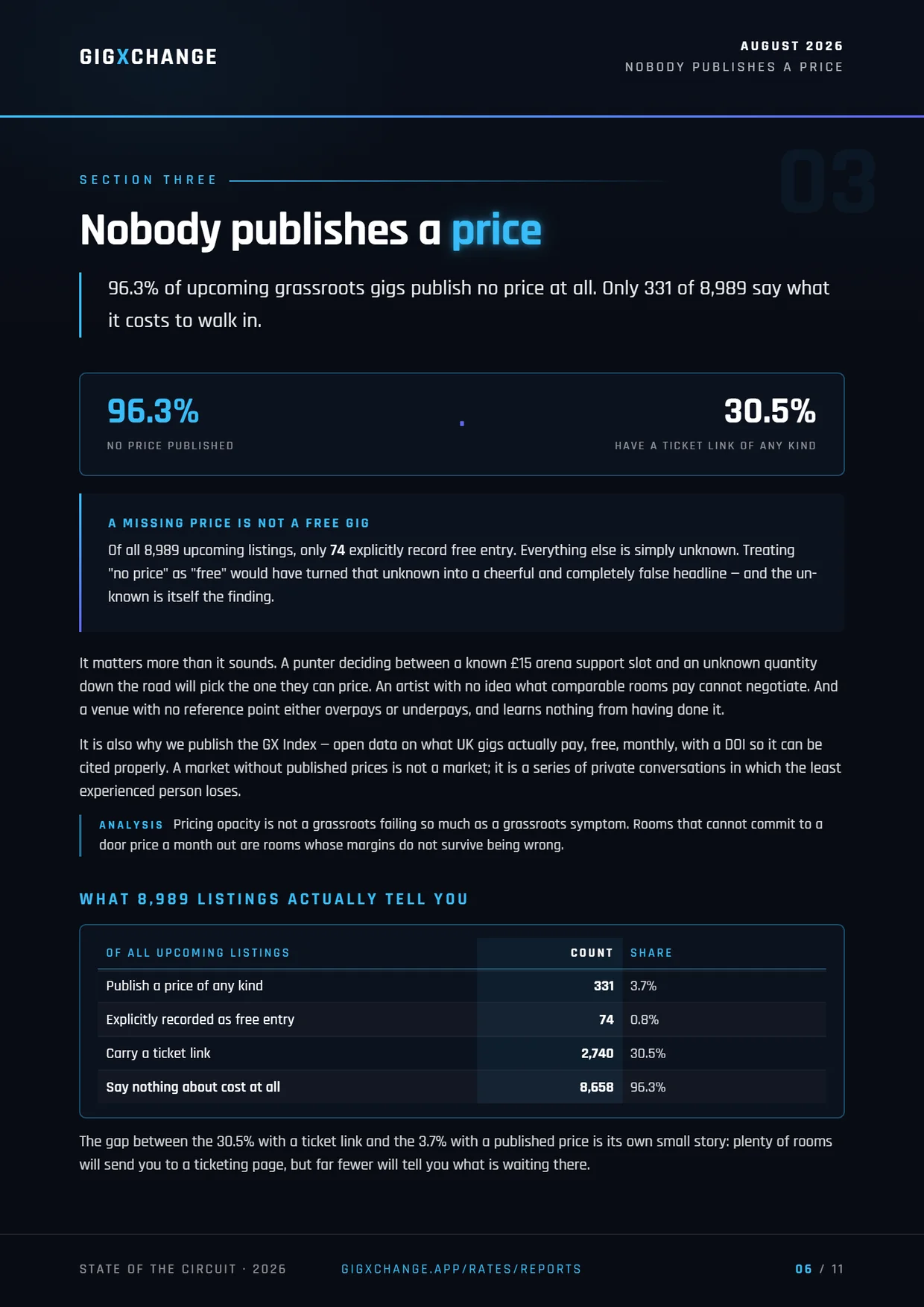
96.3% of upcoming UK grassroots gigs publish no price at all. Only 74 of 8,989 are explicitly free — a missing price is an unknown, not a free gig.
Of upcoming grassroots gigs, only 331 of 8,989 say what it costs. Roughly 30.5% carry a ticket link of any kind.
Of all 8,989 upcoming listings, only 74 explicitly say free entry. Everything else is simply unknown — and that unknown is the finding.
A punter deciding between a known £15 arena support slot and an unknown quantity down the road will pick the one they can price. An artist with no idea what comparable rooms pay cannot negotiate. And a venue with no reference point either overpays or underpays, and learns nothing from doing it.
It is why we publish the GX Index — open data on what UK gigs actually pay, free, monthly, with a DOI so it can be cited properly.
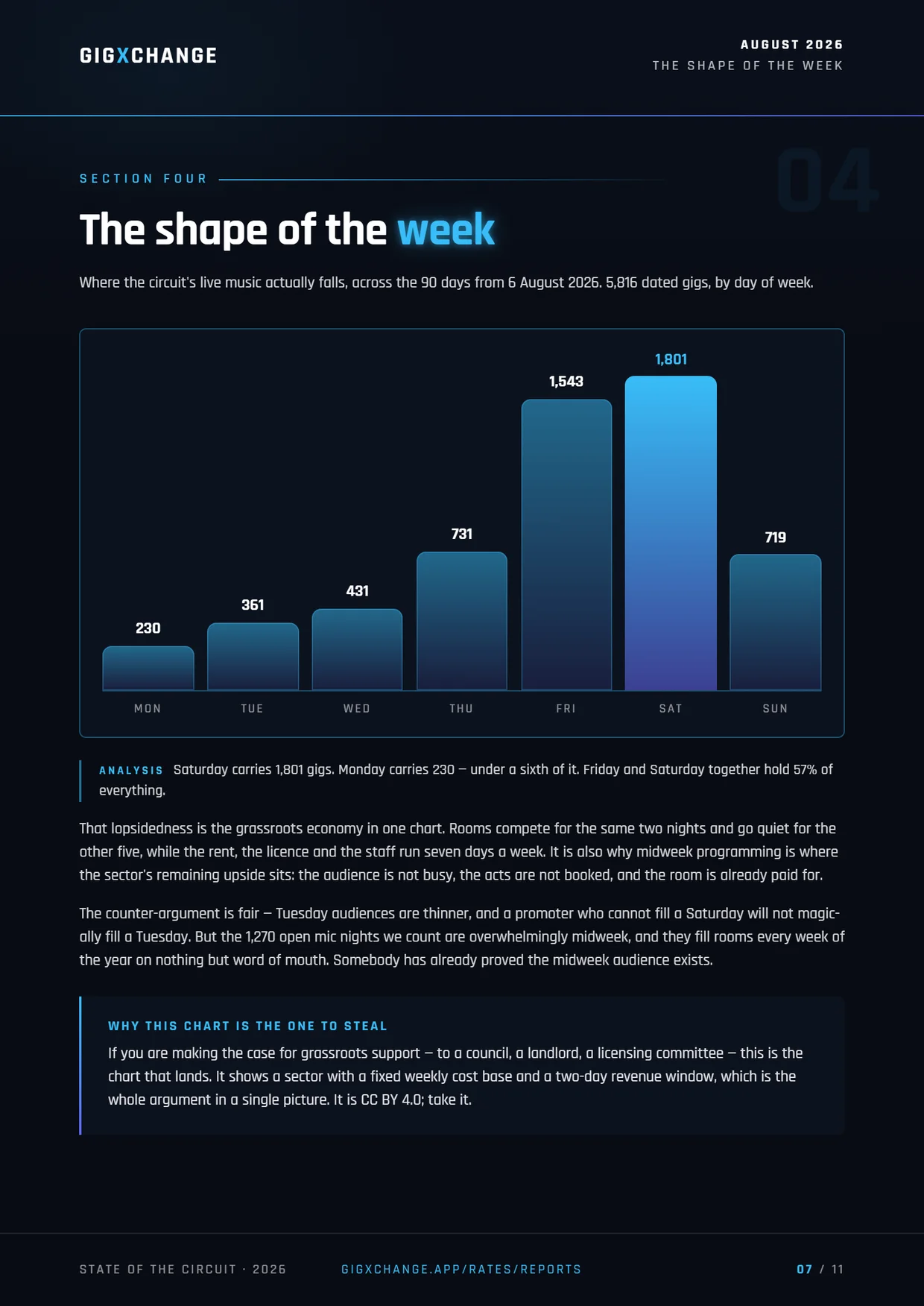
Saturday carries 1,801 UK grassroots gigs and Monday carries 230, across the 90 days from 6 August 2026. A sector with a seven-day cost base and a two-night revenue window.
Every dated grassroots gig we hold, by the night of the week it falls on.
Saturday carries 1,801 gigs. Monday carries 230 — under a sixth of it. That lopsidedness is the grassroots economy in one chart: rooms compete for the same two nights and go quiet for the other five, while the rent runs seven days a week.
The midweek gap is exactly where open mics live, and part of why they matter beyond the stage time they give away. They fill rooms every week of the year on nothing but word of mouth.
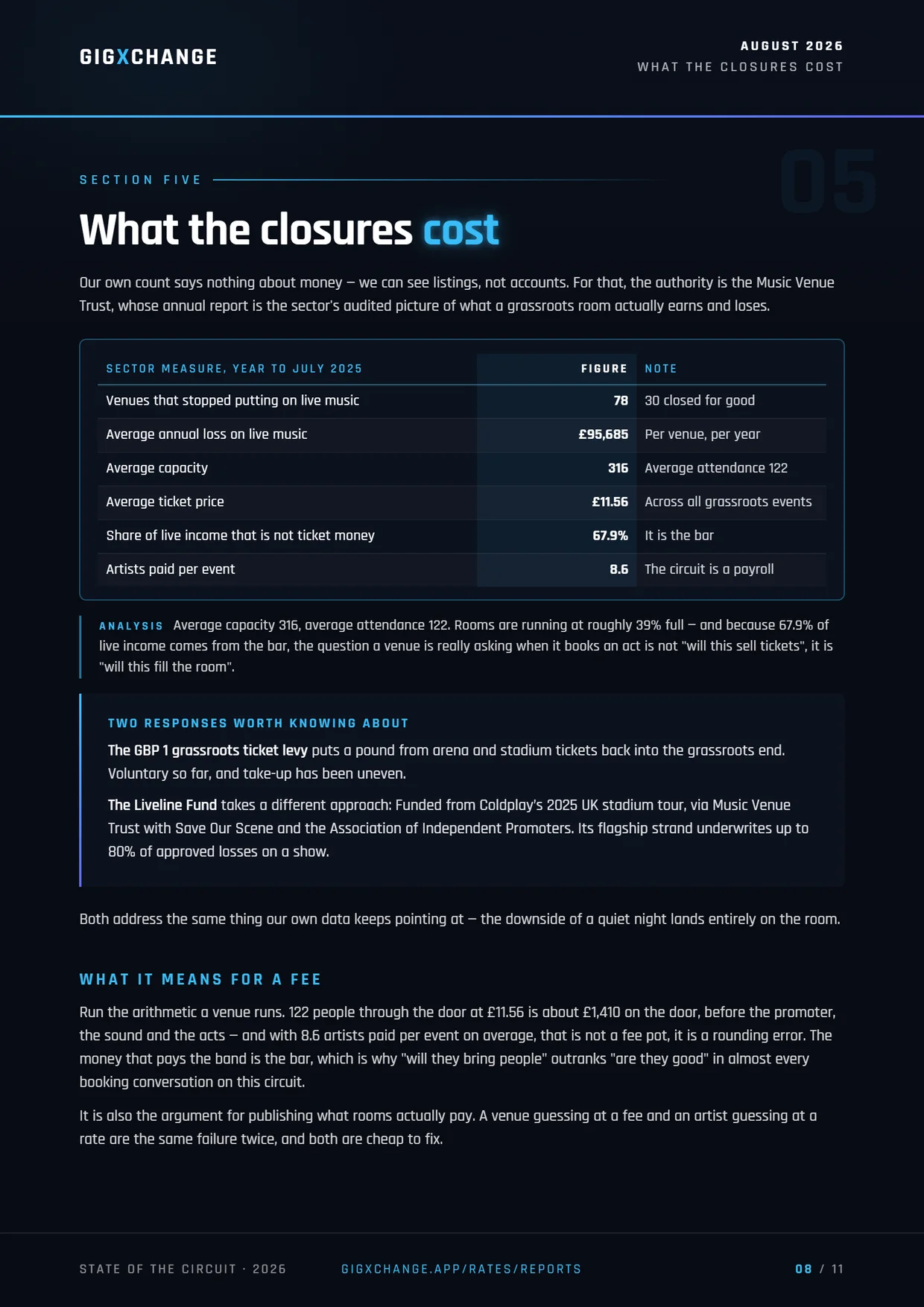
78 UK grassroots venues stopped hosting live music in the year to July 2025 and 30 closed for good, at an average loss of £95,685 on live music per venue. Figures from the Music Venue Trust Annual Report 2025 (published January 2026).
From the Music Venue Trust Annual Report 2025 (published January 2026): 78 grassroots venues stopped putting on live music, and 30 closed for good. The average venue lost £95,685 on live music over the year.
Average capacity is 316; average attendance is 122. Average ticket price is £11.56, and 67.9% of a venue's live income is not ticket money at all — it is the bar. Which means the question a venue is really asking when it books an act is not "will this sell tickets", it is "will this fill the room".
The £1 ticket levy puts a pound from arena and stadium tickets back into the grassroots end — voluntary so far, and take-up has been uneven. And The Liveline Fund takes a different approach entirely: Funded from Coldplay’s 2025 UK stadium tour, via Music Venue Trust with Save Our Scene and the Association of Independent Promoters. Its flagship strand underwrites up to 80% of approved losses on a show. Both are addressing the same thing our own data keeps pointing at — the downside of a quiet night lands entirely on the room.
A UK gig directory, a grassroots venue directory, an open mic finder, a weekly What's On email and open fee data. All free, most of it needs no account, and this is the part we can actually control.
Every upcoming grassroots gig we can find, deduplicated and refreshed continuously.
2,622 venues across 433 townsCapacity, PA, backline and booking contacts for grassroots rooms, re-verified nightly.
1,270 nights across 185 townsRecurring open mic nights — the free stage time that starts most careers.
Free, one-click unsubscribe, address never soldA national view of what is on this week, and a free weekly email of gigs near you.
Free to read, CC BY 4.0, on Zenodo, HuggingFace and KaggleOpen data on what UK gigs actually pay, published monthly with a DOI.
Free to join and to bookArtists and venues book each other directly. No agency commission in the middle.
The single most useful thing anyone can do about all of the above is turn up. One email a week, the gigs near you, so you know when to.
A UK venue stops hosting live music every 5 days — and turning up is what keeps a room open. Get a free weekly email of gigs near you. Unsubscribe any time. Privacy.
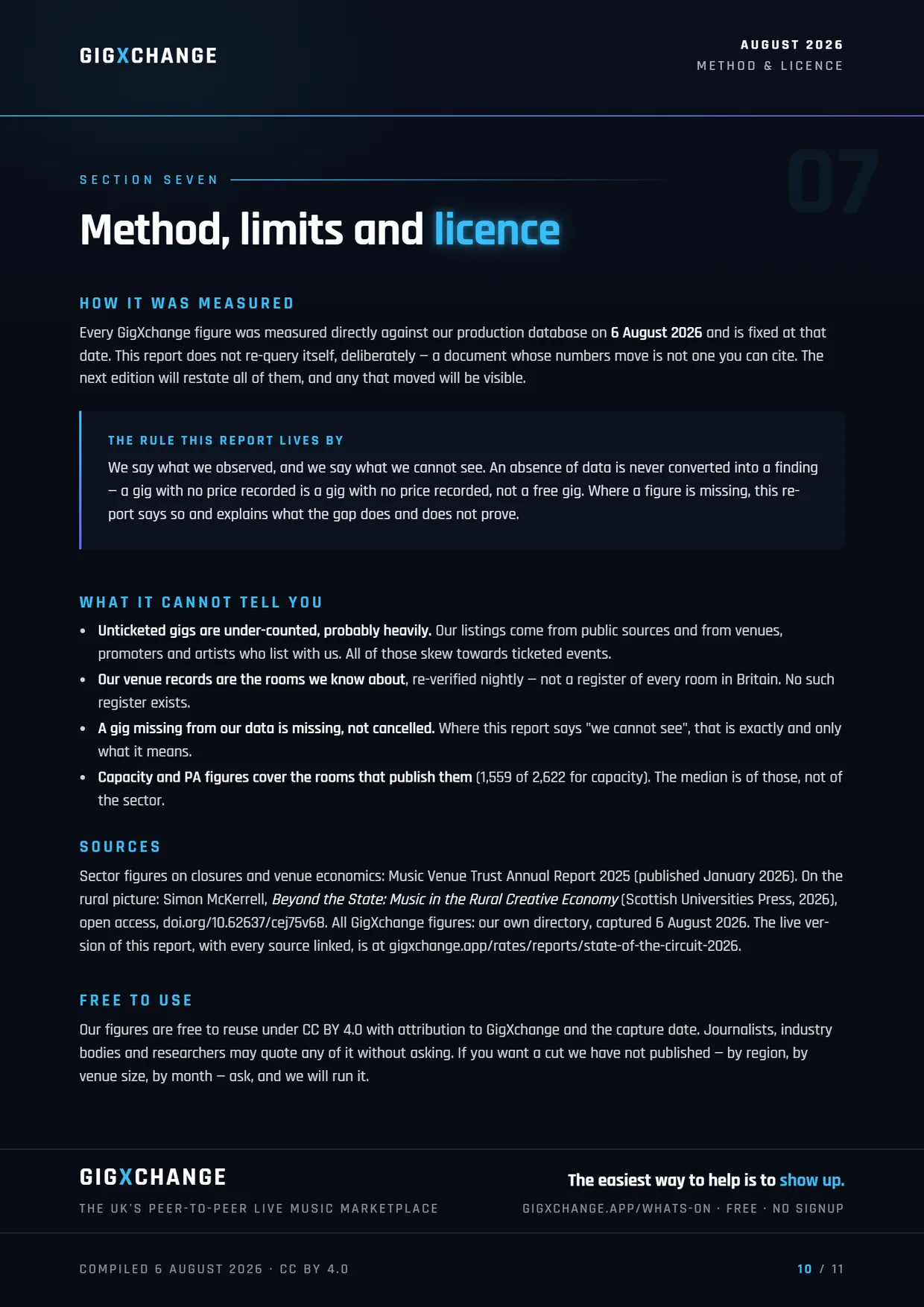
Every GigXchange figure was measured against our production database on 6 August 2026 and is fixed at that date. Free to reuse under CC BY 4.0 with attribution — and here is what the data cannot tell you.
Every GigXchange figure was measured directly against our database on 6 August 2026 and is fixed at that date. This report does not re-query itself, deliberately — a document whose numbers move is not one you can cite.
Our gig listings come from public sources and from venues, promoters and artists who list with us. They skew towards ticketed events, so unticketed pub gigs are under-counted — probably heavily. Our venue records are the rooms we know about, not every room in Britain. And a gig missing from our data is missing, not cancelled. Where we say "we cannot see", that is exactly what we mean.
Sector figures are attributed inline and belong to their publishers. The venue economics and closure counts throughout come from the Music Venue Trust Annual Report 2025 (published January 2026).
What people ask about the census, the sources and how to reuse the figures.
Everything in this report is free to use
The directories, the rate data, the weekly email. No account needed for most of it.
Real UK gig-fee data, not guesswork — built from actual bookings. Add yours and it gets sharper for everyone.