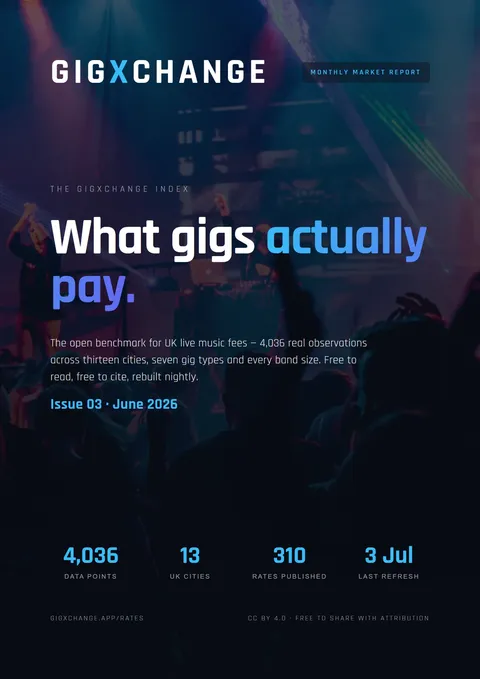
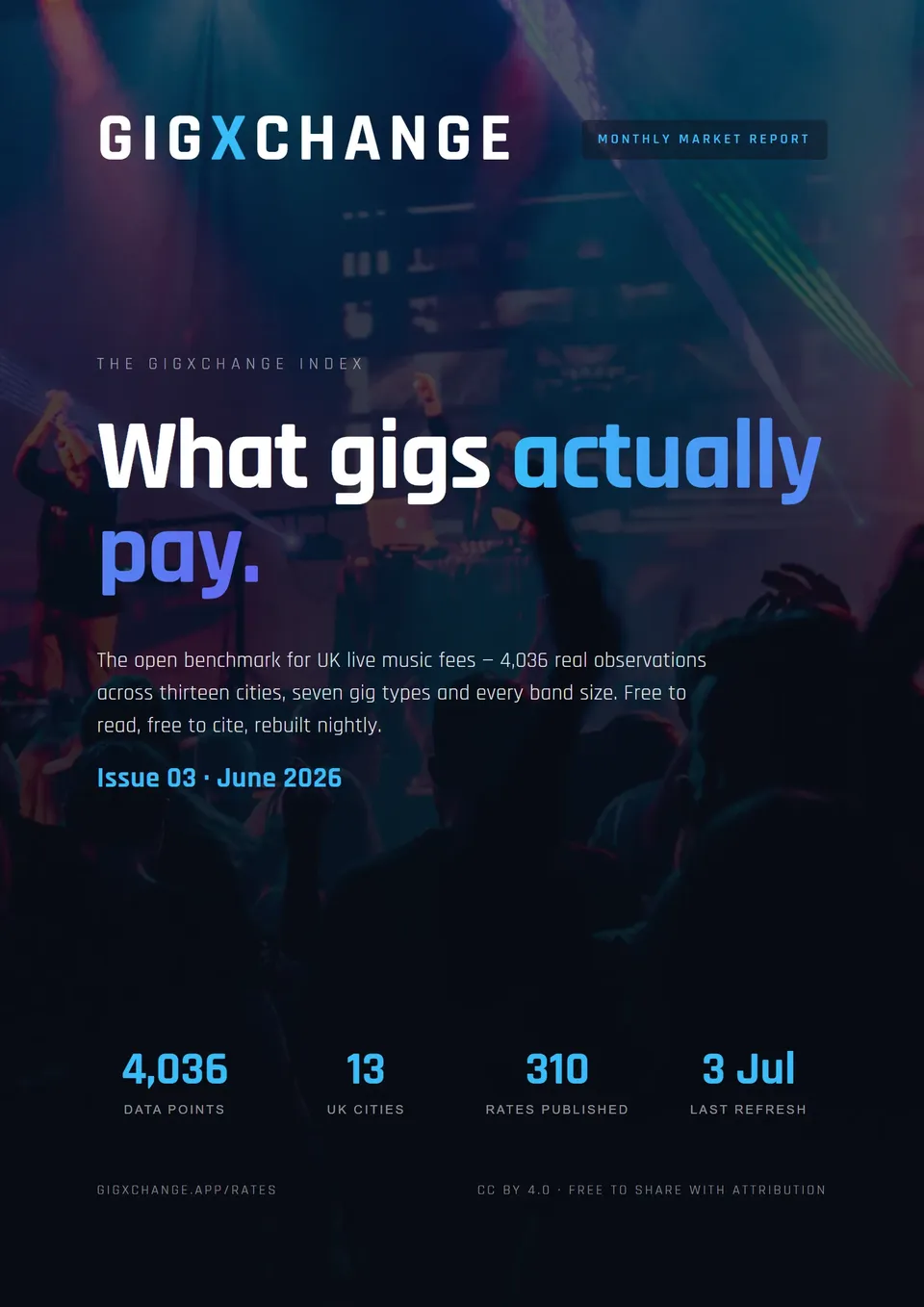
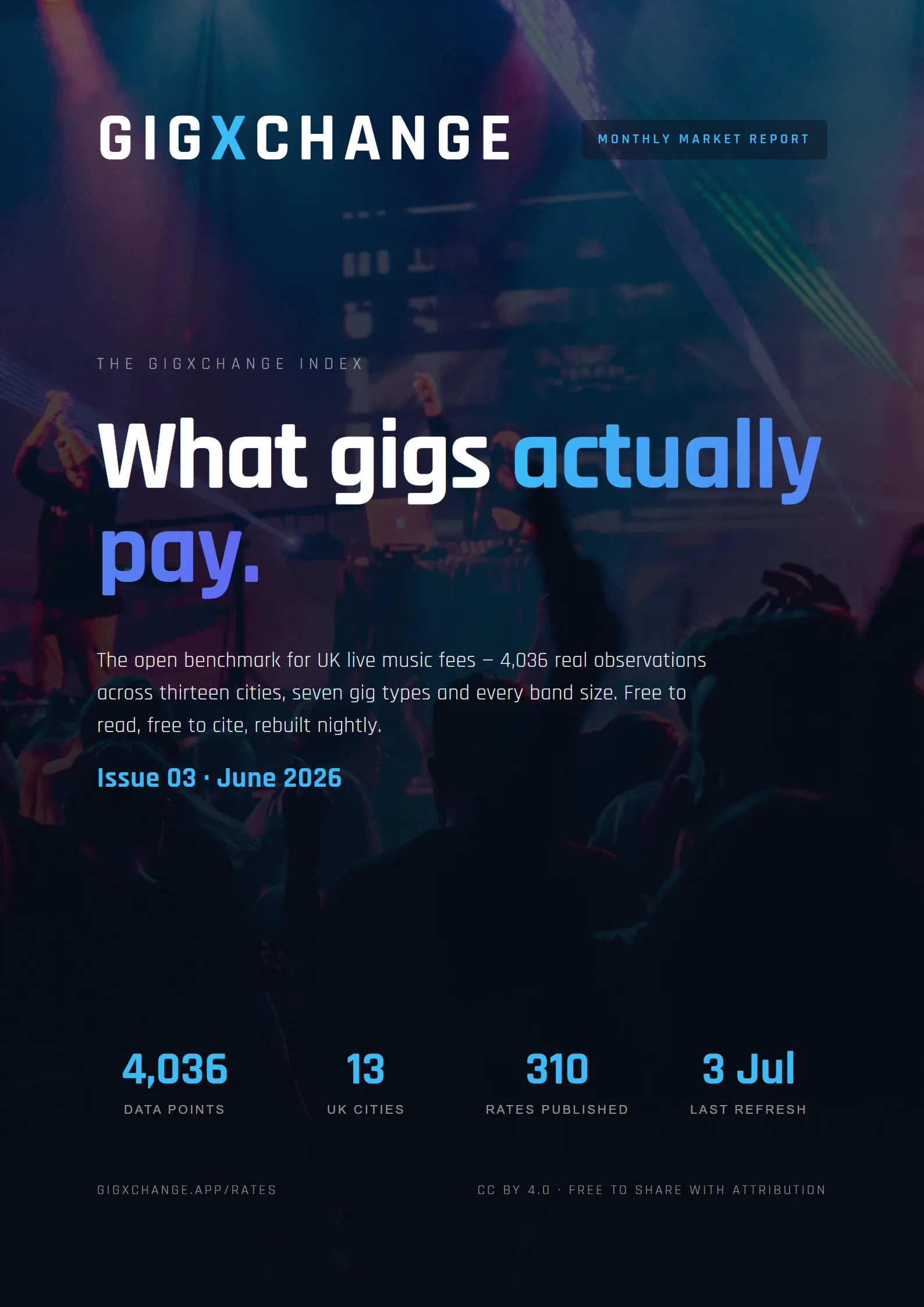
In June 2026 a 3–4 piece wedding band's median fee was £1,005 and a pub booking £425, from 4,036 data points across 13 UK cities.
A steady market, a sharper lens
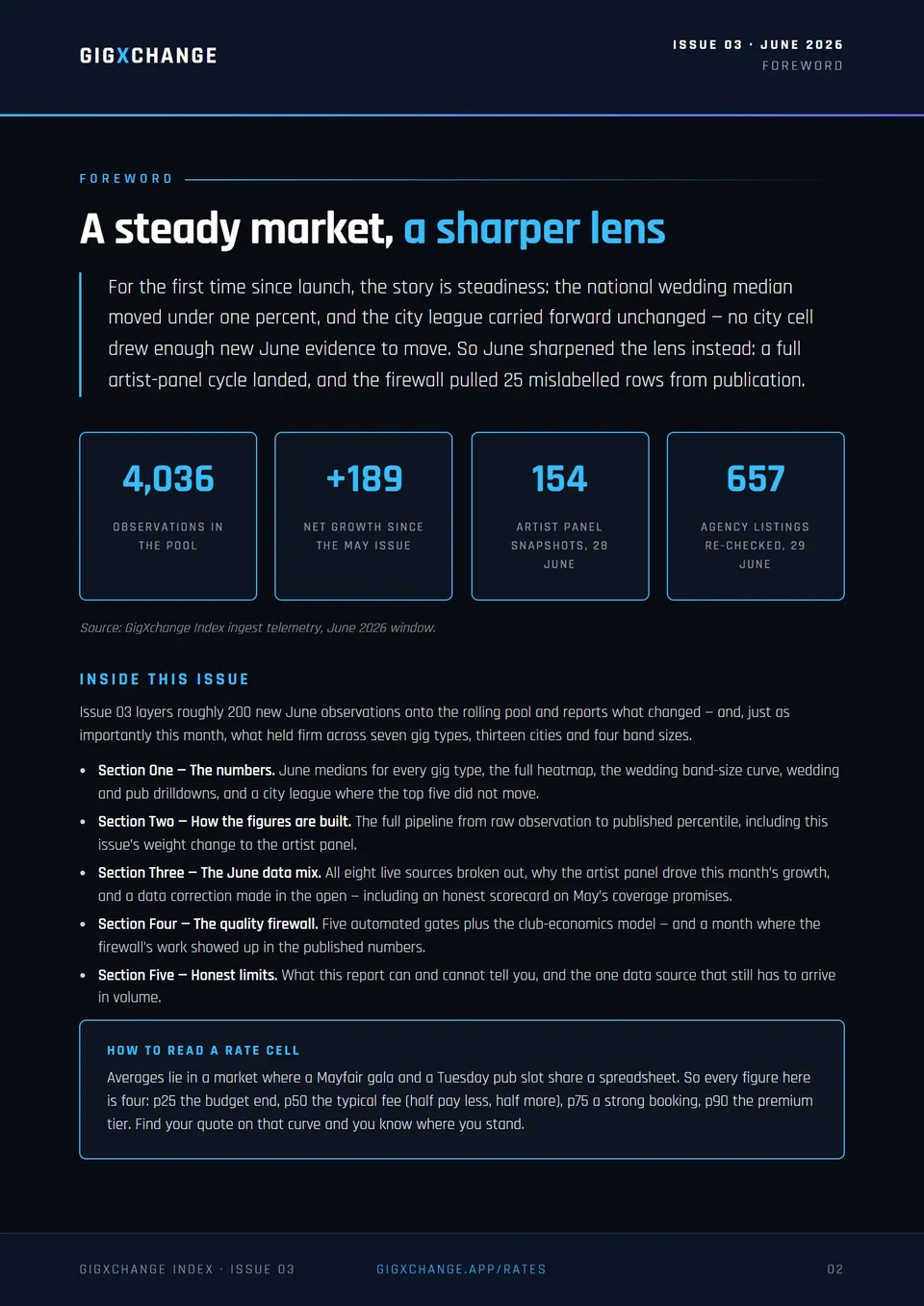
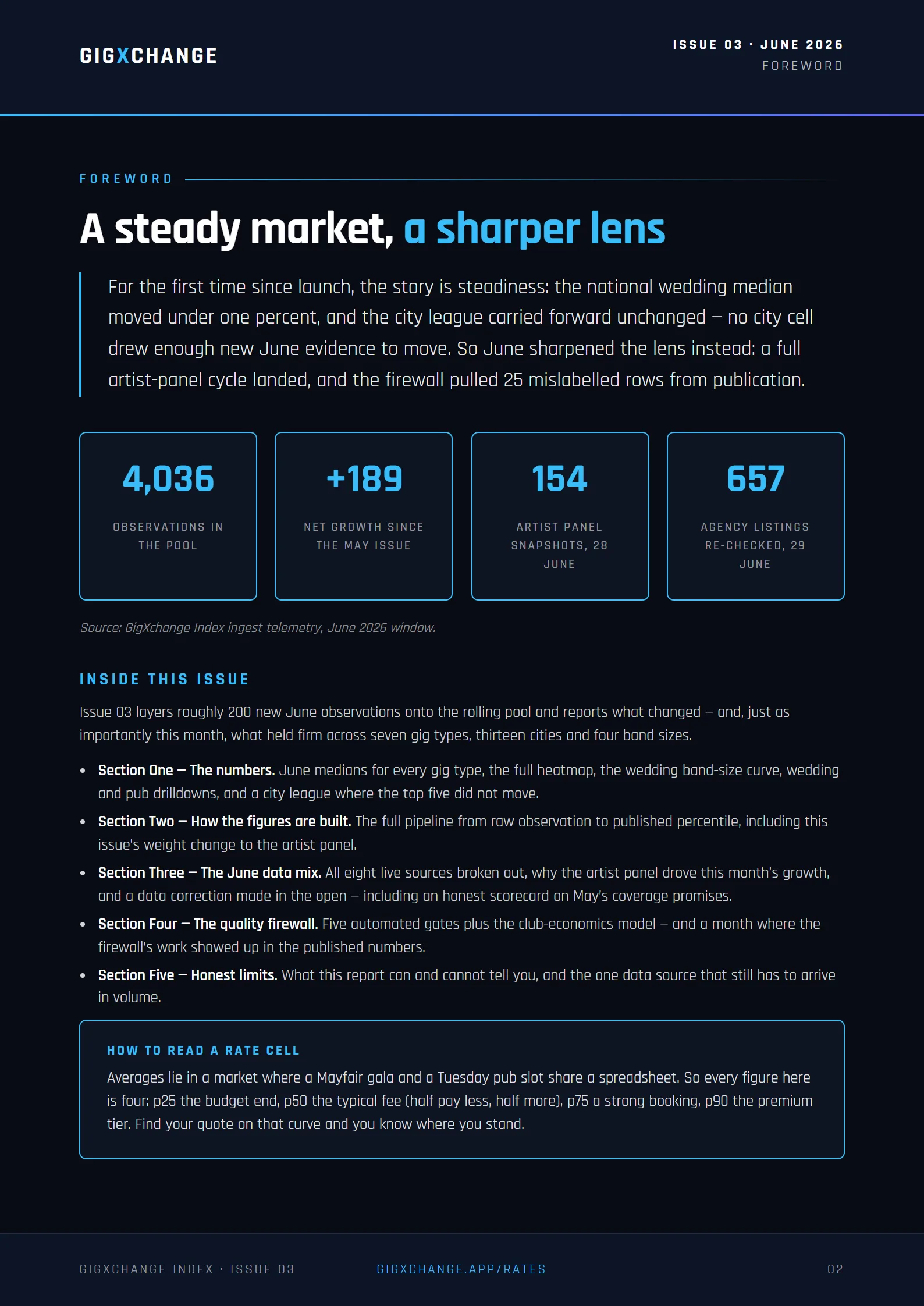
For the first time since launch, the story is steadiness: the national wedding median moved under one percent, and the city league carried forward unchanged — no city cell drew enough new June evidence to move. So June sharpened the lens instead: a full artist-panel cycle landed, and the firewall pulled 25 mislabelled rows from publication.
4,036Observations in the pool
+189Net growth since the May issue
154Artist panel snapshots, 28 June
657Published rates re-checked, 29 June
Source: GigXchange Index ingest telemetry, June 2026 window.
03 — What gigs pay
What UK gigs pay in June 2026 by gig type and band size
In June 2026 the UK median fee for a 3–4 piece ran from £425 for a pub booking to £1,005 for a wedding one. You can pick any gig type and band size for its lower quarter, median, strong booking and top tenth, with how many fees stand behind it.
Wedding · 3–4 piece · UK£1,005median fee · n 11,936
Lower quarter
£738
Median
£1,005
Strong booking
£1,281
Top tenth
£1,849
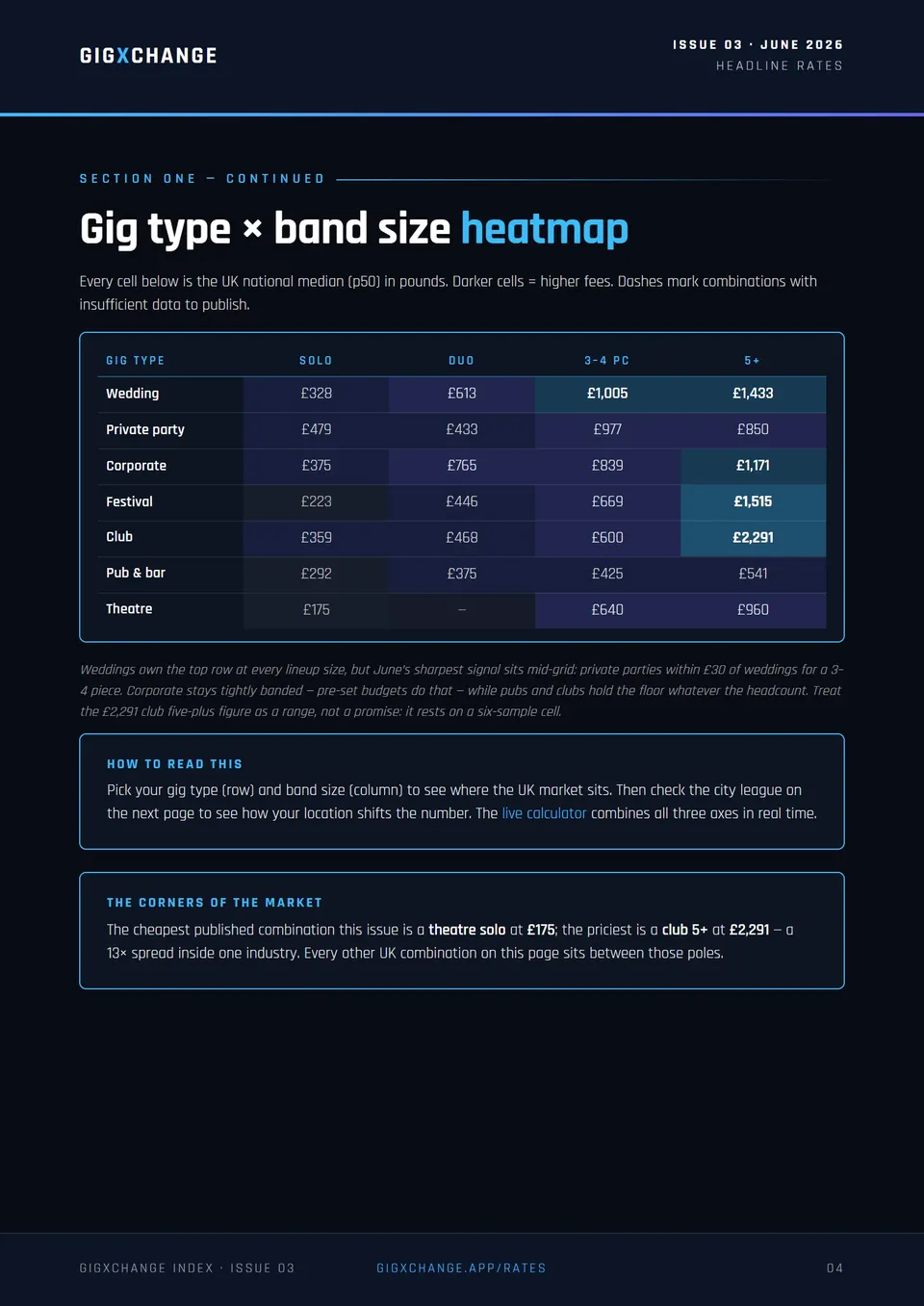
UK median fee by gig type and band size (p50, £). † = n under 10.
Gig type
Solo
Duo
3–4 piece
5+
Wedding
Private party
Corporate
Festival
Club
Pub & bar
Theatre
–
Put this table on your own site. Free under CC BY 4.0, with credit.
Where the market settled in June
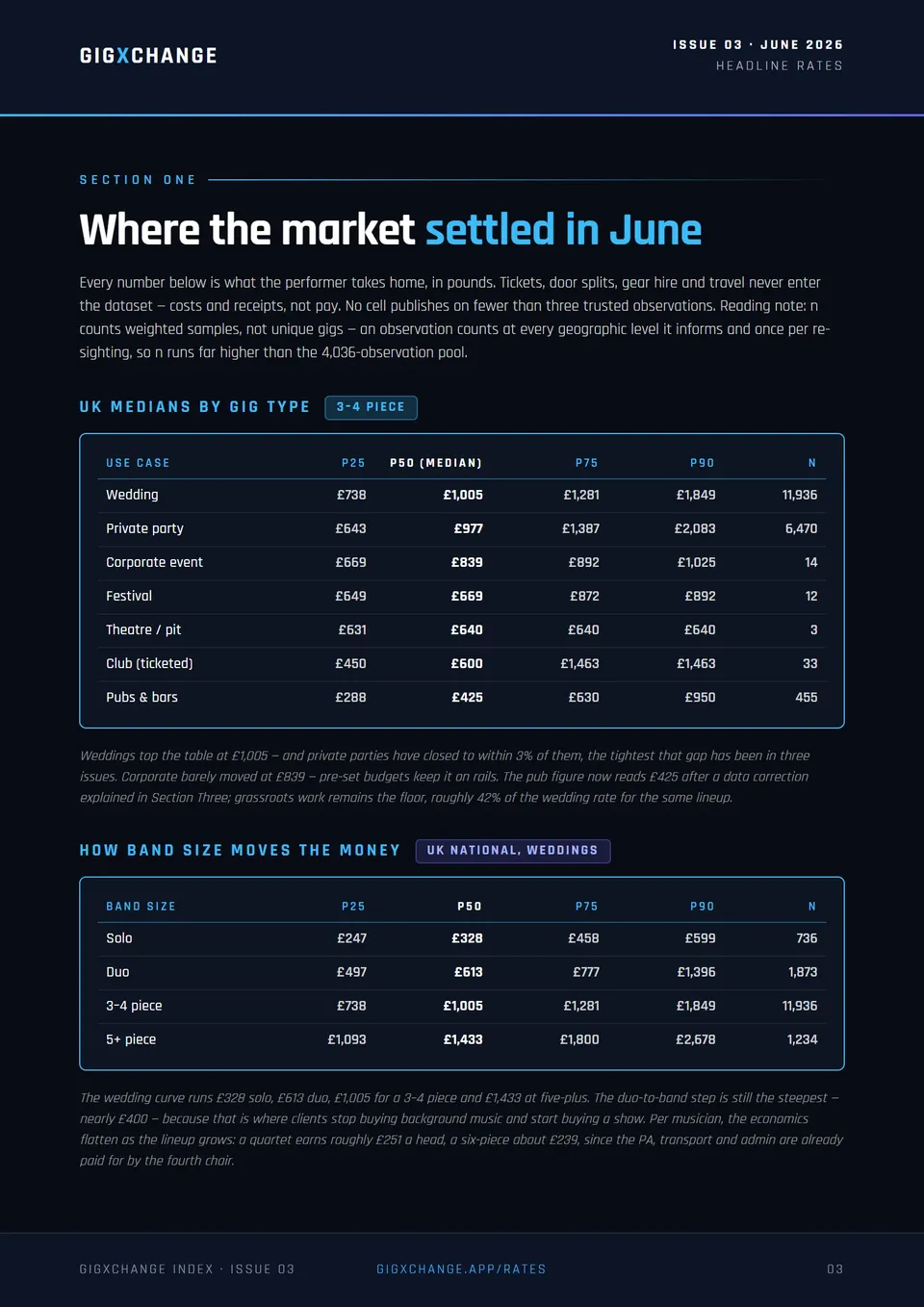
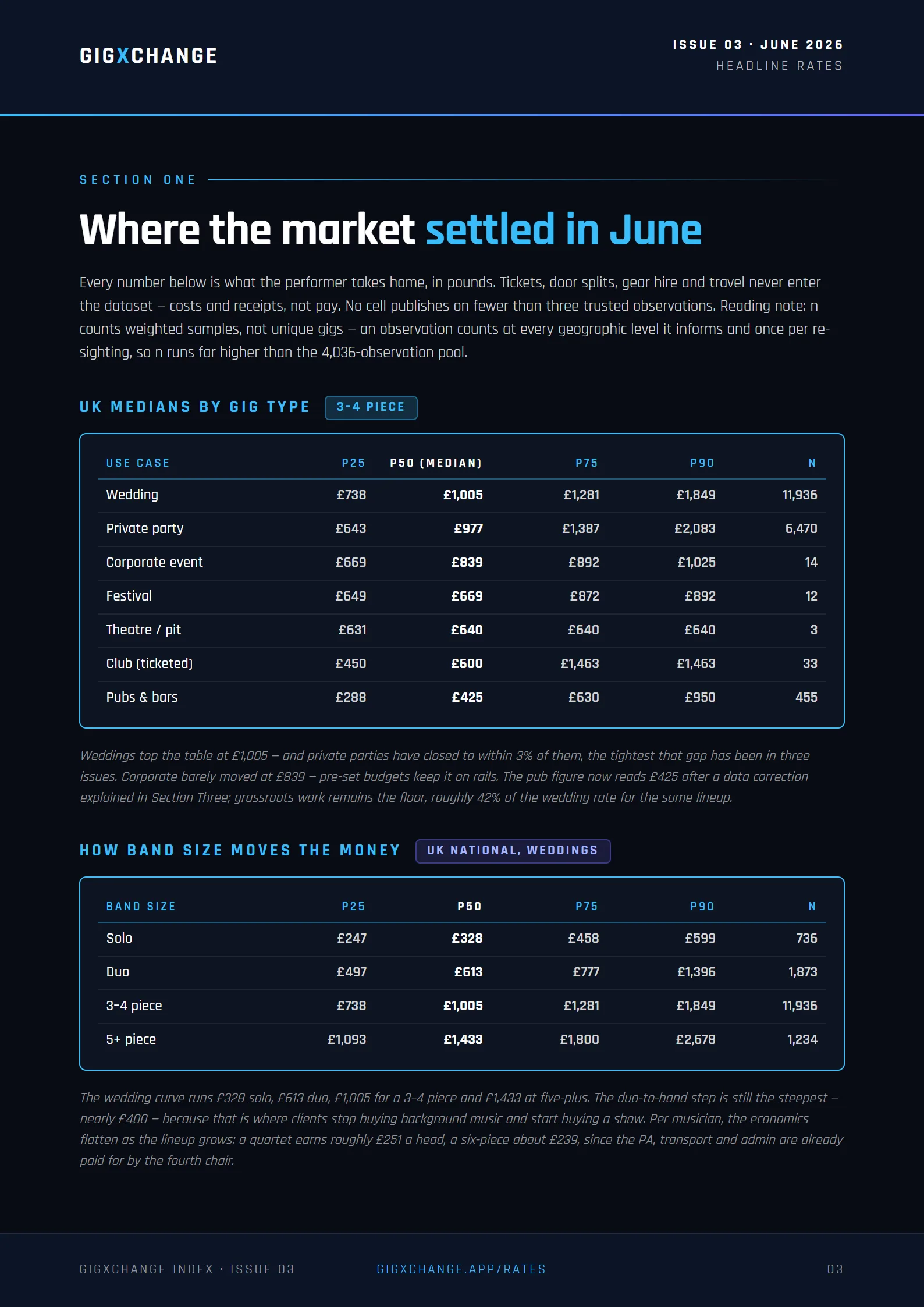
Every number below is what the performer takes home, in pounds. Tickets, door splits, gear hire and travel never enter the dataset — costs and receipts, not pay. A city or region cell needed three trusted sightings to publish; under this issue's method one observation seen repeatedly could meet that, and the UK baseline had no floor (see the Method note). Reading note: n counts weighted samples, not unique gigs — an observation counts at every geographic level it informs and once per re-sighting, so n runs far higher than the 4,036-observation pool.
By gig type
Weddings top the table at £1,005 — and private parties have closed to within 3% of them, the tightest that gap has been in three issues. Corporate barely moved at £839 — pre-set budgets keep it on rails. The pub figure now reads £425 after a data correction explained in Section Three; grassroots work remains the floor, roughly 42% of the wedding rate for the same lineup.
By band size
The wedding curve runs £328 solo, £613 duo, £1,005 for a 3–4 piece and £1,433 at five-plus. The duo-to-band step adds £392 — the point where clients stop buying background music and start buying a show — though the jump from a 3–4 piece to five-plus is slightly steeper, at £428. Per musician, the economics flatten as the lineup grows: a quartet earns roughly £251 a head, a six-piece about £239, since the PA, transport and admin are already paid for by the fourth chair.
UK wedding medians by band size, June 2026
Solo
£328
Duo
£6131.9×
3–4 piece
£1,0053.1×
5+
£1,4334.4×
Put this chart on your own site. Free under CC BY 4.0, with credit.
Across the whole grid
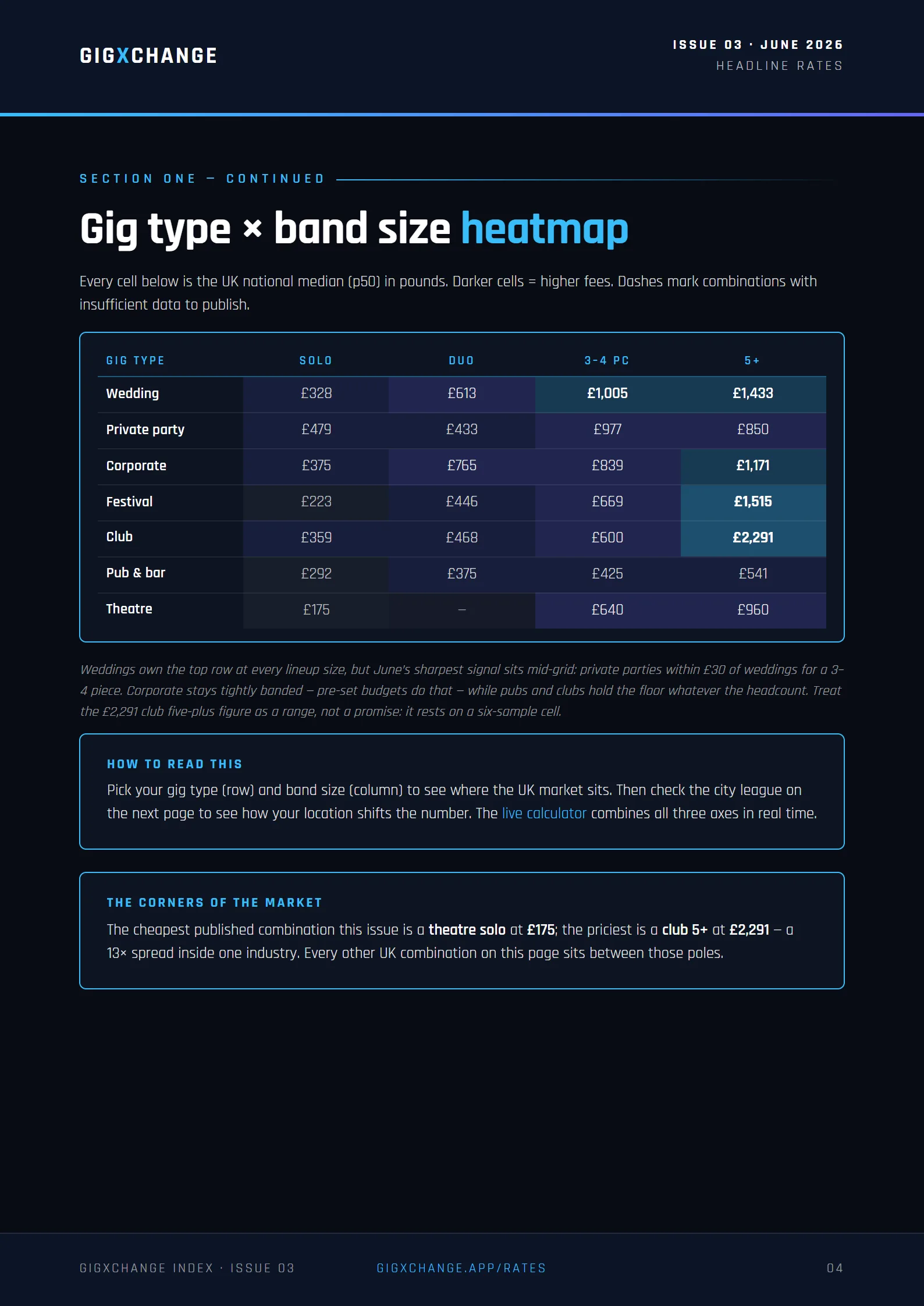
Weddings lead the 3–4 piece column, but not every lineup: private parties lead at solo (£479), corporate at duo (£765), and club (£2,291) and festival (£1,515) bookings top five-plus. June’s sharpest signal sits mid-grid: private parties within £30 of weddings for a 3–4 piece. Corporate stays tightly banded — pre-set budgets do that — while pubs and clubs hold the floor whatever the headcount. Treat the £2,291 club five-plus figure as a range, not a promise: it rests on a six-sample cell.
04 — City league
UK city league for wedding bands, June 2026
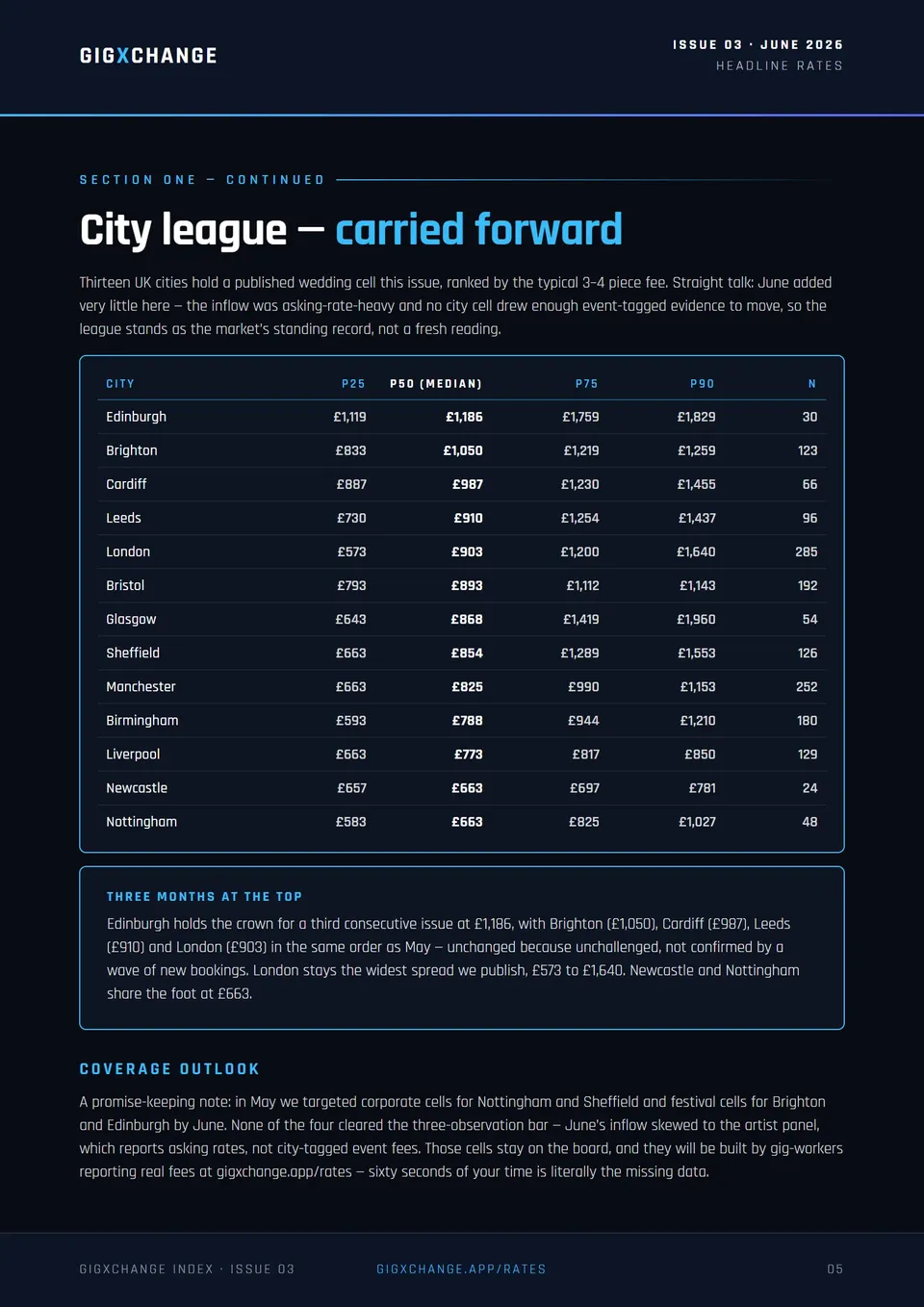
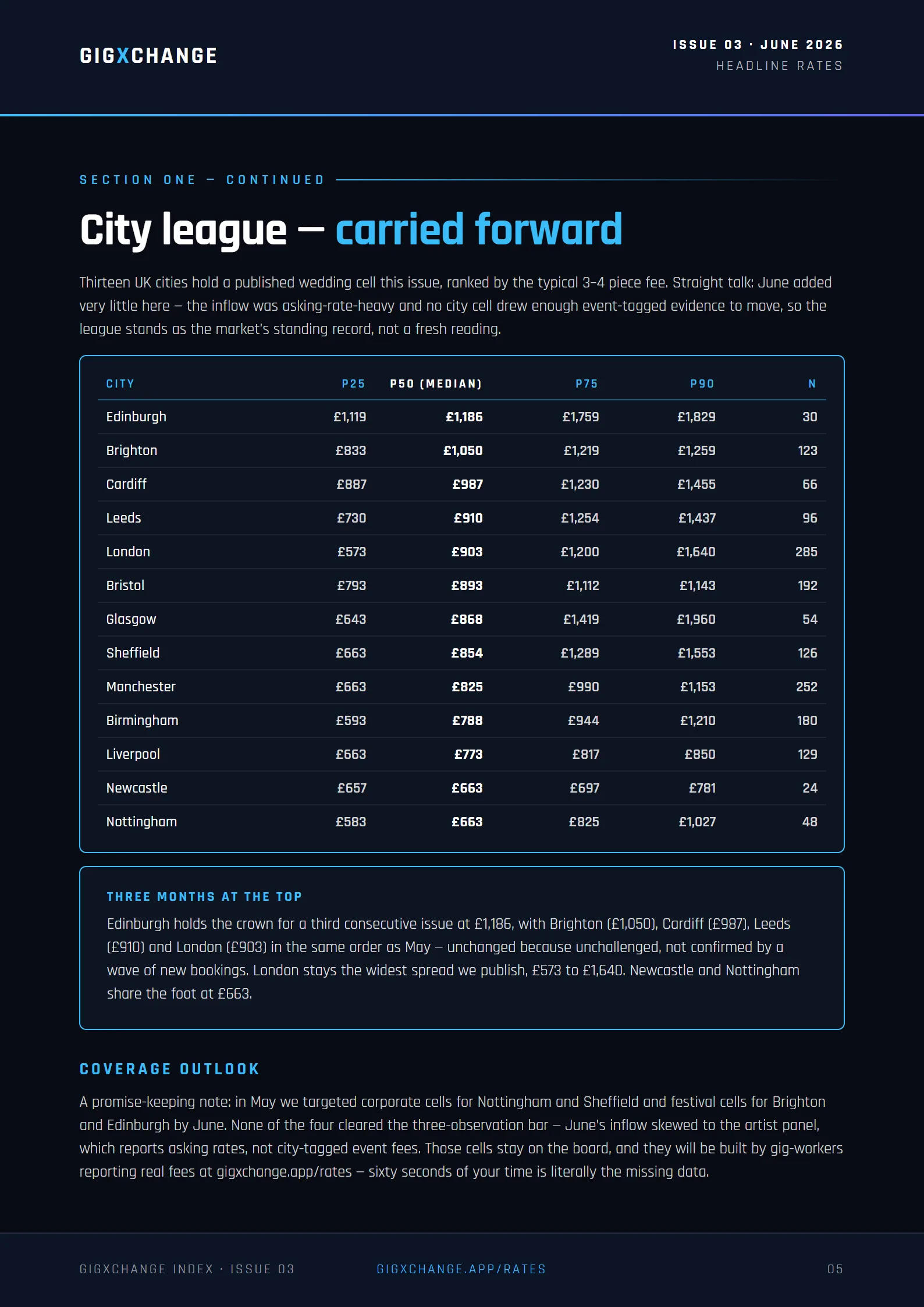
Across 13 UK cities a 3–4 piece wedding band's median ran from £663 in 2 cities including Newcastle to £1,186 in Edinburgh, £523 apart, against £1,005 for the UK as a whole.
Wedding, 3–4 piece: median and middle half by city, June 2026, as the issue published them.
Put this table on your own site. Free under CC BY 4.0, with credit.
City league — carried forward
Thirteen UK cities hold a published wedding cell this issue, ranked by the typical 3–4 piece fee. Straight talk: June added very little here — the inflow was asking-rate-heavy and no city cell drew enough event-tagged evidence to move, so the league stands as the market’s standing record, not a fresh reading.
Coverage outlook
A promise-keeping note: in May we targeted corporate cells for Nottingham and Sheffield and festival cells for Brighton and Edinburgh by June. None of the four cleared the three-observation bar — June’s inflow skewed to the artist panel, which reports asking rates, not city-tagged event fees. Those cells stay on the board, and they will be built by gig-workers reporting real fees at gigxchange.app/rates — sixty seconds of your time is literally the missing data.
05 — What changed
What changed since May 2026
What the June 2026 issue reported about weddings and pubs. The moves it names were computed under Method v1 against the previous issue and are not re-checked here.
Weddings
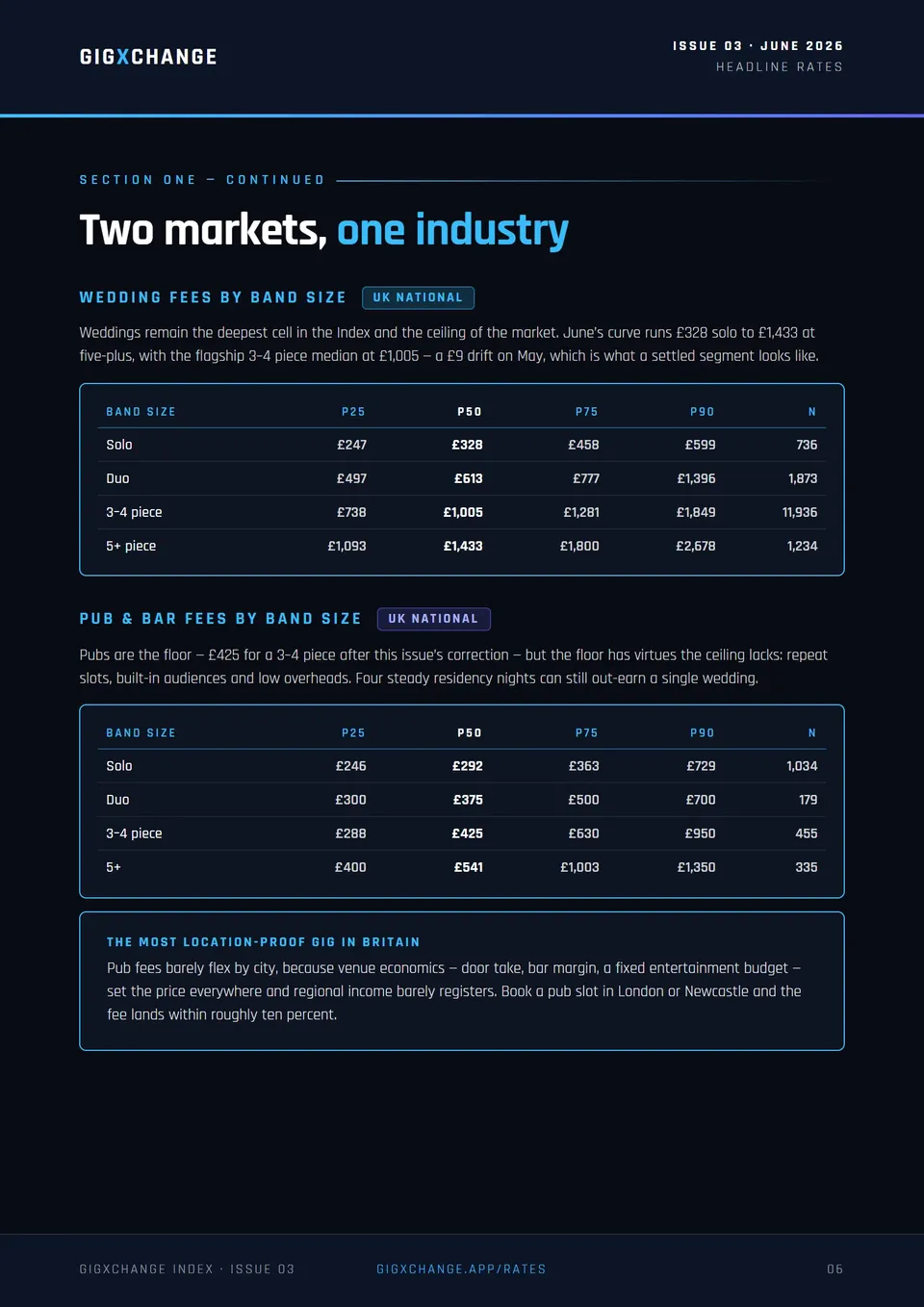
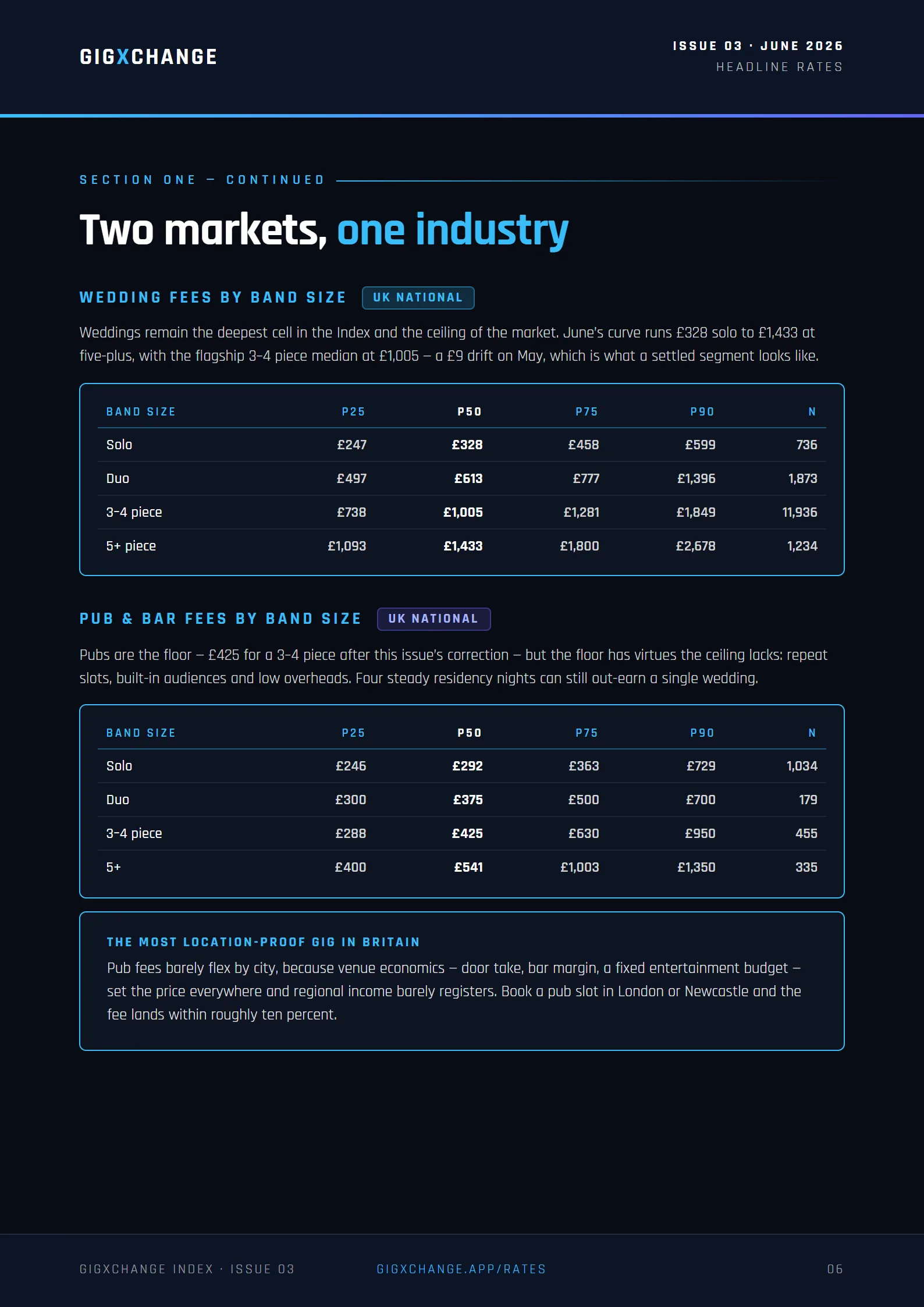
Weddings remain the deepest cell in the Index and the dearest 3–4 piece booking. June’s curve runs £328 solo to £1,433 at five-plus, with the flagship 3–4 piece median at £1,005 — a £9 drift on May, which is what a settled segment looks like.
Pubs and bars
Pubs are the floor — £425 for a 3–4 piece after this issue’s correction — but the floor has virtues the ceiling lacks: repeat slots, built-in audiences and low overheads. Four steady residency nights can still out-earn a single wedding.
06 — How it is built
How the GX Index figures are built
Every figure is a percentile of real fees paid, asked or budgeted, from 8 sources, built with Method v1; the method note sets out what that method got wrong.
How this issue was built
What each figure counts, how it is worked out, and when it was counted.
Part
How it works
What is counted
4,036 data points of the fees UK live music acts were paid or asked, in pounds, from 8 source classes.
They make 310 rate cells across 13 UK cities. Under Method v1 the n printed beside each cell counted repeat sightings, so it runs far above the pool of 4,036.
How
Each cell prints four percentiles of its fees: p25, p50, p75 and p90. Source weights were recorded but not yet applied to the figures, and a regional layer filled thin cells.
A figure on n under 10 carries a dagger: read it as a bearing, not a benchmark.
Windows
Every row in the index when the issue was compiled; Method v1 issues kept no window dates.
When
Published on 4 July 2026. Method v1 issues kept no data date for the whole pool; this issue’s text dates only one source, the artist panel’s 28 June 2026 snapshot.
The PDF is kept as issued; any revision since is dated under Methodology revisions on this page. To quote a figure, use the citation under the print edition (DOI 10.5281/zenodo.21197463) and give the publication date beside it.
Method version
v1 (from 19 April 2026), the method this issue was built with, in use until 8 August 2026; figures from issues built after that date are not comparable with this issue’s. For weddings and private parties, changes across 31 October 2026 reflect the commission correction made that day, not the market; for those figures, readings from before 31 October 2026 are not comparable with later ones.
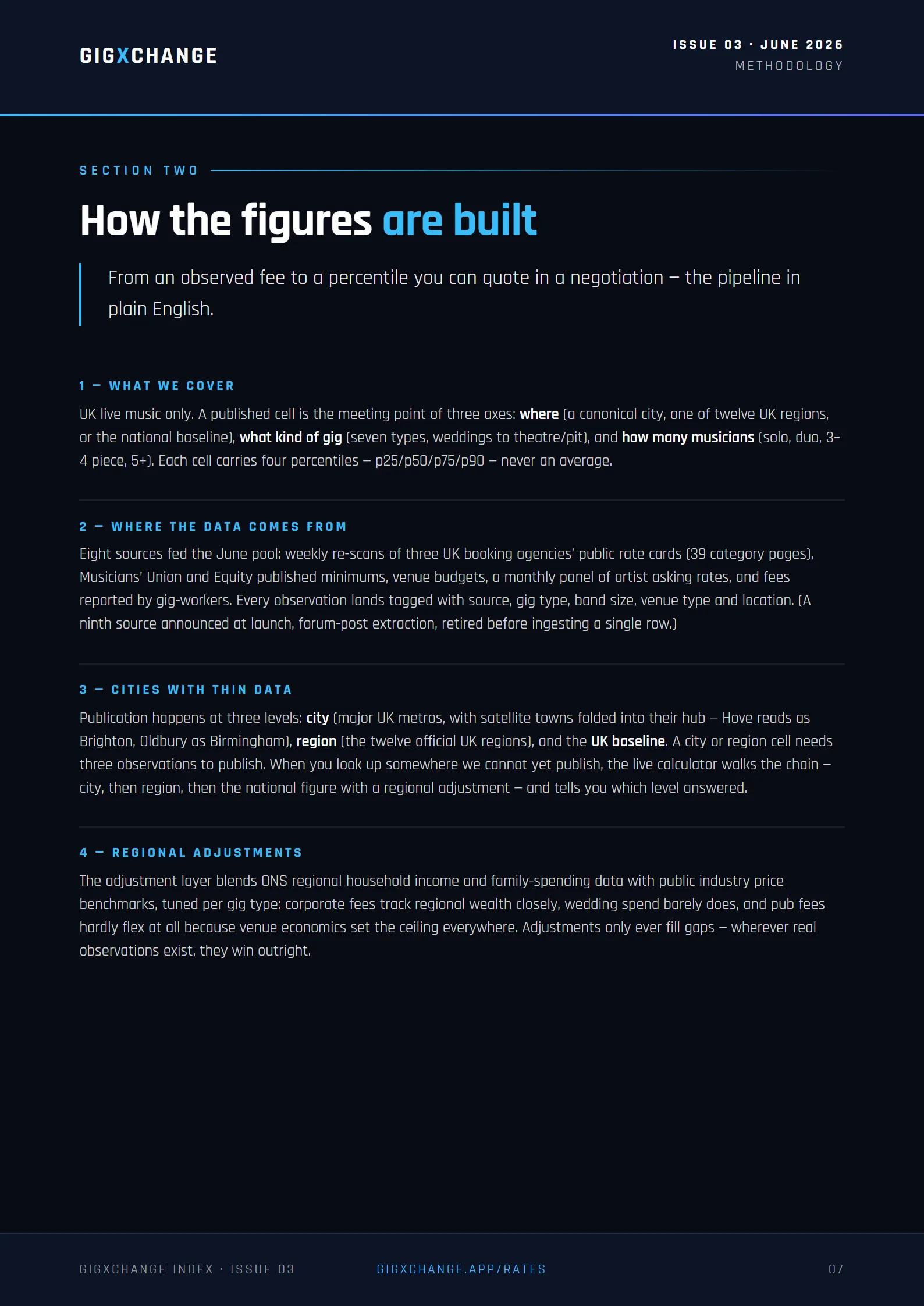
From an observed fee to a percentile you can quote in a negotiation — the pipeline in plain English.
What we cover
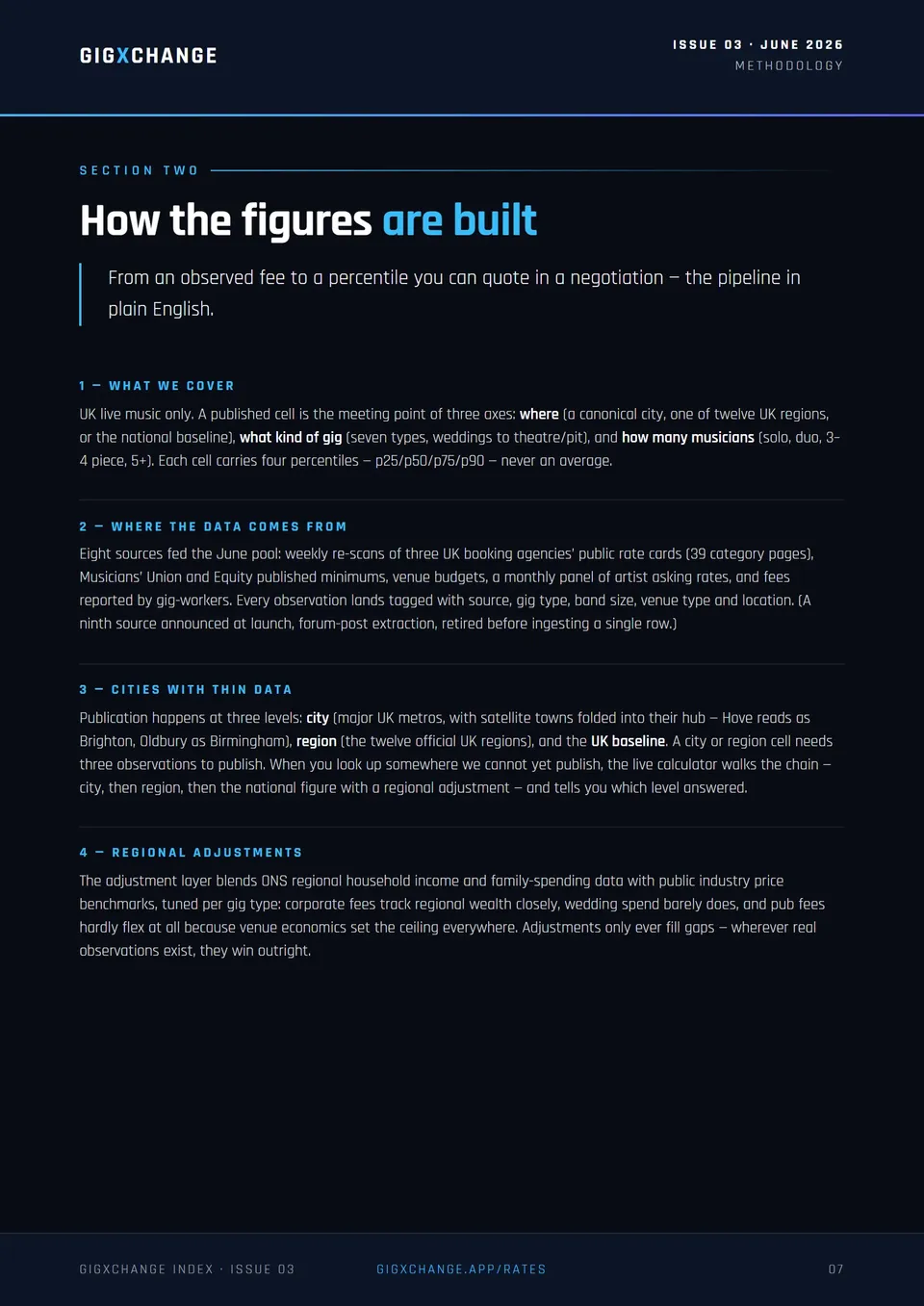
UK live music only. A published cell is the meeting point of three axes: where (a canonical city, one of twelve UK regions, or the national baseline), what kind of gig (seven types, weddings to theatre/pit), and how many musicians (solo, duo, 3–4 piece, 5+). Each cell carries four percentiles — p25/p50/p75/p90 — never an average.
Where the data comes from
Eight sources fed the June pool: weekly refreshes of published UK market rates, Musicians’ Union and Equity published minimums, venue budgets, a monthly panel of artist asking rates, and fees reported by gig-workers. Every observation lands tagged with source, gig type, band size, venue type and location. (A ninth source announced at launch, forum-post extraction, retired before ingesting a single row.)
Cities with thin data
Publication happens at three levels: city (major UK metros, with satellite towns folded into their hub — Hove reads as Brighton, Oldbury as Birmingham), region (the twelve official UK regions), and the UK baseline. A city or region cell needs three observations to publish. When you look up somewhere we cannot yet publish, the live calculator walks the chain — city, then region, then the national figure with a regional adjustment — and tells you which level answered.
Regional adjustments
The adjustment layer blends ONS regional household income and family-spending data with public industry price benchmarks, tuned per gig type: corporate fees track regional wealth closely, wedding spend barely does, and pub fees hardly flex at all because venue economics set the ceiling everywhere. Adjustments only ever fill gaps — wherever real observations exist, they win outright.
Keeping junk out
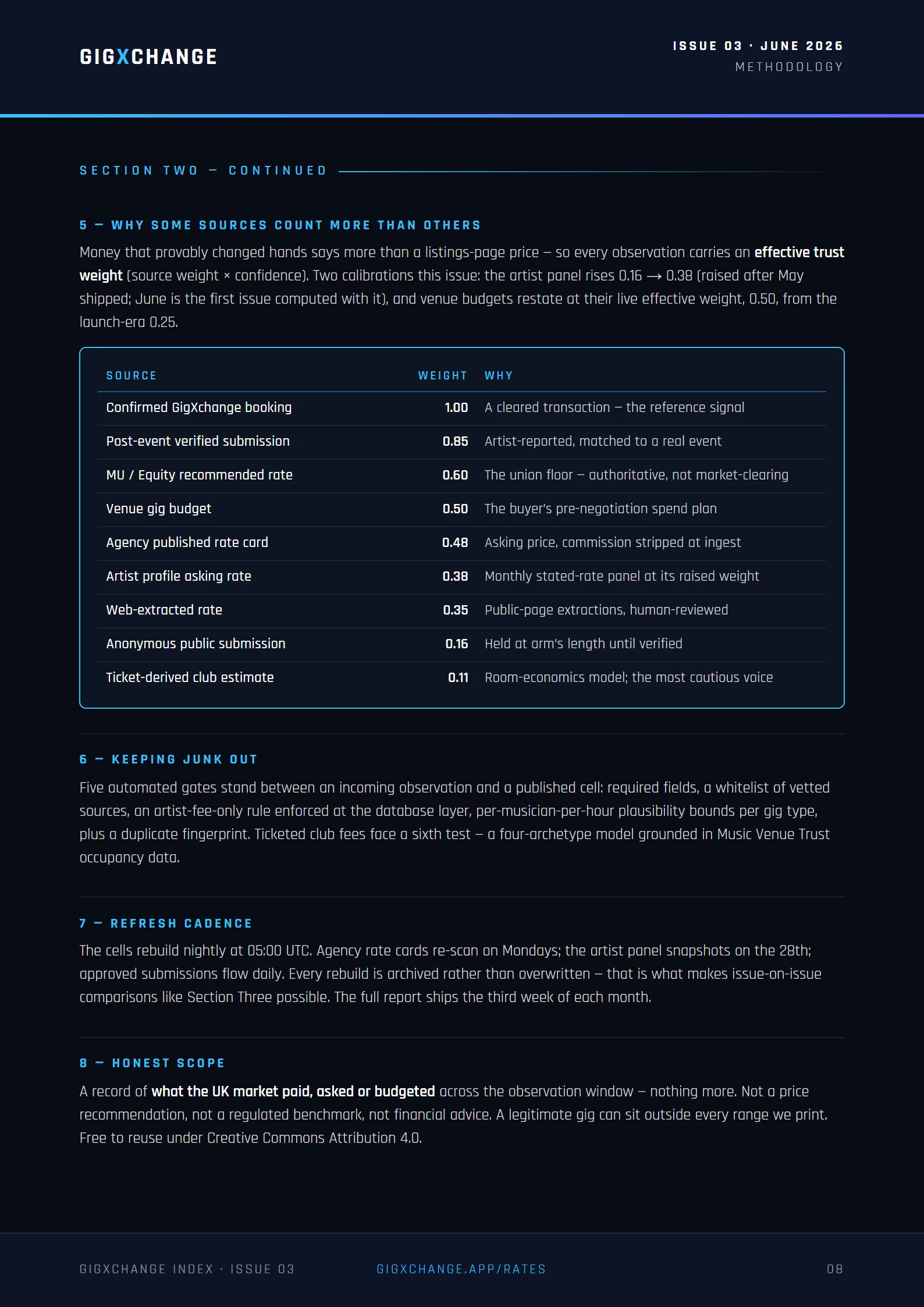
Five automated gates stand between an incoming observation and a published cell: required fields, a whitelist of vetted sources, an artist-fee-only rule enforced at the database layer, per-musician-per-hour plausibility bounds per gig type, plus a duplicate fingerprint. Ticketed club fees face a sixth test — a four-archetype model grounded in Music Venue Trust occupancy data.
Refresh cadence
The cells rebuild nightly at 05:00 UTC. Published market rates refresh on Mondays; the artist panel snapshots on the 28th; approved submissions flow daily. Every rebuild is archived rather than overwritten — that is what makes issue-on-issue comparisons like Section Three possible. The full report ships the third week of each month.
Honest scope
A record of what the UK market paid, asked or budgeted across the observation window — nothing more. Not a price recommendation, not a regulated benchmark, not financial advice. A legitimate gig can sit outside every range we print. Free to reuse under Creative Commons Attribution 4.0.
Why some sources count more than others
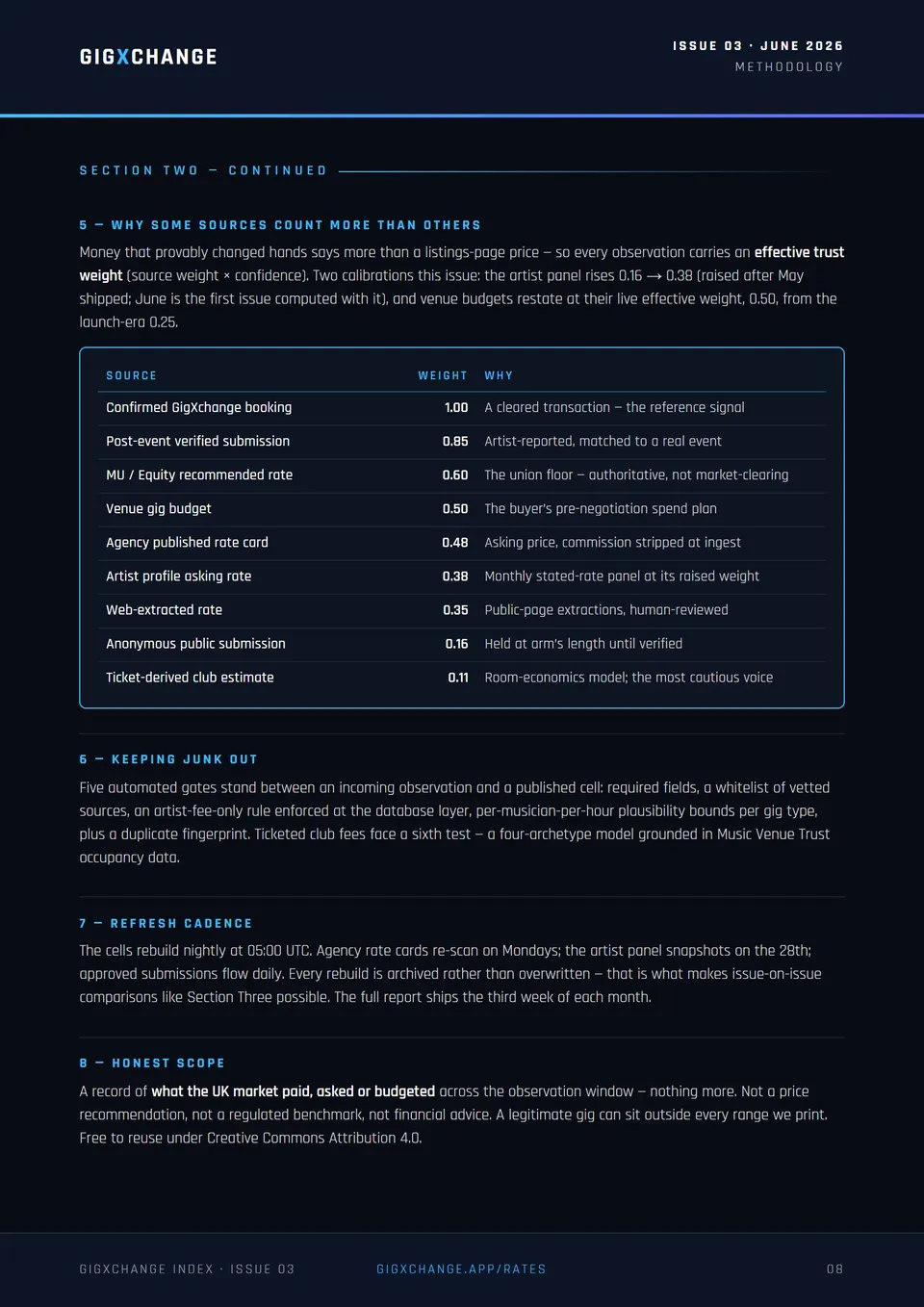
Money that provably changed hands says more than a listings-page price — so every observation carries an effective trust weight (source weight × confidence). Two calibrations this issue: the artist panel rises 0.16 → 0.38 (raised after May shipped; June is the first issue computed with it), and venue budgets restate at their live effective weight, 0.50, from the launch-era 0.25.
Share of the pool by source, June 2026
Published market rates
77.4%
Artist profile rates
6.5%
Post-event verified reports
4.8%
MU / Equity recommended
3.5%
Reviewed public rates
3.1%
Ticket-derived club estimates
3%
Venue gig budgets
1%
Anonymous submissions
0.6%
Put this chart on your own site. Free under CC BY 4.0, with credit.
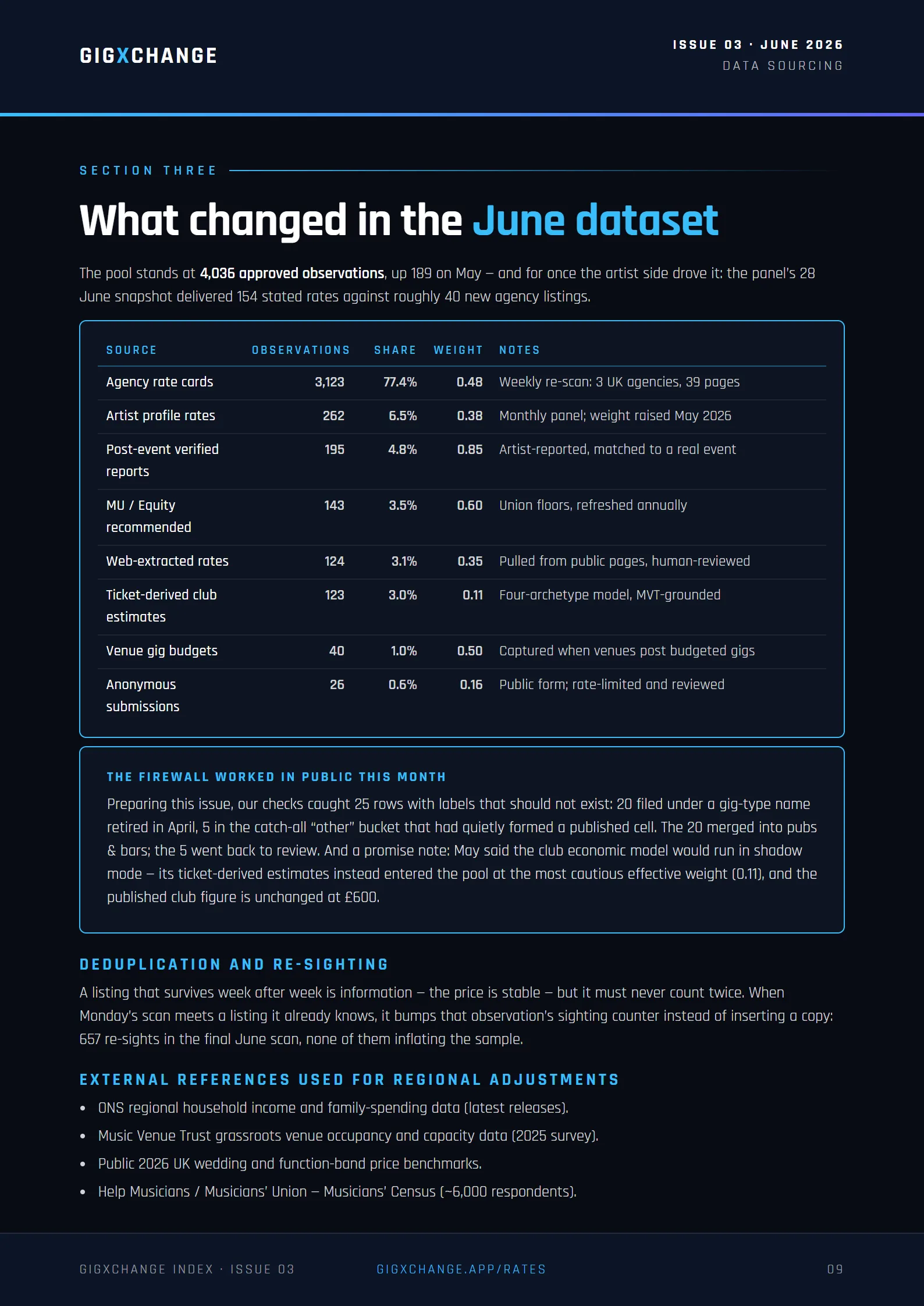
Sources in the pool at the June 2026 refresh, as the issue printed them.
Source
Observations
Share
Avg weight
Notes
Published market rates
3,123
77.4%
0.48
Weekly refresh — published UK market rates
Artist profile rates
262
6.5%
0.38
Monthly panel; weight raised May 2026
Post-event verified reports
195
4.8%
0.85
Artist-reported, matched to a real event
MU / Equity recommended
143
3.5%
0.60
Union floors, refreshed annually
Reviewed public rates
124
3.1%
0.35
Pulled from public pages, human-reviewed
Ticket-derived club estimates
123
3.0%
0.11
Four-archetype model, MVT-grounded
Venue gig budgets
40
1.0%
0.50
Captured when venues post budgeted gigs
Anonymous submissions
26
0.6%
0.16
Public form; rate-limited and reviewed
Put this table on your own site. Free under CC BY 4.0, with credit.
What changed in the June dataset
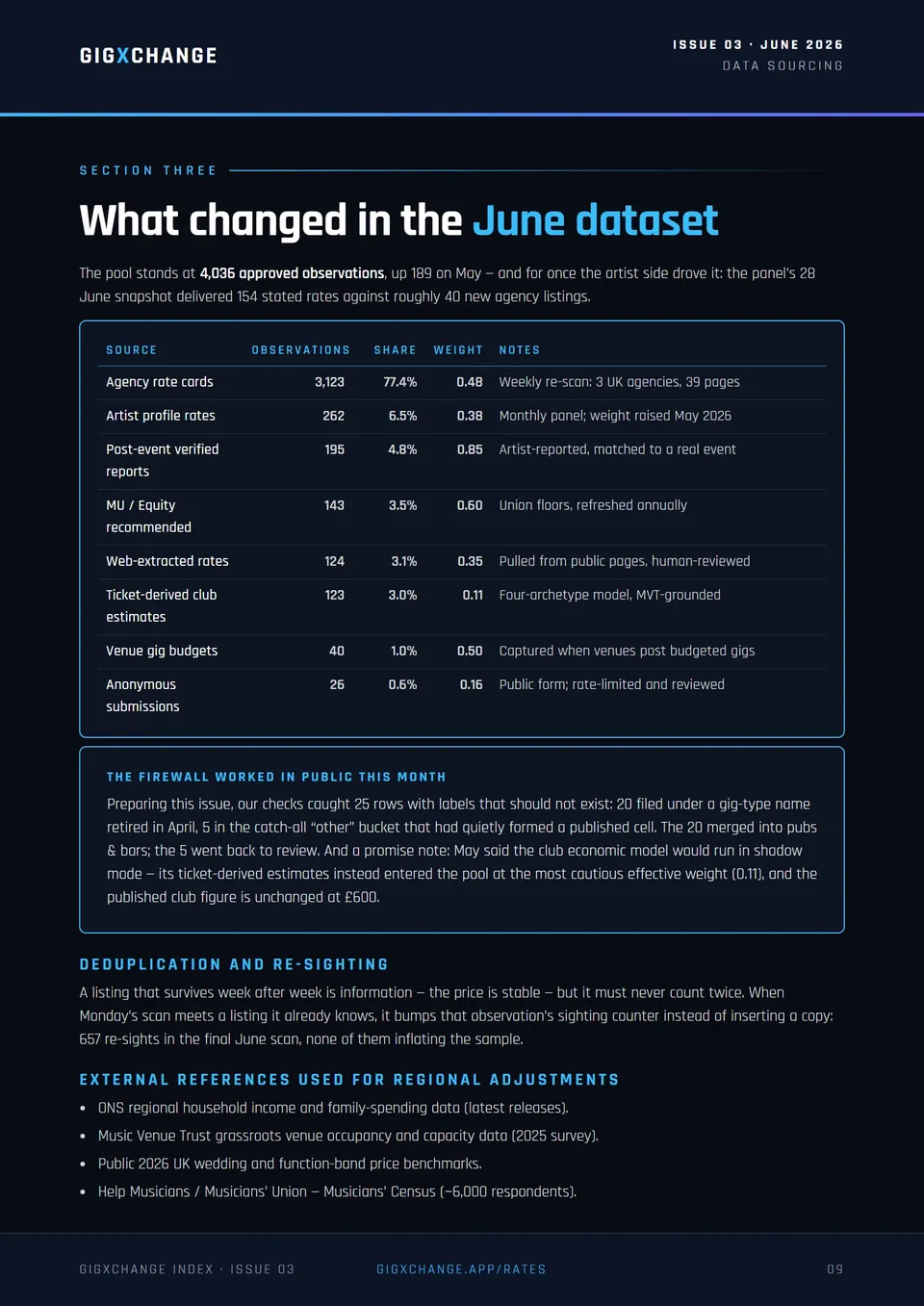
The pool stands at 4,036 approved observations, up 189 on May — and for once the artist side drove it: the panel’s 28 June snapshot delivered 154 stated rates against roughly 40 new published-rate listings.
Deduplication and re-sighting
A listing that survives week after week is information — the price is stable — but it must never count twice. When Monday’s refresh meets a listing it already knows, it bumps that observation’s sighting counter instead of inserting a copy: 657 re-sights in the final June refresh, none of them inflating the sample.
How we keep junk out
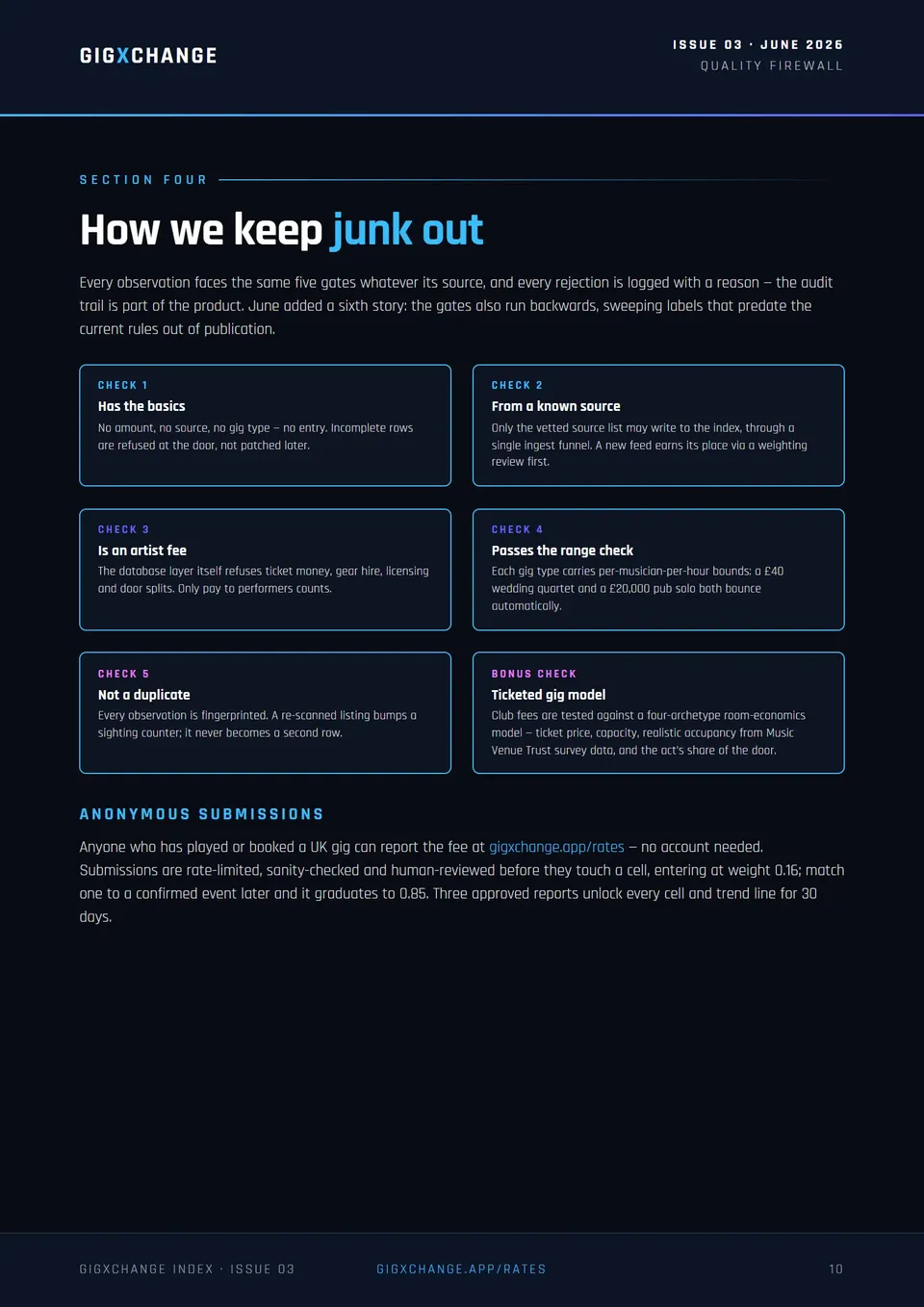
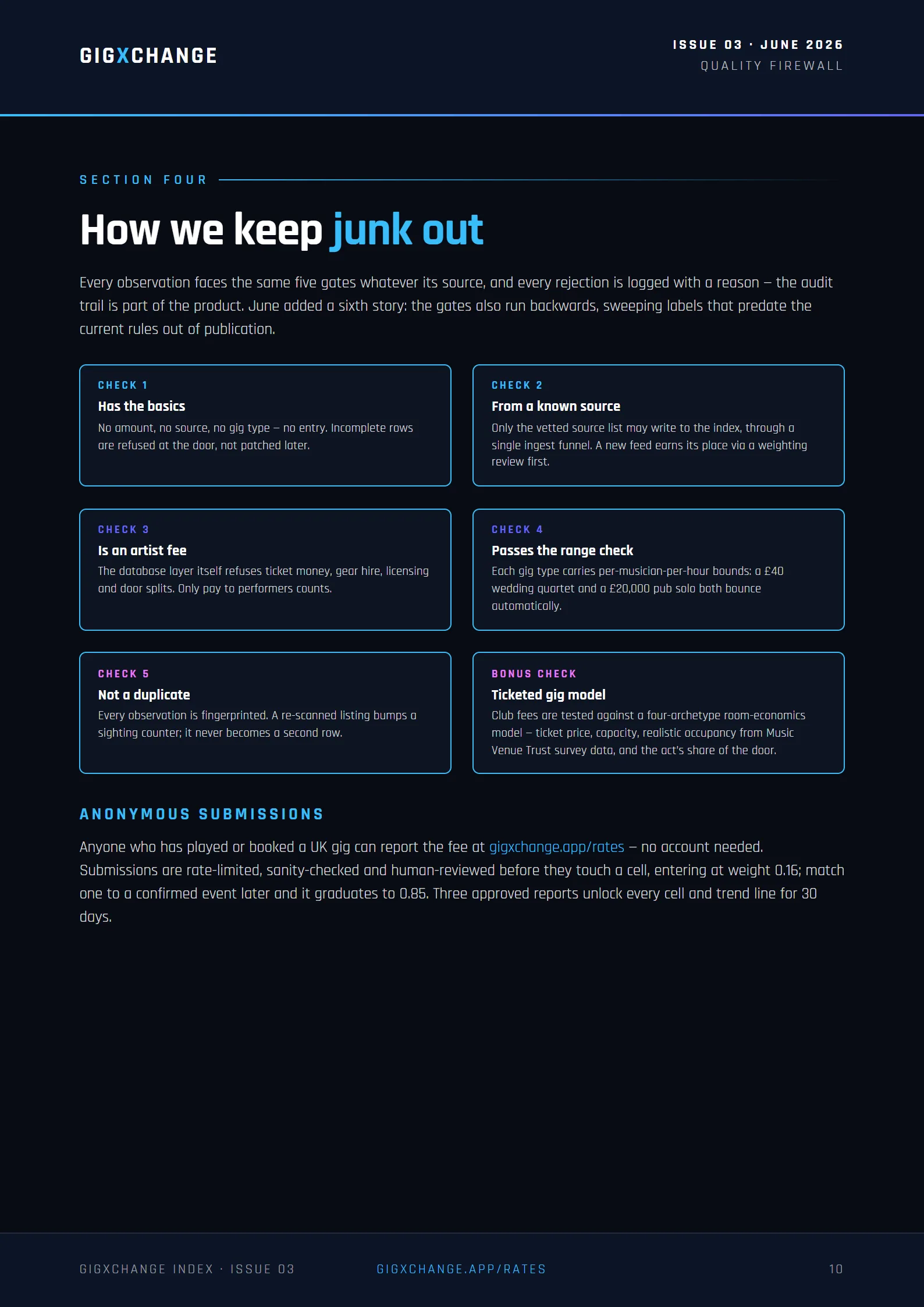
Every observation faces the same five gates whatever its source, and every rejection is logged with a reason — the audit trail is part of the product. June added a sixth story: the gates also run backwards, sweeping labels that predate the current rules out of publication.
Has the basicsNo amount, no source, no gig type — no entry. Incomplete rows are refused at the door, not patched later.
From a known sourceOnly the vetted source list may write to the index, through a single ingest funnel. A new feed earns its place via a weighting review first.
Is an artist feeThe database layer itself refuses ticket money, gear hire, licensing and door splits. Only pay to performers counts.
Passes the range checkEach gig type carries per-musician-per-hour bounds: a £40 wedding quartet and a £20,000 pub solo both bounce automatically.
Not a duplicateEvery observation is fingerprinted. A re-checked listing bumps a sighting counter; it never becomes a second row.
Ticketed gig modelClub fees are tested against a four-archetype room-economics model — ticket price, capacity, realistic occupancy from Music Venue Trust survey data, and the act’s share of the door.
Anonymous submissions
Anyone who has played or booked a UK gig can report the fee at gigxchange.app/rates — no account needed. Submissions are rate-limited, sanity-checked and human-reviewed before they touch a cell, entering at weight 0.16; match one to a confirmed event later and it graduates to 0.85. Three approved reports unlock every cell and trend line for 30 days.
External references used for regional adjustments
ONS regional household income and family-spending data (latest releases).
Music Venue Trust grassroots venue occupancy and capacity data (2025 survey).
Public 2026 UK wedding and function-band price benchmarks.
The GX Index is a record of what the UK market paid or asked, not a recommended price, an official benchmark or financial advice. The June 2026 issue published 310 rate cells across 13 UK cities.
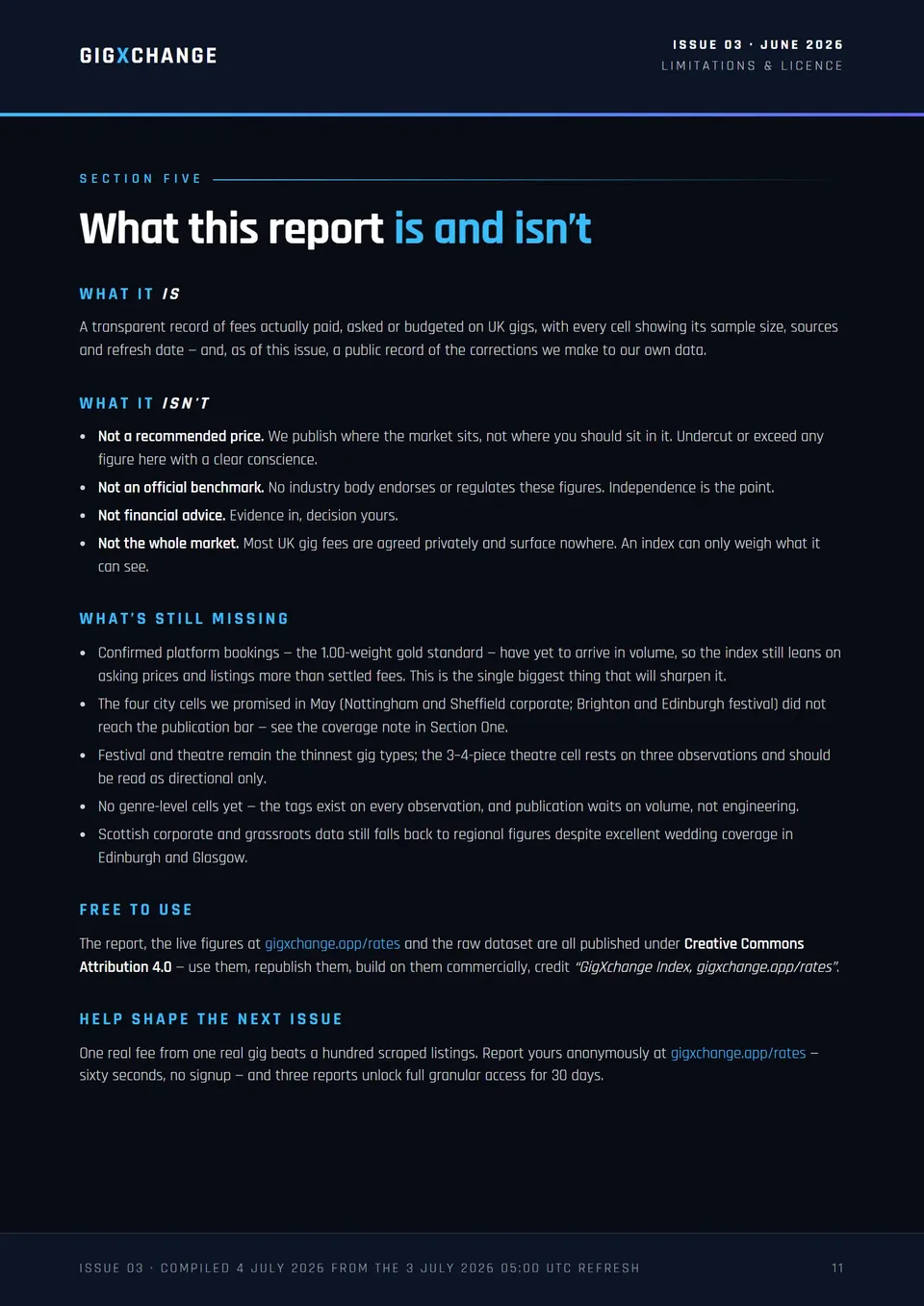
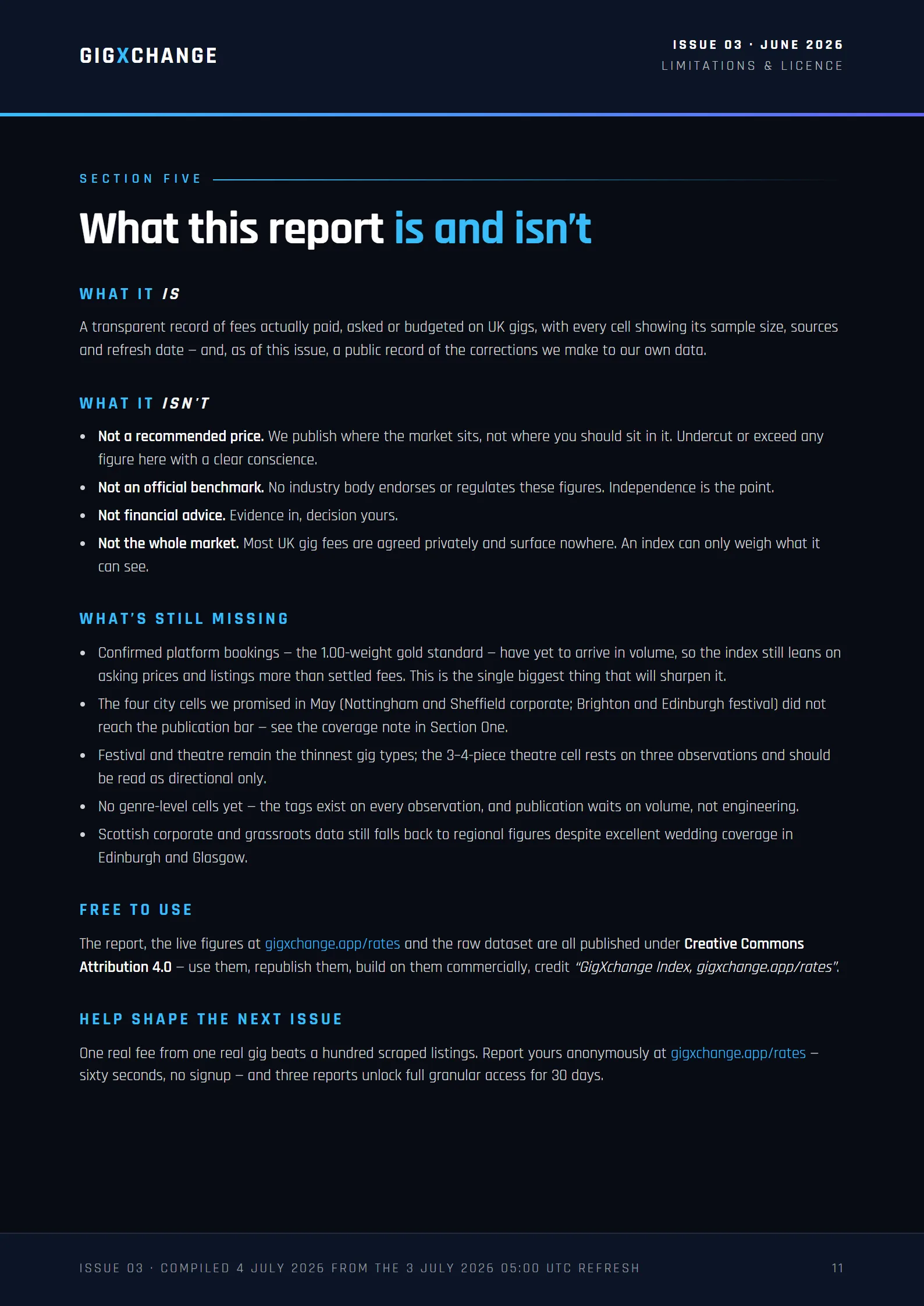
A transparent record of fees actually paid, asked or budgeted on UK gigs, with every cell showing its sample size, sources and refresh date — and, as of this issue, a public record of the corrections we make to our own data.
Not a recommended price.We publish where the market sits, not where you should sit in it. Undercut or exceed any figure here with a clear conscience.
Not an official benchmark.No industry body endorses or regulates these figures. Independence is the point.
Not financial advice.Evidence in, decision yours.
Not the whole market.Most UK gig fees are agreed privately and surface nowhere. An index can only weigh what it can see.
What’s still missing
Confirmed platform bookings — the 1.00-weight gold standard — have yet to arrive in volume, so the index still leans on asking prices and listings more than settled fees. This is the single biggest thing that will sharpen it.
The four city cells we promised in May (Nottingham and Sheffield corporate; Brighton and Edinburgh festival) did not reach the publication bar — see the coverage note in Section One.
Festival and theatre remain the thinnest gig types; the 3–4-piece theatre cell rests on three observations and should be read as directional only.
No genre-level cells yet — the tags exist on every observation, and publication waits on volume, not engineering.
Scottish corporate and grassroots data still falls back to regional figures despite excellent wedding coverage in Edinburgh and Glasgow.
Licence
The report, the live figures at gigxchange.app/rates and the raw dataset are all published under Creative Commons Attribution 4.0 — use them, republish them, build on them commercially, credit “GigXchange Index, gigxchange.app/rates”.
Help shape the next issue
One real fee from one real gig beats a hundred scraped listings. Report yours anonymously at gigxchange.app/rates — sixty seconds, no signup — and three reports unlock full granular access for 30 days.
08 — Methodology revisions
GX Index methodology revisions for June 2026
5 revisions to the June 2026 issue since it was published, the latest on 31 October 2026. Open any one to see what was printed, what it should say and why.
Method · 25 October 2026On this page
Printed: “No cell publishes on fewer than three trusted observations.”Now reads: “A city or region cell needed three trusted sightings to publish; under this issue's method one observation seen repeatedly could meet that, and the UK baseline had no floor (see the Method note).”The Method v1 threshold counted repeat sightings, not distinct observations. Some published cells rest on fewer distinct observations than stated. Not re-computed.
Correction · 25 October 2026On this page
Printed: “The duo-to-band step is still the steepest — nearly £400 — because that is where clients stop buying background music and start buying a show.”Now reads: “The duo-to-band step adds £392 — the point where clients stop buying background music and start buying a show — though the jump from a 3–4 piece to five-plus is slightly steeper, at £428.”The steps on the wedding curve were not compared before the claim was written. Wording only; the published figures are unchanged.
Correction · 25 October 2026On this page
Printed: “Weddings own the top row at every lineup size, but June’s sharpest signal sits mid-grid: private parties within £30 of weddings for a 3–4 piece.”Now reads: “Weddings lead the 3–4 piece column, but not every lineup: private parties lead at solo (£479), corporate at duo (£765), and club (£2,291) and festival (£1,515) bookings top five-plus. June’s sharpest signal sits mid-grid: private parties within £30 of weddings for a 3–4 piece.”The claim was not checked against every column of this issue's own grid. Wording only; the published figures are unchanged.
Correction · 25 October 2026On this page
Printed: “Weddings remain the deepest cell in the Index and the ceiling of the market.”Now reads: “Weddings remain the deepest cell in the Index and the dearest 3–4 piece booking.”Unscoped superlative: club five-plus (£2,291) is the dearest published tile. Wording only; the published figures are unchanged.
Method · 31 October 2026PDF only
Printed: “Asking price, commission stripped at ingest”Should read: “Asking price, commission stripped at ingest (2,646 of these rows had the agency commission taken off twice; see Methodology revisions)”2,646 published market-rate rows imported 17–21 April 2026 had the 20% agency commission taken off twice (the advertised price divided by 1.5 instead of 1.2), so they entered the Index 20% below the take-home figure our method states. Figures that drew on these rows read low, mostly weddings and private parties; none would fall. Corrected on 31 October 2026: on the live Index the UK wedding 3–4 piece median rose 12.9% and wedding five-plus 19.7%, and no cell moved more than 25%. The PDF, CSV and archived dataset are kept as issued.
In June 2026 a 3–4 piece wedding band's median fee was £1,005 and a pub booking £425, from 4,036 data points across 13 UK cities.
A steady market, a sharper lens
For the first time since launch, the story is steadiness: the national wedding median moved under one percent, and the city league carried forward unchanged — no city cell drew enough new June evidence to move. So June sharpened the lens instead: a full artist-panel cycle landed, and the firewall pulled 25 mislabelled rows from publication.
4,036Observations in the pool
+189Net growth since the May issue
154Artist panel snapshots, 28 June
657Published rates re-checked, 29 June
Source: GigXchange Index ingest telemetry, June 2026 window.
What UK gigs pay in June 2026 by gig type and band size
In June 2026 the UK median fee for a 3–4 piece ran from £425 for a pub booking to £1,005 for a wedding one. You can pick any gig type and band size for its lower quarter, median, strong booking and top tenth, with how many fees stand behind it.
Wedding · 3–4 piece · UK£1,005median fee · n 11,936
Lower quarter
£738
Median
£1,005
Strong booking
£1,281
Top tenth
£1,849
UK median fee by gig type and band size (p50, £). † = n under 10.
Gig type
Solo
Duo
3–4 piece
5+
Wedding
Private party
Corporate
Festival
Club
Pub & bar
Theatre
–
Put this table on your own site. Free under CC BY 4.0, with credit.
Where the market settled in June
Every number below is what the performer takes home, in pounds. Tickets, door splits, gear hire and travel never enter the dataset — costs and receipts, not pay. A city or region cell needed three trusted sightings to publish; under this issue's method one observation seen repeatedly could meet that, and the UK baseline had no floor (see the Method note). Reading note: n counts weighted samples, not unique gigs — an observation counts at every geographic level it informs and once per re-sighting, so n runs far higher than the 4,036-observation pool.
By gig type
Weddings top the table at £1,005 — and private parties have closed to within 3% of them, the tightest that gap has been in three issues. Corporate barely moved at £839 — pre-set budgets keep it on rails. The pub figure now reads £425 after a data correction explained in Section Three; grassroots work remains the floor, roughly 42% of the wedding rate for the same lineup.
By band size
The wedding curve runs £328 solo, £613 duo, £1,005 for a 3–4 piece and £1,433 at five-plus. The duo-to-band step adds £392 — the point where clients stop buying background music and start buying a show — though the jump from a 3–4 piece to five-plus is slightly steeper, at £428. Per musician, the economics flatten as the lineup grows: a quartet earns roughly £251 a head, a six-piece about £239, since the PA, transport and admin are already paid for by the fourth chair.
UK wedding medians by band size, June 2026
Solo
£328
Duo
£6131.9×
3–4 piece
£1,0053.1×
5+
£1,4334.4×
Put this chart on your own site. Free under CC BY 4.0, with credit.
Across the whole grid
Weddings lead the 3–4 piece column, but not every lineup: private parties lead at solo (£479), corporate at duo (£765), and club (£2,291) and festival (£1,515) bookings top five-plus. June’s sharpest signal sits mid-grid: private parties within £30 of weddings for a 3–4 piece. Corporate stays tightly banded — pre-set budgets do that — while pubs and clubs hold the floor whatever the headcount. Treat the £2,291 club five-plus figure as a range, not a promise: it rests on a six-sample cell.
UK city league for wedding bands, June 2026
Across 13 UK cities a 3–4 piece wedding band's median ran from £663 in 2 cities including Newcastle to £1,186 in Edinburgh, £523 apart, against £1,005 for the UK as a whole.
Wedding, 3–4 piece: median and middle half by city, June 2026, as the issue published them.
Put this table on your own site. Free under CC BY 4.0, with credit.
City league — carried forward
Thirteen UK cities hold a published wedding cell this issue, ranked by the typical 3–4 piece fee. Straight talk: June added very little here — the inflow was asking-rate-heavy and no city cell drew enough event-tagged evidence to move, so the league stands as the market’s standing record, not a fresh reading.
Coverage outlook
A promise-keeping note: in May we targeted corporate cells for Nottingham and Sheffield and festival cells for Brighton and Edinburgh by June. None of the four cleared the three-observation bar — June’s inflow skewed to the artist panel, which reports asking rates, not city-tagged event fees. Those cells stay on the board, and they will be built by gig-workers reporting real fees at gigxchange.app/rates — sixty seconds of your time is literally the missing data.
What changed since May 2026
What the June 2026 issue reported about weddings and pubs. The moves it names were computed under Method v1 against the previous issue and are not re-checked here.
Weddings
Weddings remain the deepest cell in the Index and the dearest 3–4 piece booking. June’s curve runs £328 solo to £1,433 at five-plus, with the flagship 3–4 piece median at £1,005 — a £9 drift on May, which is what a settled segment looks like.
Pubs and bars
Pubs are the floor — £425 for a 3–4 piece after this issue’s correction — but the floor has virtues the ceiling lacks: repeat slots, built-in audiences and low overheads. Four steady residency nights can still out-earn a single wedding.
How the GX Index figures are built
Every figure is a percentile of real fees paid, asked or budgeted, from 8 sources, built with Method v1; the method note sets out what that method got wrong.
How this issue was built
What each figure counts, how it is worked out, and when it was counted.
Part
How it works
What is counted
4,036 data points of the fees UK live music acts were paid or asked, in pounds, from 8 source classes.
They make 310 rate cells across 13 UK cities. Under Method v1 the n printed beside each cell counted repeat sightings, so it runs far above the pool of 4,036.
How
Each cell prints four percentiles of its fees: p25, p50, p75 and p90. Source weights were recorded but not yet applied to the figures, and a regional layer filled thin cells.
A figure on n under 10 carries a dagger: read it as a bearing, not a benchmark.
Windows
Every row in the index when the issue was compiled; Method v1 issues kept no window dates.
When
Published on 4 July 2026. Method v1 issues kept no data date for the whole pool; this issue’s text dates only one source, the artist panel’s 28 June 2026 snapshot.
The PDF is kept as issued; any revision since is dated under Methodology revisions on this page. To quote a figure, use the citation under the print edition (DOI 10.5281/zenodo.21197463) and give the publication date beside it.
Method version
v1 (from 19 April 2026), the method this issue was built with, in use until 8 August 2026; figures from issues built after that date are not comparable with this issue’s. For weddings and private parties, changes across 31 October 2026 reflect the commission correction made that day, not the market; for those figures, readings from before 31 October 2026 are not comparable with later ones.
From an observed fee to a percentile you can quote in a negotiation — the pipeline in plain English.
What we cover
UK live music only. A published cell is the meeting point of three axes: where (a canonical city, one of twelve UK regions, or the national baseline), what kind of gig (seven types, weddings to theatre/pit), and how many musicians (solo, duo, 3–4 piece, 5+). Each cell carries four percentiles — p25/p50/p75/p90 — never an average.
Where the data comes from
Eight sources fed the June pool: weekly refreshes of published UK market rates, Musicians’ Union and Equity published minimums, venue budgets, a monthly panel of artist asking rates, and fees reported by gig-workers. Every observation lands tagged with source, gig type, band size, venue type and location. (A ninth source announced at launch, forum-post extraction, retired before ingesting a single row.)
Cities with thin data
Publication happens at three levels: city (major UK metros, with satellite towns folded into their hub — Hove reads as Brighton, Oldbury as Birmingham), region (the twelve official UK regions), and the UK baseline. A city or region cell needs three observations to publish. When you look up somewhere we cannot yet publish, the live calculator walks the chain — city, then region, then the national figure with a regional adjustment — and tells you which level answered.
Regional adjustments
The adjustment layer blends ONS regional household income and family-spending data with public industry price benchmarks, tuned per gig type: corporate fees track regional wealth closely, wedding spend barely does, and pub fees hardly flex at all because venue economics set the ceiling everywhere. Adjustments only ever fill gaps — wherever real observations exist, they win outright.
Keeping junk out
Five automated gates stand between an incoming observation and a published cell: required fields, a whitelist of vetted sources, an artist-fee-only rule enforced at the database layer, per-musician-per-hour plausibility bounds per gig type, plus a duplicate fingerprint. Ticketed club fees face a sixth test — a four-archetype model grounded in Music Venue Trust occupancy data.
Refresh cadence
The cells rebuild nightly at 05:00 UTC. Published market rates refresh on Mondays; the artist panel snapshots on the 28th; approved submissions flow daily. Every rebuild is archived rather than overwritten — that is what makes issue-on-issue comparisons like Section Three possible. The full report ships the third week of each month.
Honest scope
A record of what the UK market paid, asked or budgeted across the observation window — nothing more. Not a price recommendation, not a regulated benchmark, not financial advice. A legitimate gig can sit outside every range we print. Free to reuse under Creative Commons Attribution 4.0.
Why some sources count more than others
Money that provably changed hands says more than a listings-page price — so every observation carries an effective trust weight (source weight × confidence). Two calibrations this issue: the artist panel rises 0.16 → 0.38 (raised after May shipped; June is the first issue computed with it), and venue budgets restate at their live effective weight, 0.50, from the launch-era 0.25.
Share of the pool by source, June 2026
Published market rates
77.4%
Artist profile rates
6.5%
Post-event verified reports
4.8%
MU / Equity recommended
3.5%
Reviewed public rates
3.1%
Ticket-derived club estimates
3%
Venue gig budgets
1%
Anonymous submissions
0.6%
Put this chart on your own site. Free under CC BY 4.0, with credit.
Sources in the pool at the June 2026 refresh, as the issue printed them.
Source
Observations
Share
Avg weight
Notes
Published market rates
3,123
77.4%
0.48
Weekly refresh — published UK market rates
Artist profile rates
262
6.5%
0.38
Monthly panel; weight raised May 2026
Post-event verified reports
195
4.8%
0.85
Artist-reported, matched to a real event
MU / Equity recommended
143
3.5%
0.60
Union floors, refreshed annually
Reviewed public rates
124
3.1%
0.35
Pulled from public pages, human-reviewed
Ticket-derived club estimates
123
3.0%
0.11
Four-archetype model, MVT-grounded
Venue gig budgets
40
1.0%
0.50
Captured when venues post budgeted gigs
Anonymous submissions
26
0.6%
0.16
Public form; rate-limited and reviewed
Put this table on your own site. Free under CC BY 4.0, with credit.
What changed in the June dataset
The pool stands at 4,036 approved observations, up 189 on May — and for once the artist side drove it: the panel’s 28 June snapshot delivered 154 stated rates against roughly 40 new published-rate listings.
Deduplication and re-sighting
A listing that survives week after week is information — the price is stable — but it must never count twice. When Monday’s refresh meets a listing it already knows, it bumps that observation’s sighting counter instead of inserting a copy: 657 re-sights in the final June refresh, none of them inflating the sample.
How we keep junk out
Every observation faces the same five gates whatever its source, and every rejection is logged with a reason — the audit trail is part of the product. June added a sixth story: the gates also run backwards, sweeping labels that predate the current rules out of publication.
Has the basicsNo amount, no source, no gig type — no entry. Incomplete rows are refused at the door, not patched later.
From a known sourceOnly the vetted source list may write to the index, through a single ingest funnel. A new feed earns its place via a weighting review first.
Is an artist feeThe database layer itself refuses ticket money, gear hire, licensing and door splits. Only pay to performers counts.
Passes the range checkEach gig type carries per-musician-per-hour bounds: a £40 wedding quartet and a £20,000 pub solo both bounce automatically.
Not a duplicateEvery observation is fingerprinted. A re-checked listing bumps a sighting counter; it never becomes a second row.
Ticketed gig modelClub fees are tested against a four-archetype room-economics model — ticket price, capacity, realistic occupancy from Music Venue Trust survey data, and the act’s share of the door.
Anonymous submissions
Anyone who has played or booked a UK gig can report the fee at gigxchange.app/rates — no account needed. Submissions are rate-limited, sanity-checked and human-reviewed before they touch a cell, entering at weight 0.16; match one to a confirmed event later and it graduates to 0.85. Three approved reports unlock every cell and trend line for 30 days.
External references used for regional adjustments
ONS regional household income and family-spending data (latest releases).
Music Venue Trust grassroots venue occupancy and capacity data (2025 survey).
Public 2026 UK wedding and function-band price benchmarks.
The GX Index is a record of what the UK market paid or asked, not a recommended price, an official benchmark or financial advice. The June 2026 issue published 310 rate cells across 13 UK cities.
A transparent record of fees actually paid, asked or budgeted on UK gigs, with every cell showing its sample size, sources and refresh date — and, as of this issue, a public record of the corrections we make to our own data.
Not a recommended price.We publish where the market sits, not where you should sit in it. Undercut or exceed any figure here with a clear conscience.
Not an official benchmark.No industry body endorses or regulates these figures. Independence is the point.
Not financial advice.Evidence in, decision yours.
Not the whole market.Most UK gig fees are agreed privately and surface nowhere. An index can only weigh what it can see.
What’s still missing
Confirmed platform bookings — the 1.00-weight gold standard — have yet to arrive in volume, so the index still leans on asking prices and listings more than settled fees. This is the single biggest thing that will sharpen it.
The four city cells we promised in May (Nottingham and Sheffield corporate; Brighton and Edinburgh festival) did not reach the publication bar — see the coverage note in Section One.
Festival and theatre remain the thinnest gig types; the 3–4-piece theatre cell rests on three observations and should be read as directional only.
No genre-level cells yet — the tags exist on every observation, and publication waits on volume, not engineering.
Scottish corporate and grassroots data still falls back to regional figures despite excellent wedding coverage in Edinburgh and Glasgow.
Licence
The report, the live figures at gigxchange.app/rates and the raw dataset are all published under Creative Commons Attribution 4.0 — use them, republish them, build on them commercially, credit “GigXchange Index, gigxchange.app/rates”.
Help shape the next issue
One real fee from one real gig beats a hundred scraped listings. Report yours anonymously at gigxchange.app/rates — sixty seconds, no signup — and three reports unlock full granular access for 30 days.
GX Index methodology revisions for June 2026
5 revisions to the June 2026 issue since it was published, the latest on 31 October 2026. Open any one to see what was printed, what it should say and why.
Method · 25 October 2026On this page
Printed: “No cell publishes on fewer than three trusted observations.”Now reads: “A city or region cell needed three trusted sightings to publish; under this issue's method one observation seen repeatedly could meet that, and the UK baseline had no floor (see the Method note).”The Method v1 threshold counted repeat sightings, not distinct observations. Some published cells rest on fewer distinct observations than stated. Not re-computed.
Correction · 25 October 2026On this page
Printed: “The duo-to-band step is still the steepest — nearly £400 — because that is where clients stop buying background music and start buying a show.”Now reads: “The duo-to-band step adds £392 — the point where clients stop buying background music and start buying a show — though the jump from a 3–4 piece to five-plus is slightly steeper, at £428.”The steps on the wedding curve were not compared before the claim was written. Wording only; the published figures are unchanged.
Correction · 25 October 2026On this page
Printed: “Weddings own the top row at every lineup size, but June’s sharpest signal sits mid-grid: private parties within £30 of weddings for a 3–4 piece.”Now reads: “Weddings lead the 3–4 piece column, but not every lineup: private parties lead at solo (£479), corporate at duo (£765), and club (£2,291) and festival (£1,515) bookings top five-plus. June’s sharpest signal sits mid-grid: private parties within £30 of weddings for a 3–4 piece.”The claim was not checked against every column of this issue's own grid. Wording only; the published figures are unchanged.
Correction · 25 October 2026On this page
Printed: “Weddings remain the deepest cell in the Index and the ceiling of the market.”Now reads: “Weddings remain the deepest cell in the Index and the dearest 3–4 piece booking.”Unscoped superlative: club five-plus (£2,291) is the dearest published tile. Wording only; the published figures are unchanged.
Method · 31 October 2026PDF only
Printed: “Asking price, commission stripped at ingest”Should read: “Asking price, commission stripped at ingest (2,646 of these rows had the agency commission taken off twice; see Methodology revisions)”2,646 published market-rate rows imported 17–21 April 2026 had the 20% agency commission taken off twice (the advertised price divided by 1.5 instead of 1.2), so they entered the Index 20% below the take-home figure our method states. Figures that drew on these rows read low, mostly weddings and private parties; none would fall. Corrected on 31 October 2026: on the live Index the UK wedding 3–4 piece median rose 12.9% and wedding five-plus 19.7%, and no cell moved more than 25%. The PDF, CSV and archived dataset are kept as issued.
09 — The print edition
The June 2026 print edition
The June 2026 issue was published on 4 July 2026 as a PDF of 11 pages, kept exactly as issued; corrections made since then appear on the web page, never in the PDF. A newer issue is out: read the October 2026 issue.
The June 2026 print edition
The June 2026 issue was published on 4 July 2026 as a PDF of 11 pages, kept exactly as issued; corrections made since then appear on the web page, never in the PDF. A newer issue is out: read the October 2026 issue.
The June 2026 UK median for a 3–4 piece wedding band is £1,005. The middle 50% of bookings fall between £738 and £1,281, with the top end reaching £1,849. Use the live rate calculator for a personalised figure by city and band size.
Edinburgh leads for the third consecutive issue at £1,186 median, with Brighton (£1,050), Cardiff (£987), Leeds (£910) and London (£903) completing an unchanged top five. London has the widest spread — £573 at the budget end to £1,640 in the premium tier. See the UK Musician Earnings 2026 report for deeper analysis.
The UK median for a solo wedding act in June 2026 is £328, with most bookings between £247 and £458. The top end reaches £599. Browse artist profiles to compare rates and listen to demos before booking.
The UK median for a 5+ piece wedding band is £1,433, with most bookings between £1,093 and £1,800. Premium-tier bookings reach £2,678. See our guide to live band pricing for a full breakdown by band size.
The UK median for a 3–4 piece pub or bar gig is £425, with most fees between £288 and £630. The figure was revised down from £487 this issue after 20 mislabelled observations were merged into the pub bucket — the correction is documented in the report. Check the Gig Directory for live listings near you.
Private parties pay £977 for a 3–4 piece in June 2026 — within 3% of the £1,005 wedding median, the tightest that gap has been in three issues. Corporate events pay £839. The rate calculator breaks both down by city and band size.
Eight sources fed the June pool, each with an effective trust weight: artist-confirmed post-event reports (0.85), Musicians’ Union and Equity recommended rates (0.60), venue gig budgets (0.50), published market rates (0.48), the monthly artist-profile panel (0.38, raised after the May issue), reviewed public rates (0.35), anonymous submissions (0.16) and ticket-derived club estimates (0.11). Confirmed GigXchange bookings (1.00) — the reference signal — are wired in but yet to arrive in volume. The June 2026 issue is built from 4,036 approved observations.
Yes — the report, the live calculator and the underlying data are all free under CC BY 4.0. Share, adapt and build on it commercially with credit to “GigXchange Index, gigxchange.app/rates”. Raw data is mirrored on Hugging Face, Zenodo and Kaggle.
The underlying figures rebuild every night at 05:00 UTC. Published market rates refresh weekly on Mondays, and the artist-profile panel snapshots on the 28th of each month. A full monthly report is published the third week of every month. Subscribe to the blog for release alerts.
The pool grew by 189 observations to 4,036, led by the monthly artist panel’s 154 stated-rate snapshots. The wedding median edged up from £996 to £1,005, the entire city top five held rank and price, and the pub figure was revised from £487 to £425 after a documented 25-row data correction. Methodology change: the artist-panel weight rose from 0.16 to 0.38. See the May 2026 issue for the baseline.
Artists, venues and event planners ask these questions about UK gig fees, and the answers come from the June 2026 issue of the GigXchange Index: 4,036 data points across 13 cities. Methodology revisions lists 5 revisions made since publication.
The June 2026 UK median for a 3–4 piece wedding band is £1,005. The middle 50% of bookings fall between £738 and £1,281, with the top end reaching £1,849. Use the live rate calculator for a personalised figure by city and band size.
Edinburgh leads for the third consecutive issue at £1,186 median, with Brighton (£1,050), Cardiff (£987), Leeds (£910) and London (£903) completing an unchanged top five. London has the widest spread — £573 at the budget end to £1,640 in the premium tier. See the UK Musician Earnings 2026 report for deeper analysis.
The UK median for a solo wedding act in June 2026 is £328, with most bookings between £247 and £458. The top end reaches £599. Browse artist profiles to compare rates and listen to demos before booking.
The UK median for a 5+ piece wedding band is £1,433, with most bookings between £1,093 and £1,800. Premium-tier bookings reach £2,678. See our guide to live band pricing for a full breakdown by band size.
The UK median for a 3–4 piece pub or bar gig is £425, with most fees between £288 and £630. The figure was revised down from £487 this issue after 20 mislabelled observations were merged into the pub bucket — the correction is documented in the report. Check the Gig Directory for live listings near you.
Private parties pay £977 for a 3–4 piece in June 2026 — within 3% of the £1,005 wedding median, the tightest that gap has been in three issues. Corporate events pay £839. The rate calculator breaks both down by city and band size.
Eight sources fed the June pool, each with an effective trust weight: artist-confirmed post-event reports (0.85), Musicians’ Union and Equity recommended rates (0.60), venue gig budgets (0.50), published market rates (0.48), the monthly artist-profile panel (0.38, raised after the May issue), reviewed public rates (0.35), anonymous submissions (0.16) and ticket-derived club estimates (0.11). Confirmed GigXchange bookings (1.00) — the reference signal — are wired in but yet to arrive in volume. The June 2026 issue is built from 4,036 approved observations.
Yes — the report, the live calculator and the underlying data are all free under CC BY 4.0. Share, adapt and build on it commercially with credit to “GigXchange Index, gigxchange.app/rates”. Raw data is mirrored on Hugging Face, Zenodo and Kaggle.
The underlying figures rebuild every night at 05:00 UTC. Published market rates refresh weekly on Mondays, and the artist-profile panel snapshots on the 28th of each month. A full monthly report is published the third week of every month. Subscribe to the blog for release alerts.
The pool grew by 189 observations to 4,036, led by the monthly artist panel’s 154 stated-rate snapshots. The wedding median edged up from £996 to £1,005, the entire city top five held rank and price, and the pub figure was revised from £487 to £425 after a documented 25-row data correction. Methodology change: the artist-panel weight rose from 0.16 to 0.38. See the May 2026 issue for the baseline.
Read next
Every report GigXchange publishes is free to read and free to cite under CC BY 4.0, from the monthly GX Index issues to the annual reports on musician earnings, venues and festivals.