UK Gig & Band Rates 2026: The GIGXCHANGE Index Data ReferenceReal median fees by gig type and band size: what artists earn and what bands cost to book, from 4,797 verified UK observations
TL;DR: UK gig & band rates, 2026
What do UK gigs pay, and what does a band cost to book? From the GigXchange Index (the UK's open live-music rate dataset, 4,797 observations from 9 weighted sources), the national median (p50, artist take-home) is £1,000 for a 3–4 piece wedding band (n=1,615), £869 for a 3–4 piece private party band (n=534), £392 for a solo corporate act (n=191) and £250 for a solo pub/bar gig (n=370). The full percentile matrix is below; live figures update at /rates.
These are net fees (what the artist takes home, direct-booked). Booking through an agency typically adds 25–50% on top. Snapshot 24 October 2026; the Index refreshes nightly.
Every “how much does a band cost” page online quotes ranges someone made up. This one doesn’t. Below is the live percentile matrix from the GigXchange Index (the UK’s open live-music rate dataset) showing exactly what each gig type and band size is being booked for, with the sample size behind every number. Read it as the artist’s take-home; if you’re booking, that’s also what you pay direct (an agency adds 25–50% on top).
The UK Rate Matrix: Median Fees by Gig Type & Band Size
Figures are artist net take-home in GBP, national (UK) baseline. p50 is the median; p25–p75 is where the middle half of bookings land; p90 is the top of the tail (London premium, peak summer dates, brand-budget corporate). n is the raw observation count behind each cell.
| Gig type | Band size | p25 | Median | p75 | p90 | n |
|---|---|---|---|---|---|---|
| Wedding | Solo | £240 | £330 | £450 | £650 | 109 |
| Wedding | Duo | £443 | £541 | £792 | £1,146 | 189 |
| Wedding | 3–4 piece | £729 | £1,000 | £1,405 | £1,900 | 1,615 |
| Wedding | 5+ piece | £1,130 | £1,489 | £1,907 | £2,837 | 427 |
| Private party | Solo | £250 | £354 | £542 | £971 | 78 |
| Private party | 3–4 piece | £500 | £869 | £1,317 | £1,955 | 534 |
| Private party | 5+ piece | £300 | £675 | £1,210 | £1,515 | 50 |
| Corporate | Solo | £278 | £392 | £469 | £610 | 191 |
| Corporate | 5+ piece | £1,025 | £1,337 | £1,708 | £2,245 | 73 |
| Pubs & bars | Solo | £162 | £250 | £325 | £425 | 370 |
| Pubs & bars | Duo | £250 | £325 | £500 | £500 | 67 |
| Pubs & bars | 3–4 piece | £275 | £350 | £600 | £700 | 275 |
| Pubs & bars | 5+ piece | £400 | £525 | £1,125 | £1,350 | 223 |
GigXchange Index · UK live-music fees · artist net take-home · snapshot 24 October 2026.
All figures net of agency commission. Source: GigXchange Index (4,797 observations, 9 weighted sources), last refreshed 24 October 2026. Live, continuously-updating percentiles (including by city and region) at /rates.
Emerging cells (low sample, read with caution)
These gig types don’t yet have enough verified observations for a confident median. We publish them with their sample size rather than hide them: treat as directional, not definitive, and expect them to move as the Index grows.
| Gig type | Band size | p25 | Median | p75 | p90 | n |
|---|---|---|---|---|---|---|
| Club | 3–4 piece | £450 | £600 | £1,463 | £1,463 | 11 |
| Festival | 5+ piece | £1,298 | £1,560 | £1,783 | £3,000 | 9 |
| Private party | Duo | £250 | £433 | £500 | £963 | 9 |
| Corporate | 3–4 piece | £669 | £812 | £892 | £1,082 | 6 |
| Theatre | Solo | £152 | £175 | £192 | £198 | 6 |
| Festival | 3–4 piece | £200 | £669 | £866 | £892 | 5 |
Emerging cells · low sample, directional only, expect movement as the Index grows. Source: GigXchange Index.
Net vs gross: what artists earn vs what bands cost
The single biggest source of confusion in band pricing is mixing up two different numbers:
- Artist net take-home: every figure in the matrix above. It’s what lands in the band’s account after any commission.
- Client gross cost: what you actually pay to book. Direct (the GigXchange model), gross = net: the band quotes its fee and you pay it. Through a traditional agency, gross is roughly 25–50% higher: the band still takes home the net figure, and the agency’s commission sits on top.
So a 3–4 piece wedding band with a £1,000 Index median costs £1,000 booked direct and roughly £1,250–£1,500 through an agency, for the same band, on the same night, with about £400 per booking going to commission. That gap is the clearest argument for booking direct, and it’s why we built the Index and the rate calculator in the first place.
How the Index is built (and why you can trust it)
The GigXchange Index isn’t a survey or a single agency’s rate card. It’s a weighted aggregate of real signals. Reliability is expressed as a quota, not a per-observation multiplier: each source class may own at most a fixed share of any published cell — the caps sum to 1.00 — and within a class the share is split so that recent observations count for more. A cell is only published once it has at least three independent observations.
- Public fee submissions: what artists and bookers report they were paid or charged — rate-limited, sanity-checked and human-reviewed. The largest quota in the model, a cap of 0.20. There is no post-event verification step.
- Confirmed GigXchange bookings: actual agreed fees, cap 0.15.
- Musicians’ Union & Equity published rates: the recommended floor, cap 0.10.
- Public UK industry rate cards: net-normalised by a documented 20% commission haircut, so they’re comparable to direct fees. Cap 0.10, however many cards are scanned.
- Venue gig budgets & public listings: breadth, the smallest quotas — caps of 0.09 and 0.05.
In total the live Index spans 13 cities and 12 regions, drawing on signals from the past 24 months. Published rate cards refresh every 7 days, recent prices count for more, and every cell is benchmarked against the Musicians’ Union floor of £167.16 per musician. Stepping from a 2 piece to a 4 piece roughly doubles the typical fee.
Figures refresh nightly at 05:00 UK time. This page is a snapshot; the always-live version, with city and regional breakdowns and a fee calculator, is at /rates. The methodology in full is on the Index page.
What’s coming: the v3 engine
A rebuilt statistical engine is in final testing. It only takes over once it proves itself against the current model on real reported fees — and when it does, the website and the monthly report switch together, on the same day, so the numbers never disagree. Four things change under the hood:
- No source can buy influence with volume. Each source class holds a quota — a maximum share of any published cell — so scanning more rate cards sharpens the rate-card estimate without enlarging its vote.
- Repeat listings stop inflating the sample. Seeing the same rate card again is mild corroboration, not nine fresh gigs. Re-sightings now count sub-linearly instead of being copied row-for-row.
- Markets are kept apart. Premium-agency quotes and union-floor rates sit in separate tiers, and no single tier may dominate a cell, so two very different markets never silently average into one misleading number.
- Every median ships with its uncertainty. A 90% confidence interval and an honest effective sample size sit behind each figure, so you can see how solid a number is, not just the number itself.
Fewer cells, each backed by more genuine evidence: numbers you can cite with the error bars attached. Until that accuracy gate is passed, every published figure — here, at /rates and in each monthly issue — stays on the current, consistent recipe.
GIGXCHANGE Index: monthly reports
This page is the evergreen reference. Each month we publish a dated snapshot issue: that month’s medians with a full changelog of what moved and why. Browse the series:
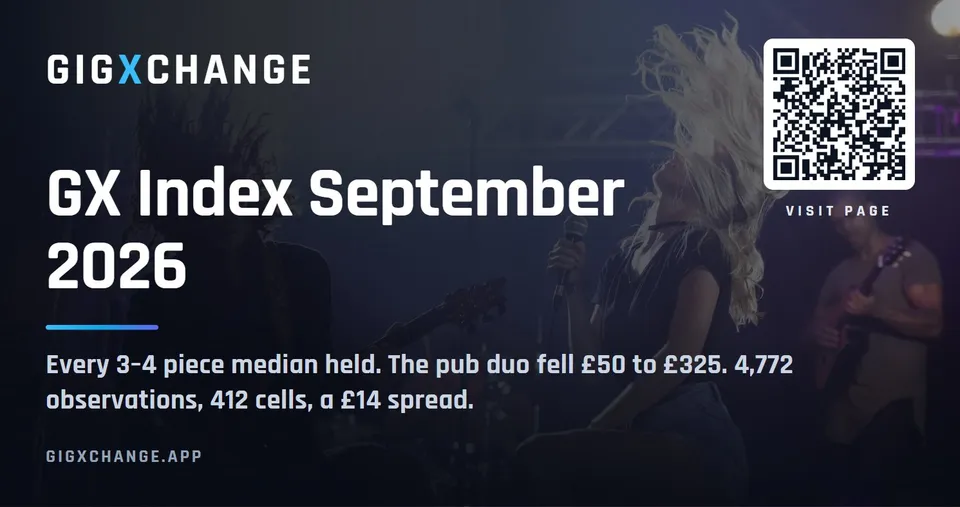
- September 2026: Issue 06: GX Index September 2026 (Issue 06): every 3–4 piece median held, the pub duo fell £50 to £325.
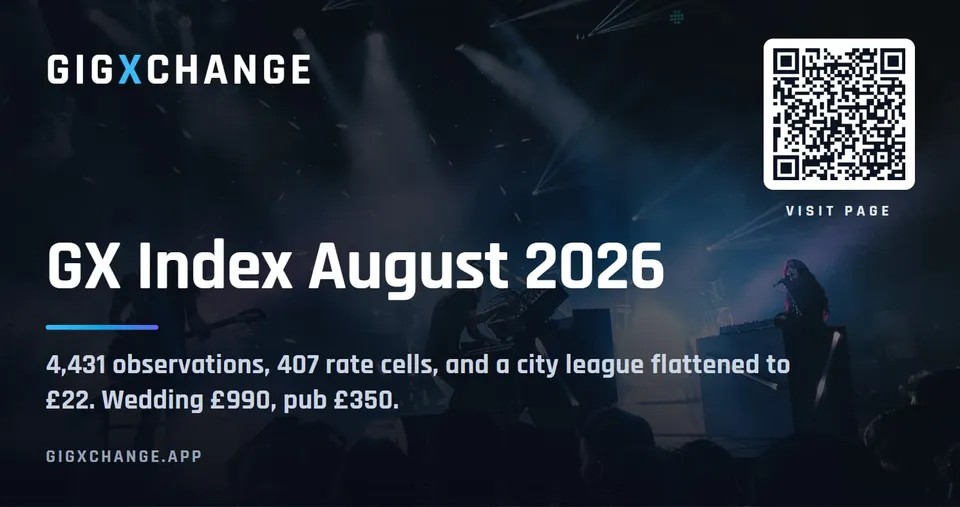
- August 2026: Issue 05: GigXchange Index August 2026 (Issue 05): 4,431 UK gig-fee observations, 407 rate cells, a city league flattened to £22.
- July 2026: Issue 04: GX Index Issue 04: the issue where we took rows out.
- June 2026: Issue 03: GX Index Issue 03: 4,036 UK live music fee observations, a steady market, the artist panel's first full cycle, and a 25-row correction made in the open.
- May 2026: Issue 02: GX Index Issue 02: 3,847 UK live music fee observations, a third agency feed, methodology fixes, and the numbers that moved.
- April 2026: Issue 01: GX Index Issue 01 — the launch report: 2,381 UK live music fee observations across 7 gig types and 14 cities.
- October 2026: Issue 07: coming soon — published the third week of the month.
Using these numbers
If you’re an artist: price at the p50 for your gig type and size as a defensible market rate, push toward p75 when you have a real audience pull, a tight set and repeat-booking history, and treat anything below p25 as a flag that you’re being undercut. The fuller pricing framework is in how to set your gig price and how much UK gigs pay.
If you’re booking: budget the p50 for a fair direct fee, expect 25–50% more through an agency, and use the live band cost guide or a city guide (e.g. function bands in Manchester) for the buyer-side detail. Then run your exact event through the free rate calculator.
Played a gig yourself? Submit 3 fees in under 2 minutes at /rates to unlock every cell, region and city drilldown for 30 days, and make the next refresh sharper for everyone.
02 — Questions11 answersAsked and answeredFrequently Asked Questions
Monthly refresh commitment
This guide was published on 1 June 2026 and is refreshed every month. UK gig fees move with the season, and every issue adds observations that shift the medians, so monthly verification matters. We re-verify every reference, recommendation, and data point monthly. Next scheduled refresh: October 2026. If any claim is outdated before then, email support@gigxchange.app and we aim to update it within one working day.