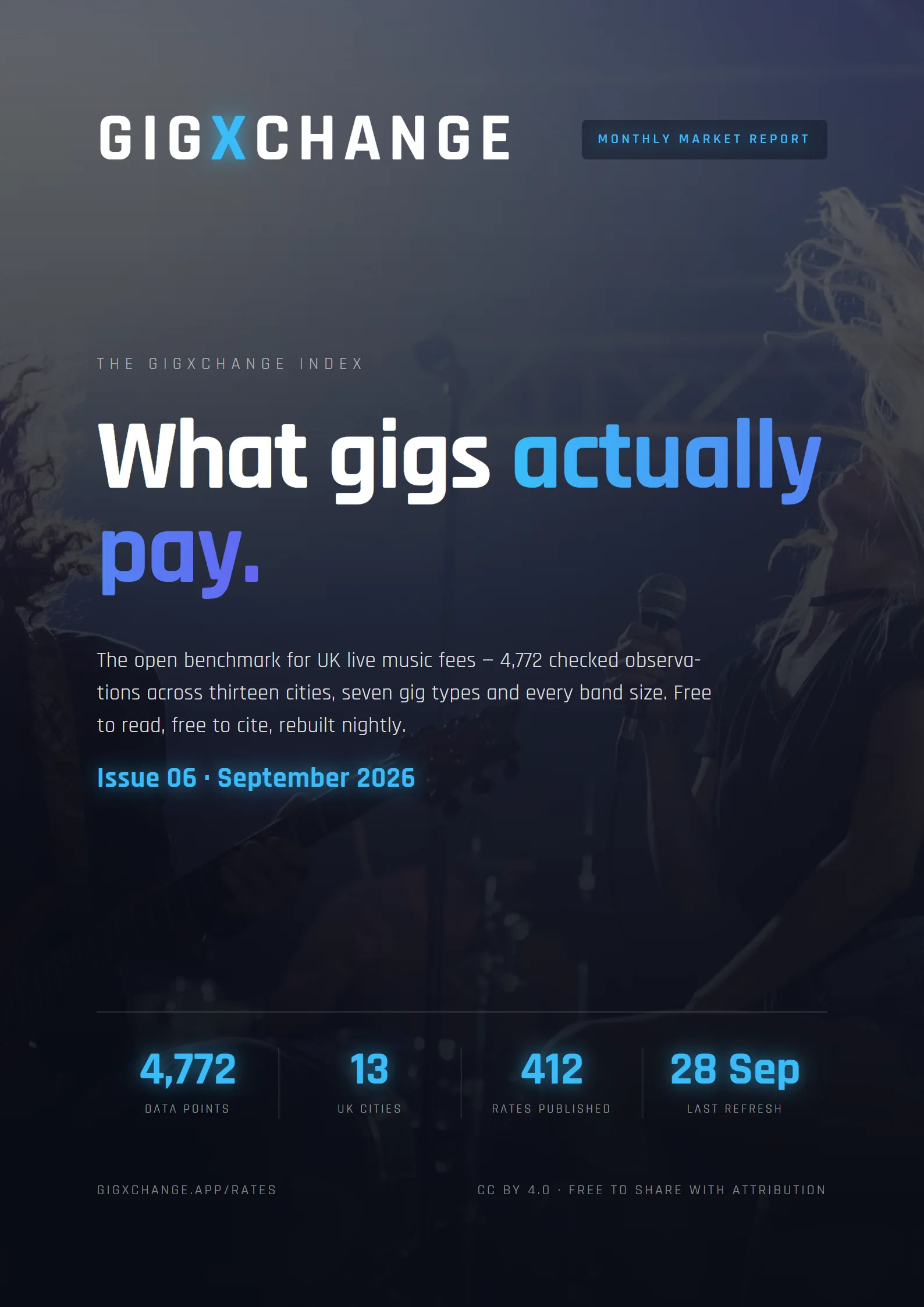
In September 2026 a 3–4 piece wedding band's median fee was £990 and a pub booking £350, from 4,772 checked observations across 13 UK cities.
The 3–4 piece held. The pub duo did not.
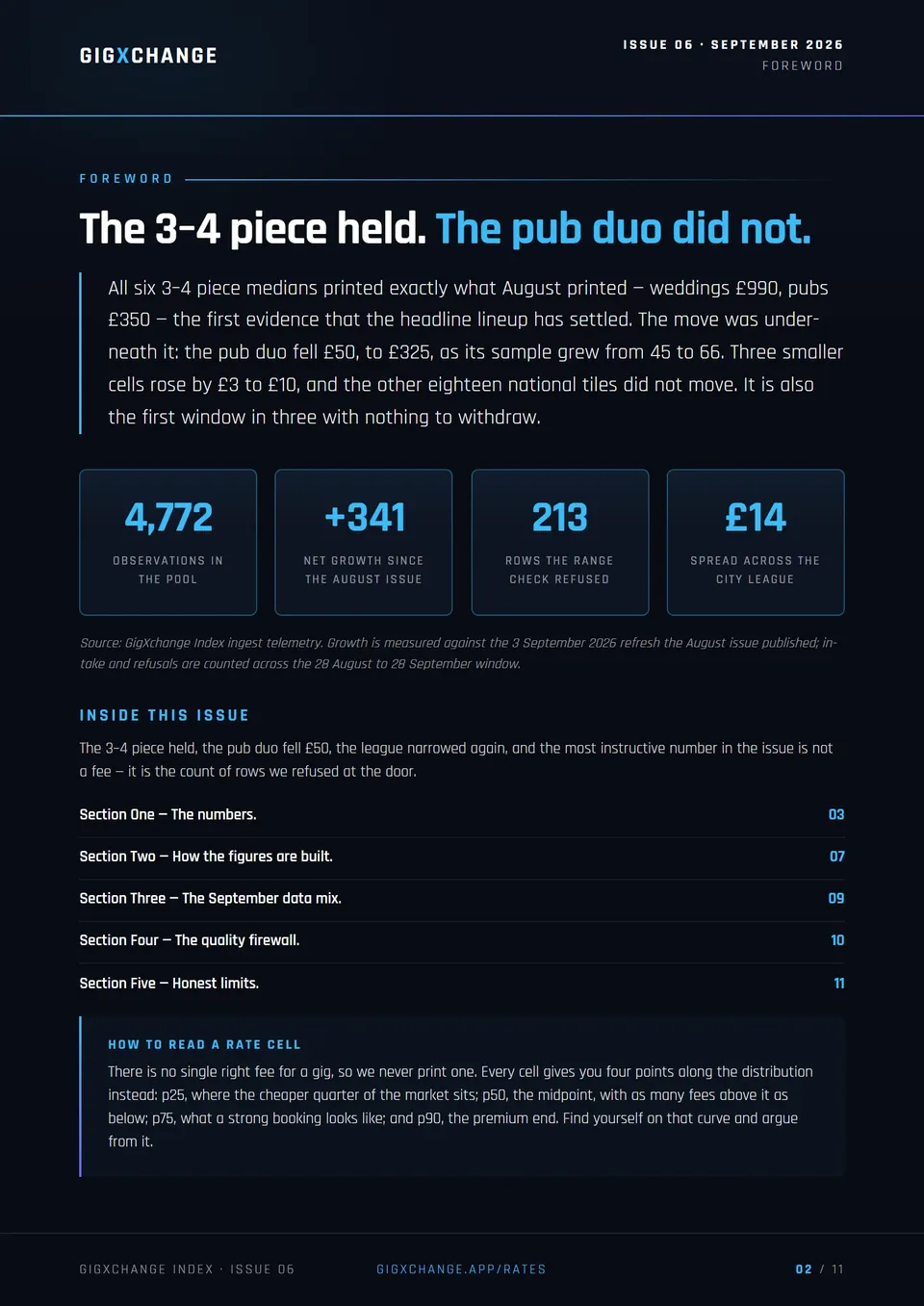
All six 3–4 piece medians printed exactly what August printed — weddings £990, pubs £350 — the first evidence that the headline lineup has settled. The move was underneath it: the pub duo fell £50, to £325, as its sample grew from 45 to 66. Three smaller cells rose by £3 to £10, and the other eighteen national tiles did not move. It is also the first window in three with nothing to withdraw.
4,772Observations in the pool
+341Net growth since the August issue
213Rows the range check refused
£14Spread across the city league
Source: GigXchange Index ingest telemetry. Growth is measured against the 3 September 2026 refresh the August issue published; intake and refusals are counted across the 28 August to 28 September window.
03 — What gigs pay
What UK gigs pay in September 2026 by gig type and band size
In September 2026 the UK median fee for a 3–4 piece ran from £350 for a pub booking to £990 for a wedding one. You can pick any gig type and band size for its lower quarter, median, strong booking and top tenth, with how many fees stand behind it.
Wedding · 3–4 piece · UK£990median fee · 1,605 observations· unchanged from August 2026
Lower quarter
£717
Median
£990
Strong booking
£1,370
Top tenth
£1,880
UK median fee by gig type and band size (p50, £). † = fewer than 10 observations.
Gig type
Solo
Duo
3–4 piece
5+
Wedding
Private party
Corporate
Festival
–
–
Club
–
Pub & bar
Theatre
–
–
–
Put this table on your own site. Free under CC BY 4.0, with credit.
Where the market settled in September
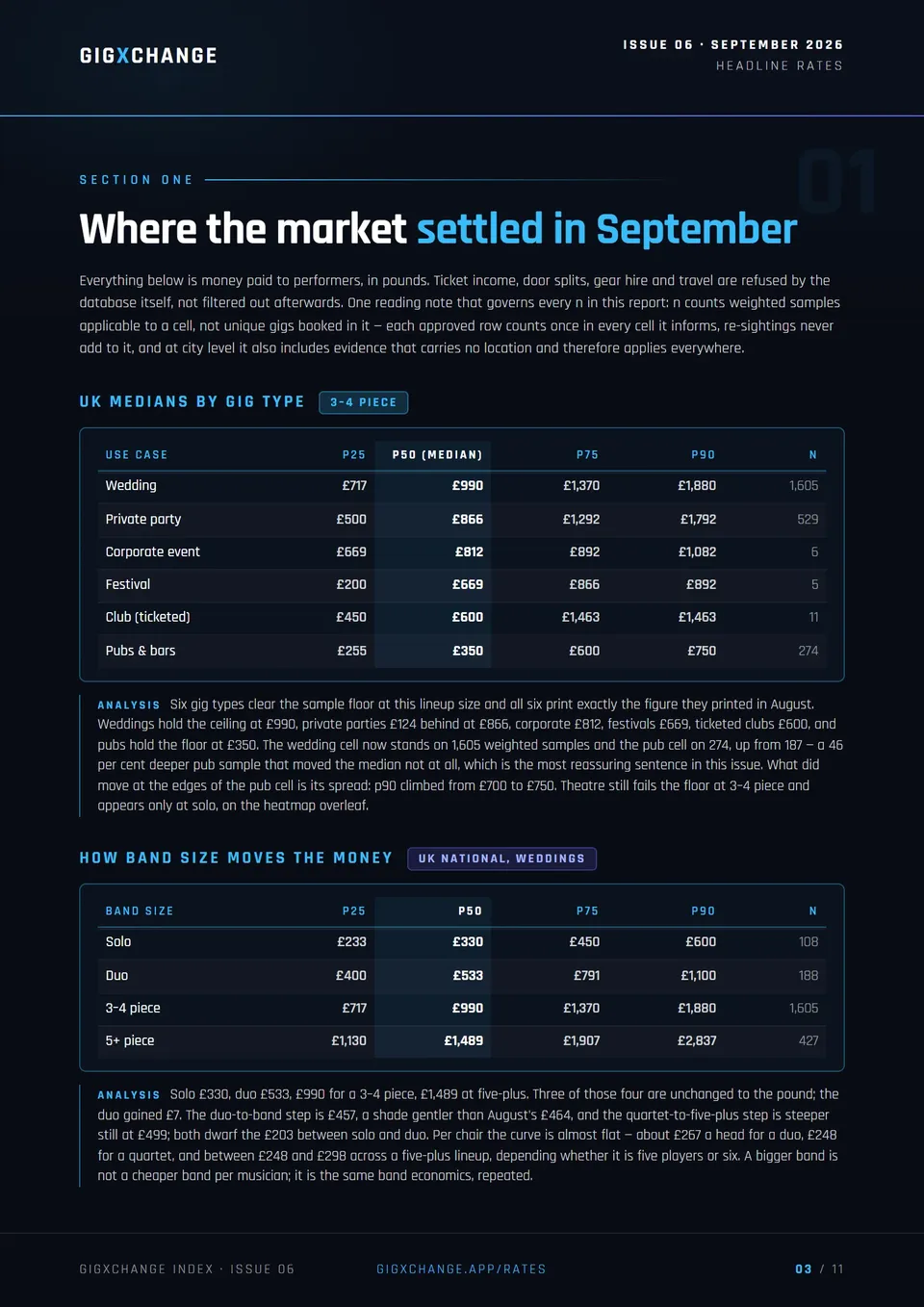
Everything below is money paid to performers, in pounds. Ticket income, door splits, gear hire and travel are refused by the database itself, not filtered out afterwards. One reading note that governs every n in this report: n counts weighted samples applicable to a cell, not unique gigs booked in it — each approved row counts once in every cell it informs, re-sightings never add to it, and at city level it also includes evidence that carries no location and therefore applies everywhere.
By gig type
Six gig types clear the sample floor at this lineup size and all six print exactly the figure they printed in August. Weddings hold the ceiling at £990, private parties £124 behind at £866, corporate £812, festivals £669, ticketed clubs £600, and pubs hold the floor at £350. The wedding cell now stands on 1,605 weighted samples and the pub cell on 274, up from 187 — a 46 per cent deeper pub sample that moved the median not at all, which is the most reassuring sentence in this issue. What did move at the edges of the pub cell is its spread: p90 climbed from £700 to £750. Theatre still fails the floor at 3–4 piece and appears only at solo, in the full grid above.
By band size
Solo £330, duo £533, £990 for a 3–4 piece, £1,489 at five-plus. Three of those four are unchanged to the pound; the duo gained £7. The duo-to-band step is £457, a shade gentler than August's £464, and the quartet-to-five-plus step is steeper still at £499; both dwarf the £203 between solo and duo. Per chair the curve is almost flat — about £267 a head for a duo, £248 for a quartet, and between £248 and £298 across a five-plus lineup, depending whether it is five players or six. A bigger band is not a cheaper band per musician; it is the same band economics, repeated.
UK wedding medians by band size, September 2026
Solo
£330
Duo
£5331.6×
3–4 piece
£9903.0×
5+
£1,4894.5×
Put this chart on your own site. Free under CC BY 4.0, with credit.
Across the whole grid
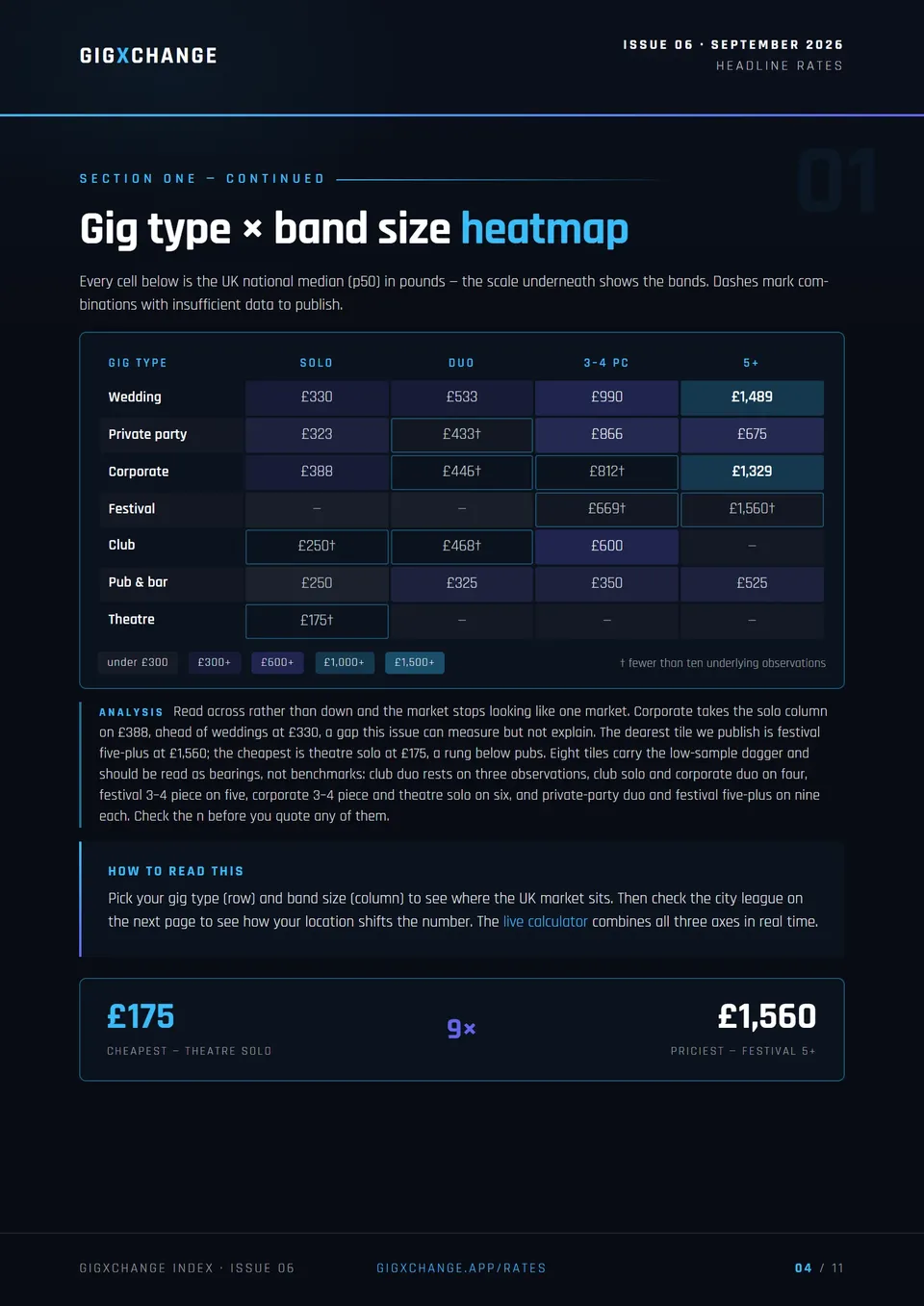
Read across rather than down and the market stops looking like one market. Corporate takes the solo column on £388, ahead of weddings at £330, a gap this issue can measure but not explain. The dearest tile we publish is festival five-plus at £1,560; the cheapest is theatre solo at £175, a rung below pubs. Eight tiles carry the low-sample dagger and should be read as bearings, not benchmarks: club duo rests on three observations, club solo and corporate duo on four, festival 3–4 piece on five, corporate 3–4 piece and theatre solo on six, and private-party duo and festival five-plus on nine each. Check the n before you quote any of them.
04 — City league
UK city league for wedding bands, September 2026
Across 13 UK cities a 3–4 piece wedding band's median ran from £1,053 in Manchester to £1,067 in 2 cities including Edinburgh, £14 apart, against £990 for the UK as a whole.
Sort by
Wedding, 3–4 piece: median and middle half by city, September 2026. "Local" = observations collected in the city; "UK-wide" = location-less evidence every city shares.
Put this table on your own site. Free under CC BY 4.0, with credit.
Thirteen cities, fourteen pounds apart
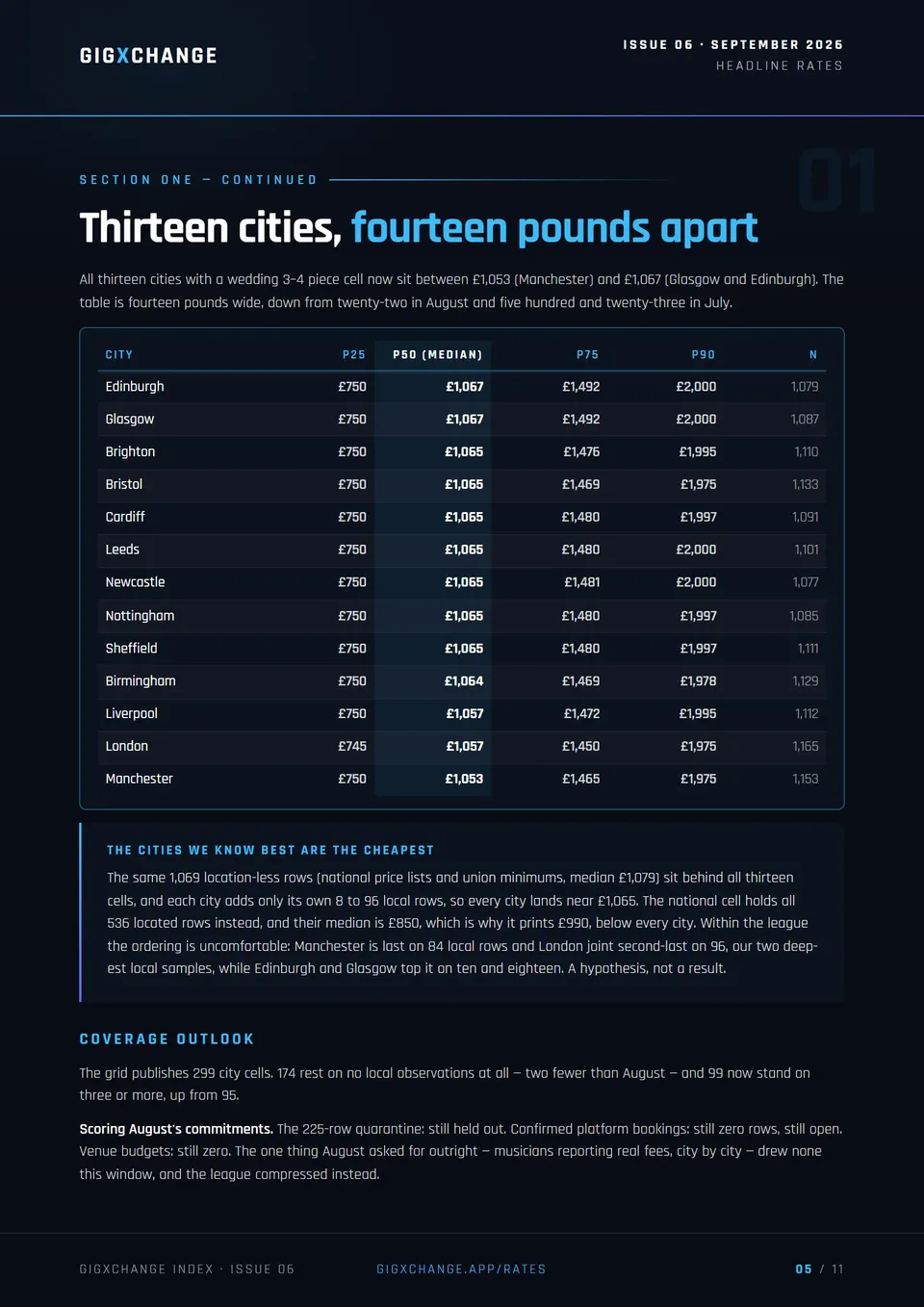
All thirteen cities with a wedding 3–4 piece cell now sit between £1,053 (Manchester) and £1,067 (Glasgow and Edinburgh). The table is fourteen pounds wide, down from twenty-two in August and five hundred and twenty-three in July.
Coverage outlook
The grid publishes 299 city cells. 174 rest on no local observations at all — two fewer than August — and 99 now stand on three or more, up from 95.
Scoring August's commitments. The 225-row quarantine: still held out. Confirmed platform bookings: still zero rows, still open. Venue budgets: still zero. The one thing August asked for outright — musicians reporting real fees, city by city — drew none this window, and the league compressed instead.
05 — What changed
What changed since August 2026
18 of the comparable national medians held from August 2026 and 4 moved; the biggest move was the pub duo, £375 to £325. Of those moves, 3 rose and 1 fell.
Weddings
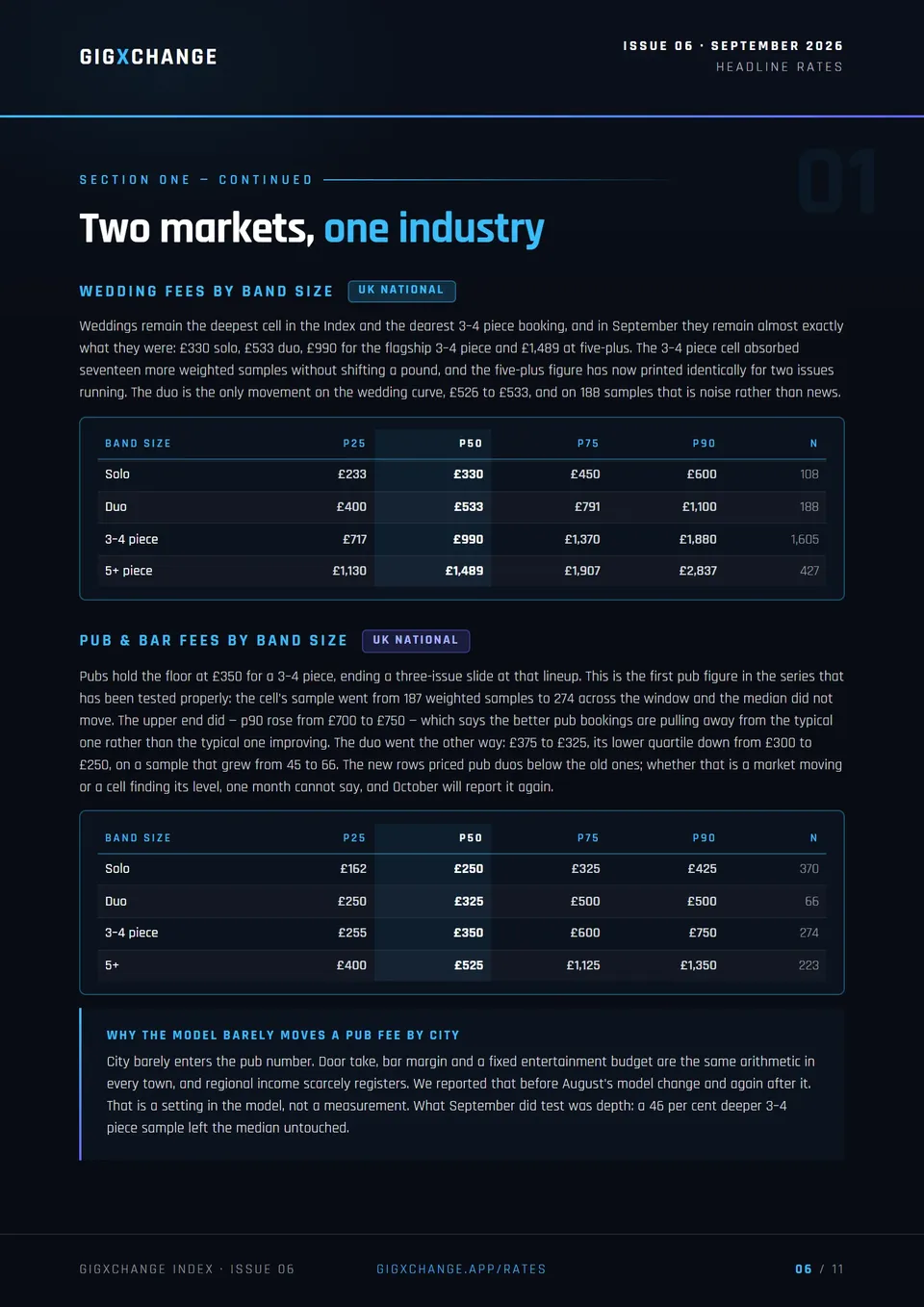
Weddings remain the deepest cell in the Index and the dearest 3–4 piece booking, and in September they remain almost exactly what they were: £330 solo, £533 duo, £990 for the flagship 3–4 piece and £1,489 at five-plus. The 3–4 piece cell absorbed seventeen more weighted samples without shifting a pound, and the five-plus figure has now printed identically for two issues running. The duo is the only movement on the wedding curve, £526 to £533, and on 188 samples that is noise rather than news.
Pubs and bars
Pubs hold the floor at £350 for a 3–4 piece, ending a three-issue slide at that lineup. This is the first pub figure in the series that has been tested properly: the cell's sample went from 187 weighted samples to 274 across the window and the median did not move. The upper end did — p90 rose from £700 to £750 — which says the better pub bookings are pulling away from the typical one rather than the typical one improving. The duo went the other way: £375 to £325, its lower quartile down from £300 to £250, on a sample that grew from 45 to 66. The new rows priced pub duos below the old ones; whether that is a market moving or a cell finding its level, one month cannot say, and October will report it again.
06 — How it is built
How the GX Index figures are built
Every figure in the September 2026 issue is a percentile of fees paid or asked, from 6 live sources, and every row passed the quality gates before it counted.
How this issue was built
What each figure counts, how it is worked out, and when it was counted.
Part
How it works
What is counted
4,772 checked observations of the fees UK live music acts were paid or asked, in pounds, from 9 source classes, 6 with rows in this issue.
They make 412 rate cells across 13 UK cities.
How
Each cell prints four percentiles of its fees: p25, p50, p75 and p90. Each source class is weighted up to its own top share of a cell as its rows grow, quality gates refuse a row before it counts, and thin cells fall back to region, then the UK baseline.
A figure on fewer than 10 observations carries a dagger: read it as a bearing, not a benchmark.
Windows
Every row approved up to 28 September 2026, the issue’s data date. Its moves compare it with the August 2026 issue.
When
Captured 28 September 2026, and published on 6 October 2026.
The PDF is kept as issued; any revision since is dated under Methodology revisions on this page. To quote a figure, use the citation under the print edition (DOI 10.5281/zenodo.23174013) and give the captured date beside it.
Method version
v5 (from 12 August 2026), the method this issue was built with, in use until 31 October 2026. For weddings and private parties, changes across 31 October 2026 reflect the commission correction made that day, not the market; for those figures, readings from before 31 October 2026 are not comparable with later ones.
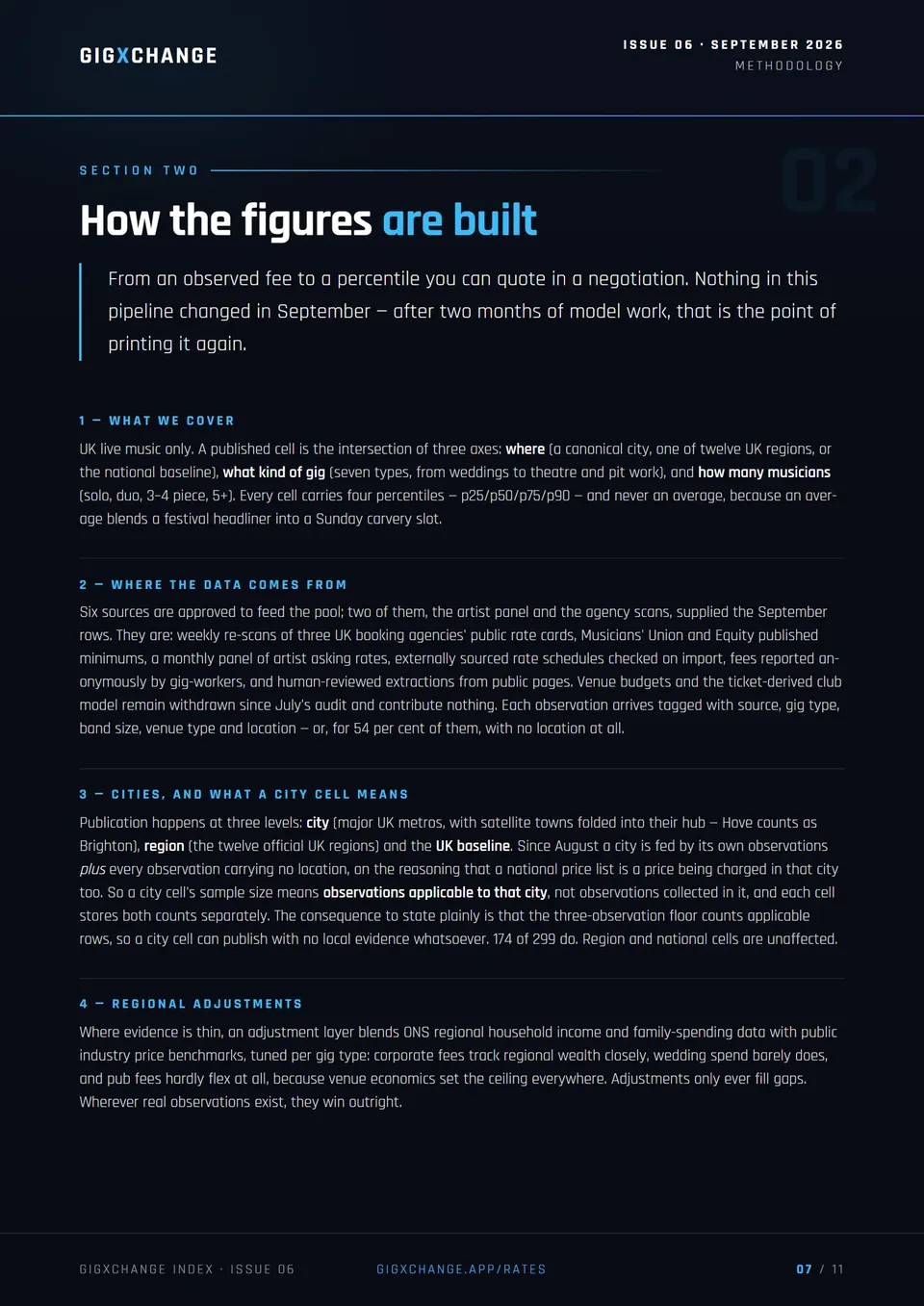
From an observed fee to a percentile you can quote in a negotiation. Nothing in this pipeline changed in September — after two months of model work, that is the point of printing it again.
What we cover
UK live music only. A published cell is the intersection of three axes: where (a canonical city, one of twelve UK regions, or the national baseline), what kind of gig (seven types, from weddings to theatre and pit work), and how many musicians (solo, duo, 3–4 piece, 5+). Every cell carries four percentiles — p25/p50/p75/p90 — and never an average, because an average blends a festival headliner into a Sunday carvery slot.
Where the data comes from
Six sources are approved to feed the pool; two of them, the artist panel and the weekly published-rate refresh, supplied the September rows. They are: weekly refreshes of published UK market rates, Musicians' Union and Equity published minimums, a monthly panel of artist asking rates, externally sourced rate schedules checked on import, fees reported anonymously by gig-workers, and human-reviewed extractions from public pages. Venue budgets and the ticket-derived club model remain withdrawn since July's audit and contribute nothing. Each observation arrives tagged with source, gig type, band size, venue type and location — or, for 54 per cent of them, with no location at all.
Cities, and what a city cell means
Publication happens at three levels: city (major UK metros, with satellite towns folded into their hub — Hove counts as Brighton), region (the twelve official UK regions) and the UK baseline. Since August a city is fed by its own observations plus every observation carrying no location, on the reasoning that a national price list is a price being charged in that city too. So a city cell's sample size means observations applicable to that city, not observations collected in it, and each cell stores both counts separately. The consequence to state plainly is that the three-observation floor counts applicable rows, so a city cell can publish with no local evidence whatsoever. 174 of 299 do. Region and national cells are unaffected.
Regional adjustments
Where evidence is thin, an adjustment layer blends ONS regional household income and family-spending data with public industry price benchmarks, tuned per gig type: corporate fees track regional wealth closely, wedding spend barely does, and pub fees hardly flex at all, because venue economics set the ceiling everywhere. Adjustments only ever fill gaps. Wherever real observations exist, they win outright.
One grid, every city
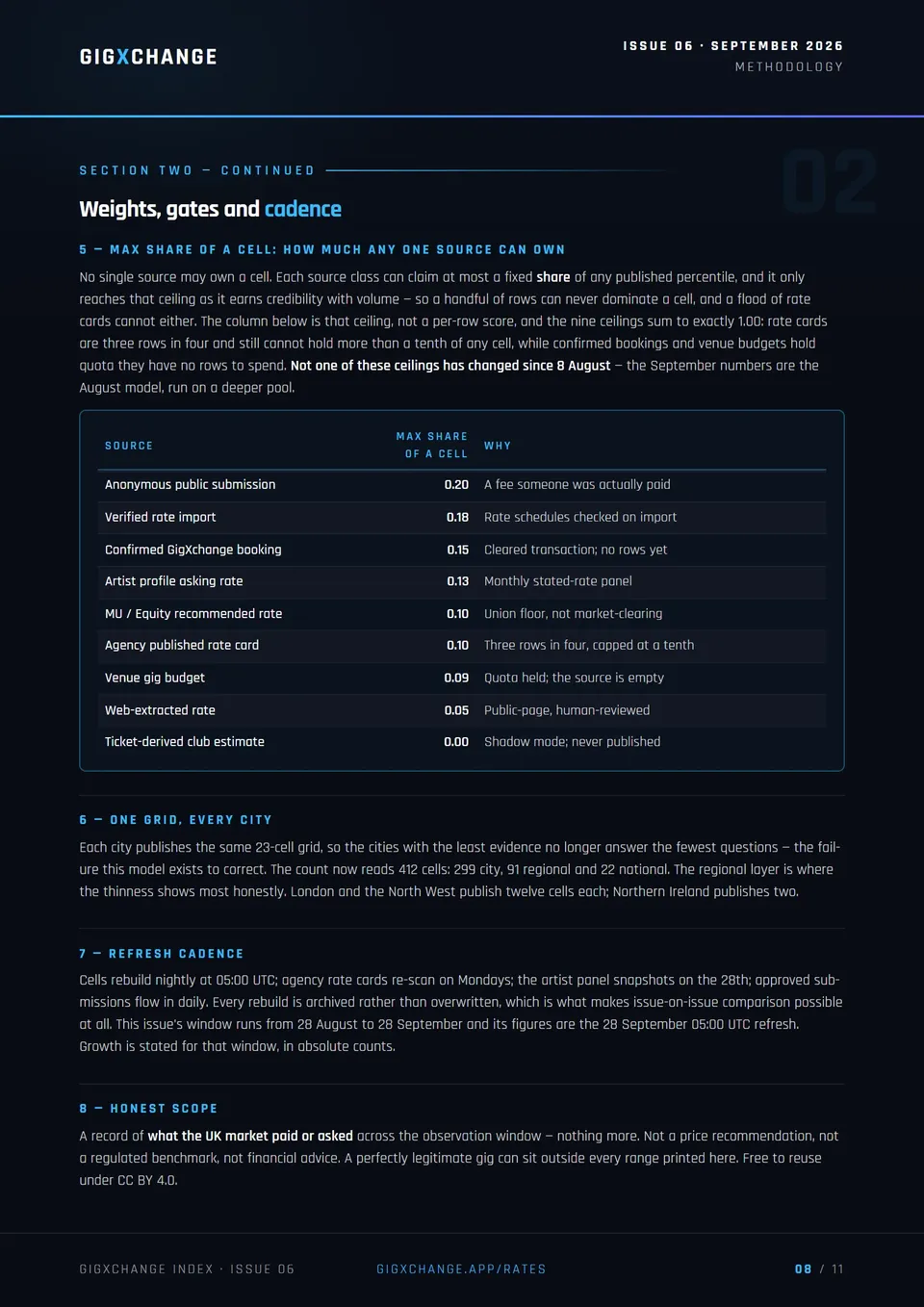
Each city publishes the same 23-cell grid, so the cities with the least evidence no longer answer the fewest questions — the failure this model exists to correct. The count now reads 412 cells: 299 city, 91 regional and 22 national. The regional layer is where the thinness shows most honestly. London and the North West publish twelve cells each; Northern Ireland publishes two.
Refresh cadence
Cells rebuild nightly at 05:00 UTC; published market rates refresh on Mondays; the artist panel snapshots on the 28th; approved submissions flow in daily. Every rebuild is archived rather than overwritten, which is what makes issue-on-issue comparison possible at all. This issue's window runs from 28 August to 28 September and its figures are the 28 September 05:00 UTC refresh. Growth is stated for that window, in absolute counts.
Honest scope
A record of what the UK market paid or asked across the observation window — nothing more. Not a price recommendation, not a regulated benchmark, not financial advice. A perfectly legitimate gig can sit outside every range printed here. Free to reuse under CC BY 4.0.
Max share of a cell: how much any one source can own
No single source may own a cell. Each source class can claim at most a fixed share of any published percentile, and it only reaches that ceiling as it earns credibility with volume — so a handful of rows can never dominate a cell, and a flood of rate cards cannot either. The column below is that ceiling, not a per-row score, and the nine ceilings sum to exactly 1.00: published market rates are three rows in four and still cannot hold more than a tenth of any cell, while confirmed bookings and venue budgets hold quota they have no rows to spend. Not one of these ceilings has changed since 8 August — the September numbers are the August model, run on a deeper pool.
The most of any cell each source can own, September 2026
Anonymous / unverified submission
20%
Verified rate import
18%
Confirmed booking
15%
Artist profile asking rate
13%
Published market rate
10%
MU / Equity published rate
10%
Venue gig budget
9%
Reviewed public rate
5%
Put this chart on your own site. Free under CC BY 4.0, with credit.
Sources in the pool at the September 2026 refresh, and the most of any cell each one can own.
Source
Observations
Max share
Why
Published market rate
3,535
0.10
Asking price; commission stripped at ingest
Artist profile asking rate
846
0.13
Monthly stated-rate panel
Reviewed public rate
173
0.05
Extracted from public pages; human-reviewed
MU / Equity published rate
143
0.10
Authoritative floor, not market-clearing
Verified rate import
39
0.18
Externally sourced rate schedule, checked on import
Anonymous / unverified submission
36
0.20
Pending review; low intrinsic signal
Confirmed booking
0
0.15
Cleared transaction; strongest signal per row
Venue gig budget
0
0.09
Pre-negotiation target, not transacted
Ticket-derived club estimate
0
0.00
Four-archetype grassroots model (MVT-grounded)
Put this table on your own site. Free under CC BY 4.0, with credit.
What changed in the September dataset
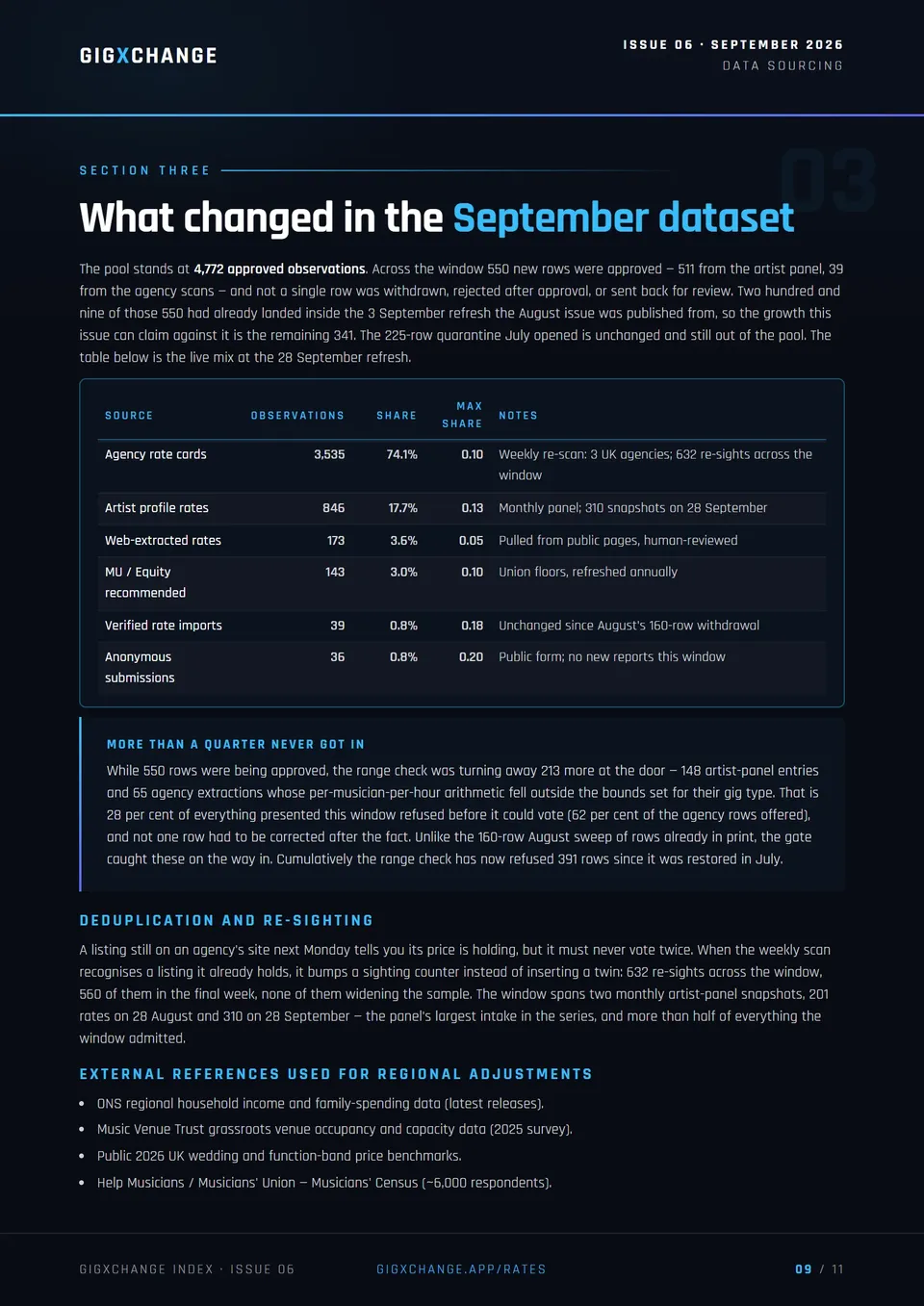
The pool stands at 4,772 approved observations. Across the window 550 new rows were approved — 511 from the artist panel, 39 from the weekly published-rate refresh — and not a single row was withdrawn, rejected after approval, or sent back for review. Two hundred and nine of those 550 had already landed inside the 3 September refresh the August issue was published from, so the growth this issue can claim against it is the remaining 341. The 225-row quarantine July opened is unchanged and still out of the pool. The table below is the live mix at the 28 September refresh.
Deduplication and re-sighting
A listing still published next Monday tells you its price is holding, but it must never vote twice. When the weekly refresh recognises a listing it already holds, it bumps a sighting counter instead of inserting a twin: 632 re-sights across the window, 560 of them in the final week, none of them widening the sample. The window spans two monthly artist-panel snapshots, 201 rates on 28 August and 310 on 28 September — the panel's largest intake in the series, and more than half of everything the window admitted.
How we keep junk out
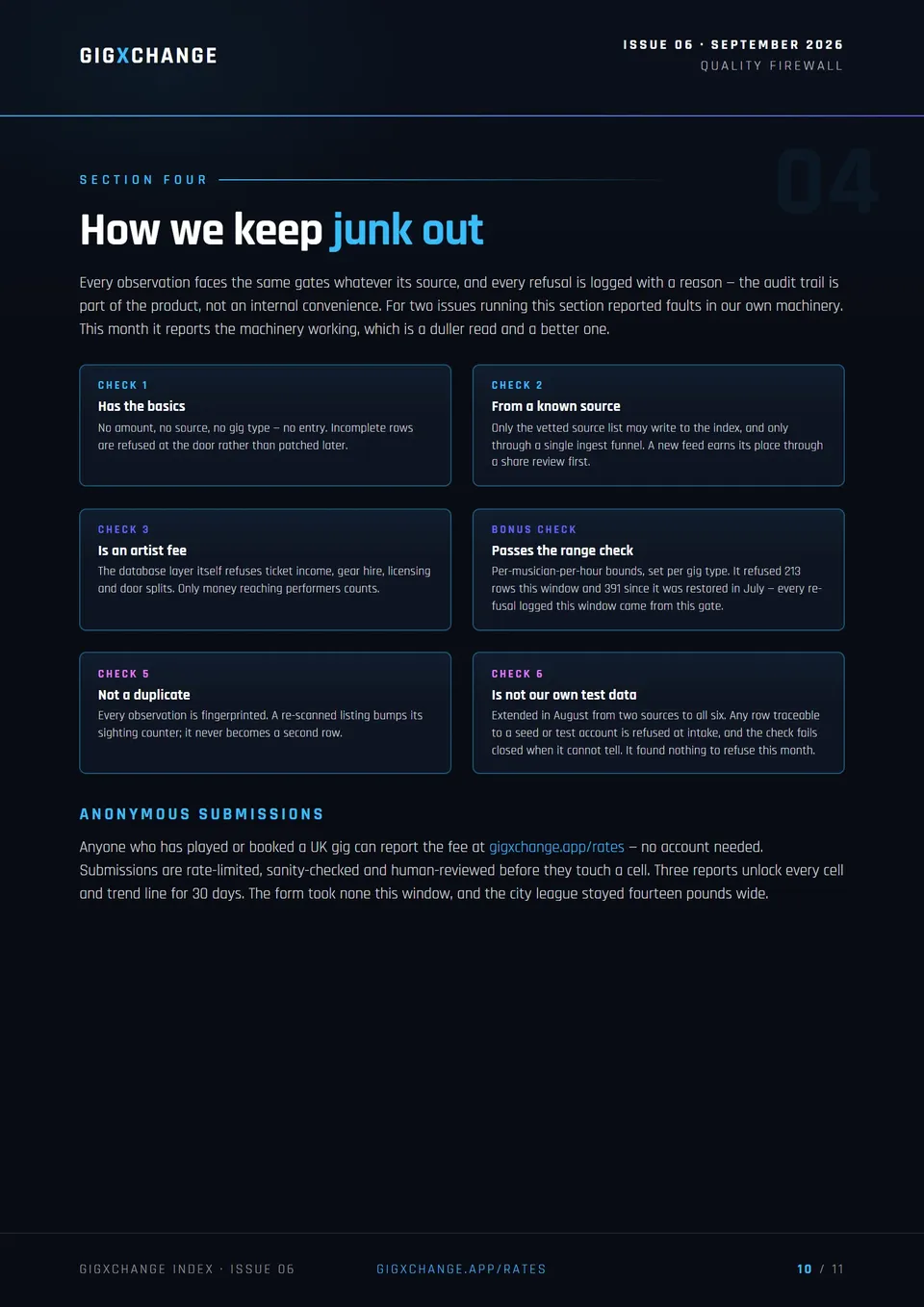
Every observation faces the same gates whatever its source, and every refusal is logged with a reason — the audit trail is part of the product, not an internal convenience. For two issues running this section reported faults in our own machinery. This month it reports the machinery working, which is a duller read and a better one.
Has the basicsNo amount, no source, no gig type — no entry. Incomplete rows are refused at the door rather than patched later.
From a known sourceOnly the vetted source list may write to the index, and only through a single ingest funnel. A new feed earns its place through a share review first.
Is an artist feeThe database layer itself refuses ticket income, gear hire, licensing and door splits. Only money reaching performers counts.
Passes the range checkPer-musician-per-hour bounds, set per gig type. It refused 213 rows this window and 391 since it was restored in July — every refusal logged this window came from this gate.
Not a duplicateEvery observation is fingerprinted. A re-checked listing bumps its sighting counter; it never becomes a second row.
Is not our own test dataExtended in August from two sources to all six. Any row traceable to a seed or test account is refused at intake, and the check fails closed when it cannot tell. It found nothing to refuse this month.
Anonymous submissions
Anyone who has played or booked a UK gig can report the fee at gigxchange.app/rates — no account needed. Submissions are rate-limited, sanity-checked and human-reviewed before they touch a cell. Three reports unlock every cell and trend line for 30 days. The form took none this window, and the city league stayed fourteen pounds wide.
External references used for regional adjustments
ONS regional household income and family-spending data (latest releases).
Music Venue Trust grassroots venue occupancy and capacity data (2025 survey).
Public 2026 UK wedding and function-band price benchmarks.
The GX Index is a record of what the UK market paid or asked, not a recommended price, an official benchmark or financial advice. Its thinnest evidence is local: 174 of the 299 city cells in September 2026 hold no rows collected in that city.
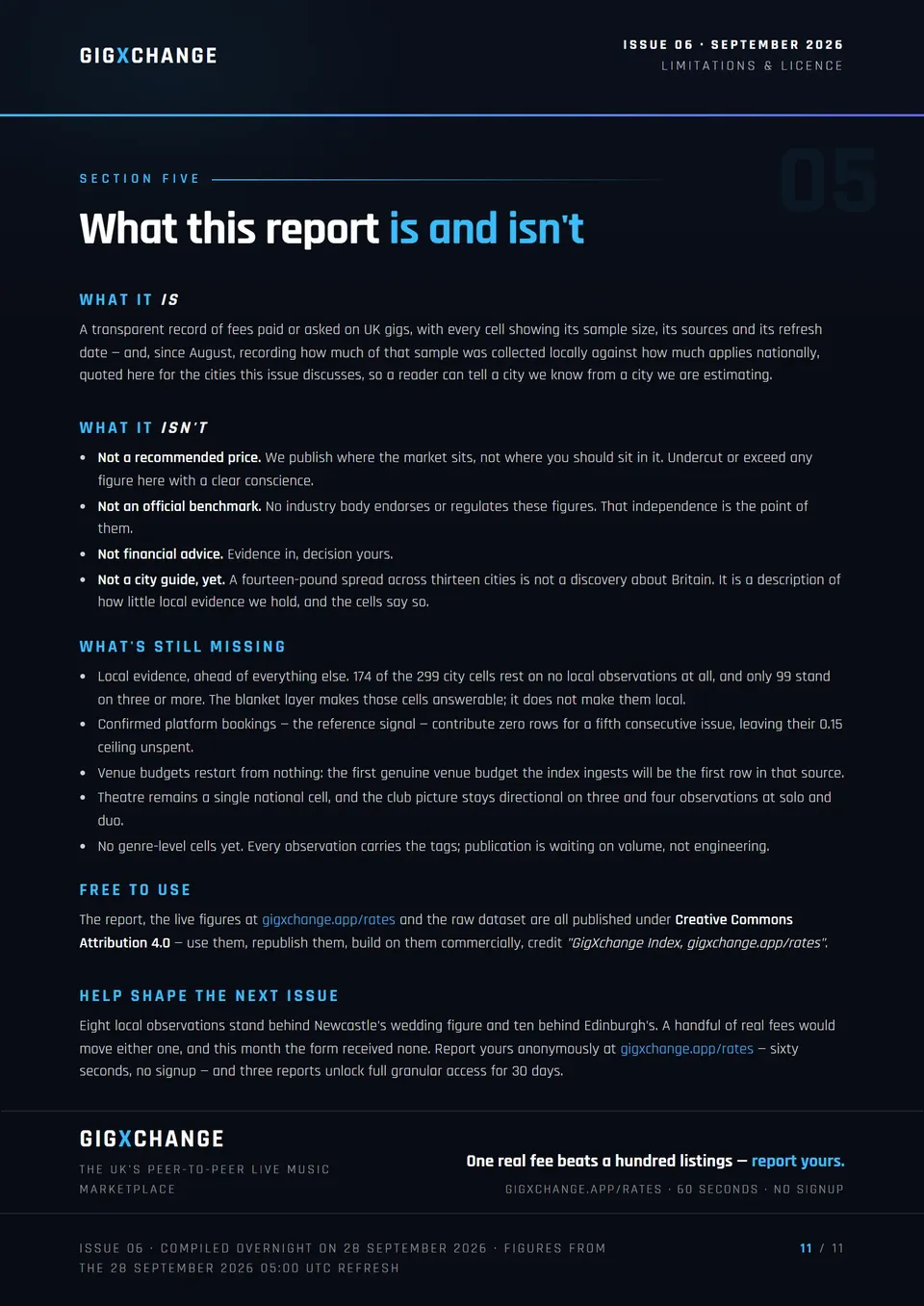
A transparent record of fees paid or asked on UK gigs, with every cell showing its sample size, its sources and its refresh date — and, since August, recording how much of that sample was collected locally against how much applies nationally, quoted here for the cities this issue discusses, so a reader can tell a city we know from a city we are estimating.
Not a recommended price.We publish where the market sits, not where you should sit in it. Undercut or exceed any figure here with a clear conscience.
Not an official benchmark.No industry body endorses or regulates these figures. That independence is the point of them.
Not financial advice.Evidence in, decision yours.
Not a city guide, yet.A fourteen-pound spread across thirteen cities is not a discovery about Britain. It is a description of how little local evidence we hold, and the cells say so.
What's still missing
Local evidence, ahead of everything else. 174 of the 299 city cells rest on no local observations at all, and only 99 stand on three or more. The blanket layer makes those cells answerable; it does not make them local.
Confirmed platform bookings — the reference signal — contribute zero rows for a fifth consecutive issue, leaving their 0.15 ceiling unspent.
Venue budgets restart from nothing: the first genuine venue budget the index ingests will be the first row in that source.
Theatre remains a single national cell, and the club picture stays directional on three and four observations at solo and duo.
No genre-level cells yet. Every observation carries the tags; publication is waiting on volume, not engineering.
Licence
The report, the live figures at gigxchange.app/rates and the raw dataset are all published under Creative Commons Attribution 4.0 — use them, republish them, build on them commercially, credit "GigXchange Index, gigxchange.app/rates".
Help shape the next issue
Eight local observations stand behind Newcastle's wedding figure and ten behind Edinburgh's. A handful of real fees would move either one, and this month the form received none. Report yours anonymously at gigxchange.app/rates — sixty seconds, no signup — and three reports unlock full granular access for 30 days.
08 — Methodology revisions
GX Index methodology revisions for September 2026
One revision to the September 2026 issue was published on 31 October 2026, after the issue itself. Open it to see what was printed, what it should say and why.
Method · 31 October 2026PDF only
Printed: “Three rows in four, capped at a tenth”Should read: “Three rows in four, capped at a tenth (2,646 of these rows had the agency commission taken off twice; see Methodology revisions)”2,646 published market-rate rows imported 17–21 April 2026 had the 20% agency commission taken off twice (the advertised price divided by 1.5 instead of 1.2), so they entered the Index 20% below the take-home figure our method states. Figures that drew on these rows read low, mostly weddings and private parties; none would fall. Corrected on 31 October 2026: on the live Index the UK wedding 3–4 piece median rose 12.9% and wedding five-plus 19.7%, and no cell moved more than 25%. The PDF, CSV and archived dataset are kept as issued.
In September 2026 a 3–4 piece wedding band's median fee was £990 and a pub booking £350, from 4,772 checked observations across 13 UK cities.
The 3–4 piece held. The pub duo did not.
All six 3–4 piece medians printed exactly what August printed — weddings £990, pubs £350 — the first evidence that the headline lineup has settled. The move was underneath it: the pub duo fell £50, to £325, as its sample grew from 45 to 66. Three smaller cells rose by £3 to £10, and the other eighteen national tiles did not move. It is also the first window in three with nothing to withdraw.
4,772Observations in the pool
+341Net growth since the August issue
213Rows the range check refused
£14Spread across the city league
Source: GigXchange Index ingest telemetry. Growth is measured against the 3 September 2026 refresh the August issue published; intake and refusals are counted across the 28 August to 28 September window.
What UK gigs pay in September 2026 by gig type and band size
In September 2026 the UK median fee for a 3–4 piece ran from £350 for a pub booking to £990 for a wedding one. You can pick any gig type and band size for its lower quarter, median, strong booking and top tenth, with how many fees stand behind it.
Wedding · 3–4 piece · UK£990median fee · 1,605 observations· unchanged from August 2026
Lower quarter
£717
Median
£990
Strong booking
£1,370
Top tenth
£1,880
UK median fee by gig type and band size (p50, £). † = fewer than 10 observations.
Gig type
Solo
Duo
3–4 piece
5+
Wedding
Private party
Corporate
Festival
–
–
Club
–
Pub & bar
Theatre
–
–
–
Put this table on your own site. Free under CC BY 4.0, with credit.
Where the market settled in September
Everything below is money paid to performers, in pounds. Ticket income, door splits, gear hire and travel are refused by the database itself, not filtered out afterwards. One reading note that governs every n in this report: n counts weighted samples applicable to a cell, not unique gigs booked in it — each approved row counts once in every cell it informs, re-sightings never add to it, and at city level it also includes evidence that carries no location and therefore applies everywhere.
By gig type
Six gig types clear the sample floor at this lineup size and all six print exactly the figure they printed in August. Weddings hold the ceiling at £990, private parties £124 behind at £866, corporate £812, festivals £669, ticketed clubs £600, and pubs hold the floor at £350. The wedding cell now stands on 1,605 weighted samples and the pub cell on 274, up from 187 — a 46 per cent deeper pub sample that moved the median not at all, which is the most reassuring sentence in this issue. What did move at the edges of the pub cell is its spread: p90 climbed from £700 to £750. Theatre still fails the floor at 3–4 piece and appears only at solo, in the full grid above.
By band size
Solo £330, duo £533, £990 for a 3–4 piece, £1,489 at five-plus. Three of those four are unchanged to the pound; the duo gained £7. The duo-to-band step is £457, a shade gentler than August's £464, and the quartet-to-five-plus step is steeper still at £499; both dwarf the £203 between solo and duo. Per chair the curve is almost flat — about £267 a head for a duo, £248 for a quartet, and between £248 and £298 across a five-plus lineup, depending whether it is five players or six. A bigger band is not a cheaper band per musician; it is the same band economics, repeated.
UK wedding medians by band size, September 2026
Solo
£330
Duo
£5331.6×
3–4 piece
£9903.0×
5+
£1,4894.5×
Put this chart on your own site. Free under CC BY 4.0, with credit.
Across the whole grid
Read across rather than down and the market stops looking like one market. Corporate takes the solo column on £388, ahead of weddings at £330, a gap this issue can measure but not explain. The dearest tile we publish is festival five-plus at £1,560; the cheapest is theatre solo at £175, a rung below pubs. Eight tiles carry the low-sample dagger and should be read as bearings, not benchmarks: club duo rests on three observations, club solo and corporate duo on four, festival 3–4 piece on five, corporate 3–4 piece and theatre solo on six, and private-party duo and festival five-plus on nine each. Check the n before you quote any of them.
UK city league for wedding bands, September 2026
Across 13 UK cities a 3–4 piece wedding band's median ran from £1,053 in Manchester to £1,067 in 2 cities including Edinburgh, £14 apart, against £990 for the UK as a whole.
Sort by
Wedding, 3–4 piece: median and middle half by city, September 2026. "Local" = observations collected in the city; "UK-wide" = location-less evidence every city shares.
Put this table on your own site. Free under CC BY 4.0, with credit.
Thirteen cities, fourteen pounds apart
All thirteen cities with a wedding 3–4 piece cell now sit between £1,053 (Manchester) and £1,067 (Glasgow and Edinburgh). The table is fourteen pounds wide, down from twenty-two in August and five hundred and twenty-three in July.
Coverage outlook
The grid publishes 299 city cells. 174 rest on no local observations at all — two fewer than August — and 99 now stand on three or more, up from 95.
Scoring August's commitments. The 225-row quarantine: still held out. Confirmed platform bookings: still zero rows, still open. Venue budgets: still zero. The one thing August asked for outright — musicians reporting real fees, city by city — drew none this window, and the league compressed instead.
What changed since August 2026
18 of the comparable national medians held from August 2026 and 4 moved; the biggest move was the pub duo, £375 to £325. Of those moves, 3 rose and 1 fell.
Weddings
Weddings remain the deepest cell in the Index and the dearest 3–4 piece booking, and in September they remain almost exactly what they were: £330 solo, £533 duo, £990 for the flagship 3–4 piece and £1,489 at five-plus. The 3–4 piece cell absorbed seventeen more weighted samples without shifting a pound, and the five-plus figure has now printed identically for two issues running. The duo is the only movement on the wedding curve, £526 to £533, and on 188 samples that is noise rather than news.
Pubs and bars
Pubs hold the floor at £350 for a 3–4 piece, ending a three-issue slide at that lineup. This is the first pub figure in the series that has been tested properly: the cell's sample went from 187 weighted samples to 274 across the window and the median did not move. The upper end did — p90 rose from £700 to £750 — which says the better pub bookings are pulling away from the typical one rather than the typical one improving. The duo went the other way: £375 to £325, its lower quartile down from £300 to £250, on a sample that grew from 45 to 66. The new rows priced pub duos below the old ones; whether that is a market moving or a cell finding its level, one month cannot say, and October will report it again.
How the GX Index figures are built
Every figure in the September 2026 issue is a percentile of fees paid or asked, from 6 live sources, and every row passed the quality gates before it counted.
How this issue was built
What each figure counts, how it is worked out, and when it was counted.
Part
How it works
What is counted
4,772 checked observations of the fees UK live music acts were paid or asked, in pounds, from 9 source classes, 6 with rows in this issue.
They make 412 rate cells across 13 UK cities.
How
Each cell prints four percentiles of its fees: p25, p50, p75 and p90. Each source class is weighted up to its own top share of a cell as its rows grow, quality gates refuse a row before it counts, and thin cells fall back to region, then the UK baseline.
A figure on fewer than 10 observations carries a dagger: read it as a bearing, not a benchmark.
Windows
Every row approved up to 28 September 2026, the issue’s data date. Its moves compare it with the August 2026 issue.
When
Captured 28 September 2026, and published on 6 October 2026.
The PDF is kept as issued; any revision since is dated under Methodology revisions on this page. To quote a figure, use the citation under the print edition (DOI 10.5281/zenodo.23174013) and give the captured date beside it.
Method version
v5 (from 12 August 2026), the method this issue was built with, in use until 31 October 2026. For weddings and private parties, changes across 31 October 2026 reflect the commission correction made that day, not the market; for those figures, readings from before 31 October 2026 are not comparable with later ones.
From an observed fee to a percentile you can quote in a negotiation. Nothing in this pipeline changed in September — after two months of model work, that is the point of printing it again.
What we cover
UK live music only. A published cell is the intersection of three axes: where (a canonical city, one of twelve UK regions, or the national baseline), what kind of gig (seven types, from weddings to theatre and pit work), and how many musicians (solo, duo, 3–4 piece, 5+). Every cell carries four percentiles — p25/p50/p75/p90 — and never an average, because an average blends a festival headliner into a Sunday carvery slot.
Where the data comes from
Six sources are approved to feed the pool; two of them, the artist panel and the weekly published-rate refresh, supplied the September rows. They are: weekly refreshes of published UK market rates, Musicians' Union and Equity published minimums, a monthly panel of artist asking rates, externally sourced rate schedules checked on import, fees reported anonymously by gig-workers, and human-reviewed extractions from public pages. Venue budgets and the ticket-derived club model remain withdrawn since July's audit and contribute nothing. Each observation arrives tagged with source, gig type, band size, venue type and location — or, for 54 per cent of them, with no location at all.
Cities, and what a city cell means
Publication happens at three levels: city (major UK metros, with satellite towns folded into their hub — Hove counts as Brighton), region (the twelve official UK regions) and the UK baseline. Since August a city is fed by its own observations plus every observation carrying no location, on the reasoning that a national price list is a price being charged in that city too. So a city cell's sample size means observations applicable to that city, not observations collected in it, and each cell stores both counts separately. The consequence to state plainly is that the three-observation floor counts applicable rows, so a city cell can publish with no local evidence whatsoever. 174 of 299 do. Region and national cells are unaffected.
Regional adjustments
Where evidence is thin, an adjustment layer blends ONS regional household income and family-spending data with public industry price benchmarks, tuned per gig type: corporate fees track regional wealth closely, wedding spend barely does, and pub fees hardly flex at all, because venue economics set the ceiling everywhere. Adjustments only ever fill gaps. Wherever real observations exist, they win outright.
One grid, every city
Each city publishes the same 23-cell grid, so the cities with the least evidence no longer answer the fewest questions — the failure this model exists to correct. The count now reads 412 cells: 299 city, 91 regional and 22 national. The regional layer is where the thinness shows most honestly. London and the North West publish twelve cells each; Northern Ireland publishes two.
Refresh cadence
Cells rebuild nightly at 05:00 UTC; published market rates refresh on Mondays; the artist panel snapshots on the 28th; approved submissions flow in daily. Every rebuild is archived rather than overwritten, which is what makes issue-on-issue comparison possible at all. This issue's window runs from 28 August to 28 September and its figures are the 28 September 05:00 UTC refresh. Growth is stated for that window, in absolute counts.
Honest scope
A record of what the UK market paid or asked across the observation window — nothing more. Not a price recommendation, not a regulated benchmark, not financial advice. A perfectly legitimate gig can sit outside every range printed here. Free to reuse under CC BY 4.0.
Max share of a cell: how much any one source can own
No single source may own a cell. Each source class can claim at most a fixed share of any published percentile, and it only reaches that ceiling as it earns credibility with volume — so a handful of rows can never dominate a cell, and a flood of rate cards cannot either. The column below is that ceiling, not a per-row score, and the nine ceilings sum to exactly 1.00: published market rates are three rows in four and still cannot hold more than a tenth of any cell, while confirmed bookings and venue budgets hold quota they have no rows to spend. Not one of these ceilings has changed since 8 August — the September numbers are the August model, run on a deeper pool.
The most of any cell each source can own, September 2026
Anonymous / unverified submission
20%
Verified rate import
18%
Confirmed booking
15%
Artist profile asking rate
13%
Published market rate
10%
MU / Equity published rate
10%
Venue gig budget
9%
Reviewed public rate
5%
Put this chart on your own site. Free under CC BY 4.0, with credit.
Sources in the pool at the September 2026 refresh, and the most of any cell each one can own.
Source
Observations
Max share
Why
Published market rate
3,535
0.10
Asking price; commission stripped at ingest
Artist profile asking rate
846
0.13
Monthly stated-rate panel
Reviewed public rate
173
0.05
Extracted from public pages; human-reviewed
MU / Equity published rate
143
0.10
Authoritative floor, not market-clearing
Verified rate import
39
0.18
Externally sourced rate schedule, checked on import
Anonymous / unverified submission
36
0.20
Pending review; low intrinsic signal
Confirmed booking
0
0.15
Cleared transaction; strongest signal per row
Venue gig budget
0
0.09
Pre-negotiation target, not transacted
Ticket-derived club estimate
0
0.00
Four-archetype grassroots model (MVT-grounded)
Put this table on your own site. Free under CC BY 4.0, with credit.
What changed in the September dataset
The pool stands at 4,772 approved observations. Across the window 550 new rows were approved — 511 from the artist panel, 39 from the weekly published-rate refresh — and not a single row was withdrawn, rejected after approval, or sent back for review. Two hundred and nine of those 550 had already landed inside the 3 September refresh the August issue was published from, so the growth this issue can claim against it is the remaining 341. The 225-row quarantine July opened is unchanged and still out of the pool. The table below is the live mix at the 28 September refresh.
Deduplication and re-sighting
A listing still published next Monday tells you its price is holding, but it must never vote twice. When the weekly refresh recognises a listing it already holds, it bumps a sighting counter instead of inserting a twin: 632 re-sights across the window, 560 of them in the final week, none of them widening the sample. The window spans two monthly artist-panel snapshots, 201 rates on 28 August and 310 on 28 September — the panel's largest intake in the series, and more than half of everything the window admitted.
How we keep junk out
Every observation faces the same gates whatever its source, and every refusal is logged with a reason — the audit trail is part of the product, not an internal convenience. For two issues running this section reported faults in our own machinery. This month it reports the machinery working, which is a duller read and a better one.
Has the basicsNo amount, no source, no gig type — no entry. Incomplete rows are refused at the door rather than patched later.
From a known sourceOnly the vetted source list may write to the index, and only through a single ingest funnel. A new feed earns its place through a share review first.
Is an artist feeThe database layer itself refuses ticket income, gear hire, licensing and door splits. Only money reaching performers counts.
Passes the range checkPer-musician-per-hour bounds, set per gig type. It refused 213 rows this window and 391 since it was restored in July — every refusal logged this window came from this gate.
Not a duplicateEvery observation is fingerprinted. A re-checked listing bumps its sighting counter; it never becomes a second row.
Is not our own test dataExtended in August from two sources to all six. Any row traceable to a seed or test account is refused at intake, and the check fails closed when it cannot tell. It found nothing to refuse this month.
Anonymous submissions
Anyone who has played or booked a UK gig can report the fee at gigxchange.app/rates — no account needed. Submissions are rate-limited, sanity-checked and human-reviewed before they touch a cell. Three reports unlock every cell and trend line for 30 days. The form took none this window, and the city league stayed fourteen pounds wide.
External references used for regional adjustments
ONS regional household income and family-spending data (latest releases).
Music Venue Trust grassroots venue occupancy and capacity data (2025 survey).
Public 2026 UK wedding and function-band price benchmarks.
The GX Index is a record of what the UK market paid or asked, not a recommended price, an official benchmark or financial advice. Its thinnest evidence is local: 174 of the 299 city cells in September 2026 hold no rows collected in that city.
A transparent record of fees paid or asked on UK gigs, with every cell showing its sample size, its sources and its refresh date — and, since August, recording how much of that sample was collected locally against how much applies nationally, quoted here for the cities this issue discusses, so a reader can tell a city we know from a city we are estimating.
Not a recommended price.We publish where the market sits, not where you should sit in it. Undercut or exceed any figure here with a clear conscience.
Not an official benchmark.No industry body endorses or regulates these figures. That independence is the point of them.
Not financial advice.Evidence in, decision yours.
Not a city guide, yet.A fourteen-pound spread across thirteen cities is not a discovery about Britain. It is a description of how little local evidence we hold, and the cells say so.
What's still missing
Local evidence, ahead of everything else. 174 of the 299 city cells rest on no local observations at all, and only 99 stand on three or more. The blanket layer makes those cells answerable; it does not make them local.
Confirmed platform bookings — the reference signal — contribute zero rows for a fifth consecutive issue, leaving their 0.15 ceiling unspent.
Venue budgets restart from nothing: the first genuine venue budget the index ingests will be the first row in that source.
Theatre remains a single national cell, and the club picture stays directional on three and four observations at solo and duo.
No genre-level cells yet. Every observation carries the tags; publication is waiting on volume, not engineering.
Licence
The report, the live figures at gigxchange.app/rates and the raw dataset are all published under Creative Commons Attribution 4.0 — use them, republish them, build on them commercially, credit "GigXchange Index, gigxchange.app/rates".
Help shape the next issue
Eight local observations stand behind Newcastle's wedding figure and ten behind Edinburgh's. A handful of real fees would move either one, and this month the form received none. Report yours anonymously at gigxchange.app/rates — sixty seconds, no signup — and three reports unlock full granular access for 30 days.
GX Index methodology revisions for September 2026
One revision to the September 2026 issue was published on 31 October 2026, after the issue itself. Open it to see what was printed, what it should say and why.
Method · 31 October 2026PDF only
Printed: “Three rows in four, capped at a tenth”Should read: “Three rows in four, capped at a tenth (2,646 of these rows had the agency commission taken off twice; see Methodology revisions)”2,646 published market-rate rows imported 17–21 April 2026 had the 20% agency commission taken off twice (the advertised price divided by 1.5 instead of 1.2), so they entered the Index 20% below the take-home figure our method states. Figures that drew on these rows read low, mostly weddings and private parties; none would fall. Corrected on 31 October 2026: on the live Index the UK wedding 3–4 piece median rose 12.9% and wedding five-plus 19.7%, and no cell moved more than 25%. The PDF, CSV and archived dataset are kept as issued.
09 — The print edition
The September 2026 print edition
The September 2026 issue was published on 6 October 2026 as a PDF of 11 pages, kept exactly as issued; corrections made since then appear on the web page, never in the PDF. A newer issue is out: read the October 2026 issue.
The September 2026 print edition
The September 2026 issue was published on 6 October 2026 as a PDF of 11 pages, kept exactly as issued; corrections made since then appear on the web page, never in the PDF. A newer issue is out: read the October 2026 issue.
The September 2026 UK median for a 3-4 piece wedding band is £990 - the same figure August printed, now standing on 1,605 weighted samples instead of 1,588. Half of bookings sit between £717 and £1,370, and the premium tier reaches £1,880. The live rate calculator gives a figure for your own city and lineup.
The headline lineup did not move at all: all six gig-type medians at 3-4 piece printed exactly what they printed in August - weddings £990, private parties £866, corporate £812, festivals £669, ticketed clubs £600 and pubs £350. The movement was underneath them. The pub duo fell £50 to £325 as its sample grew from 45 to 66, three smaller cells rose by £3 to £10, and the other eighteen national tiles did not move. The pool itself grew by 341 observations.
Glasgow and Edinburgh are nominally joint top at £1,067, with Manchester at the foot on £1,053 and London and Liverpool on £1,057. Fourteen pounds separate top from bottom, down from twenty-two in August. At that width the ordering is not a meaningful league, and we would rather say so than dress it up.
The same 1,069 location-less rows - national price lists and union minimums - sit behind all thirteen wedding cells, so a city moves off that shared baseline only as far as its own local evidence pushes it. Manchester is last on 84 local rows and London joint second-last on 96, our two deepest local samples, while Edinburgh and Glasgow top the table on ten and eighteen. Bristol, third on 64 local rows, is the counter-example. We print it as a hypothesis, not a result.
A 3-4 piece pub or bar booking pays £350, with most between £255 and £600 and the premium end at £750. Solo pub work sits at £250, a duo at £325 and a five-plus lineup at £525. The duo is the one pub cell that moved this month, down £50 from August on a sample that grew from 45 to 66. The 3-4 piece is the first pub figure in the series to be properly tested: the cell grew from 187 weighted samples to 274 across the window and the median did not move.
The range check turned away 213 of the 763 rows presented across the window - 148 artist-panel entries and 65 published-rate entries whose per-musician-per-hour arithmetic fell outside the bounds set for their gig type. Cumulatively it has refused 391 rows since it was restored in July. Nothing had to be withdrawn after approval this window, which had not happened in three issues.
511 came from the monthly artist panel and 39 from the weekly published-rate refresh; no other source contributed a row. 209 of the 550 had already landed inside the 3 September refresh the August issue published from, so the growth this issue claims against it is the remaining 341. The anonymous public form took no reports at all this window.
At 3-4 piece, weddings lead on £990, private parties follow at £866 and corporate bookings at £812, with festivals on £669 and ticketed clubs on £600. The £124 gap between weddings and private parties is unchanged from August. The corporate and festival cells at this lineup size rest on six and five observations and carry a low-sample flag in the report, so check the sample size before quoting either.
Local evidence, ahead of everything else: 174 of the 299 city cells rest on no observations collected in that city, and only 99 stand on three or more. Confirmed platform bookings contribute zero rows for a fifth consecutive issue despite holding a 0.15 ceiling. Venue budgets restart from nothing. Theatre is a single national cell and the club picture stays directional on three and four observations. You can close the first gap in sixty seconds at gigxchange.app/rates.
Artists, venues and event planners ask these questions about UK gig fees, and the answers come from the September 2026 issue of the GigXchange Index: 4,772 checked observations across 13 cities. Methodology revisions lists 1 revision made since publication.
The September 2026 UK median for a 3-4 piece wedding band is £990 - the same figure August printed, now standing on 1,605 weighted samples instead of 1,588. Half of bookings sit between £717 and £1,370, and the premium tier reaches £1,880. The live rate calculator gives a figure for your own city and lineup.
The headline lineup did not move at all: all six gig-type medians at 3-4 piece printed exactly what they printed in August - weddings £990, private parties £866, corporate £812, festivals £669, ticketed clubs £600 and pubs £350. The movement was underneath them. The pub duo fell £50 to £325 as its sample grew from 45 to 66, three smaller cells rose by £3 to £10, and the other eighteen national tiles did not move. The pool itself grew by 341 observations.
Glasgow and Edinburgh are nominally joint top at £1,067, with Manchester at the foot on £1,053 and London and Liverpool on £1,057. Fourteen pounds separate top from bottom, down from twenty-two in August. At that width the ordering is not a meaningful league, and we would rather say so than dress it up.
The same 1,069 location-less rows - national price lists and union minimums - sit behind all thirteen wedding cells, so a city moves off that shared baseline only as far as its own local evidence pushes it. Manchester is last on 84 local rows and London joint second-last on 96, our two deepest local samples, while Edinburgh and Glasgow top the table on ten and eighteen. Bristol, third on 64 local rows, is the counter-example. We print it as a hypothesis, not a result.
A 3-4 piece pub or bar booking pays £350, with most between £255 and £600 and the premium end at £750. Solo pub work sits at £250, a duo at £325 and a five-plus lineup at £525. The duo is the one pub cell that moved this month, down £50 from August on a sample that grew from 45 to 66. The 3-4 piece is the first pub figure in the series to be properly tested: the cell grew from 187 weighted samples to 274 across the window and the median did not move.
The range check turned away 213 of the 763 rows presented across the window - 148 artist-panel entries and 65 published-rate entries whose per-musician-per-hour arithmetic fell outside the bounds set for their gig type. Cumulatively it has refused 391 rows since it was restored in July. Nothing had to be withdrawn after approval this window, which had not happened in three issues.
511 came from the monthly artist panel and 39 from the weekly published-rate refresh; no other source contributed a row. 209 of the 550 had already landed inside the 3 September refresh the August issue published from, so the growth this issue claims against it is the remaining 341. The anonymous public form took no reports at all this window.
At 3-4 piece, weddings lead on £990, private parties follow at £866 and corporate bookings at £812, with festivals on £669 and ticketed clubs on £600. The £124 gap between weddings and private parties is unchanged from August. The corporate and festival cells at this lineup size rest on six and five observations and carry a low-sample flag in the report, so check the sample size before quoting either.
Local evidence, ahead of everything else: 174 of the 299 city cells rest on no observations collected in that city, and only 99 stand on three or more. Confirmed platform bookings contribute zero rows for a fifth consecutive issue despite holding a 0.15 ceiling. Venue budgets restart from nothing. Theatre is a single national cell and the club picture stays directional on three and four observations. You can close the first gap in sixty seconds at gigxchange.app/rates.
Read next
Every report GigXchange publishes is free to read and free to cite under CC BY 4.0, from the monthly GX Index issues to the annual reports on musician earnings, venues and festivals.