

11 — The print edition
The print edition
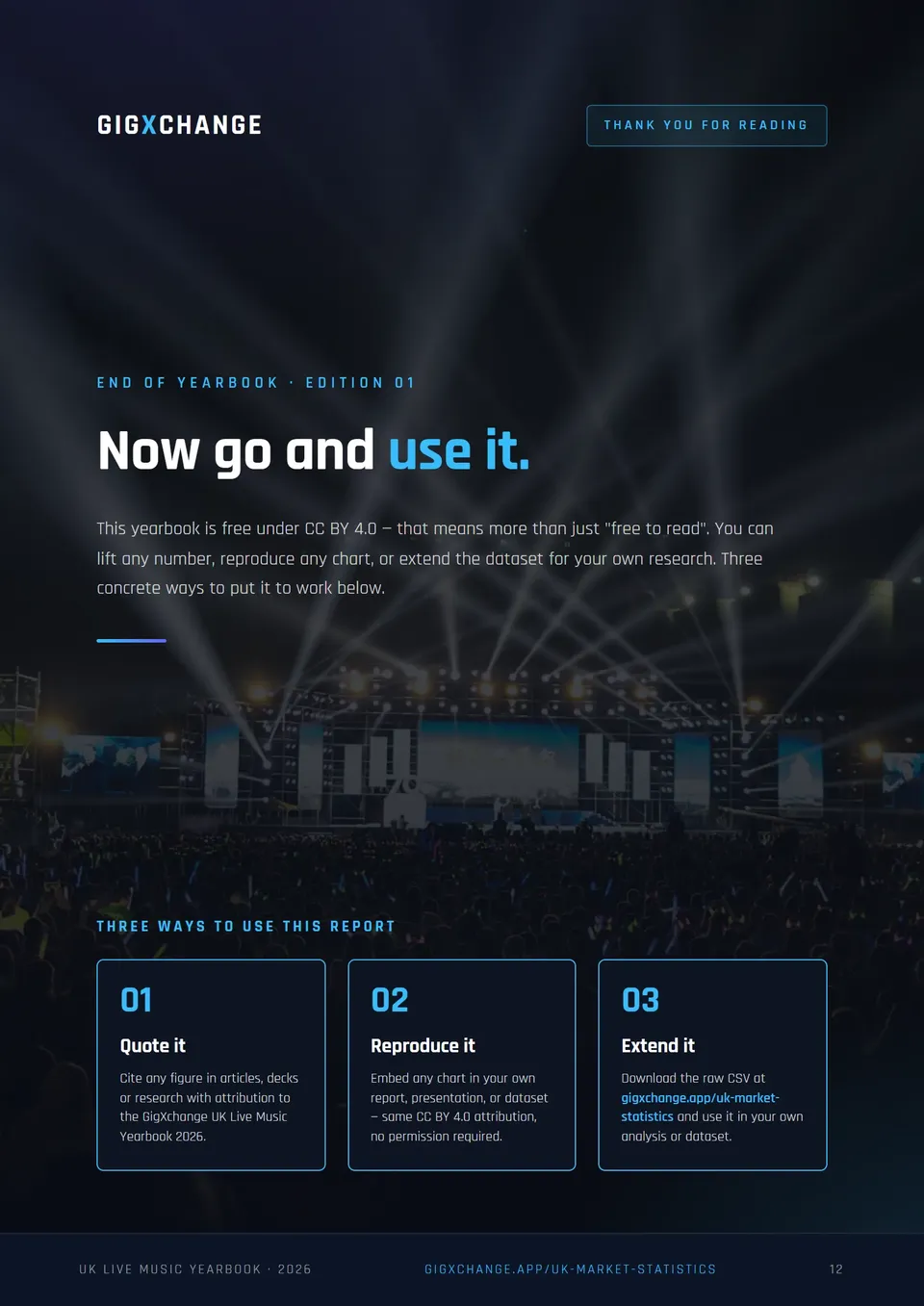
Flip through all 12 pages below, or download the PDF.
The print edition
Flip through all 12 pages below, or download the PDF.


GigXchange Industry Reports · Annual Edition · March 2026
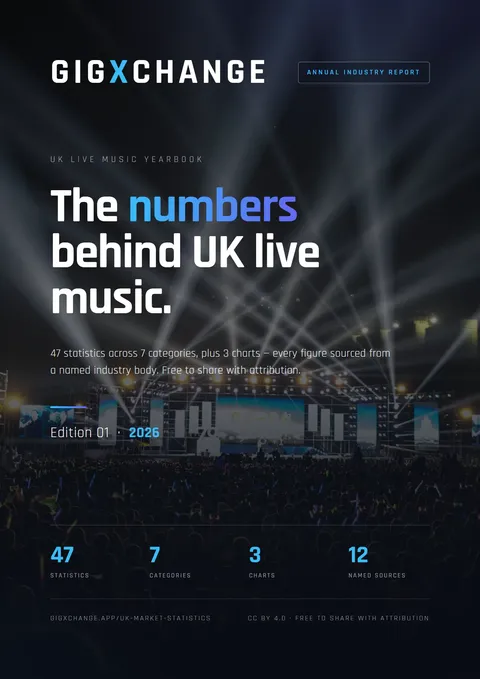
An annual snapshot of the UK live music economy — venues, fees, audiences and scene-level trends, in 12 pages. Every figure sourced and dated.
Last updated: 1 November 2026
What UK music adds to the economy. UK music contributes about £7.6bn a year in gross value added
£7.6bn gross value added in 2023 (UK Music, This Is Music 2024)
Live music is roughly £2.5bn of it
Recovered past pre-pandemic levels
Exports are a genuine national success story
Yet the median musician has not moved in real terms
Free to cite under CC BY 4.0
| Read the yearbook | |
| UK market statistics | |
| Find out more | |
| Download PDF |
The live music share of the industry. Live music accounts for around £2.5bn of the UK music economy
Roughly a third of total industry GVA
Audience numbers back above pre-pandemic levels
Growth concentrated in arenas and festivals
The grassroots end has not shared in it
What gigs actually pay is tracked nightly on the Index
Fees by city, act size and event type
| Read the yearbook | |
| Live GX Index | |
| Find out more | |
| Download PDF |
What is left of the grassroots circuit. 810 grassroots music venues in the Music Venue Trust network at the end of 2024
810 at the end of 2024, down from 960 in 2022 (Music Venue Trust)
After a sustained run of closures
The grassroots circuit is the entry point for working acts
Lose it and the pipeline goes with it
Our venue directory exists to open that door
Free outreach templates to approach them
| Read the yearbook | |
| Grassroots venue directory | |
| Find out more | |
| Download PDF |
Nearly half below minimum-wage equivalent. 43% of UK musicians earn under £14,000 a year from music
43% under £14k (Help Musicians’ Musicians’ Census)
Below the full-time minimum-wage equivalent
More than two in five earn under £14k from music
An average hides a sharply unequal spread
The full earnings picture is its own report
See what individual gigs pay on the live Index
| Read the yearbook | |
| UK Musician Earnings 2026 | |
| Find out more | |
| Download PDF |
UK Live Music Yearbook 2026 — 12 pages. One citable annual picture of the UK live music year
12 pages, free to read, no signup
The economy, the venues, the fees and the gap
Every figure traced to a named, dated source
Consolidates UK Music, MVT, Help Musicians, MU and ONS
Read in-browser or download the PDF
CC BY 4.0 — quote, adapt, build on it
| Read the yearbook | |
| All reports library | |
| Find out more | |
| Download PDF |
UK music is a £7.6bn industry - live music £2.5bn of it - that runs on guesswork. The yearbook gathers 51 statistics across 7 categories, plus 3 charts, every figure from a named industry body and free to cite.
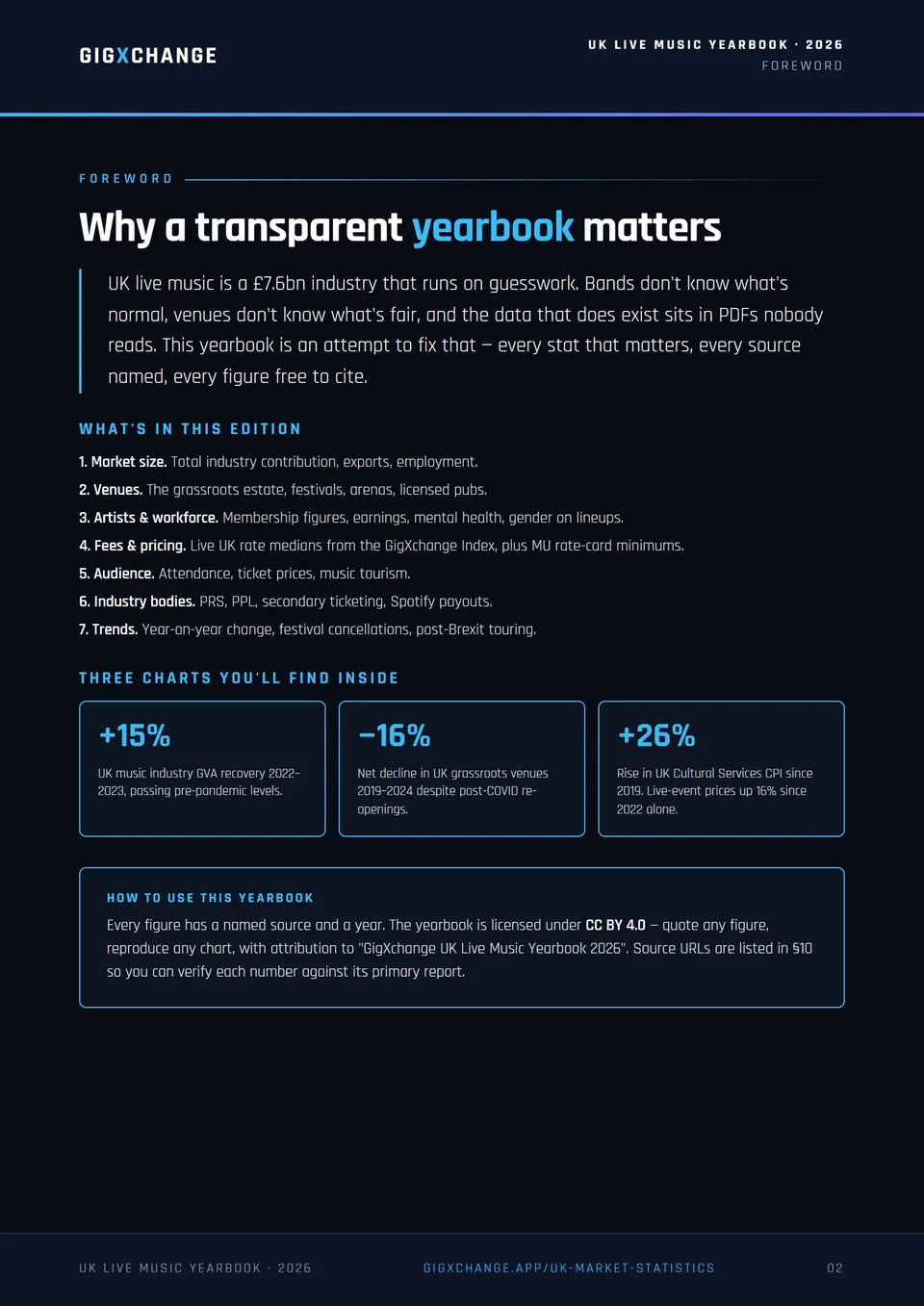
UK music is a £7.6bn industry - live music £2.5bn of it - that runs on guesswork. Bands don't know what's normal, venues don't know what's fair, and the data that does exist sits in PDFs nobody reads. This yearbook is an attempt to fix that - every stat that matters, every source named, every figure free to cite.
Rise in UK Cultural Services CPI since 2019. Live-event prices up 16% since 2022 alone.
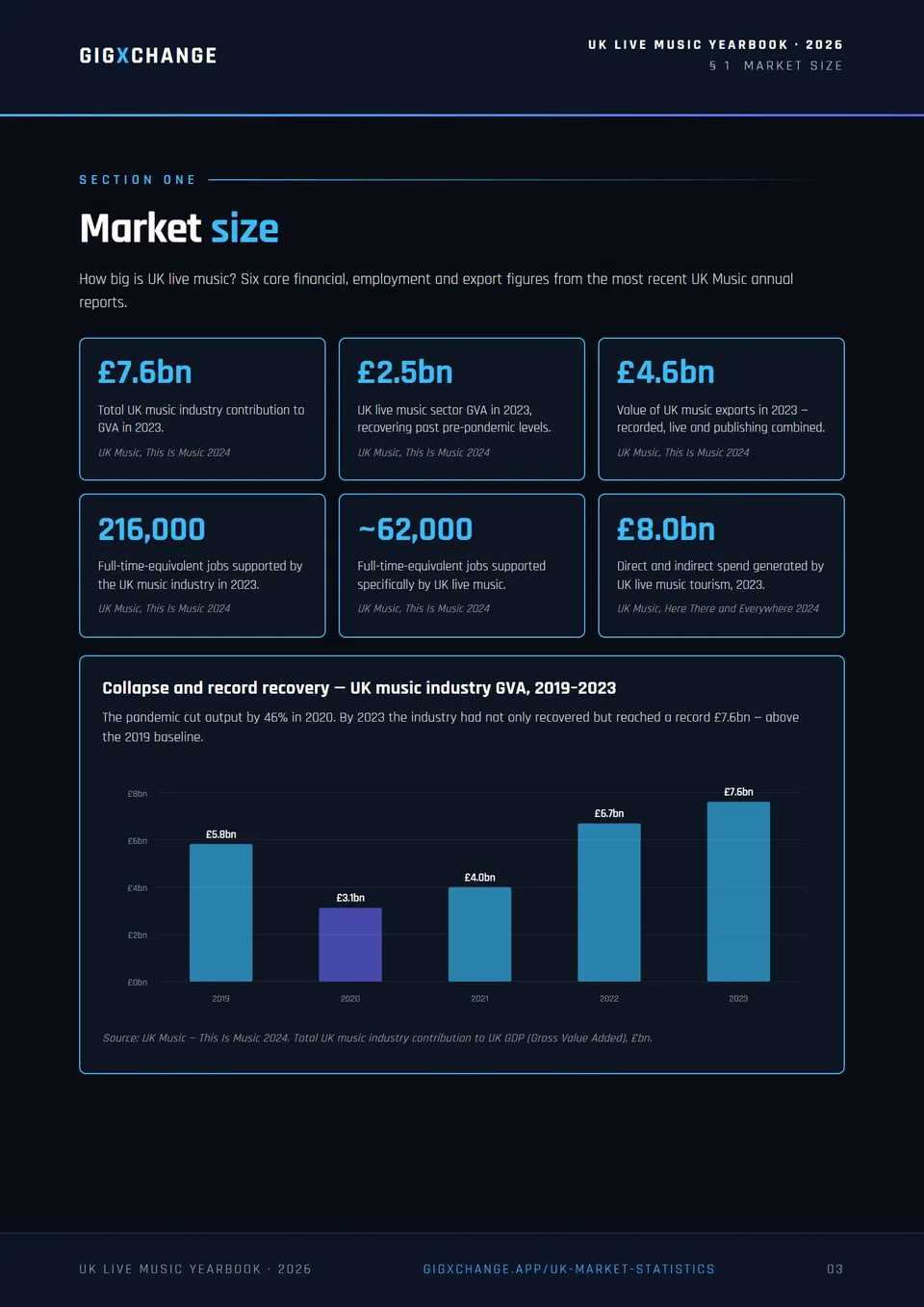
UK music added a record £7.6bn of GVA in 2023, after the pandemic cut output by 46% in 2020 - live music alone £2.5bn, with music exports worth £4.6bn (UK Music, This Is Music 2024).
How big is UK live music? Six core financial, employment and export figures from the most recent UK Music annual reports.
The section's six statistics - industry GVA, live GVA, exports, jobs and music tourism, each with its source and year - are on our UK live music statistics page.
The pandemic cut output by 46% in 2020. By 2023 the industry had not only recovered but reached a record £7.6bn - above the 2019 baseline.
| Year | GVA (£bn) | Change on year |
|---|---|---|
| 2019 | 5.8 | - |
| 2020 | 3.1 | -46.6% |
| 2021 | 4.0 | +29.0% |
| 2022 | 6.7 | +67.5% |
| 2023 | 7.6 | +13.4% |
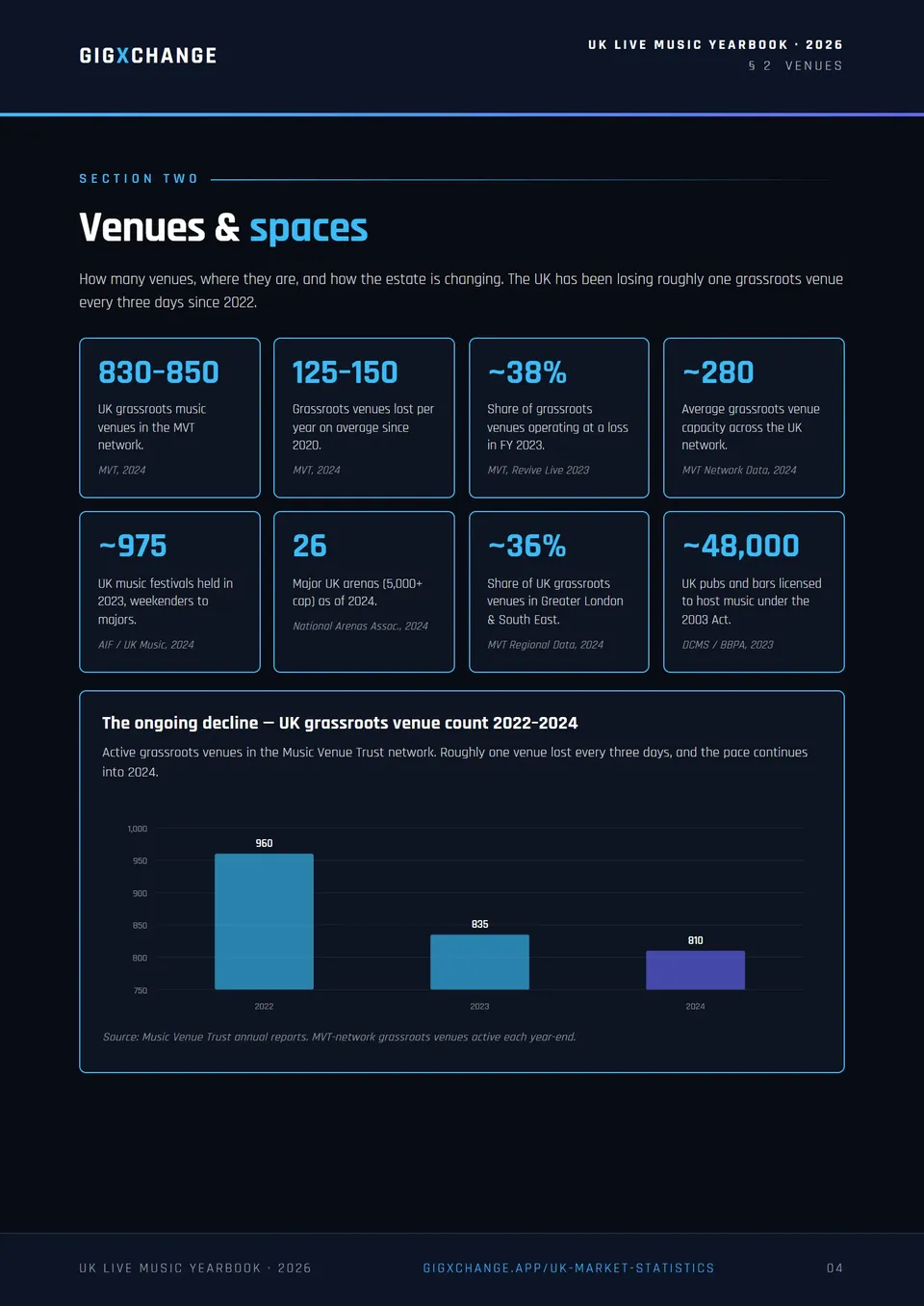
The Music Venue Trust network held 960 grassroots venues in 2022, 835 in 2023 and 810 in 2024 - 125 lost in 2023 alone, roughly one every three days.
How many venues, where they are, and how the estate is changing. The Music Venue Trust network lost 125 grassroots venues in 2023 - roughly one every three days - and a further 25 in 2024.
The section's eight statistics - grassroots venues, closures, capacity, festivals, arenas and licensed pubs, each with its source and year - are on our UK live music statistics page.
Active grassroots venues in the Music Venue Trust network: 125 lost in 2023 (roughly one every three days), 25 in 2024.
| Year | Venues | Change on year |
|---|---|---|
| 2022 | 960 | - |
| 2023 | 835 | -125 |
| 2024 | 810 | -25 |
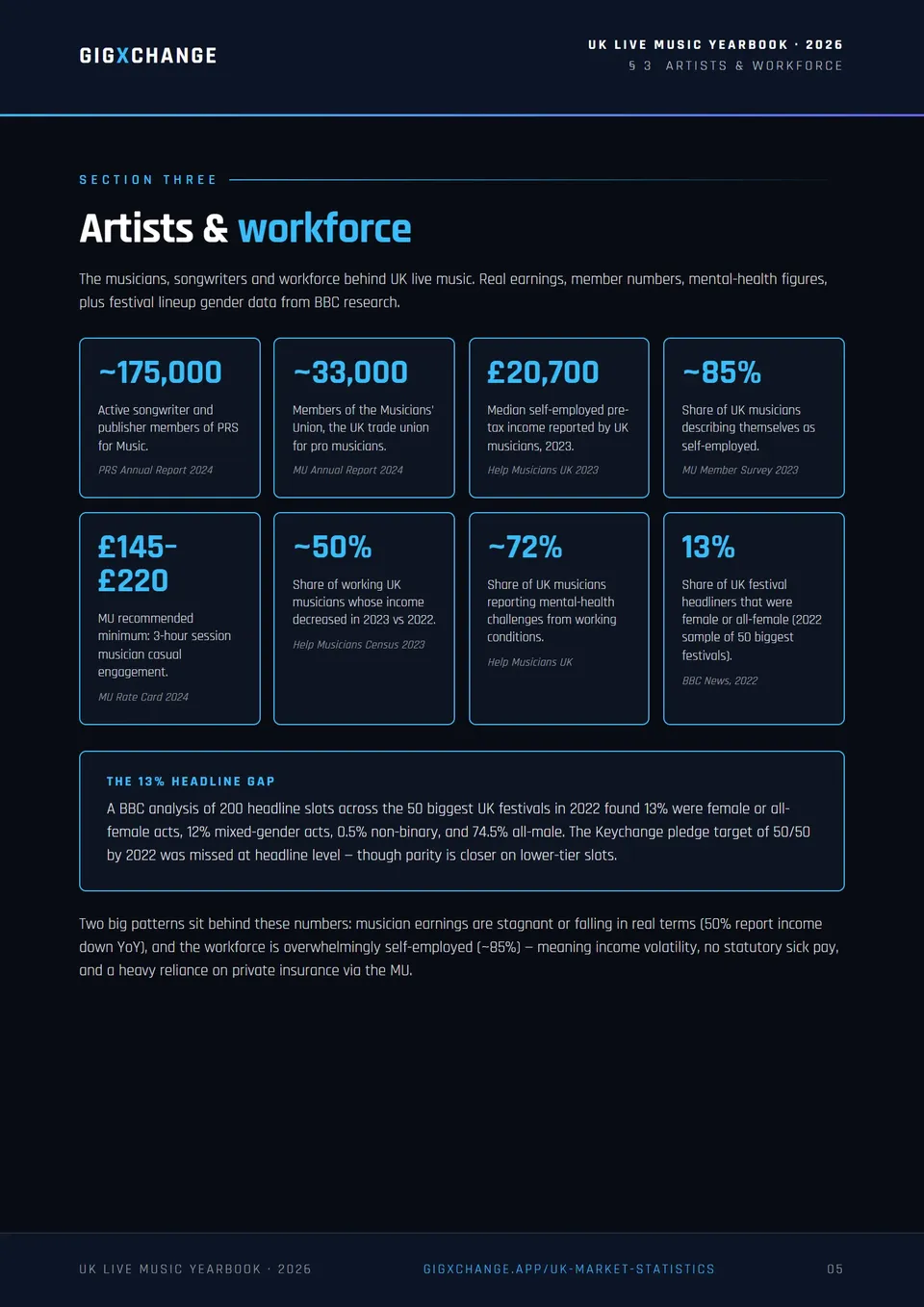
The workforce behind UK live music is ~85% self-employed, ~50% saw income fall in 2023, and 13% of 2022's big-festival headliners were female or all-female acts.
The musicians, songwriters and workforce behind UK live music. Real earnings, member numbers, mental-health figures, plus festival lineup gender data from BBC research.
The section's eight statistics - PRS and MU members, earnings, self-employment, MU rates, mental health and festival headliners, each with its source and year - are on our UK live music statistics page.
Two big patterns sit behind these numbers: musician earnings are stagnant or falling in real terms (50% report income down YoY), and the workforce is overwhelmingly self-employed (~85%) - meaning income volatility, no statutory sick pay, and a heavy reliance on private insurance via the MU.
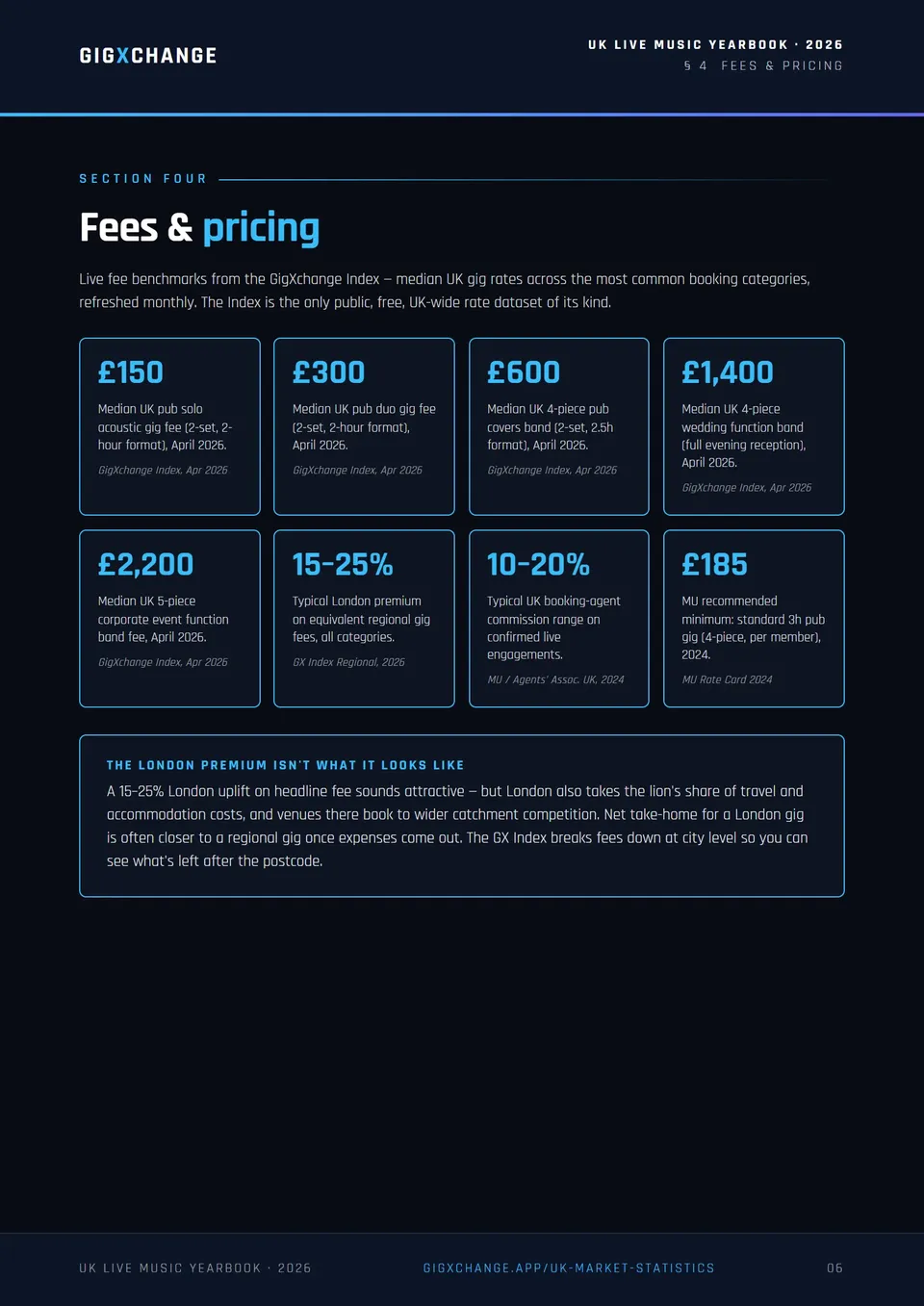
April 2026 medians from the GigXchange Index: £150 for a pub solo acoustic set, £300 for a pub duo, £600 for a 4-piece pub covers band and £1,400 for a 4-piece wedding band.
Live fee benchmarks from the GigXchange Index - median UK gig rates across the most common booking categories, refreshed monthly. The Index is the only public, free, UK-wide rate dataset of its kind.
The section's eight statistics - pub, wedding and corporate medians, the London premium, agent commission and MU minimums, each with its source and year - are on our UK live music statistics page.
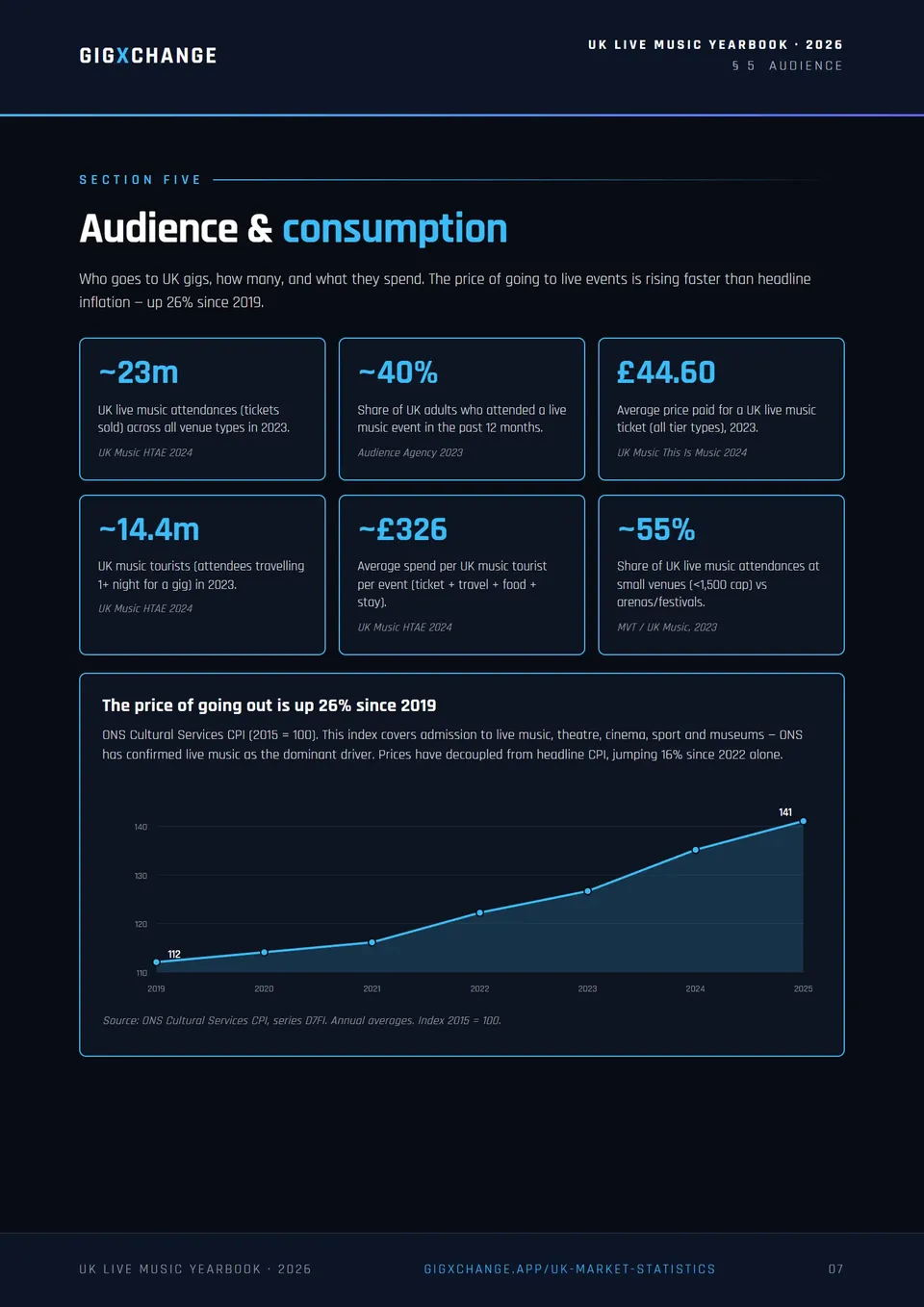
The price of going to live events is rising faster than headline inflation: the ONS Cultural Services index rose from 112.0 in 2019 to 141.2 in 2025, up 26% - and 16% since 2022 alone.
Who goes to UK gigs, how many, and what they spend. The price of going to live events is rising faster than headline inflation - up 26% since 2019.
The section's six statistics - attendances, audience share, ticket prices and music tourism, each with its source and year - are on our UK live music statistics page.
ONS Cultural Services CPI (2015 = 100). This index covers admission to live music, theatre, cinema, sport and museums - ONS has confirmed live music as the dominant driver. Prices have decoupled from headline CPI, jumping 16% since 2022 alone.
| Year | Index (2015 = 100) | Change since 2019 |
|---|---|---|
| 2019 | 112.0 | - |
| 2020 | 114.1 | +1.9% |
| 2021 | 116.0 | +3.6% |
| 2022 | 122.1 | +9.0% |
| 2023 | 126.6 | +13.0% |
| 2024 | 135.2 | +20.7% |
| 2025 | 141.2 | +26.1% |
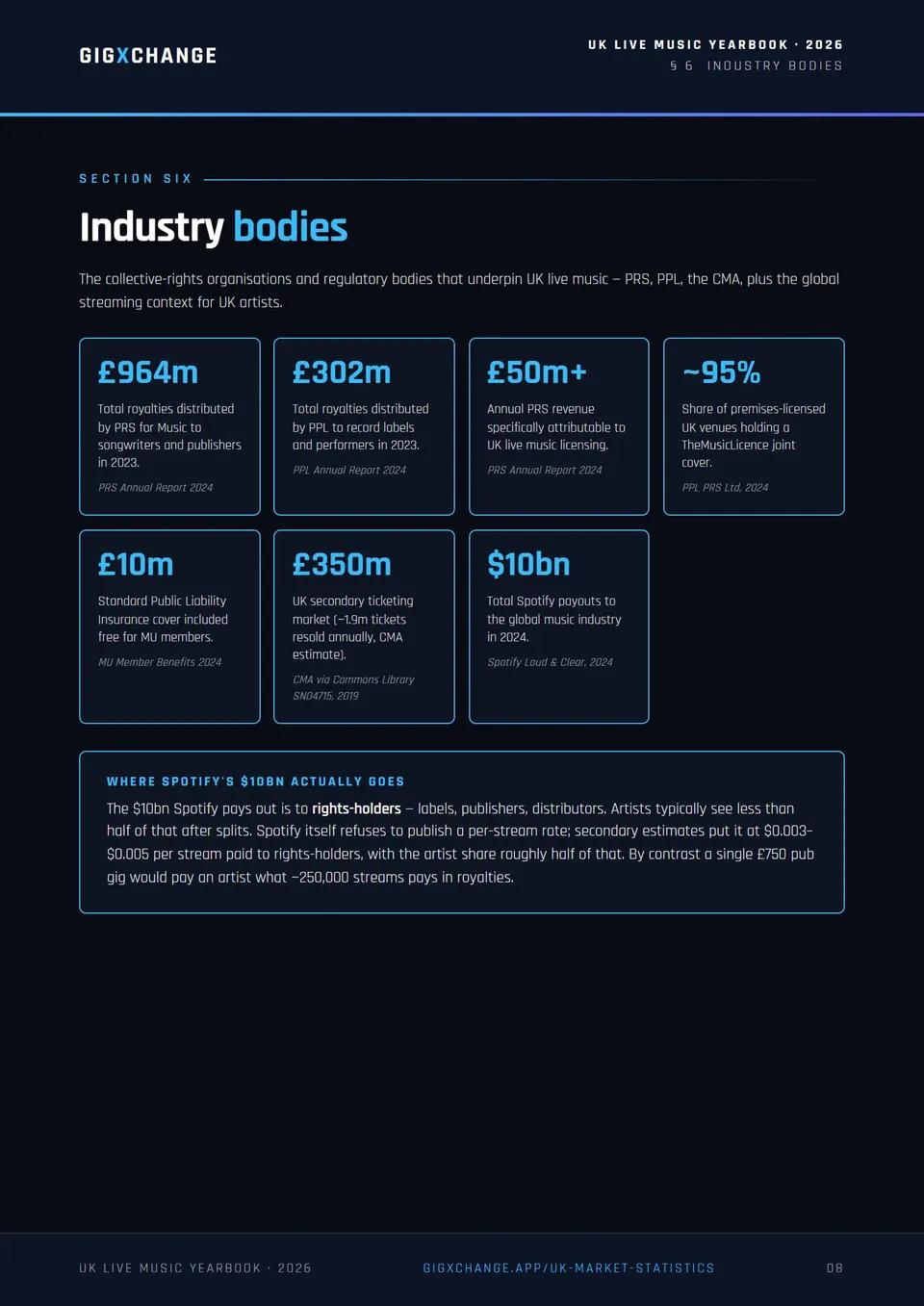
PRS for Music paid out £964m to songwriters and publishers in 2023 and PPL £302m to labels and performers; Spotify paid $10bn to rights-holders worldwide in 2024.
The collective-rights organisations and regulatory bodies that underpin UK live music - PRS, PPL, the CMA, plus the global streaming context for UK artists.
The section's seven statistics - PRS and PPL royalties, live licensing, insurance, secondary ticketing and Spotify payouts, each with its source and year - are on our UK live music statistics page.
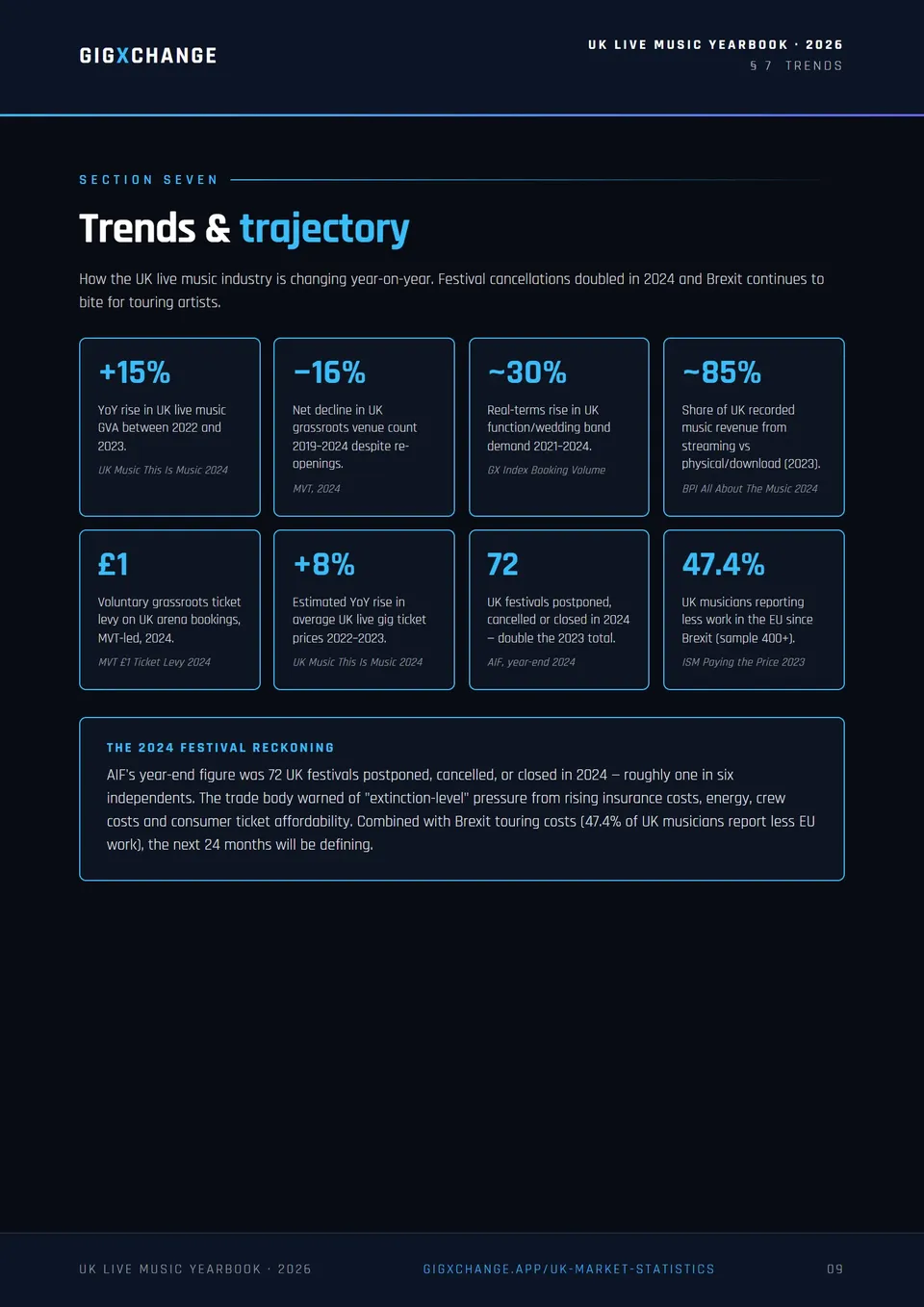
72 UK festivals were postponed, cancelled or closed in 2024 - double 2023's total - and 47.4% of UK musicians report less EU work since Brexit.
How the UK live music industry is changing year-on-year. Festival cancellations doubled in 2024 and Brexit continues to bite for touring artists.
The section's eight statistics - GVA, venue decline, function demand, streaming share, the ticket levy, ticket prices, festival losses and Brexit, each with its source and year - are on our UK live music statistics page.
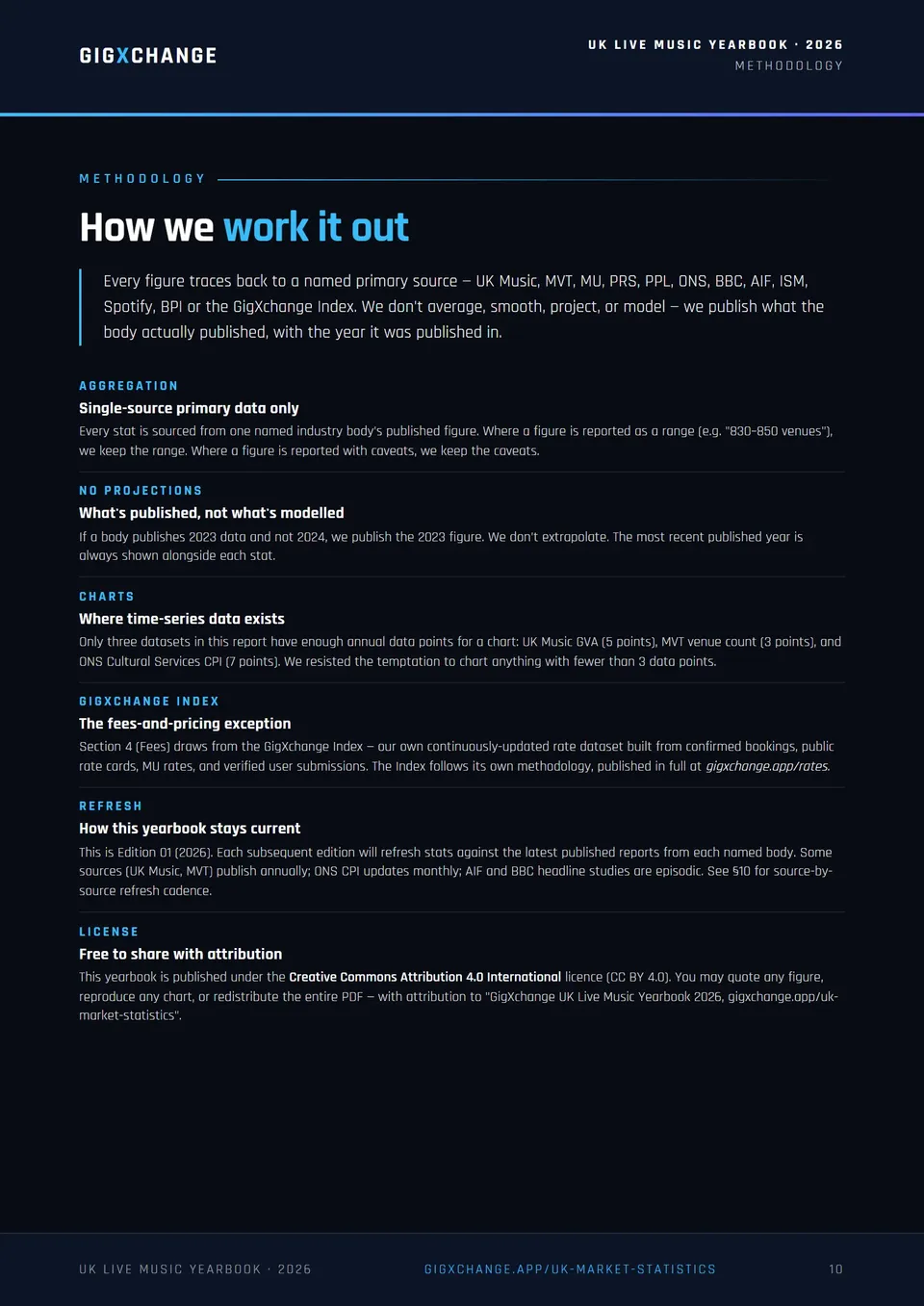
Every figure traces back to one of 14 named primary sources - from UK Music and the Music Venue Trust to ONS and the GigXchange Index - published as the body published it, with its year.
Every figure traces back to a named primary source - UK Music, MVT, MU, PRS, PPL, ONS, BBC, AIF, ISM, Spotify, BPI or the GigXchange Index. We don't average, smooth, project, or model - we publish what the body actually published, with the year it was published in.
Every stat is sourced from one named industry body's published figure. Where a figure is reported as a range (e.g. "830-850 venues"), we keep the range. Where a figure is reported with caveats, we keep the caveats.
If a body publishes 2023 data and not 2024, we publish the 2023 figure. We don't extrapolate. The most recent published year is always shown alongside each stat.
Only three datasets in this report have enough annual data points for a chart: UK Music GVA (5 points), MVT venue count (3 points), and ONS Cultural Services CPI (7 points). We resisted the temptation to chart anything with fewer than 3 data points.
Section 4 (Fees) draws from the GigXchange Index - our own continuously-updated rate dataset built from confirmed bookings, public rate cards, MU rates, and verified user submissions. The Index follows its own methodology, published in full at gigxchange.app/rates.
This is Edition 01 (2026). Each subsequent edition will refresh stats against the latest published reports from each named body. Some sources (UK Music, MVT) publish annually; ONS CPI updates monthly; AIF and BBC headline studies are episodic. See the sources below for source-by-source refresh cadence.
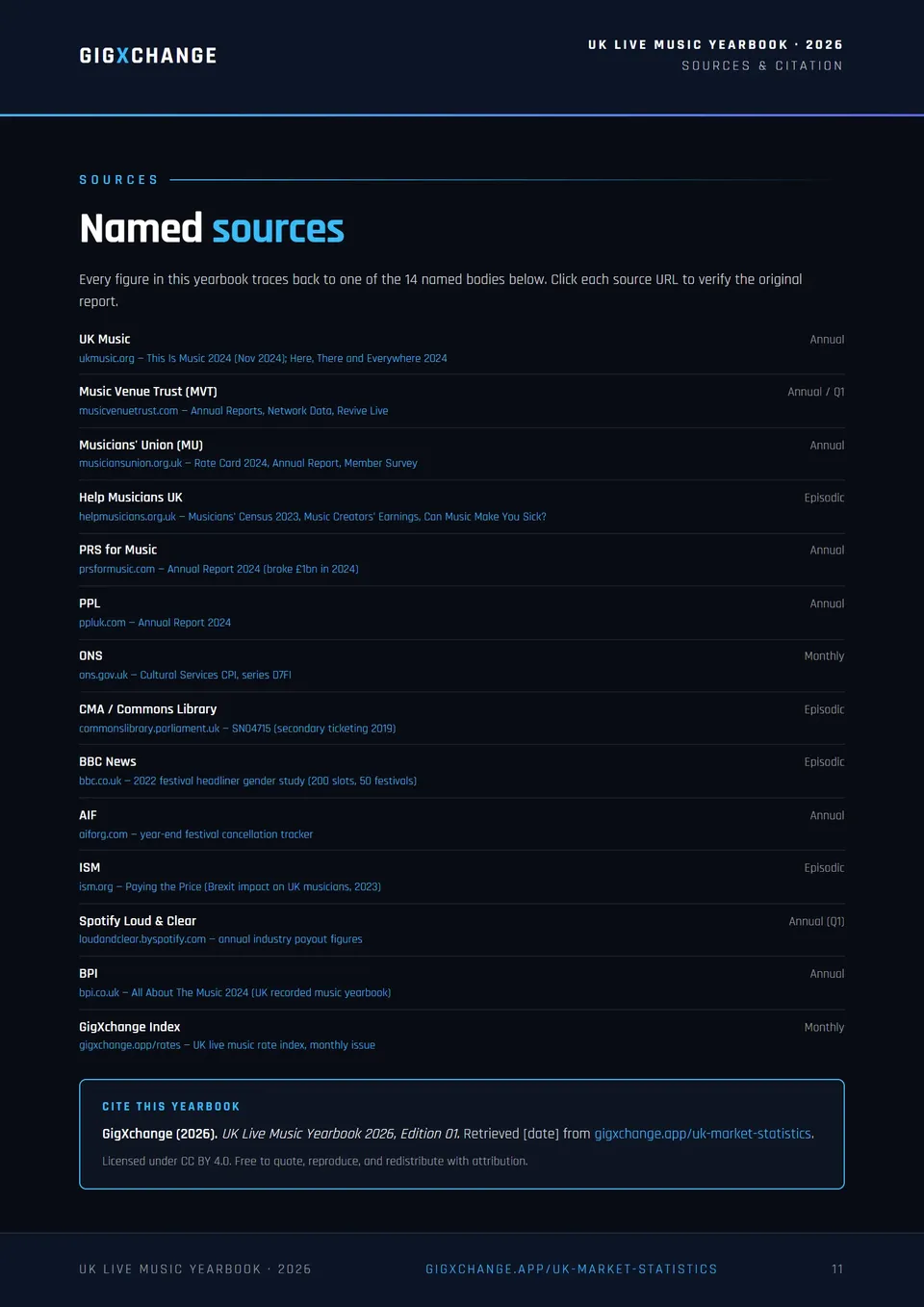
Every figure in this yearbook traces back to one of the 14 named bodies below.
| Source | Reports used | Cadence |
|---|---|---|
| UK Music | ukmusic.org - This Is Music 2024 (Nov 2024); Here, There and Everywhere 2024 | Annual |
| Music Venue Trust (MVT) | musicvenuetrust.com - Annual Reports, Network Data, Revive Live | Annual / Q1 |
| Musicians' Union (MU) | musiciansunion.org.uk - Rate Card 2024, Annual Report, Member Survey | Annual |
| Help Musicians UK | helpmusicians.org.uk - Musicians' Census 2023, Music Creators' Earnings, Can Music Make You Sick? | Episodic |
| PRS for Music | prsformusic.com - Annual Report 2024 (broke £1bn in 2024) | Annual |
| PPL | ppluk.com - Annual Report 2024 | Annual |
| ONS | ons.gov.uk - Cultural Services CPI, series D7FI | Monthly |
| CMA / Commons Library | commonslibrary.parliament.uk - SN04715 (secondary ticketing 2019) | Episodic |
| BBC News | bbc.co.uk - 2022 festival headliner gender study (200 slots, 50 festivals) | Episodic |
| AIF | aiforg.com - year-end festival cancellation tracker | Annual |
| ISM | ism.org - Paying the Price (Brexit impact on UK musicians, 2023) | Episodic |
| Spotify Loud & Clear | loudandclear.byspotify.com - annual industry payout figures | Annual (Q1) |
| BPI | bpi.co.uk - All About The Music 2024 (UK recorded music yearbook) | Annual |
| GigXchange Index | gigxchange.app/rates - UK live music rate index, monthly issue | Monthly |

An annual snapshot of the UK live music economy — venues, fees, audiences and scene-level trends, in 12 pages. Every figure sourced and dated.
Last updated: 1 November 2026
UK music is a £7.6bn industry - live music £2.5bn of it - that runs on guesswork. The yearbook gathers 51 statistics across 7 categories, plus 3 charts, every figure from a named industry body and free to cite.
UK music is a £7.6bn industry - live music £2.5bn of it - that runs on guesswork. Bands don't know what's normal, venues don't know what's fair, and the data that does exist sits in PDFs nobody reads. This yearbook is an attempt to fix that - every stat that matters, every source named, every figure free to cite.
Rise in UK Cultural Services CPI since 2019. Live-event prices up 16% since 2022 alone.
UK music added a record £7.6bn of GVA in 2023, after the pandemic cut output by 46% in 2020 - live music alone £2.5bn, with music exports worth £4.6bn (UK Music, This Is Music 2024).
How big is UK live music? Six core financial, employment and export figures from the most recent UK Music annual reports.
The section's six statistics - industry GVA, live GVA, exports, jobs and music tourism, each with its source and year - are on our UK live music statistics page.
The pandemic cut output by 46% in 2020. By 2023 the industry had not only recovered but reached a record £7.6bn - above the 2019 baseline.
| Year | GVA (£bn) | Change on year |
|---|---|---|
| 2019 | 5.8 | - |
| 2020 | 3.1 | -46.6% |
| 2021 | 4.0 | +29.0% |
| 2022 | 6.7 | +67.5% |
| 2023 | 7.6 | +13.4% |
The Music Venue Trust network held 960 grassroots venues in 2022, 835 in 2023 and 810 in 2024 - 125 lost in 2023 alone, roughly one every three days.
How many venues, where they are, and how the estate is changing. The Music Venue Trust network lost 125 grassroots venues in 2023 - roughly one every three days - and a further 25 in 2024.
The section's eight statistics - grassroots venues, closures, capacity, festivals, arenas and licensed pubs, each with its source and year - are on our UK live music statistics page.
Active grassroots venues in the Music Venue Trust network: 125 lost in 2023 (roughly one every three days), 25 in 2024.
| Year | Venues | Change on year |
|---|---|---|
| 2022 | 960 | - |
| 2023 | 835 | -125 |
| 2024 | 810 | -25 |
The workforce behind UK live music is ~85% self-employed, ~50% saw income fall in 2023, and 13% of 2022's big-festival headliners were female or all-female acts.
The musicians, songwriters and workforce behind UK live music. Real earnings, member numbers, mental-health figures, plus festival lineup gender data from BBC research.
The section's eight statistics - PRS and MU members, earnings, self-employment, MU rates, mental health and festival headliners, each with its source and year - are on our UK live music statistics page.
Two big patterns sit behind these numbers: musician earnings are stagnant or falling in real terms (50% report income down YoY), and the workforce is overwhelmingly self-employed (~85%) - meaning income volatility, no statutory sick pay, and a heavy reliance on private insurance via the MU.
April 2026 medians from the GigXchange Index: £150 for a pub solo acoustic set, £300 for a pub duo, £600 for a 4-piece pub covers band and £1,400 for a 4-piece wedding band.
Live fee benchmarks from the GigXchange Index - median UK gig rates across the most common booking categories, refreshed monthly. The Index is the only public, free, UK-wide rate dataset of its kind.
The section's eight statistics - pub, wedding and corporate medians, the London premium, agent commission and MU minimums, each with its source and year - are on our UK live music statistics page.
The price of going to live events is rising faster than headline inflation: the ONS Cultural Services index rose from 112.0 in 2019 to 141.2 in 2025, up 26% - and 16% since 2022 alone.
Who goes to UK gigs, how many, and what they spend. The price of going to live events is rising faster than headline inflation - up 26% since 2019.
The section's six statistics - attendances, audience share, ticket prices and music tourism, each with its source and year - are on our UK live music statistics page.
ONS Cultural Services CPI (2015 = 100). This index covers admission to live music, theatre, cinema, sport and museums - ONS has confirmed live music as the dominant driver. Prices have decoupled from headline CPI, jumping 16% since 2022 alone.
| Year | Index (2015 = 100) | Change since 2019 |
|---|---|---|
| 2019 | 112.0 | - |
| 2020 | 114.1 | +1.9% |
| 2021 | 116.0 | +3.6% |
| 2022 | 122.1 | +9.0% |
| 2023 | 126.6 | +13.0% |
| 2024 | 135.2 | +20.7% |
| 2025 | 141.2 | +26.1% |
PRS for Music paid out £964m to songwriters and publishers in 2023 and PPL £302m to labels and performers; Spotify paid $10bn to rights-holders worldwide in 2024.
The collective-rights organisations and regulatory bodies that underpin UK live music - PRS, PPL, the CMA, plus the global streaming context for UK artists.
The section's seven statistics - PRS and PPL royalties, live licensing, insurance, secondary ticketing and Spotify payouts, each with its source and year - are on our UK live music statistics page.
72 UK festivals were postponed, cancelled or closed in 2024 - double 2023's total - and 47.4% of UK musicians report less EU work since Brexit.
How the UK live music industry is changing year-on-year. Festival cancellations doubled in 2024 and Brexit continues to bite for touring artists.
The section's eight statistics - GVA, venue decline, function demand, streaming share, the ticket levy, ticket prices, festival losses and Brexit, each with its source and year - are on our UK live music statistics page.
Every figure traces back to one of 14 named primary sources - from UK Music and the Music Venue Trust to ONS and the GigXchange Index - published as the body published it, with its year.
Every figure traces back to a named primary source - UK Music, MVT, MU, PRS, PPL, ONS, BBC, AIF, ISM, Spotify, BPI or the GigXchange Index. We don't average, smooth, project, or model - we publish what the body actually published, with the year it was published in.
Every stat is sourced from one named industry body's published figure. Where a figure is reported as a range (e.g. "830-850 venues"), we keep the range. Where a figure is reported with caveats, we keep the caveats.
If a body publishes 2023 data and not 2024, we publish the 2023 figure. We don't extrapolate. The most recent published year is always shown alongside each stat.
Only three datasets in this report have enough annual data points for a chart: UK Music GVA (5 points), MVT venue count (3 points), and ONS Cultural Services CPI (7 points). We resisted the temptation to chart anything with fewer than 3 data points.
Section 4 (Fees) draws from the GigXchange Index - our own continuously-updated rate dataset built from confirmed bookings, public rate cards, MU rates, and verified user submissions. The Index follows its own methodology, published in full at gigxchange.app/rates.
This is Edition 01 (2026). Each subsequent edition will refresh stats against the latest published reports from each named body. Some sources (UK Music, MVT) publish annually; ONS CPI updates monthly; AIF and BBC headline studies are episodic. See the sources below for source-by-source refresh cadence.
Every figure in this yearbook traces back to one of the 14 named bodies below.
| Source | Reports used | Cadence |
|---|---|---|
| UK Music | ukmusic.org - This Is Music 2024 (Nov 2024); Here, There and Everywhere 2024 | Annual |
| Music Venue Trust (MVT) | musicvenuetrust.com - Annual Reports, Network Data, Revive Live | Annual / Q1 |
| Musicians' Union (MU) | musiciansunion.org.uk - Rate Card 2024, Annual Report, Member Survey | Annual |
| Help Musicians UK | helpmusicians.org.uk - Musicians' Census 2023, Music Creators' Earnings, Can Music Make You Sick? | Episodic |
| PRS for Music | prsformusic.com - Annual Report 2024 (broke £1bn in 2024) | Annual |
| PPL | ppluk.com - Annual Report 2024 | Annual |
| ONS | ons.gov.uk - Cultural Services CPI, series D7FI | Monthly |
| CMA / Commons Library | commonslibrary.parliament.uk - SN04715 (secondary ticketing 2019) | Episodic |
| BBC News | bbc.co.uk - 2022 festival headliner gender study (200 slots, 50 festivals) | Episodic |
| AIF | aiforg.com - year-end festival cancellation tracker | Annual |
| ISM | ism.org - Paying the Price (Brexit impact on UK musicians, 2023) | Episodic |
| Spotify Loud & Clear | loudandclear.byspotify.com - annual industry payout figures | Annual (Q1) |
| BPI | bpi.co.uk - All About The Music 2024 (UK recorded music yearbook) | Annual |
| GigXchange Index | gigxchange.app/rates - UK live music rate index, monthly issue | Monthly |
Flip through all 12 pages below, or download the PDF.
Flip through all 12 pages below, or download the PDF.
GigXchange (2026). UK Live Music Yearbook 2026. GigXchange Industry Reports, Annual Edition. Available at: gigxchange.app/rates/reports/uk-live-music-yearbook-2026. Licensed under CC BY 4.0.
Cite this report
GigXchange (2026). UK Live Music Yearbook 2026. GigXchange Industry Reports, Annual Edition. Available at: gigxchange.app/rates/reports/uk-live-music-yearbook-2026. Licensed under CC BY 4.0.
DOI 10.5281/zenodo.23807794 · PDF
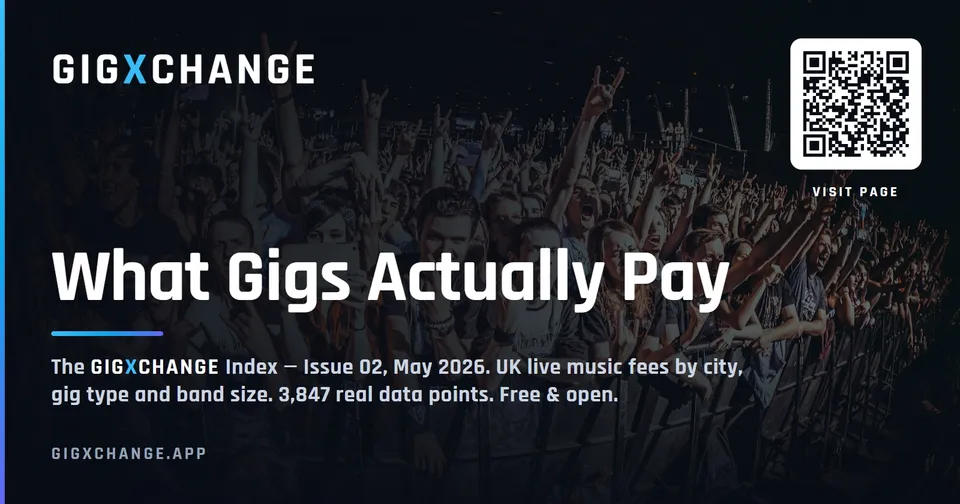
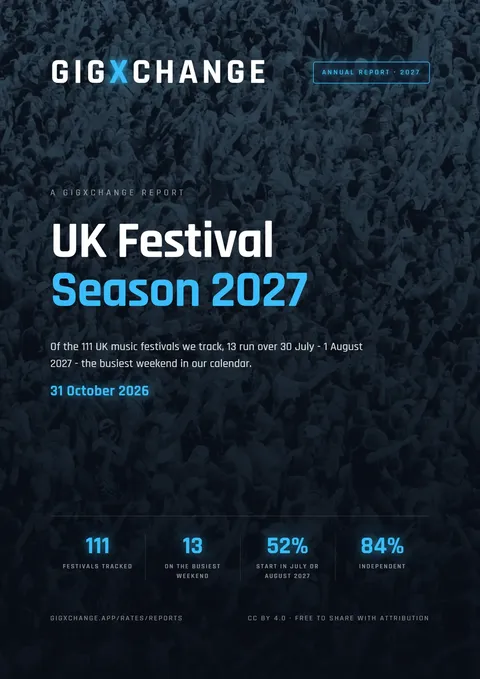
| UK Festival Season 202731 Oct 2026 · Annual · 11 pages · PDF | |
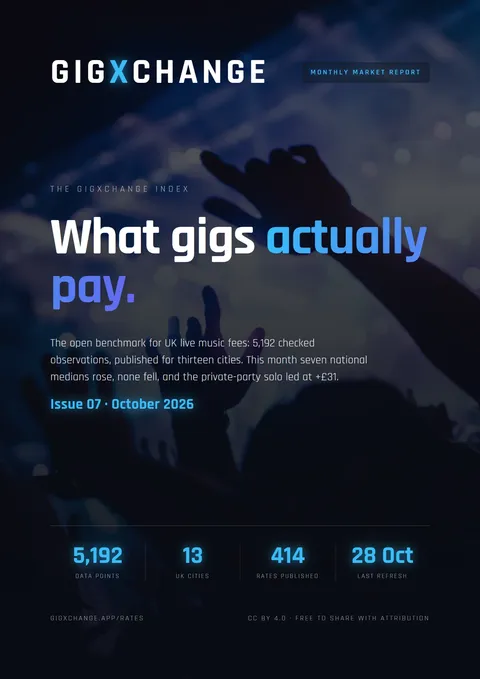
| GIGXCHANGE Index — October 202629 Oct 2026 · Index · 11 pages · PDF | |
| GIGXCHANGE Index — September 20266 Oct 2026 · Index · 11 pages · PDF | |
| GIGXCHANGE Index — August 20263 Sept 2026 · Index · 11 pages · PDF | |
| State of the Circuit 20266 Aug 2026 · Annual · 11 pages · PDF | |
| GIGXCHANGE Index — July 202631 Jul 2026 · Index · 11 pages · PDF | |
| GIGXCHANGE Index — June 20264 Jul 2026 · Index · 11 pages · PDF | |
| GIGXCHANGE Index — May 202620 May 2026 · Index · 11 pages · PDF | |
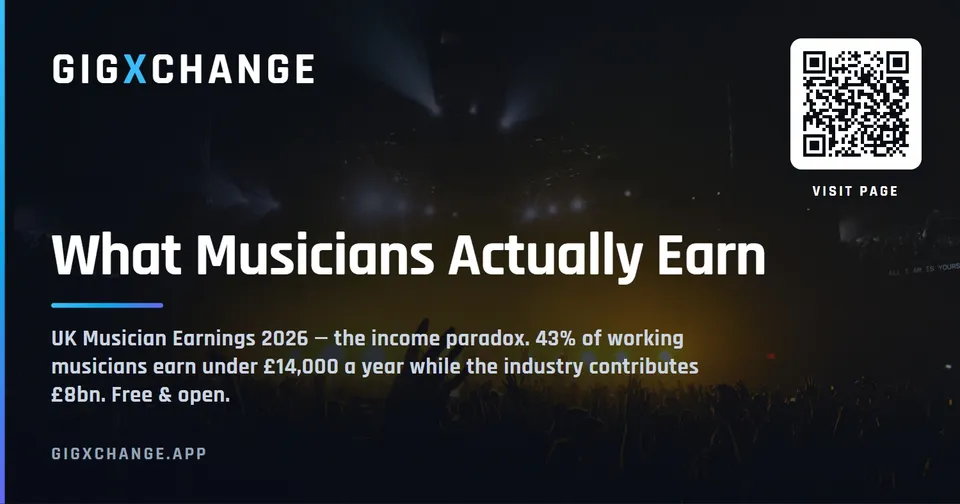
| UK Musician Earnings 202623 Apr 2026 · Special · 11 pages · PDF | |
| Browse all reports & datasets |
GX Index — October 2026 · the yearbook is the annual picture; the Index shows what gigs pay right now.
The numbers| GX Index — live rates | |
| UK Market Statistics |
| Grassroots venue directory |
Add your real gig fees to the UK Gig Pay Survey — anonymous, ~60 seconds, and every entry sharpens the next GX Index.
| Take the survey |
| Gig directory |
The yearbook is the annual picture. The GX Index tells you what gigs are paying right now, free and rebuilt nightly.
The yearbook is the annual picture. The GX Index tells you what gigs are paying right now, free and rebuilt nightly.
Real UK gig-fee data, not guesswork — built from actual bookings. Add yours and it gets sharper for everyone.