GX Index October 2026: What UK Gigs Paid (£175–£1,560)Issue 07 of the GigXchange Index: seven national medians up and none down, a wedding band at an even £1,000, four pub medians that held on mostly restated rates, and 145 new rows refused at the door
TL;DR: GX Index Issue 07, October 2026
The GIGXCHANGE Index Issue 07 has seven national medians up and none down. A 3–4 piece wedding band reached an even £1,000, up £10 on September, and the biggest move was the private-party solo, £323 to £354, on a sample that grew by one row. The other 15 tiles held, all four pub medians among them, though 307 of the 390 panel rows behind the pub growth were members restating a September rate, so those figures have not yet had a fresh test. The pool reached 5,192 observations, publication reached 414 cells and the city league widened to £17.
Below: the tables, why I am taking back something I said about pub fees last month, a scorecard for what September promised, and the cells still too thin to quote. The live numbers sit at /rates, and the full issue is on the October report page.
GX Index · Issue 07
October 2026 in numbers
Fees paid or asked, shown as artist take-home after commission, from the GX Index refresh of 28 October 2026, 05:00 UTC. n is how many observations apply to a cell, not how many gigs were booked in it, and at city level it includes rows with no location. Full report: Issue 07. Previous issue: September 2026.
- 5,192Checked observations in the pool, up 420 on the September refresh
- £1,000Median fee for a 3–4 piece wedding band, UK-wide, up £10
- 7 of 22National medians that moved, every one of them upward
- 145New rows turned away by the range check
- 414Published rate cells: 299 city, 93 regional and 22 national
- £17Gap between the top and bottom of the 13-city wedding league, up from £14
Fees paid or asked, shown as artist take-home after commission, from the GX Index refresh of 28 October 2026, 05:00 UTC. n is how many observations apply to a cell, not how many gigs were booked in it, and at city level it includes rows with no location. Full report: Issue 07. Previous issue: September 2026.
1. Seven rose, none fell: where the movement actually sat
If you quoted a wedding last month off the £990 figure, you were not wrong then and you are not wrong now. The median is £1,000, and a £10 move inside a cell that runs from £729 to £1,900 is no reason to reprice anything. The more useful question is where the movement landed: seven cells in the function market, and none at all in pubs.
Of the 22 national tiles we can compare with September, seven moved and all seven moved up. The other 15 held. That reads like a strong month for fees and I do not think it was one. It was a month where a small number of new rows met a small number of cells, and everything else stayed put.
The six headline gig types, September beside October
Here is the 3–4 piece lineup, the row most people come here for. Four of the six gig types printed exactly what they printed in September, and the two that moved did so by £10 and £3, which widened the gap between the two dearest bookings at this size from £124 to £131.
| p25 | £729 |
| p50 (median) | £1,000 |
| p75 | £1,405 |
| p90 | £1,900 |
| September p50 | £990 |
| n | 1,616 |
Private party
| p25 | £500 |
| p50 (median) | £869 |
| p75 | £1,329 |
| p90 | £1,955 |
| September p50 | £866 |
| n | 537 |
Corporate
| p25 | £669 |
| p50 (median) | £812 |
| p75 | £892 |
| p90 | £1,082 |
| September p50 | £812 |
| n | 6 |
Festival
| p25 | £200 |
| p50 (median) | £669 |
| p75 | £866 |
| p90 | £892 |
| September p50 | £669 |
| n | 5 |
Ticketed club
| p25 | £450 |
| p50 (median) | £600 |
| p75 | £1,463 |
| p90 | £1,463 |
| September p50 | £600 |
| n | 11 |
Pub & bar
| p25 | £275 |
| p50 (median) | £350 |
| p75 | £600 |
| p90 | £750 |
| September p50 | £350 |
| n | 379 |
3–4 piece medians by gig type · UK national, artist take-home. Source: GX Index Issue 07, 28 October 2026 refresh.
| Gig type | p25 | p50 (median) | p75 | p90 | September p50 | n |
|---|---|---|---|---|---|---|
| Wedding | £729 | £1,000 | £1,405 | £1,900 | £990 | 1,616 |
| Private party | £500 | £869 | £1,329 | £1,955 | £866 | 537 |
| Corporate | £669 | £812 | £892 | £1,082 | £812 | 6 |
| Festival | £200 | £669 | £866 | £892 | £669 | 5 |
| Ticketed club | £450 | £600 | £1,463 | £1,463 | £600 | 11 |
| Pub & bar | £275 | £350 | £600 | £750 | £350 | 379 |
3–4 piece medians by gig type · UK national, artist take-home. Source: GX Index Issue 07, 28 October 2026 refresh.
Two of those rows will mislead you if you skip the n column: six observations behind corporate and five behind festival, both flagged as low-sample in the report. The row I would look at twice is private parties, where a p90 of £1,955 sits above the wedding p90 on about a third of the rows.
Across all 22 national tiles the medians run from £175 for a theatre solo to £1,560 for a festival five-plus. Both are unchanged and both are thin, on six and nine observations.
The seven that moved, and the 28 rows behind them
This is the table I would read first. Every tile that rose is here, with its sample before and after.
Private party, solo
| September | £323 |
| October | £354 |
| Change | +£31 |
| n, September to October | 77 to 78 |
Wedding, 3–4 piece
| September | £990 |
| October | £1,000 |
| Change | +£10 |
| n, September to October | 1,605 to 1,616 |
Wedding, duo
| September | £533 |
| October | £541 |
| Change | +£8 |
| n, September to October | 188 to 189 |
Corporate, 5+ piece
| September | £1,329 |
| October | £1,337 |
| Change | +£8 |
| n, September to October | 72 to 73 |
Corporate, solo
| September | £388 |
| October | £392 |
| Change | +£4 |
| n, September to October | 187 to 191 |
Wedding, solo
| September | £330 |
| October | £333 |
| Change | +£3 |
| n, September to October | 108 to 110 |
Private party, 3–4 piece
| September | £866 |
| October | £869 |
| Change | +£3 |
| n, September to October | 529 to 537 |
The seven national medians that moved · Ordered by size of move. Source: GX Index Issue 07, comparing the 28 September and 28 October 2026 refreshes.
| Tile | September | October | Change | n, September to October |
|---|---|---|---|---|
| Private party, solo | £323 | £354 | +£31 | 77 to 78 |
| Wedding, 3–4 piece | £990 | £1,000 | +£10 | 1,605 to 1,616 |
| Wedding, duo | £533 | £541 | +£8 | 188 to 189 |
| Corporate, 5+ piece | £1,329 | £1,337 | +£8 | 72 to 73 |
| Corporate, solo | £388 | £392 | +£4 | 187 to 191 |
| Wedding, solo | £330 | £333 | +£3 | 108 to 110 |
| Private party, 3–4 piece | £866 | £869 | +£3 | 529 to 537 |
The seven national medians that moved · Ordered by size of move. Source: GX Index Issue 07, comparing the 28 September and 28 October 2026 refreshes.
Add up the last column and those seven tiles gained 28 rows between them. That is all of the growth outside pubs. The four pub tiles took the other 392 and did not move, and the remaining 11 tiles gained nothing and did nothing.
So my summary of October: the function market got a trickle of new evidence, and every cell that got some of it went up a little. I cannot tell you from 28 rows whether that is a market rising or a handful of rows landing slightly high.
The £31 jump I would not quote yet
The biggest move of the month is the private-party solo, up £31 from £323 to £354. Its sample went from 77 to 78. A median that shifts £31 on one extra row says more about how thin the middle of that cell is than it says about the market, and I would want to see it hold for another month before building anything on it.
It does reorder the solo column, so it belongs in print. Private parties at £354 now sit ahead of weddings at £333, where in September the order ran the other way, £330 to £323. Corporate still leads that column on £392.
2. Pubs: 392 new rows and no fresh test
Last month I told you the pub 3–4 piece was the first properly tested pub figure in the series, because its sample grew and the median held. This month the sample grew again and the median held again, so you might expect me to call it twice as tested. I am going the other way. I overstated it, and the reason is where the rows came from.
All four pub medians held
Here are the four pub tiles. Every median is the one September printed, and every sample is bigger.
Solo
| n, September to October | 370 to 546 |
| p25 | £162 |
| p50 (median) | £250 |
| p75 | £325 |
| p90 | £425 |
Duo
| n, September to October | 66 to 93 |
| p25 | £250 |
| p50 (median) | £325 |
| p75 | £500 |
| p90 | £500 |
3–4 piece
| n, September to October | 274 to 379 |
| p25 | £275 |
| p50 (median) | £350 |
| p75 | £600 |
| p90 | £750 |
5+ piece
| n, September to October | 223 to 307 |
| p25 | £400 |
| p50 (median) | £525 |
| p75 | £1,050 |
| p90 | £1,350 |
Pub & bar fees by lineup · UK national, artist take-home. Source: GX Index Issue 07, 28 October 2026 refresh.
| Lineup | n, September to October | p25 | p50 (median) | p75 | p90 |
|---|---|---|---|---|---|
| Solo | 370 to 546 | £162 | £250 | £325 | £425 |
| Duo | 66 to 93 | £250 | £325 | £500 | £500 |
| 3–4 piece | 274 to 379 | £275 | £350 | £600 | £750 |
| 5+ piece | 223 to 307 | £400 | £525 | £1,050 | £1,350 |
Pub & bar fees by lineup · UK national, artist take-home. Source: GX Index Issue 07, 28 October 2026 refresh.
Two cells narrowed around a median that stayed still. The 3–4 piece lower quartile rose from £255 to £275, and the five-plus upper quartile came down from £1,125 to £1,050. If you play pubs in a band, that £275 is the one figure here that moved your way, and the next heading is why I would not lean on it.
Why 392 rows is not 392 new opinions
The pub tiles gained 392 rows this month, and 390 of them came from the artist-panel snapshot on 28 October, all labelled as pub rates. The panel reads the rate an artist has on their profile once a month, which is how it is meant to work: it tracks asking prices over time. It also adds a new row per member each month, so its count has run 201 in August, 310 in September and 390 in October whether or not anybody changed their mind.
This month 307 of those 390 were members the panel had already recorded in September, each restating the same rate. So when the pub medians hold, most of what you are looking at is the same musicians asking the same money. That is a true and useful fact about asking prices. It is not a fresh test of what pubs pay, and only reported fees can give us one. Two of the three anonymous reports that arrived this window were pub bookings, which is a start and nowhere near enough.
The duo, one month on
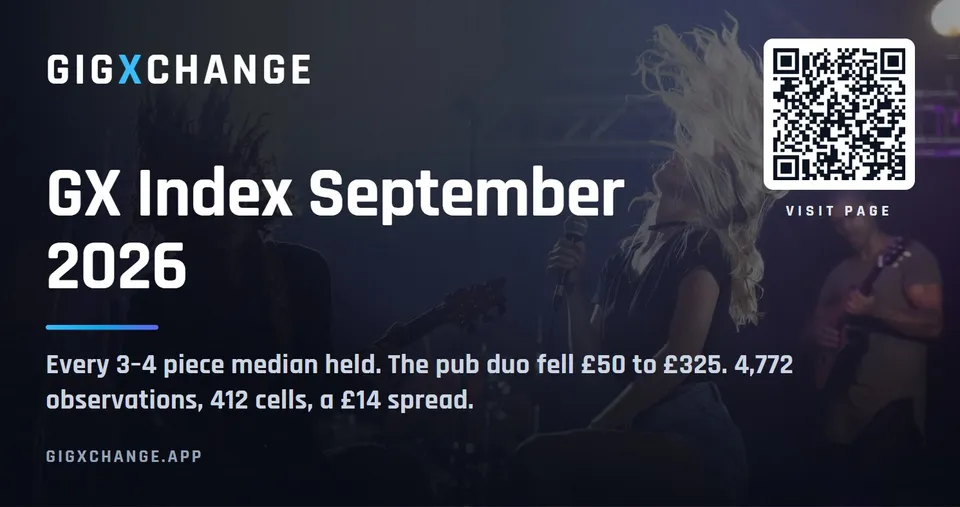
September’s one faller was the pub duo, £375 down to £325, and I promised to report it again whatever it did. It held at £325, quartiles and all, on a sample that grew from 66 to 93. I also promised to say which reading the extra evidence supports: a market moving, or a small cell finding its level. The fall did not continue, which leans towards a cell finding its level. Given where this month’s pub rows came from, it leans rather than proves.
The arithmetic has not improved. A £325 duo is £162.50 a head, and the Musicians’ Union national gig rate for April 2026 recommends a minimum of £167.16 per musician for groups in pubs and clubs, up to 3 hours. A 3–4 piece on £350 is further off, at between £87.50 and £116.67 a head. If you want to build a quote up from that floor, start with How to set your gig price.
3. Band size: £333 solo, £1,489 at five-plus
No gig type has more observations behind it than weddings, though the pub cells have just shown that size alone proves little: 1,080 of the 1,616 rows in the wedding 3–4 piece cell carry no location, and almost all of those are published market rates. The three lower rungs each rose a little this month and the top one did not move at all.
The curve, rung by rung
Each card gives the median with the middle half of fees beneath it, so you can see how wide a rung is as well as where it sits.
Reading the steps: £208, £459, £489
A second player on a solo booking adds £208 at the median. Turning a duo into a band adds £459, which nearly doubles the fee. The steepest step is still the last one, 3–4 piece to five-plus, at £489, though it shrank by £10 because the rung below it rose and the rung above it did not.
Per head, there is no steady discount for size
Divide by the players and the curve changes shape: £333 for a solo act, about £271 each in a duo, £250 to £333 in a 3–4 piece and about £248 to £298 at five or six players. A duo player takes less than a soloist, but a trio can match the solo figure and a five-piece can beat a quartet, which is why what UK gigs pay depends so much on how many people share the fee.
All of those clear the £222.88 per musician the Musicians’ Union recommends for functions of up to 4 hours. That is good news for the median wedding and says nothing about the quarter of fees below it: a quartet at the £729 lower quartile is on £182.25 a head, and that falls short.
4. The city league: £1,065 to £1,082
The wedding league widened by three pounds this month, from £14 to £17, and I would not read anything into the three pounds. Not one city gained a local row: all 13 local counts are the ones September printed. The only new rows in these cells are 11 shared ones with no location, taking the shared pool from 1,069 to 1,080, and that was enough to lift every city median by between £1 and £15 and reshuffle the table.
Thirteen cities, with their local counts
Two things go into a city cell: the fees collected there, and every fee with no location attached, since a national price list is on offer in Leeds as much as anywhere. Only the first differs from city to city, so that is the column to read. The 1,080 shared rows sit behind all thirteen.
| Median | £1,082 |
| Middle half | £750–£1,500 |
| p90 | £2,049 |
| Local rows | 10 |
| UK-wide rows | 1,080 |
| Median | £1,079 |
| Middle half | £750–£1,500 |
| p90 | £2,000 |
| Local rows | 41 |
| UK-wide rows | 1,080 |
| Median | £1,079 |
| Middle half | £750–£1,500 |
| p90 | £2,034 |
| Local rows | 32 |
| UK-wide rows | 1,080 |
| Median | £1,079 |
| Middle half | £750–£1,500 |
| p90 | £2,034 |
| Local rows | 22 |
| UK-wide rows | 1,080 |
| Median | £1,079 |
| Middle half | £750–£1,500 |
| p90 | £2,049 |
| Local rows | 18 |
| UK-wide rows | 1,080 |
| Median | £1,079 |
| Middle half | £750–£1,500 |
| p90 | £2,049 |
| Local rows | 8 |
| UK-wide rows | 1,080 |
| Median | £1,073 |
| Middle half | £750–£1,500 |
| p90 | £2,034 |
| Local rows | 42 |
| UK-wide rows | 1,080 |
| Median | £1,072 |
| Middle half | £750–£1,500 |
| p90 | £2,034 |
| Local rows | 16 |
| UK-wide rows | 1,080 |
| Median | £1,067 |
| Middle half | £750–£1,500 |
| p90 | £2,000 |
| Local rows | 64 |
| UK-wide rows | 1,080 |
| Median | £1,065 |
| Middle half | £750–£1,476 |
| p90 | £1,995 |
| Local rows | 96 |
| UK-wide rows | 1,080 |
| Median | £1,065 |
| Middle half | £750–£1,492 |
| p90 | £2,000 |
| Local rows | 84 |
| UK-wide rows | 1,080 |
| Median | £1,065 |
| Middle half | £750–£1,500 |
| p90 | £2,000 |
| Local rows | 60 |
| UK-wide rows | 1,080 |
| Median | £1,065 |
| Middle half | £750–£1,500 |
| p90 | £2,000 |
| Local rows | 43 |
| UK-wide rows | 1,080 |
City league · Wedding fees, 3–4 piece band · Ranked by median, then by local rows. Source: GX Index Issue 07, 28 October 2026 refresh.
| City | Median | Middle half | p90 | Local rows | UK-wide rows |
|---|---|---|---|---|---|
| Edinburgh | £1,082 | £750–£1,500 | £2,049 | 10 | 1,080 |
| Brighton | £1,079 | £750–£1,500 | £2,000 | 41 | 1,080 |
| Leeds | £1,079 | £750–£1,500 | £2,034 | 32 | 1,080 |
| Cardiff | £1,079 | £750–£1,500 | £2,034 | 22 | 1,080 |
| Glasgow | £1,079 | £750–£1,500 | £2,049 | 18 | 1,080 |
| Newcastle | £1,079 | £750–£1,500 | £2,049 | 8 | 1,080 |
| Sheffield | £1,073 | £750–£1,500 | £2,034 | 42 | 1,080 |
| Nottingham | £1,072 | £750–£1,500 | £2,034 | 16 | 1,080 |
| Bristol | £1,067 | £750–£1,500 | £2,000 | 64 | 1,080 |
| London | £1,065 | £750–£1,476 | £1,995 | 96 | 1,080 |
| Manchester | £1,065 | £750–£1,492 | £2,000 | 84 | 1,080 |
| Birmingham | £1,065 | £750–£1,500 | £2,000 | 60 | 1,080 |
| Liverpool | £1,065 | £750–£1,500 | £2,000 | 43 | 1,080 |
City league · Wedding fees, 3–4 piece band · Ranked by median, then by local rows. Source: GX Index Issue 07, 28 October 2026 refresh.
Thirteen cities within £17 of each other is not evidence that Britain prices a wedding band the same everywhere. It reflects how little local evidence we hold. Edinburgh tops the table on ten fees collected there, and Newcastle, joint second on £1,079, rests on eight. For a UK-wide answer, £1,000 is the number to give.
Why £1,000 sits below all thirteen
This looks like a mistake and it is not. The national cell counts all 1,616 wedding 3–4 piece rows: 536 located in a city, with an unweighted median of £850, and 1,080 with no city, almost all published market rates, with an unweighted median of £1,079. Each city cell holds those same 1,080 rows plus only its own 8 to 96 local ones, so every city lands near £1,079. The national figure is the only one that takes in all 536 located rows at once, and it prints £1,000, below the lot.
Bristol joined the pattern, on no new local rows
In September I printed a hypothesis: the cities where we hold the most local fees land lowest, because local fees run below the national price lists. Bristol was the awkward exception. This month the five cities with the most local rows, London on 96, Manchester on 84, Bristol on 64, Birmingham on 60 and Liverpool on 43, fill the bottom five places. That is consistent with the sum above, but do not read it as fresh support. Bristol still has the 64 rows it had in September, so the same local evidence has simply landed differently on a slightly bigger shared pool, and 96 rows is a thin basis for any claim about London.
5. The gate: 145 new rows refused
The range check is a per-musician-per-hour limit, set separately for each gig type. Everything refused in this window was refused by that one gate, and nothing that got through had to be taken back out. The number to quote is 145, and the report prints a second one, 243, beside it.
145 or 243: two ways to count the window
Our intake count opens at midnight on 28 September, but the September issue was built from the 05:00 UTC refresh that same morning, so those five hours can be counted twice if you are not careful. On the midnight count, 732 rows were approved and 243 refused. Take out the 312 approvals and 98 refusals September already claimed and you get what is new to this issue: 420 admitted and 145 refused. Since it was restored in July, the gate has refused 536 rows in all.
Published-rate rows fared worst
Of the 145, 111 were artist-panel entries and 34 were published-rate listings. The 34 looks small until you set it against the 61 new published-rate rows on offer: that is 56 per cent refused, or 60 per cent on the midnight count. Across the whole window the gate turned away about a quarter of what it was offered. Separately, 561 older published-rate listings were re-sighted without widening a sample, because a listing still online a week later shows its price holding and must never vote twice. The panel, as section 2 showed, works differently: every monthly snapshot is a new row.
Where the 420 came from
Three sources supplied every new row: 390 from the artist panel, 27 from the weekly published-rate refresh and three anonymous fee reports, after none in September. Nothing was withdrawn or sent back for review, so those 420 rows are exactly the growth. This is the mix at the close of the window.
Published market rates
| Observations | 3,562 |
| Share of pool | 68.6 per cent |
| Top weight | 0.10 |
| Note | Weekly refresh; 561 older listings re-sighted |
Artist profile rates
| Observations | 1,236 |
| Share of pool | 23.8 per cent |
| Top weight | 0.13 |
| Note | Monthly panel; 390 snapshots on 28 October |
Reviewed public rates
| Observations | 173 |
| Share of pool | 3.3 per cent |
| Top weight | 0.05 |
| Note | Pulled from public pages, human-reviewed |
MU / Equity recommended
| Observations | 143 |
| Share of pool | 2.8 per cent |
| Top weight | 0.10 |
| Note | Union floors, refreshed annually |
Verified rate imports
| Observations | 39 |
| Share of pool | 0.8 per cent |
| Top weight | 0.18 |
| Note | No change since the August withdrawal |
Anonymous submissions
| Observations | 39 |
| Share of pool | 0.8 per cent |
| Top weight | 0.20 |
| Note | Public form; three new reports this window |
Observation breakdown by source · At the 28 October 2026 refresh. Top weight is the share a source would hold if every source were present at full strength. Source: GX Index Issue 07.
| Source | Observations | Share of pool | Top weight | Note |
|---|---|---|---|---|
| Published market rates | 3,562 | 68.6 per cent | 0.10 | Weekly refresh; 561 older listings re-sighted |
| Artist profile rates | 1,236 | 23.8 per cent | 0.13 | Monthly panel; 390 snapshots on 28 October |
| Reviewed public rates | 173 | 3.3 per cent | 0.05 | Pulled from public pages, human-reviewed |
| MU / Equity recommended | 143 | 2.8 per cent | 0.10 | Union floors, refreshed annually |
| Verified rate imports | 39 | 0.8 per cent | 0.18 | No change since the August withdrawal |
| Anonymous submissions | 39 | 0.8 per cent | 0.20 | Public form; three new reports this window |
Observation breakdown by source · At the 28 October 2026 refresh. Top weight is the share a source would hold if every source were present at full strength. Source: GX Index Issue 07.
Two things I have been describing loosely
Both are in the issue’s method notes, and both belong here because last month’s post got them wrong. First, a source’s top weight is not a hard ceiling. In any cell a source counts for its top weight times n ÷ (n + 50), and the weights of the sources actually present are then scaled to add up to one. So where little else exists, a source holds far more than its column figure: published market rates carry 67 to 69 per cent of the weight in the wedding 3–4 piece cells for London, Manchester and Edinburgh. In September I wrote that they could never hold more than a tenth of a cell. That was wrong.
Second, n is a plain count of observations, not “weighted samples”, which is what earlier write-ups called it. Neither correction changes a published figure. No source weight and no range bound has moved since 8 August, and the methodology has the detail.
6. Using a cell: a reply you can send
Each cell gives you four points rather than one fee: p25, where the cheaper quarter sits; p50, the weighted midpoint; p75, a strong fee; and p90, the premium end. Its best use is settling an argument about whether a quote is reasonable. Find your own cell at the live lookup by place, gig type and lineup, check its n, and work from the spread rather than the middle.
When a client says your quote is high
This is the message I would send. Swap in the figures for your own cell, keep the range rather than only the median, and use it only where a real sample stands behind the number. On a corporate 3–4 piece resting on six observations it would be a bluff.
Hi [name],

Thanks for getting back to me. Our fee for [date] is [£ amount] for a [lineup], and I understand if that is more than you were expecting, so here is where it comes from.

The GX Index, a public record of UK live music fees, puts the October 2026 median for a 3-4 piece wedding band at £1,000, with the middle half of fees between £729 and £1,405. Our quote sits [inside / at the top of] that range because [one real reason: travel, set length, a late finish].

The figures are public if you would like to look: gigxchange.app/rates/reports/october-2026

Happy to talk it through.

[your name]
It works from the other side of the table too. If you book for a venue, the pub table in section 2 shows where an offer sits before you make it, and the rate calculator will price a specific lineup.
7. September’s promises, scored
Nothing gets quietly dropped: that is the rule for this section. September made four commitments for this issue and asked readers for one thing, so here are all five.
| What we said in September | What actually happened | Verdict |
|---|---|---|
| The pub duo gets reported again, whatever it does, and October says which reading the extra evidence supports | Reported: it held at £325, quartiles and all, on 93 observations. The fall did not continue, which leans towards a small cell finding its level, but most of the month’s pub rows restate September rates. | Kept, reading still open |
| Local counts keep printing, and cities separate only through local reporting. If the league is fourteen pounds wide, it gets printed fourteen pounds wide | Local and UK-wide counts sit beside every city in the league and in the published CSV. The league came out at £17, and £17 is what the issue prints. No city gained a local row, so the £3 widening came from the shared rows. | Kept, no new local rows |
| The 225 rows quarantined in July and the 160 withdrawn in August stay out, and the model stays where it is unless the reason can be explained on the page it affects | Neither set was readmitted. No source weight and no range bound has moved since 8 August. | Kept |
| Confirmed bookings and venue budgets stay at zero rather than being filled with something weaker | Both still supply no rows, and both still hold a top weight with nothing under it. | Kept, still open |
| The public fee form took no reports in September, and I asked you for some | Three came in: two pub bookings and one private party. | A small start |
September’s promises, scored in October · Source: GX Index Issue 07.
One more, since I said it in print: Issue 07 was due to compile overnight on 28 October and publish within days, and it went live on 29 October. The pub walk-back in section 2 and the two wording corrections in section 5 sit outside the scorecard because nobody promised them, but if you cite us, they are the parts of this issue to read first.
8. Where the evidence runs out
The Index is a record of what the UK market paid or asked, not a recommended price and not an official benchmark. Before anyone cites it somewhere it does not belong, here is what it still cannot tell you.
- Fees collected city by city. 173 of the 299 city cells hold no observations collected in that city, so their figures are national evidence applied locally, however large their n looks. 100 stand on three or more, one better than September.
- Fresh pub evidence. The panel largely re-records the same members, so reported pub fees are what would test the pub medians.
- Money that provably changed hands. Confirmed platform bookings and venue budgets still supply no rows.
- Theatre and clubs. Theatre is a single solo tile at £175 on six observations, and the club solo and duo cells rest on four and three.
- Eight thin tiles. The same eight carry the low-sample flag as in September, and not one gained an observation this month: each still rests on between three and nine.
- Cells by genre. Rows carry a genre hint where the source gives one, and publication waits on volume.
Gaps in the grid are filled by an adjustment layer built from ONS family-spending data and public industry price benchmarks. It never overrides a real observation. The regional layer shows the thin spots most plainly: London and the North West publish twelve cells each, Northern Ireland two.
9. What comes next
Issue 08 covers November, compiles overnight on 28 November and publishes within days. Four commitments for it, none of them grand:
- The pub rows get their source counted again. November will say how many new pub rows restate a panel rate and how many are fresh, whatever the medians do.
- The £354 and the £1,000 get a second look. If either falls back, that goes in print as plainly as this month’s rises did.
- Local counts stay beside every city, and the league gets printed at whatever width it comes out.
- The 225 rows quarantined in July and the 160 withdrawn in August stay out, and confirmed bookings and venue budgets stay empty until they hold something real.
If a monthly issue is too slow for you, the live index is the same data rebuilt every night at 05:00 UTC, with published market rates refreshed on Mondays and the panel on the 28th. Every back issue is on the reports hub, and the GX Index data reference ties the series together.
10. How to add to it
Ten fees collected in Edinburgh put it at the top of the wedding league, and eight stand behind Newcastle. Each approved fee from either city adds to its local tally, and very few would be needed to move either cell. The same goes for pubs: a fee somebody was actually paid is the one thing the panel cannot give us.
You can report one anonymously through the UK Gig Pay Survey, with no account, in about a minute, and three approved reports open the granular trend data for 30 days. If you gig regularly, keep the rate on your GigXchange profile current, since the panel reads it on the 28th. Disagree with how I have read something here? Send me the argument and I will answer it in next month’s write-up.
For anyone citing this: everything is under CC BY 4.0, so use it, republish it and build on it commercially, with the credit “GigXchange Index, gigxchange.app/rates”. The October report page has the PDF and the 414-row CSV, the dataset is on Hugging Face and Kaggle, and it carries a Zenodo DOI. For sector-wide context I use UK Music’s This Is Music 2025, and the shows themselves are in the gig directory.
Keep reading: earlier issues
02 — Questions11 answersAsked and answeredFrequently Asked Questions
Annual refresh commitment
This guide was published on 30 October 2026 and is refreshed every October. UK live music rate data moves monthly, so annual verification matters. We re-verify every reference, recommendation, and data point once a year. Next scheduled refresh: October 2027. If any claim is outdated before then, email support@gigxchange.app and we aim to update it within one working day.