GX Index April 2026: What UK Gigs Paid at Launch (Issue 01)Issue 01 of the GigXchange Index, the launch report: 2,381 data points, 14 cities, 345 published rate cells
TL;DR: GX Index Issue 01, April 2026
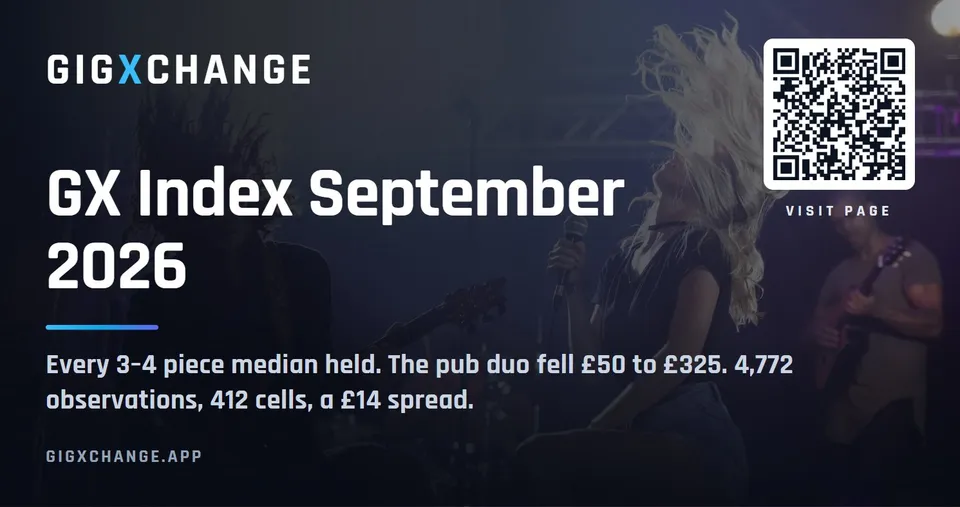
The GIGXCHANGE Index launches with Issue 01: 2,381 data points across 7 gig types and 14 UK cities, the first free, open record of what UK gigs actually pay. The headline: UK wedding median £1,340 for a 3–4 piece (n=4,299), private party £1,098 (n=774), pubs & bars £487 (n=44). Scotland tops the city league: Edinburgh at £1,779, Glasgow at £1,678.
Every figure is artist take-home (net of commission), published only once a cell has at least three trusted observations. This is the baseline: future issues track how the numbers move from here. Live percentiles at /rates.
GX Index · Issue 01
April 2026 snapshot
All figures are artist take-home (net of commission). Data from the GX Index (2,381 observations, 9 weighted sources) compiled 20 April 2026 from the 19 April 05:00 UTC refresh. The n shown on individual cells can be higher than 2,381 because one observation can inform multiple cells (e.g. UK-level and city-level simultaneously). Live percentiles at /rates. Full report: Issue 01 (web).
Sources: GX Index · 19 Apr refresh · GX Index · n=4,299 · GX Index · n=44 · Issue 01 coverage · GX Index · live · GX Index · n=50
- 2,381Total data points: the launch baselineGX Index · 19 Apr refresh
- £1,340UK median wedding fee, 3–4 piece band (net of commission)GX Index · n=4,299
- £487UK median pub & bar fee, 3–4 piece bandGX Index · n=44
- 14UK cities with published city-level ratesIssue 01 coverage
- 345Rate cells published across 7 gig types and 14 citiesGX Index · live
- £1,779Edinburgh wedding median: top of the city leagueGX Index · n=50
All figures are artist take-home (net of commission). Data from the GX Index (2,381 observations, 9 weighted sources) compiled 20 April 2026 from the 19 April 05:00 UTC refresh. The n shown on individual cells can be higher than 2,381 because one observation can inform multiple cells (e.g. UK-level and city-level simultaneously). Live percentiles at /rates. Full report: Issue 01 (web).
Why a transparent rate index matters
Most of the UK live music industry runs on guesswork. Artists ask for too little because they don’t know what’s normal. Venues pay too much, or post jobs at fees no good act will accept. Both sides are flying blind.
The GigXchange Index fixes that. It is the first free, open record of what UK gigs actually pay: broken down by city, gig type and band size, with the sample size behind every number. This is Issue 01: the baseline. Everything that follows tracks how the market moves from here.
One principle up front: we never publish an “average”. A single £25,000 corporate gig drags the mean across a hundred weddings up by hundreds of pounds. So we publish four numbers instead, a low (p25), a typical (p50, the median), a high (p75) and a top-end (p90), so you can see exactly where a gig sits on the curve.
The launch numbers
Every figure below is what the artist actually takes home, in pounds. No ticket splits, tips, gear hire, travel or licensing: those aren’t fees and they distort the picture. A rate publishes only once we have at least three trusted observations for a city (one for the UK as a whole).
Wedding
| p25 | £995 |
| p50 (median) | £1,340 |
| p75 | £1,757 |
| p90 | £2,241 |
| n | 4,299 |
Private party
| p25 | £732 |
| p50 (median) | £1,098 |
| p75 | £1,550 |
| p90 | £2,463 |
| n | 774 |
Corporate
| p25 | £771 |
| p50 (median) | £839 |
| p75 | £920 |
| p90 | £1,082 |
| n | 24 |
Festival
| p25 | £649 |
| p50 (median) | £757 |
| p75 | £866 |
| p90 | £866 |
| n | 8 |
Theatre / pit
| p25 | £622 |
| p50 (median) | £631 |
| p75 | £640 |
| p90 | £640 |
| n | 10 |
Club (ticketed)
| p25 | £455 |
| p50 (median) | £600 |
| p75 | £1,297 |
| p90 | £1,463 |
| n | 46 |
Pubs & bars
| p25 | £433 |
| p50 (median) | £487 |
| p75 | £649 |
| p90 | £649 |
| n | 44 |
UK national medians by gig type · 3–4 piece band · All figures artist take-home (net of commission). Source: GX Index, 19 April 2026 refresh.
| Gig type | p25 | p50 (median) | p75 | p90 | n |
|---|---|---|---|---|---|
| Wedding | £995 | £1,340 | £1,757 | £2,241 | 4,299 |
| Private party | £732 | £1,098 | £1,550 | £2,463 | 774 |
| Corporate | £771 | £839 | £920 | £1,082 | 24 |
| Festival | £649 | £757 | £866 | £866 | 8 |
| Theatre / pit | £622 | £631 | £640 | £640 | 10 |
| Club (ticketed) | £455 | £600 | £1,297 | £1,463 | 46 |
| Pubs & bars | £433 | £487 | £649 | £649 | 44 |
UK national medians by gig type · 3–4 piece band · All figures artist take-home (net of commission). Source: GX Index, 19 April 2026 refresh.
Weddings are the biggest part of the data and pay the most: typically £1,340 for a 4-piece. Corporate gigs cluster tightly because companies set fixed budgets and stick to them. Pubs sit at the bottom, as you’d expect. Festival, theatre and corporate cells are thin at launch (single and low-double digits): directionally useful, but treat them as early signals that will firm up issue by issue.
Wedding fees by band size
One of the most useful outputs of the Index is the relationship between band size and fee. Each extra musician adds roughly £600–£700 to the typical wedding fee, but the curve is not linear. Stepping from a 2 piece to a 4 piece more than doubles the median.
Solo
| p25 | £305 |
| p50 | £367 |
| p75 | £560 |
| p90 | £650 |
| n | 202 |
Duo
| p25 | £470 |
| p50 | £600 |
| p75 | £985 |
| p90 | £1,540 |
| n | 507 |
3–4 piece
| p25 | £995 |
| p50 | £1,340 |
| p75 | £1,757 |
| p90 | £2,241 |
| n | 4,299 |
5+ piece
| p25 | £1,595 |
| p50 | £2,000 |
| p75 | £2,570 |
| p90 | £3,572 |
| n | 1,910 |
Wedding fees by band size · UK national · artist take-home. Source: GX Index, 19 April 2026.
| Band size | p25 | p50 | p75 | p90 | n |
|---|---|---|---|---|---|
| Solo | £305 | £367 | £560 | £650 | 202 |
| Duo | £470 | £600 | £985 | £1,540 | 507 |
| 3–4 piece | £995 | £1,340 | £1,757 | £2,241 | 4,299 |
| 5+ piece | £1,595 | £2,000 | £2,570 | £3,572 | 1,910 |
Wedding fees by band size · UK national · artist take-home. Source: GX Index, 19 April 2026.
The steepest jump is duo to 3–4 piece: that’s the leap from background music to a headline act with drums and bass, and the price reflects it (about £740 more on the typical fee). Beyond five musicians the incremental cost per head drops, because the logistics (PA, transport, stage plot) are already covered.
Wedding fees by city
The top 12 cities for a 3–4 piece wedding band, ranked by typical fee. Smaller places we don’t yet have enough data for fall back to the regional or UK figure when you look them up.
Edinburgh
| p25 | £1,678 |
| p50 | £1,779 |
| p75 | £2,638 |
| p90 | £2,744 |
| n | 50 |
Glasgow
| p25 | £965 |
| p50 | £1,678 |
| p75 | £2,493 |
| p90 | £2,972 |
| n | 75 |
Cardiff
| p25 | £1,330 |
| p50 | £1,480 |
| p75 | £1,845 |
| p90 | £2,183 |
| n | 110 |
Brighton
| p25 | £1,154 |
| p50 | £1,424 |
| p75 | £1,658 |
| p90 | £1,880 |
| n | 150 |
Leeds
| p25 | £1,095 |
| p50 | £1,366 |
| p75 | £1,880 |
| p90 | £2,155 |
| n | 160 |
London
| p25 | £865 |
| p50 | £1,355 |
| p75 | £1,796 |
| p90 | £2,444 |
| n | 445 |
Bristol
| p25 | £1,170 |
| p50 | £1,295 |
| p75 | £1,685 |
| p90 | £1,715 |
| n | 285 |
Sheffield
| p25 | £995 |
| p50 | £1,281 |
| p75 | £1,933 |
| p90 | £2,329 |
| n | 210 |
Manchester
| p25 | £995 |
| p50 | £1,240 |
| p75 | £1,485 |
| p90 | £1,729 |
| n | 410 |
Birmingham
| p25 | £890 |
| p50 | £1,195 |
| p75 | £1,416 |
| p90 | £2,000 |
| n | 285 |
Liverpool
| p25 | £995 |
| p50 | £1,160 |
| p75 | £1,225 |
| p90 | £1,275 |
| n | 215 |
Newcastle
| p25 | £985 |
| p50 | £995 |
| p75 | £1,045 |
| p90 | £1,225 |
| n | 40 |
City league · Wedding fees, 3–4 piece band · Ranked by p50. Source: GX Index, 19 April 2026.
| City | p25 | p50 | p75 | p90 | n |
|---|---|---|---|---|---|
| Edinburgh | £1,678 | £1,779 | £2,638 | £2,744 | 50 |
| Glasgow | £965 | £1,678 | £2,493 | £2,972 | 75 |
| Cardiff | £1,330 | £1,480 | £1,845 | £2,183 | 110 |
| Brighton | £1,154 | £1,424 | £1,658 | £1,880 | 150 |
| Leeds | £1,095 | £1,366 | £1,880 | £2,155 | 160 |
| London | £865 | £1,355 | £1,796 | £2,444 | 445 |
| Bristol | £1,170 | £1,295 | £1,685 | £1,715 | 285 |
| Sheffield | £995 | £1,281 | £1,933 | £2,329 | 210 |
| Manchester | £995 | £1,240 | £1,485 | £1,729 | 410 |
| Birmingham | £890 | £1,195 | £1,416 | £2,000 | 285 |
| Liverpool | £995 | £1,160 | £1,225 | £1,275 | 215 |
| Newcastle | £985 | £995 | £1,045 | £1,225 | 40 |
City league · Wedding fees, 3–4 piece band · Ranked by p50. Source: GX Index, 19 April 2026.
Scotland leads the country: Edinburgh (£1,779) and Glasgow (£1,678) are the top two cities, something that isn’t widely talked about. The Scottish wedding market is smaller but high-end, and premium venues set a floor that lifts the whole city median. London has the widest range of any city: from £865 for a small register-office wedding up to £2,444 for a high-end Mayfair function.
How we built it
Transparency is the whole point of the Index. Here is exactly what fed the April numbers:
Industry rate cards
| Observations | 2,076 |
| Share | 87.2% |
| Avg w×c | 0.48 |
| Status | 2 feeds, refreshed weekly |
Performer profiles
| Observations | 162 |
| Share | 6.8% |
| Avg w×c | 0.16 |
| Status | Artist-declared min/max |
MU / Equity rates
| Observations | 103 |
| Share | 4.3% |
| Avg w×c | 0.53 |
| Status | Annually refreshed floor |
Venue gig budgets
| Observations | 40 |
| Share | 1.7% |
| Avg w×c | 0.50 |
| Status | Booking-request stage |
Confirmed bookings
| Observations | 0 |
| Share | · |
| Avg w×c | 1.00 |
| Status | First volumes expected May |
Post-event submissions
| Observations | 0 |
| Share | · |
| Avg w×c | 0.85 |
| Status | Pipeline ready, no volume yet |
Anonymous submissions
| Observations | 0 |
| Share | · |
| Avg w×c | 0.16 |
| Status | Public form live at /rates |
Observation breakdown by source · April 2026. Avg w×c = average weight × confidence: how much each observation counts toward the final percentile. Source: GX Index Issue 01.
| Source | Observations | Share | Avg w×c | Status |
|---|---|---|---|---|
| Industry rate cards | 2,076 | 87.2% | 0.48 | 2 feeds, refreshed weekly |
| Performer profiles | 162 | 6.8% | 0.16 | Artist-declared min/max |
| MU / Equity rates | 103 | 4.3% | 0.53 | Annually refreshed floor |
| Venue gig budgets | 40 | 1.7% | 0.50 | Booking-request stage |
| Confirmed bookings | 0 | · | 1.00 | First volumes expected May |
| Post-event submissions | 0 | · | 0.85 | Pipeline ready, no volume yet |
| Anonymous submissions | 0 | · | 0.16 | Public form live at /rates |
Observation breakdown by source · April 2026. Avg w×c = average weight × confidence: how much each observation counts toward the final percentile. Source: GX Index Issue 01.
Industry rate cards dominate by raw count (87%), but each one only carries 0.48 of a full vote. A single confirmed booking (weight 1.00) outweighs two rate-card listings. The honest gap at launch: no confirmed bookings and no post-event submissions had entered the Index yet. Every published cell is built from asking prices, recommended rates and venue budgets, not from money that has actually changed hands. The rates are directionally right; they get more precise as booking data starts flowing.
Each observation also passes five quality checks before it counts: it must have the basics (amount, source, gig type), come from one of the nine vetted sources, be an artist fee (not a ticket split or gear hire), pass a per-musician-per-hour sanity bound, and not be a duplicate. Anything rejected is logged, never silently dropped.
Issue 01 spans 14 cities and 12 regions across the past 24 months, and the rate cards behind it refresh every 7 days. Every cell is benchmarked against the Musicians’ Union floor of £167.16 per musician.
What we couldn’t tell you yet at launch
I’d rather be upfront about the gaps than pretend the data is complete. At Issue 01:
- 14 of the 20 biggest UK cities covered. Smaller ones use the regional or UK figure for now.
- No confirmed bookings in the data: the gold-standard weight-1.0 source had not yet produced volume. Expected to land from the May issue.
- Festival, theatre and corporate cells based on under 50 observations each: usable, but expect movement as coverage extends.
- No genre-specific figures yet (folk vs. rock vs. soul). Genre is captured on every row; we publish it once volume allows.
What came next
Issue 01 set the baseline. Issue 02 (May 2026) rebuilt the foundations under it: data volume grew 62% to 3,847 observations, a third rate-card source came online, every rate-card fee moved onto a consistent take-home basis, and the re-sighting mechanism was restored so repeat listings track price stability instead of inflating sample size. That rebuild re-based headline medians roughly a quarter below the April figures on this page — so treat April’s levels as the launch-era snapshot and May onwards as the continuous series. Ranks and ratios (which gig types pay most, which cities lead) carried straight through.
For the always-current view, see the live UK gig & band rate reference, which is rebuilt from the Index nightly.
How to contribute
Every gig you have played is an observation we need. The Index gets more accurate with more data: especially from sources beyond published rate cards.
Head to /rates and submit three gig fees anonymously in under 2 minutes. No email, no signup, no account required. In return you unlock every cell, every trend line and every city drilldown for 30 days. Three observations from you makes the whole system better for everyone.
If you are a venue booker, music journalist or academic researcher, the Index is free to cite and free to build on under CC BY 4.0. Attribution: “GigXchange Index, gigxchange.app/rates”.
02 — Questions6 answersAsked and answeredFrequently Asked Questions
Annual refresh commitment
This guide was published on 20 April 2026 and is refreshed every April. UK live music rate data moves monthly, so annual verification matters. We re-verify every reference, recommendation, and data point once a year. Next scheduled refresh: April 2027. If any claim is outdated before then, email support@gigxchange.app and we aim to update it within one working day.