
Meet Take A Chance On Three
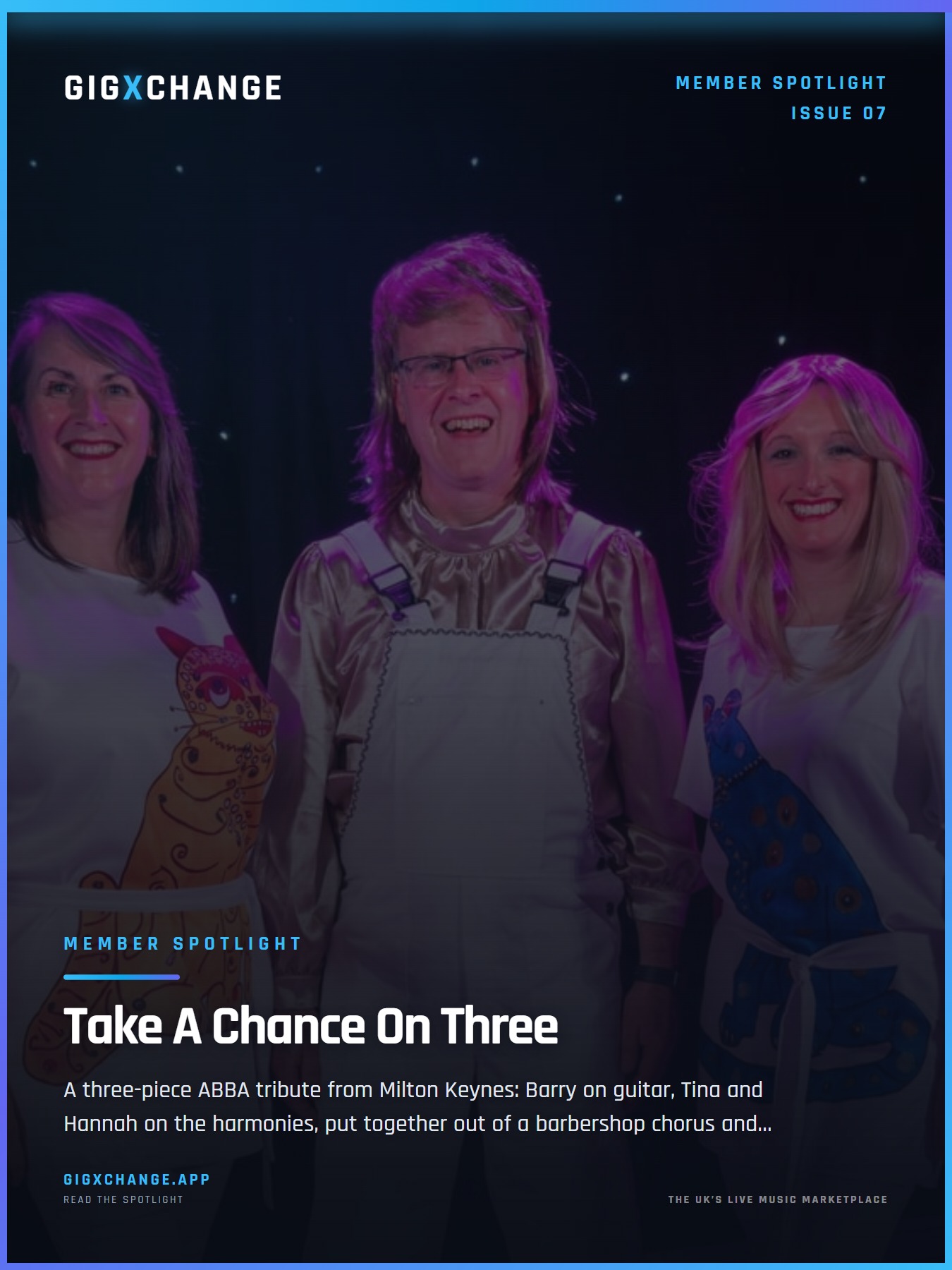
A three-piece ABBA tribute from Milton Keynes: Barry on guitar, Tina and Hannah on the harmonies, put together out of a barbershop chorus and thirty-two years of marriage. Twenty-five ABBA songs, a costume change at half time, and a singalong that splits the room down the middle. They work the places other acts overlook — retirement villages, social clubs and village halls across seven counties.
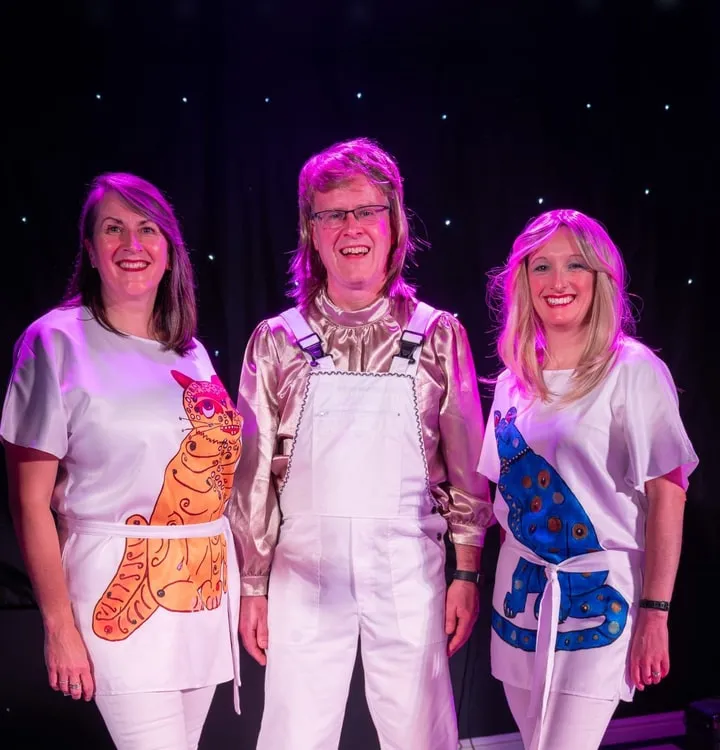
Take A Chance On Three are a three-piece ABBA tribute from Milton Keynes — Hannah, Tina and Barry, billed as Agnetha, Frida and Björn. The harmonies are sung live rather than…


Last updated: 12 October 2026
At a glance
Bio, key details, links and a peek at the act — before we get into it.
Take A Chance On Three are a three-piece ABBA tribute from Milton Keynes — Hannah, Tina and Barry, billed as Agnetha, Frida and Björn. The harmonies are sung live rather than played off a backing track, the costumes change at half time, and the set is built for parties, corporate nights, social clubs and retirement villages across the Midlands and South East. One booking came from a resident's wish day: she chose an ABBA tribute, and sat at the front in costume. Rated 4.88 by their clients.
The origin
How the act came together.
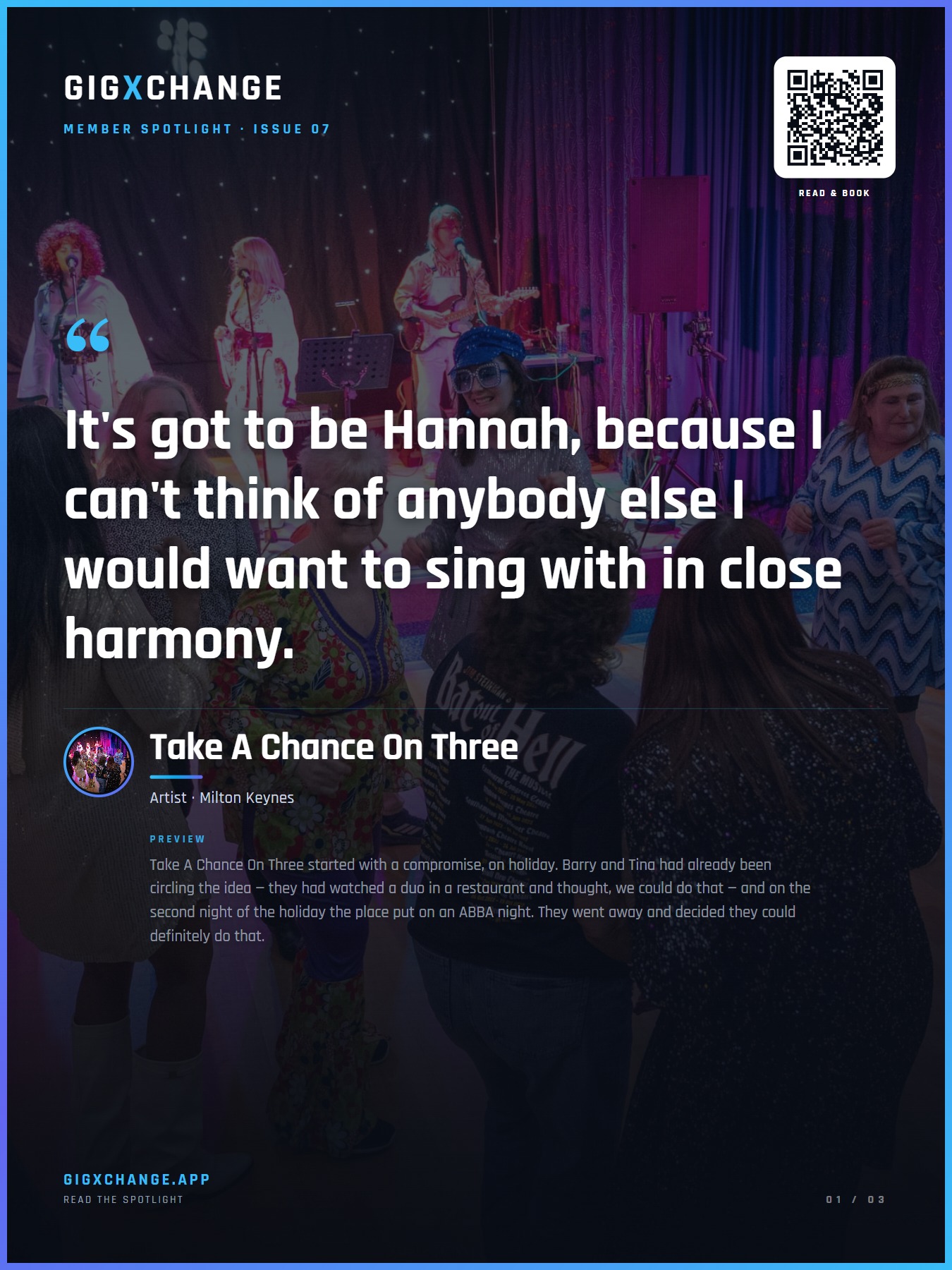
Take A Chance On Three started with a compromise, on holiday. Barry and Tina had already been circling the idea — they had watched a duo in a restaurant and thought, we could do that — and on the second night of the holiday the place put on an ABBA night. They went away and decided they could definitely do that.
They had form. Barry and Tina met at work, and had been together long enough to have celebrated their thirty-second wedding anniversary a couple of weeks before this conversation. Tina started singing in school choirs from a young age. Barry played in bands as a teenager. At some point the two facts met over a conversation at the office and they put a band together there: a colleague on drums, a guitarist, a bass player, and another colleague on backing vocals.
The company ran a convention every year. The work band played the Christmas one, got asked back for the summer, and did three in the end. Everyone up dancing, as they remember it, and really good fun.
The chorus years
Then came the usual interruption. A bit of amateur dramatics — Barry musical-directed a couple of shows, Tina directed one — and then a family, and careers, and everything stopped. It restarted in the mid-2000s, when Barry and his twin brother talked about doing some music together and ended up joining a male barbershop chorus. He stayed about ten years. "It wasn't really my thing," he says: mostly the great American songbook, 1900 to 1950. "But some of it I quite enjoyed."
The consequential part was what he said to Tina while he was in it — you're really good at harmony singing, you should join something. She joined the women's chorus, named after the motorway junction nearest to home, eighteen or nearly nineteen years ago. The chorus's Music Director at the time was Hannah and Tina has since sung in three different quartets with her.
A cappella did something to Tina's technique that decades of singing had not. "You have to sing properly, because there is no accompaniment," she says. "It's literally just four parts, four-part voices. There's nowhere to hide." In a quartet there is less hiding still, because there is only one person on each part. She now warms up for anything between half an hour and an hour before a show, and warms down afterwards with gentle humming rather than simply stopping.
Getting Hannah
Back to the holiday. Barry was set on ABBA; Tina wanted a mixture. They compromised — start with ABBA — and the next day they discussed it and decided that Hannah might be interested.
Tina's price was tickets. She is a serious Ed Sheeran fan, and he had just announced a run of gigs. Get me the tickets, she said, and I'll email Hannah and ask her. He got the tickets, so the email got sent. Hannah considered the offer and discussed it with her family and then came back and said yes.
It's got to be Hannah, because I can't think of anybody else I would want to sing with in close harmony.The band started in May 2025.
The sound
What you’re actually getting if you book the act.
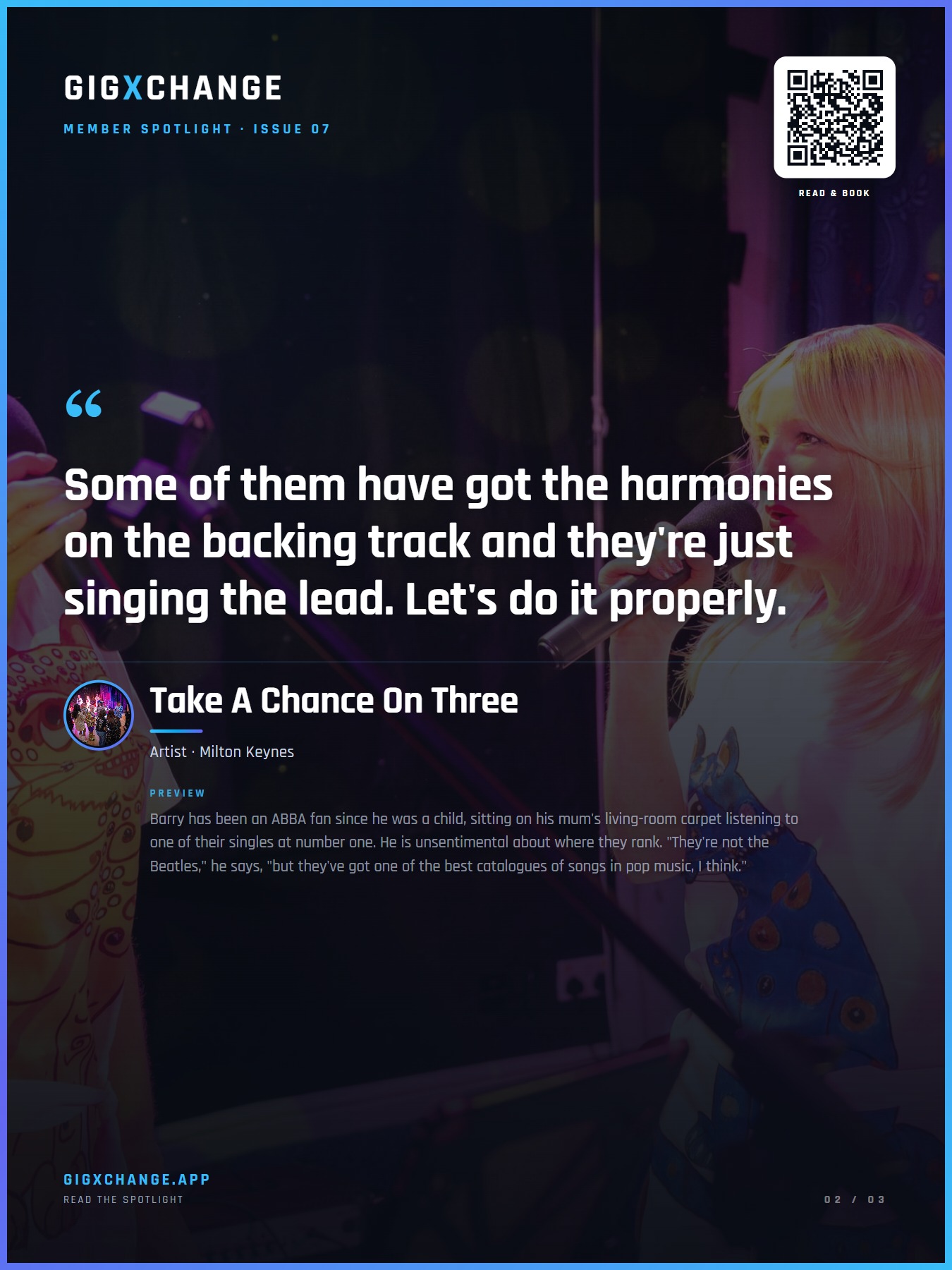
Barry has been an ABBA fan since he was a child, sitting on his mum's living-room carpet listening to one of their singles at number one. He is unsentimental about where they rank. "They're not the Beatles," he says, "but they've got one of the best catalogues of songs in pop music, I think."
He has followed the band's development closely enough to have opinions about it: on the first couple of albums, he says, "they haven't worked out that the girls should do the singing", with Björn taking the lead on a run of album tracks. By the third album, and 'SOS', "that's when they really get their sound together". Everything after that, in his words, is gold dust for a long time.
The harmony is the point
The reason the act works is those two voices, and Barry's advice to any new tribute act starts there: find a niche. "Tina and Hannah are really good singers and they're used to harmonising together, so it's a good fit for doing ABBA." He is pointed about the alternative, having watched other acts do it the easy way.
Some of them have got the harmonies on the backing track and they're just singing the lead. Let's do it properly.Take A Chance On Three run to backing tracks — three people cannot play ABBA's arrangements between them — but the vocals are sung live, and rearranged to suit two singers rather than a studio full of overdubs. There is one exception in the whole set: 'Take A Chance On Me', where the male vocal running under the opening is left on the track: this is due to the original version being a tape loop of Björn and Benny singing with no breathing — impossible to produce live with one male singer.
Barry plays rhythm guitar, which was part of ABBA's appeal in the first place. He had not played much for years — picking it up now and then — and learning a two-hour set got him back into it properly. Twenty-five songs, and he plays without notes. "I have to remember all the songs."
How the set is built
Roughly chronological, with exceptions. It opens with 'Waterloo', which they are careful to say was coincidence rather than imitation: the running order was fixed before they saw the same song open somebody else's show. The late-seventies dance material is deliberately grouped — the Voulez-Vous era, 'Gimme! Gimme! Gimme!' — so the floor gets an uninterrupted run at it. The ballads are kept down: 'Chiquitita' and 'Fernando' sit together at mid-pace, and 'Thank You For The Music' closes.
The set has been edited by the dancefloor. 'On and On and On', an album track off Super Trouper, went in and came straight back out. "That clears the dancefloor, just because people don't know it." It has been replaced with 'When I Kissed the Teacher', which they hope will not do the same thing.
Neither of them pretends to love every song in it. Barry is not a fan of 'Honey Honey' — an early one, and not even a UK hit for ABBA themselves. Tina's least favourite was 'On and On and On', as her own part is "do, do, do" most of the way through. "Whilst it's very easy, because I really don't have to do a lot, it is so boring."
And they are clear about whose songs these are. "We're not doing the heavy lifting here," Barry says. ABBA have done that already: "we're on their coattails."
Where to see Take A Chance On Three
Milton Keynes base. Open to travel for the right room.
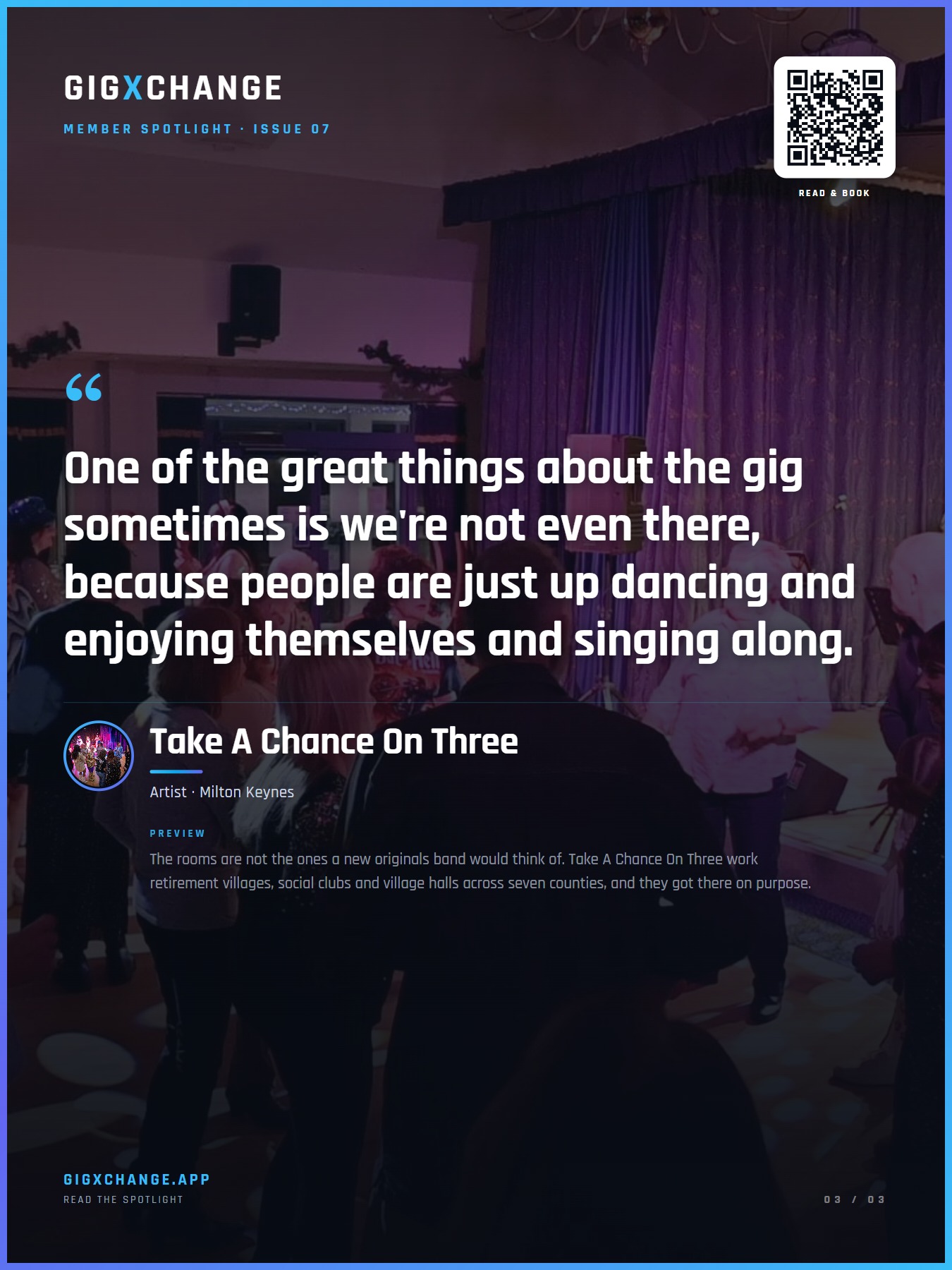
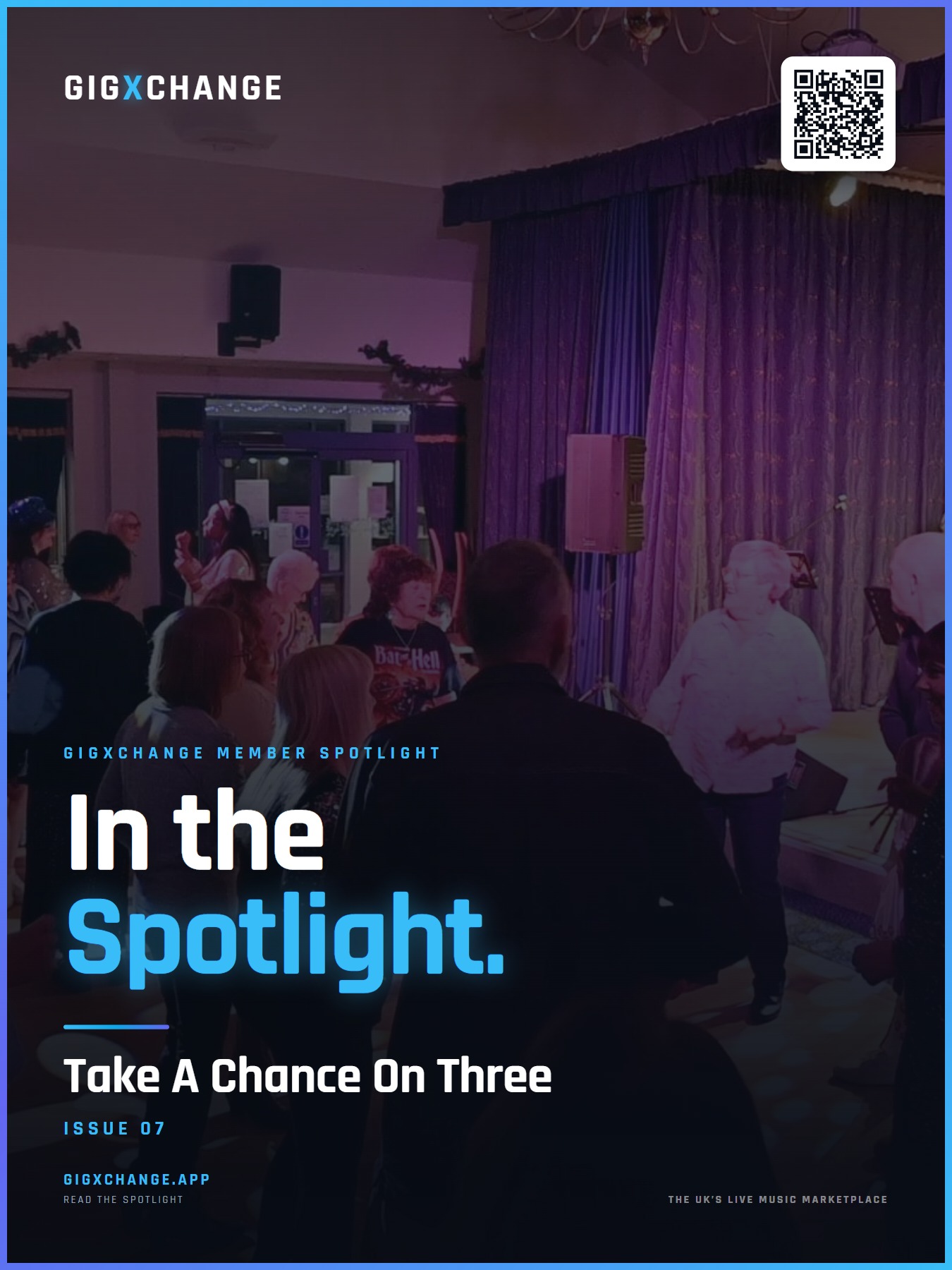
The rooms are not the ones a new originals band would think of. Take A Chance On Three work retirement villages, social clubs and village halls across seven counties, and they got there on purpose.
"Going into a lot of bands, especially if you're doing original music, you wouldn't be thinking about going into retirement villages," Barry says. "Whereas that's an option for us." The social club circuit books tribute acts too, and between the two they have found most of their work so far. Social clubs are harder going — another band, another week, and you are up against acts you have never heard of — so at the moment the focus is on the retirement villages, where they get more out of the room.
The wish day at Bedworth
The clearest example is a retirement village at Bedworth, near Coventry. The staff run a rotation that lets residents choose something they would like to happen, and one resident — a serious ABBA fan — chose an ABBA tribute. The band knew before they arrived, because the person booking them explained it. She was sitting right at the front, in costume, when they came on. Some of the staff were in costume too. Other residents came, and family, and friends. She sang along the whole way through, and they had a photo with her afterwards.
That is the part they keep returning to. "Obviously we like to perform, otherwise we wouldn't do it. But it's also about bringing the entertainment and the joy to people who can't necessarily go to it. It's bringing it to them, so that they can still enjoy something that they love."
What a night actually looks like
They do not turn up in costume. Tina has already wrecked a T-shirt unloading gear, so the outfits go on at the venue, and the band ask for fifteen minutes and preferably a bit more — mostly for the wigs and make-up. There is a change at half time; two costumes each.
Twice now, audience members have asked the band if they could sing with them, and been allowed to. People come over between sets to talk about a song that means something to them, or to ask for one. There is a singalong built into the set, judged on the night against how receptive the room is: a bit of pantomime, the audience split in two with Tina and Hannah taking a half each to compete, then everyone back together on 'Fernando'.
One of the great things about the gig sometimes is that it's like we're not even there, because people are just up dancing and enjoying themselves and singing along.The travel radius is around a hundred miles, and it flexes on the fee, the distance, the date, the time of day and how long they are wanted for. So far that has meant Bedfordshire, Buckinghamshire, Cambridgeshire, Hertfordshire, Northamptonshire, Nottinghamshire and Warwickshire. The diary is built around Hannah, who has the full-time job and the young family. "Everyone gets a veto on every gig that we get offered," Barry says, "so we only do the ones that we can definitely make."
Live dates synced from the Take A Chance On Three profile — enquire about an open date.
Booking & rates
How to get a quote, and roughly what to expect.
Live ranges from the Take A Chance On Three profile. Cross-check against the GX Index for Milton Keynes-wide percentiles.
They arrive self-contained. The band bring their own professional PA, stage monitors and lighting, and play music before and between the sets so the room never goes quiet.
The offer is modular, because venues asked for it to be. Two hours of ABBA is twenty-five songs. Enough of the places they play asked whether they did anything besides ABBA that they are now learning another forty-five minutes of non-ABBA party material — Ed Sheeran, Harry Styles, Earth Wind & Fire, Kylie — so a booker can take forty-five minutes of ABBA, an hour and a half of ABBA, or ABBA plus everything else. Some events want three hours, and that now works too.
The costumes are being upgraded on the same logic. Two of the women's outfits came off the internet; Barry bought white dungarees and Tina put the bling on them herself, and both the dungarees and the cat dresses track what ABBA wore in the Mamma Mia video.
The bit nobody sees
A two-hour set has cost them eight- and nine-hour days. Load the car, drive, unload, set up, soundcheck, change, play, then do the whole thing in reverse to get home.
The admin sits with Barry, and he is unusual in not minding it. "It's like a little project for me." He spends a lot of time emailing venues and going after bookings directly, and he is realistic about the reason he can: it would not be sustainable alongside a full-time job.
It's still a lot of work, and if I was working all the time it would be difficult. I'd be doing it every night.He has the comparison to hand, too. In the 1980s he was phoning venues who then had no way of hearing the band at all unless you posted them a tape. Websites, contact forms and email have made the same job easier, if not shorter.
What they're after
Around twenty-five gigs a year is roughly the shape they want — near enough one every other week, with downtime built in, and the occasional weekend where somebody wants both days. Beyond that the ambition is range: further afield, and to keep going.
On the platform they are verified and rated 4.88 by their clients, across eight reviews. On their own site a client, Nina V, put it plainly: "The band were not only professional and courteous, but also great performers." Availability and enquiries run through the profile.
Quick-fire Q&A
Six honest answers from a working artist.
Why ABBA?
I'm a big fan, and we had the constituent parts to do ABBA fairly easily, and there's a market for it. I know there's a lot of ABBA tribute acts, but there's definitely a market out there.
What is your advice to a new tribute act?
Find a niche. Research the songs. If you need wigs, get the wigs. And pick the right band for you — because if you do not enjoy it, slogging out ABBA night after night is soul destroying.
Is there an ABBA song you cannot stand playing?
Barry: I'm not particularly a big fan of Honey Honey. Tina: On and On and On — Hannah sings it and I literally go do, do, do pretty much all the way through. Whilst it's very easy, because I really don't have to do a lot, it is so boring. (They have since dropped it.)
What is the dream gig?
Do a gig for Björn and Benny. Get them to see us. — Not going to happen, darling. And: if someone said to me, do you want to come and sing at Voyage, I would bite their hand off.
Do you feel pressure to play it exactly like the record?
No, I don't think so. We change the backing vocals so that it suits us, because generally there's only the two of us. It's all live apart from that one track.
What is the best thing about a good night?
One of the great things about the gig sometimes is that it's like we're not even there, because people are just up dancing and enjoying themselves and singing along. We just happen to be like a record in the background — which I'm quite happy with.
Find Take A Chance On Three on GIGXCHANGE
Book direct, no middleman, contract and payment built in.
Book Take A Chance On Three
Everything in this issue comes from their live GigXchange profile — so what you read is what you can book.
Take A Chance On Three is a artist based in Milton Keynes on GigXchange, the UK’s peer-to-peer live music marketplace. Enquire direct from their profile — no agency sits in the middle and no commission comes off the fee. Every booking generates a digital contract, and deposits are held securely until the gig is done.
Not sure what to offer? The GX Index publishes real UK fee percentiles by city, band size and event type, and the rate calculator turns them into a number you can put in an email. New to booking live music? How it works walks the whole journey.
Book Take A Chance On Three
View the full profile, or download this spotlight issue.
More from the series
One spotlight a fortnight — new editorials drop on the hub.

Use this on your EPK, socials, outreach
Take A Chance On Three is a featured GigXchange Spotlight member. Drop the badge into your electronic press kit, link-in-bio, email signature, or cold-pitch deck — a portable signal that you’ve been editorially profiled on the UK’s peer-to-peer live music marketplace.


Want a spotlight of your own?
Sign up, complete your profile, and email founder@gigxchange.app. Members only — no fee, no paid placement.