
Meet Cheri McQueen
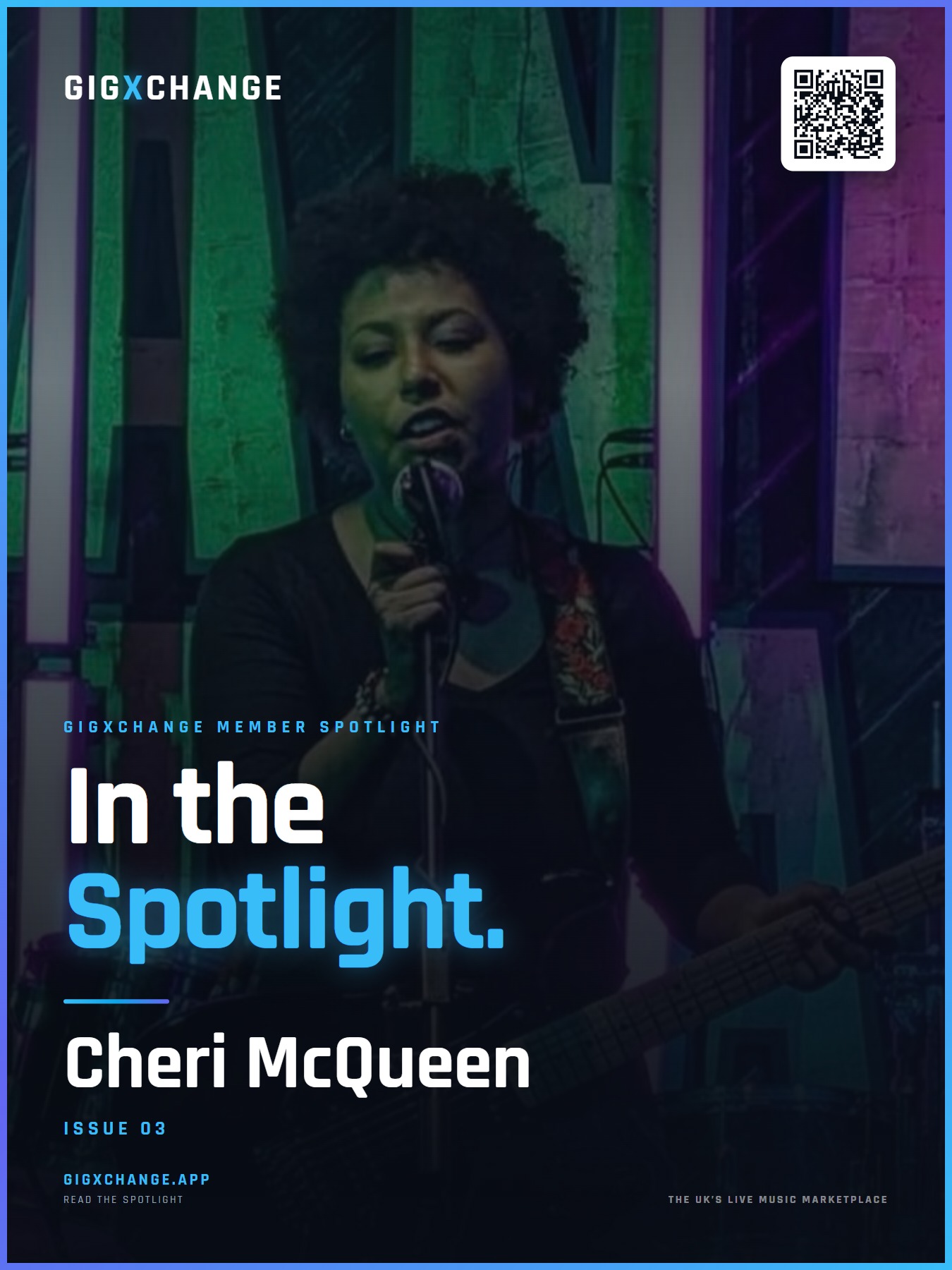
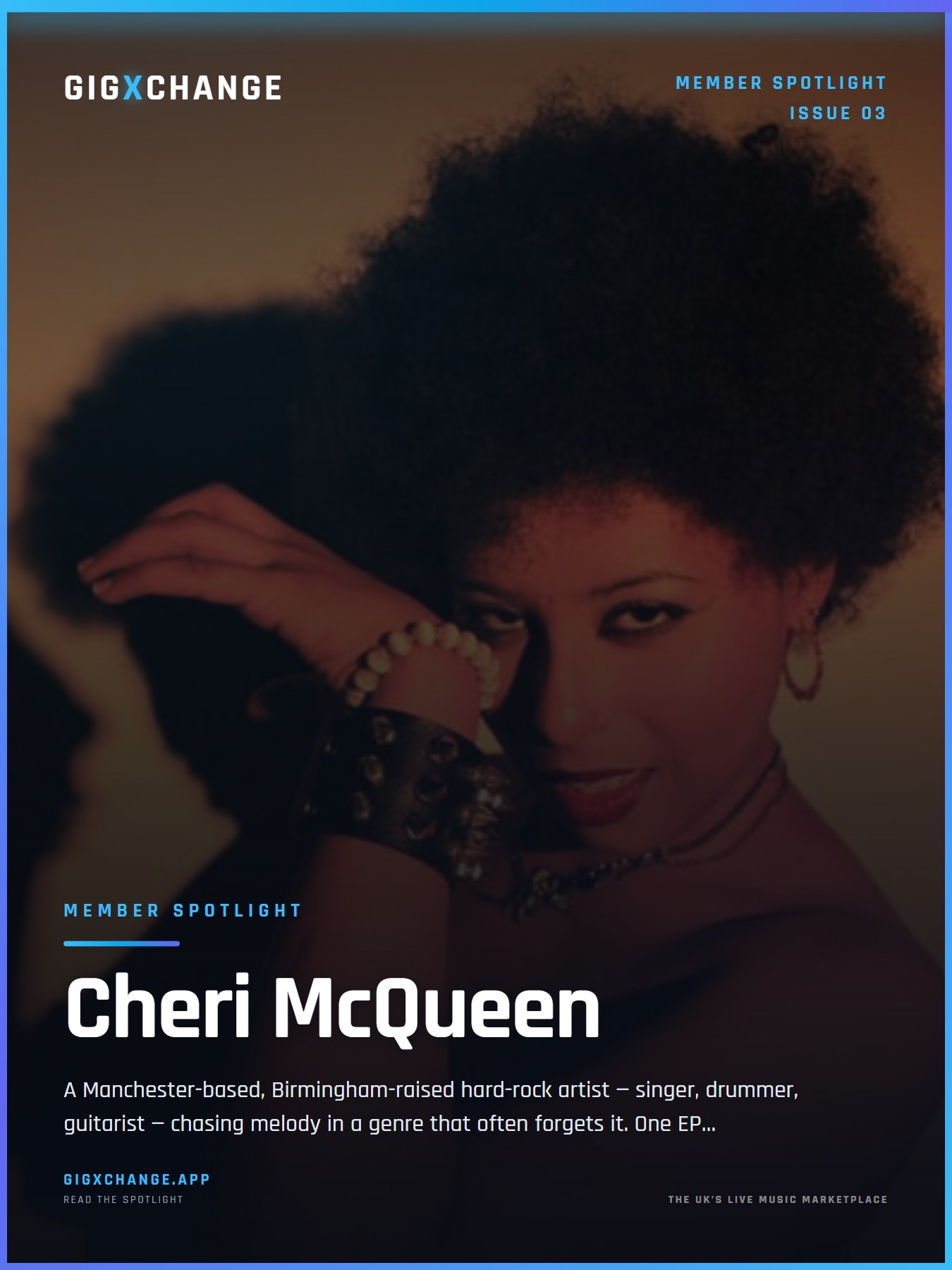
A Manchester-based, Birmingham-raised hard-rock artist — singer, drummer, guitarist — chasing melody in a genre that often forgets it. One EP deep, two bands taking shape, and a stated goal of out-playing Prince across 27 instruments.

Cheri McQueen is a Manchester-based hard-rock artist — singer, drummer and guitarist — who writes melodic, 80s-tinged rock with the volume of metal and the hooks of a pop song…








Last updated: 24 July 2026
At a glance
Bio, key details, links and a peek at the act — before we get into it.
Cheri McQueen is a Manchester-based hard-rock artist — singer, drummer and guitarist — who writes melodic, 80s-tinged rock with the volume of metal and the hooks of a pop song. Birmingham-raised and self-taught across half a dozen instruments, she released her debut EP *Long Live McQueen* entirely solo, and is now assembling the band — two of them, in fact — to take the songs live. Independent, unsigned, and in no mood to wait around. Best on rooms that want energy, heart and a frontwoman who means it.
The origin
How the act came together.
Cheri McQueen’s earliest musical memory is a violin. She was seven; her headmistress walked into class carrying one, played a few bars, and announced the school was starting music lessons. Cheri ran straight to the front and put her name down before anyone else had moved. Twelve years on, she’s still chasing that feeling — across as many instruments as she can get her hands on.
One kid, a school orchestra, and every instrument she could reach
She still remembers the awe of it. ‘I’d never seen anyone play an instrument before,’ she says of that first violin. ‘It sounded beautiful.’ The school split each year group into three classes — piano, flute and violin — a homemade orchestra. Cheri landed in piano, and stuck with it for three years before walking away. ‘I left because the teacher wasn’t very good,’ she says, with the bluntness that runs through everything she does.
That piano place turned into drums in secondary school — the one instrument she says she ‘properly stuck with’. ‘I heard somebody else play it and I was like, I want to play an instrument,’ she says. ‘I just love playing instruments.’ Guitar followed at seventeen; lockdown sharpened the habit rather than stalling it. ‘I don’t have any instruments at home, so it’s like, okay, what am I going to do? Just watch other people do it. I was bored.’ Vocals run underneath all of it: in and out of choirs her whole life, formal lessons at eighteen, and years of teaching herself by ear. ‘I’d listen to Ariana Grande a lot and try to copy whatever she does,’ she says. ‘It taught me how to stay on key, how to do the runs.’
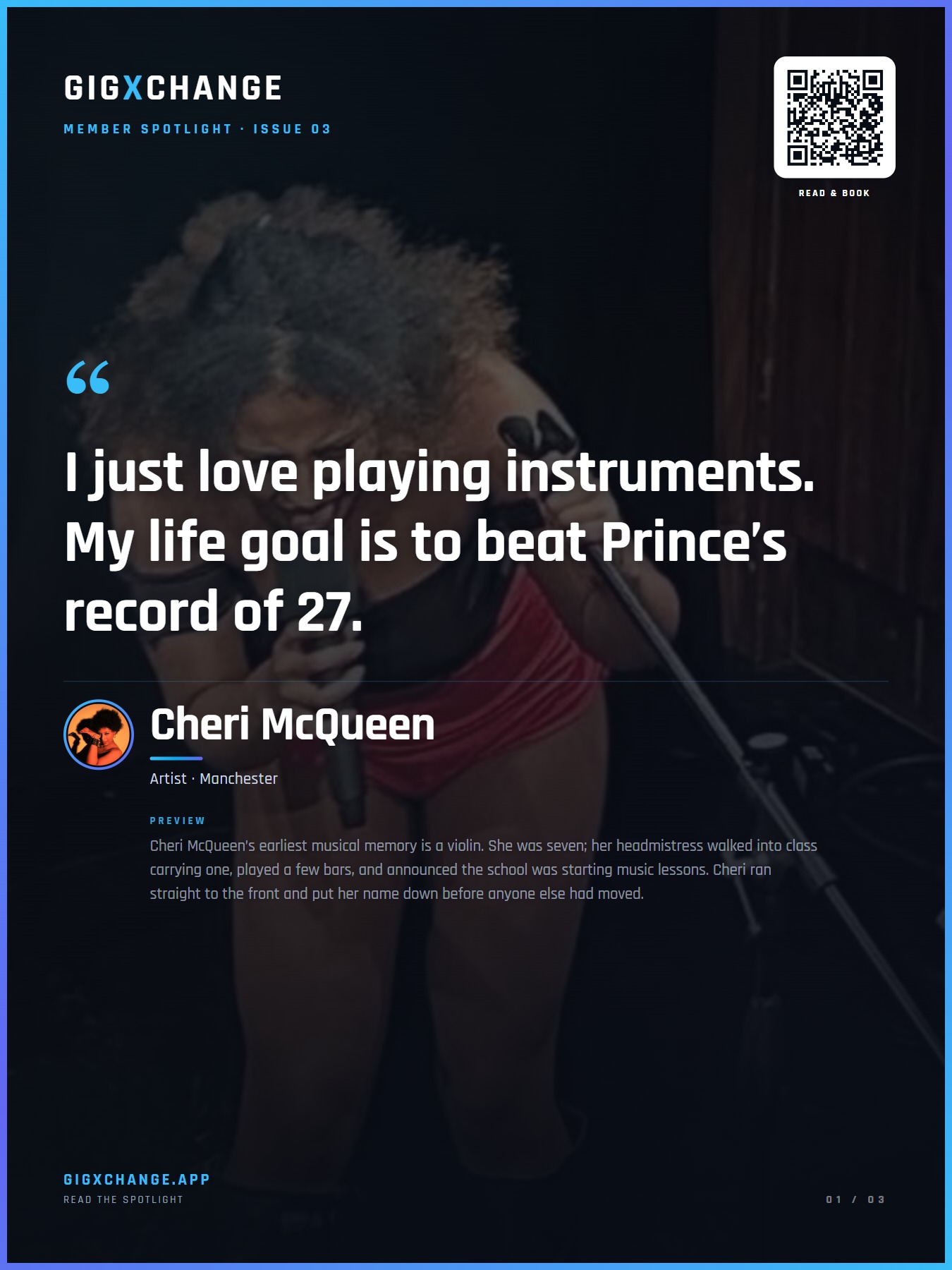
The ambition is gloriously unsubtle. ‘I just love playing instruments,’ she says. ‘My life goal is to beat Prince’s record of being able to play 27.’
I just love playing instruments. My life goal is to beat Prince’s record of 27.The first guitar — and the gig she didn’t see coming
She came to guitar at seventeen, but the decision behind it predated the instrument by a decade. ‘Ever since I first heard my head teacher play, I was like, this is what I’m going to do for the rest of my life.’
Her first time on a stage was an accident. Six or seven months into guitar, she was in a choir at Birmingham’s Midlands Arts Centre — vocal training, learning Carole King’s ‘It’s Too Late’ — when the teacher asked if anyone wanted to take a solo. ‘I said yes thinking she meant a vocal solo,’ Cheri remembers, ‘and then everyone turned round going, wait, you can play guitar?’ She had a few weeks to learn a guitar solo and stand up with the instrument for the first time. ‘I didn’t know if it was going well or not, but it did.’ It’s still up on her YouTube — the friend who filmed it caught the whole thing.
Why she left Birmingham for Manchester
Cheri was raised in Birmingham and grew frustrated watching its grassroots scene thin out — good bars closing, fewer players around. When she went looking for a city with a healthier circuit it came down to Manchester or London. Manchester was cheaper, so Manchester won, and she has no regrets. ‘The people are lovely, the scene’s booming,’ she says. ‘I recommend it to anybody.’
In 2025, at eighteen, she made it official and became Cheri McQueen — the artist, not just the kid who could play everything. ‘I can’t just have all this skill and not put it out there,’ she says. ‘I actually want to do something with it.’
The sound
What you’re actually getting if you book the act.
Ask Cheri to name her genre and she doesn’t hesitate — then she narrows it. ‘Just rock. Definitely hard rock. Definitely not indie rock — let’s get that out there now.’ What ties her music together isn’t volume, though. It’s melody.
Melody first, always
Her north star is the melodic end of 80s rock and metal — big, bright, hook-driven songs with the heart of a ballad and the kick of a riff, the lift you get from a chorus like ‘Livin’ on a Prayer’. What she can’t stand is music that forgets the tune. ‘I want a melody. I want something to sing, something to actually listen to,’ she says. ‘I want my mind blown. Death metal doesn’t blow my mind.’
‘Regardless of what genre you’d put a song in,’ she adds, ‘I make sure it’s at least melodic — in the way I sing it, in the way I play it.’
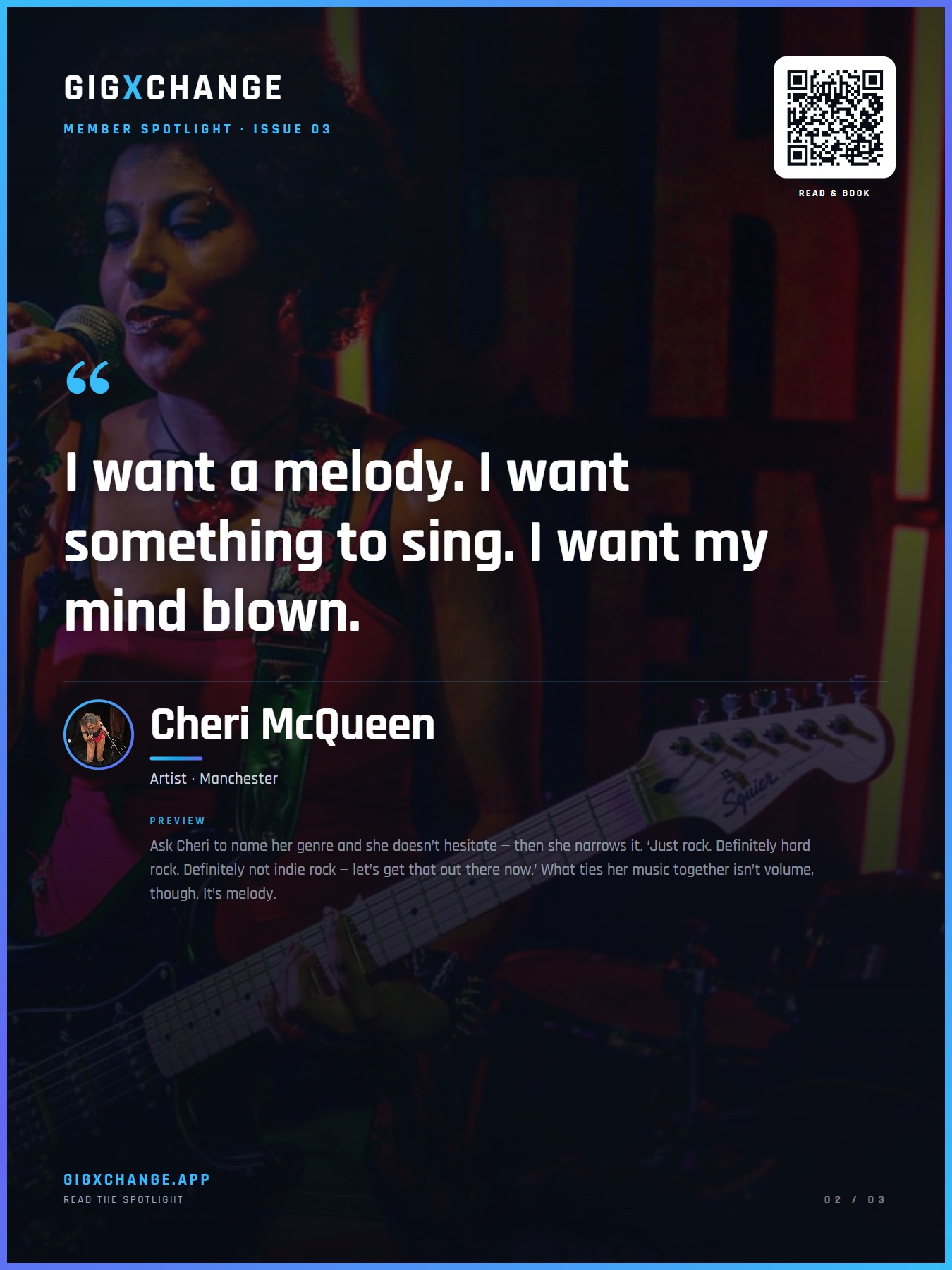
I want a melody. I want something to sing. I want my mind blown.Heavy, not harsh — the tone she’s after
She’s refreshingly honest about how she gets there. ‘I don’t know much about tone,’ she says. ‘I just know what sounds good to me.’ What sounds good is weight without brittleness: ‘I don’t like a really twangy sound — I like a more heavier kind of sound.’ Metal is the pull she hasn’t fully caught yet, and she’ll tell you so. ‘I actually really like metal, if you can tell already. I just can’t play it yet — I’m practising.’ The line she won’t cross is the one where the song disappears. ‘I don’t like the death-metal sub-genre. It’s my least favourite genre of music. You can’t hear anything — it’s just a bunch of growling.’
The women who shaped the voice
Cheri splits her influences in two: the players she learns sound from, and the ones she learns work ethic from. The 80s hard-rock women matter to her for a specific reason — they smuggled real life into a scene built on partying. ‘The men were like, yeah, we want to party, we want to rock — which is fine,’ she says. ‘But some of the women put into perspective things they went through in their life and put it into hair metal. That 80s scene was so bright, so full of partying — to see them do that, it switched my brain.’
Vocally she points first to Lee Aaron. ‘When I heard Rebel Angel for the first time, it just resonated in my soul. Her voice is incredible on any track — you just feel the song through her.’ She rates Chrissy Steele too, whose one album was buried by the timing of grunge — ‘she goes a lot higher than Lee Aaron, with a lot more power; I’ve tried singing some of her songs and they are difficult.’ On guitar her hero is Lita Ford, who plays lead and sings at the same time — ‘that’s out there; I struggle to play rhythm and sing without looking at my hands.’
Two bands, one artist
Cheri’s building toward two separate projects: an all-female punk band (name still under wraps) and a band built around her own melodic-rock songs. She’s keeping them deliberately apart — the genres don’t mix — and writing demos for both so collaborators can hear exactly what she’s going for before they sign on. ‘I have a vision, but I want to find the perfect people for that vision,’ she says. ‘I know I can write good music, so I’ll just write this stuff now so people get a feel of me.’
She’s tried to start the punk band twice already, and learned the hard way that shared enthusiasm isn’t the same as a shared direction. ‘At first everyone had completely different tastes — one person likes jazz, the other electropop, the other acoustic indie,’ she says. ‘I thought we could all bring something different, but it just didn’t work, because I knew what I was going for.’ She’s not interested in steamrolling anyone — ‘I am no dictator’ — but she’s clear about the brief. This time she’s changing her approach rather than her standards.
Long Live McQueen
Her debut EP, *Long Live McQueen*, is a true solo record — she played every part, programmed the drums she didn’t have a kit for, and self-produced it on free software (BandLab) while teaching herself as she went. ‘I’d push buttons here and there, I’d watch videos, but nothing sounded good,’ she says. The production isn’t perfect and she’s the first to say so, but she shipped it anyway. ‘I’d rather release something than release nothing. I’d worked too hard to release nothing.’ Her own favourites are the most melodic cuts — *Sauna*, with its 80s-metal lean, and *Honey Go Go*, which quietly topped her Spotify Wrapped for artists. ‘Those two were the most fun to make, the most fun to record, the most fun to sing.’
Where to see Cheri McQueen
Manchester base. Open to travel for the right room.
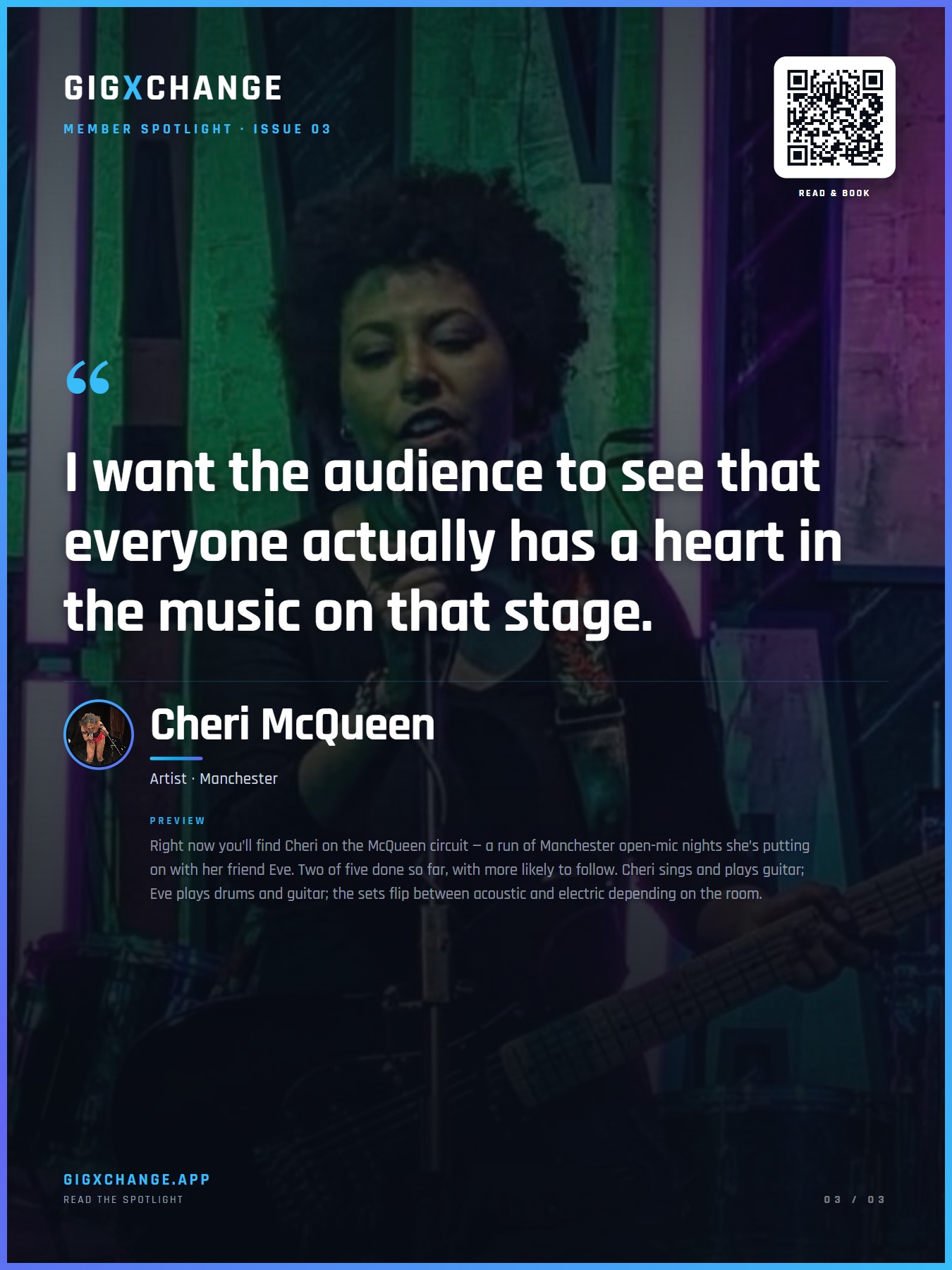
Right now you’ll find Cheri on the McQueen circuit — a run of Manchester open-mic nights she’s putting on with her friend Eve. Two of five done so far, with more likely to follow. Cheri sings and plays guitar; Eve plays drums and guitar; the sets flip between acoustic and electric depending on the room.
What a Cheri McQueen set is meant to feel like
More than anything she wants a stage with a pulse. She’s tired of watching bands stare at the floor. ‘I want to see people moving around. I want energy, I want heart,’ she says, pointing to Living Colour as her bar for live presence. ‘I want the audience to see that everyone actually has a heart in the music on that stage.’
I want the audience to see that everyone actually has a heart in the music on that stage.The performers who set her bar
Her benchmarks run from the arena to the open mic. There’s Living Colour for sheer energy — ‘everyone jumping around with their bass and their guitars, the singer jumping into the audience. That’s what I want to see.’ Then there’s Madonna, who’s shaped how she carries herself: ‘I’ve literally studied this woman, read a bunch of books about her,’ she says — what stays with her is that Madonna ‘puts her all into every performance, with or without the theatrics.’ She points to Lady Gaga too, watching old clips of Gaga playing open mics before the fame: ‘a top-tier performance, stripped back — no visuals or aesthetics, letting the music speak for itself.’ For Cheri the through-line goes back to a Year 4 ‘show, don’t tell’ lesson she never let go of: the music comes first — ‘if your music isn’t good, it doesn’t matter how much you hide it with costumes and lights’ — and then the feeling. ‘Even if your song is sad and slow, you need to exude that. Show us how you feel; let us hear how you feel.’
The night the cymbals weren’t there
Live music is held together by small logistics, and Cheri has the bruises to prove it. She and Eve turned up to a set at Grand Central in Manchester expecting house cymbals on the kit. There weren’t any. ‘We asked another band if we could borrow theirs, and they said no — which is fair,’ she says. With time to kill they ducked into a nearby music room to work out a version of the set without drums. ‘Eve was so stressed, but it sounded really good regardless of cymbals or not.’ Then, on the night, ‘we figured out the kick pedal was broken too.’ They played anyway. It’s exactly the kind of war story that explains why she pores over a venue’s backline before she says yes.
Manchester-based, happy to travel
She’s anchored in Manchester and works part-time in hospitality, but her diary is flexible — she’ll rearrange shifts around a confirmed booking. She’s glad to travel to the bigger cities (Birmingham, London, Liverpool) as standard, and to smaller towns too, as long as the fee matches the journey. ‘I wouldn’t mind, as long as the price matched the commute and I thought it was worth my time.’
Below: the next stretch of Cheri’s live diary, synced from her profile, plus the kinds of room she plays best.
Live dates synced from the Cheri McQueen profile — enquire about an open date.
Booking & rates
How to get a quote, and roughly what to expect.
Live ranges from the Cheri McQueen profile. Cross-check against the GX Index for Manchester-wide percentiles.
Cheri’s a solo artist for now, which keeps her flexible and affordable. She prices in the emerging-act bracket — a starting fee around £150 that scales with the room, the night and the travel.
Every booking is a conversation. She’ll weigh the date, the journey and the fee, and she’s straight about it: the bigger cities are easy, the smaller towns are fine if the number’s right. For a venue with a last-minute Saturday to fill in Manchester, she’s exactly the kind of act to call.
To book, message Cheri direct via her GigXchange profile. The deposit is held in escrow, the contract is generated automatically, and the balance clears through Stripe once the gig’s done — no invoices to chase, no bank transfer to nag about.
It’s the whole reason she’s here. ‘You put in ten years learning, a couple more getting a band together, then the recording, then the marketing — and then it’s: where are my gigs?’ The platform’s job is to close that last gap and put her in front of venues directly, with no one in the middle.
Why now, and why direct
If she sounds impatient, that’s by design. ‘I’ve tried to start my girl band twice. I’m just restless now — I really want to get moving forward,’ she says. ‘I used the same method twice; it’s not going to work, so I need to change my approach.’ Cutting out the middle is part of that change. Booking direct through the platform means she keeps control of the act she’s spent twelve years building — ‘part of why it’s good to be independent is you can do whatever you want’ — without waiting on a gatekeeper to decide she’s ready.
She’s also clear-eyed about how the industry can rush women toward an early sell-by date — and she’s decided not to play along. Plenty of artists hit their stride well into their thirties, after years of graft; she’d rather build that momentum now than wait for anyone’s permission. For Cheri, a booking isn’t just a night’s work — it’s momentum, and momentum is the thing she’s decided not to leave to chance.
Part of why it’s good to be independent — you can do whatever you want.Quick-fire Q&A
Six honest answers from a working artist.
When was your first gig — and what was it?
Birmingham, about six or seven months into learning guitar. I was in a choir at the Midlands Arts Centre — vocal training — and we were learning ‘It’s Too Late’ by Carole King. The teacher asked if anyone wanted to do a solo bit. I said yes thinking she meant a vocal solo, and then everyone turned round going, ‘wait, you can play guitar?’ So I had a few weeks to learn a guitar solo, and I stood up and played it — the first time I’d ever performed standing up with a guitar. I didn’t sing while playing yet; I wasn’t experienced enough for that. It’s still up on my YouTube.
One song that always works in a pub?
‘Livin’ on a Prayer’. I bang on about it, but it genuinely works anywhere — pub, bar, wherever. It just lifts the room.
Worst advice you’ve ever been given as a musician?
Honestly, I don’t ask for much advice — I’d rather try something and learn from it. But the worst thing I’ve been told is the stuff aimed at women: that you won’t be taken seriously as a musician, so you should ‘use your assets’ more. I’m not naive about the bias — plenty of women in rock have talked about it. I just refuse to let it set the terms. The music has to do the talking.
Artist or rebrand — what’s the difference?
An artist changes over time; that’s healthy. Look at Lady Gaga’s eras — that’s evolution. A ‘rebrand’ is when a label decides sales are down and changes everything about you to chase fans. It sounds fake because it is. Being independent means I get to actually change on my own terms instead of being repackaged.
One thing every venue should know but most don’t?
Lighting. So many places run cheap RGB lights that completely overshadow the performer — I’ll get photos back where the colours have swallowed me whole. Grand Central in Manchester gets it right; their lighting actually flatters the act. My other idea: venues should keep a little pot of money — performers chip in — to slowly fund the basics: house cymbals, decent lights, gear that gets replaced when it wears out. Everyone benefits.
Why GigXchange?
Because the hardest part of being independent isn’t the playing, it’s finding the rooms. The open-mic directory alone is a lifesaver — thirty-odd in Manchester, broken down by day and by what backline they’ve got. I had to piece that together by hand before. If the platform can put me in front of venues directly, that’s the bit of the puzzle that’s always been missing.
Find Cheri McQueen on GIGXCHANGE
Book direct, no middleman, contract and payment built in.
The artist profile
Photos, audio, video, availability and rates — everything you need to send an enquiry.
Manchester live music
Where Cheri is based — browse other Manchester acts, venues and gigs in the directory.
The GX Index
Live UK gig-rate percentiles by city, act size and event type — the reference Cheri prices against.
Book Cheri McQueen
Everything in this issue comes from their live GigXchange profile — so what you read is what you can book.
Cheri McQueen is a artist based in Manchester on GigXchange, the UK’s peer-to-peer live music marketplace. Enquire direct from their profile — no agency sits in the middle and no commission comes off the fee. Every booking generates a digital contract, and deposits are held securely until the gig is done.
Not sure what to offer? The GX Index publishes real UK fee percentiles by city, band size and event type, and the rate calculator turns them into a number you can put in an email. New to booking live music? How it works walks the whole journey.
Book Cheri McQueen
View the full profile, or download this spotlight issue.
More from the series
One spotlight a fortnight — new editorials drop on the hub.





Use this on your EPK, socials, outreach
Cheri McQueen is a featured GigXchange Spotlight member. Drop the badge into your electronic press kit, link-in-bio, email signature, or cold-pitch deck — a portable signal that you’ve been editorially profiled on the UK’s peer-to-peer live music marketplace.
Want a spotlight of your own?
Sign up, complete your profile, and email founder@gigxchange.app. Members only — no fee, no paid placement.