7 UK Music Booking Agencies & Platforms for Emerging Artists (2026)Seven platforms, three business models, one working musician's read
TL;DR: UK live-music booking platforms in 2026
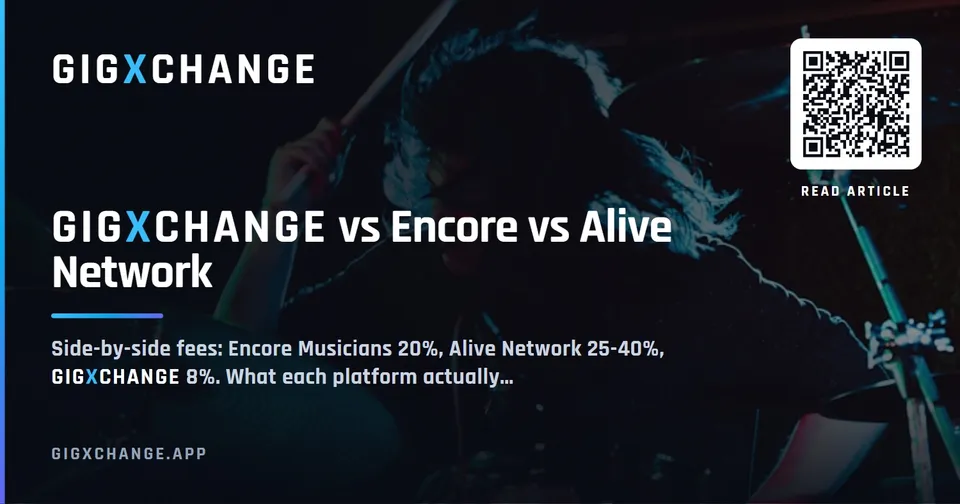
Seven platforms, three models. Agencies (Alive Network around 20%, Encore Musicians 20%) handle private events end-to-end at premium prices. Marketplaces (GigPig free for artists, GigSalad US-only, Gigmit festival-focused) match supply and demand at scale. Directories (Last Minute Musicians) are subscription listings with no commission but no booking tools. Peer-to-peer (GigXchange, 0–5%) opens direct contact between artists, venues, agents and promoters but has the smallest catalogue.
Pick by job-to-be-done: regular pub/bar gigs → GigPig · weddings & corporate → Encore or Alive · festivals → Gigmit · passive listing only → Last Minute Musicians · direct contact + digital contracts → GigXchange.
The cards above show which model suits which job. The panel below shows the actual numbers behind each platform: what they charge, what artists take home, and the industry floor you should never dip below.
Disclosure first, since it matters for what follows: I built one of the seven platforms compared here (GigXchange). I’ve also been a paying user of GigPig as a working musician and put bookings through Encore. This piece is the comparison I wish I’d had when I was choosing: same scrutiny applied to all seven, including my own. Where another platform genuinely fits a use case better, I say so.
I’ve been gigging in the UK since 2009, over 15 years on the circuit. For most of that time, booking a gig meant emailing into the void, hoping someone replied, and shaking hands on a fee that may or may not get honoured. There was no “platform” for live music booking. There was email, Facebook, and word of mouth. Meanwhile the sector matured around us: UK Music’s Music by Numbers 2024 put total industry contribution at £7.6bn with 216,000 people employed, and live music alone was worth roughly £2.5bn.
That’s changed. There are now genuine platforms trying to solve this problem: some better than others, all taking different approaches. None of them is right for every job. The point of this piece is to help you pick the right one for yours.
The platforms that win long-term will be the ones that solve the trust problem: contracts, payments, reviews. Everything else is just a listing.
The Three Models
Before comparing specific platforms, it helps to understand that there are fundamentally three models at play:
- Agency model: You tell them what you want, they find an act from their roster. You pay a premium (an agency commission, typically around 20%, on top of the artist fee) for the convenience. Examples: Alive Network, Encore Musicians.
- Directory model: A listing site where musicians pay a subscription to be visible. Venues browse and contact acts directly. Examples: Last Minute Musicians, Bands for Hire.
- Marketplace model: Both sides use the platform. Venues post dates, musicians apply, and the platform handles contracts/payments. Examples: GigPig, GigXchange.
Each model suits different situations. Agencies are great for weddings and corporate events where you want a guaranteed level of quality and don’t mind paying for it. The UK wedding market is worth around £14.7bn a year and roughly 10% of that is typically earmarked for entertainment. Directories work for established acts who want passive enquiries. Marketplaces are best for regular venue bookings where both sides want efficiency and transparency, particularly valuable when the Music Venue Trust reports 125 grassroots venue closures in 2023 (one every 3 days) and every remaining venue needs to fill calendars without expensive intermediaries.
GigPig
- What it is: The biggest live music marketplace in the UK right now. 18,000+ artists, 3,000+ venues, and over 120,000 gigs facilitated since 2023. Recently expanded into Ireland.
- How it works: Venues post available dates. Artists apply. GigPig handles invoicing and payment. Venues choose from a vetted catalogue of performers.
- Pricing: Free for artists. Venues pay £10 per booking (pay-as-you-go), £150/month (up to 20 gigs), or £250/month (up to 60 gigs). They claim venues save up to 70% compared to traditional booking. Backed by £1.3M seed funding from Haatch Ventures and Notion Capital.
- Strengths: Scale. They've got the most artists and venues of any UK platform. If you're a venue booking live music every week, the volume is hard to beat. The invoicing system is a genuine time-saver.
- Weaknesses: Venue-driven model. Artists can't approach venues directly. They wait for opportunities to appear. The monthly fee for venues can be steep if you only book occasionally. And there's no built-in contract system. The "agreement" is essentially the booking confirmation.
Encore Musicians
- What it is: A UK-based marketplace focused heavily on weddings, private events, and corporate gigs. Self-reported booking and payout figures are published in their Accountability section.
- How it works: Clients describe their event. Encore matches them with suitable acts. Musicians set their own pricing. Encore takes a 20% service fee from the musician’s performance fee[1].
- Pricing: Free to join as a musician. 20% commission on every booking[1].
- Strengths: Strong for functions, weddings, and corporate events. The vetting process means quality is generally high. Good for musicians who want passive income from private gigs without doing their own marketing.
- Weaknesses: A 20% commission is a meaningful share of fee, especially on lower-paying gigs: at the Musicians’ Union recommended minimum of £140 for a 3-hour engagement, that’s £28 gone per gig, or around £1,450 across a year of weekly pub work. Not designed for regular venue bookings (pubs, bars, restaurants). Musicians don’t have direct relationships with bookers. Encore mediates everything.
Alive Network
- What it is: The UK's largest traditional entertainment agency. Over 10,000 events per year. Primarily weddings, corporate events, and private functions.
- How it works: Classical agency model. Artists set their base price per county; Alive adds their commission on top[2]. Clients pay a deposit to Alive, then the balance direct to the artist on the day.
- Pricing: Around 20% commission, varying by membership tier[2]. Artists control their base fee.
- Strengths: Massive reach for private events. Trusted brand. Legally binding contracts on every booking. If you're a function band or wedding act, Alive can keep your diary full.
- Weaknesses: Strictly agency model: no direct relationships. Not designed for pub/bar/restaurant bookings. Commission on top of artist fees means clients pay more. Heavily weighted toward covers and function acts, so original artists are largely excluded.
Last Minute Musicians
- What it is: One of the UK's longest-running musician directories. 3,500+ acts listed. Focused on functions, weddings, and events.
- How it works: Directory model. Musicians pay a subscription to be listed. Clients browse, watch videos, read reviews, and contact acts directly. No commission on bookings.
- Pricing: Musicians pay a subscription fee. Zero commission: you keep 100% of your fee.
- Strengths: No commission is the big draw. Strong SEO. They rank well for "hire a musician" type searches. Direct contact between client and musician means you build your own relationships.
- Weaknesses: No contract system, no payment handling, no booking management. It's essentially a Yellow Pages for musicians. Heavily function/wedding focused. Not useful for regular venue bookings. The quality varies hugely since there's minimal vetting.
GigSalad
- What it is: International entertainment marketplace. US and Canada only, does not operate in the UK, but included here because it appears in search results. 110,000+ entertainers, $113M in gigs booked.
- How it works: Clients post events. Entertainers send quotes. GigSalad handles booking and payment.
- Pricing: Musicians pay a membership fee. GigSalad adds a service fee to client bookings.
- Strengths: Broad range of entertainment (not just music). Good for private events. International reach.
- Weaknesses: US-centric. UK catalogue is thin compared to domestic platforms. Not designed for regular venue bookings. Pricing structure can be confusing.
Gigmit
- What it is: European-focused platform connecting artists with festivals and live events. Strong in Germany and expanding.
- How it works: Festivals and promoters post opportunities. Artists apply. Gigmit facilitates the booking.
- Strengths: Best platform for getting on festival lineups. Good for touring artists looking for European dates.
- Weaknesses: Not useful for regular UK pub/bar gigs. Limited venue presence in the UK. More suited to emerging artists trying to break into the festival circuit than working musicians filling their weekly diary.
GIGXCHANGE
- What it is: A peer-to-peer live music marketplace for the UK. Artists, venues, agents, and promoters connect directly. Launched 2026, currently in Open Alpha.
- How it works: Completely democratised: any user type can initiate an engagement. Venues post dates with fees upfront. Artists browse and apply. But artists can also approach venues directly, and agents/promoters can manage bookings for their roster. Every booking generates an automatic digital contract. Payment is secured through Stripe-protected payment and released when the gig is complete. See the full booking workflow. Built-in messaging, two-way reviews, calendar sync, and emergency cover.
- Pricing: Free to use, with no subscription and no commission on fees. The only charge is optional: 5% for protected payment through the platform’s Stripe checkout, where the deposit is held safely until the gig is done; settle the booking privately (cash, bank transfer) and there is no charge.
- Strengths: The only platform where all four user types (artists, venues, agents, promoters) have equal access. Automatic contracts on every booking. Secure payments via Stripe: no cash, no chasing. Fees visible upfront. Search with filters for genre, location, budget, date, capacity. Built by a working musician who's lived the problem for 16 years.
- Weaknesses: Early stage. Smaller catalogue than the agencies and incumbent marketplaces, no contest there. One-person operation, which means development is fast but support is limited. No mobile app yet (web only). Unproven at scale. If you need a vetted function band for a wedding next month, Encore or Alive will deliver faster. They have the rosters and the QA process this doesn’t yet.
I'd rather be honest about where we are than pretend we're something we're not. We're new, we're small, and we're building in public. What we do have is the right architecture: proper contracts, secure payments, and equal access for everyone.
The Comparison Table
| Platform | Model | Artist Cost | Contracts | Payments | Best For |
|---|---|---|---|---|---|
| GigPig | Marketplace | Free | No | Invoicing | Regular venue bookings |
| Encore | Marketplace | 20%[1] | Yes | Via Encore | Weddings, corporate |
| Alive Network | Agency | around 20% (varies)[2] | Yes | Deposit + direct | Functions, big events |
| Last Minute Musicians | Directory | Subscription | No | Direct (cash) | Passive enquiries |
| GigSalad | Marketplace | Membership + fee | Yes | Via platform | Private events (US/Canada only) |
| Gigmit | Marketplace | Freemium | No | Direct | Festivals, Europe |
| GIGXCHANGE | P2P Marketplace | 0–5% | Automatic | Stripe-protected payment | All UK gig types |
Where the Industry Is Heading
The live music industry at grassroots level is roughly a decade behind every other marketplace. Uber solved transport, Airbnb solved accommodation, Deliveroo solved food delivery. Live music is still running on Facebook messages and handshake deals at the bottom of the funnel.
What the data points to in 2026:
- Agency fee compression. Encore and Alive Network both publish a 20% rate. Five years ago, opaque commissions of 25-40% were normal. The disclosure pressure is real.
- Marketplace consolidation. GigPig has £1.3M of seed funding and 18,000+ artists. The smaller competitors are unlikely to catch up. Expect a winner-takes-most outcome at the marketplace tier.
- Contract enforcement is moving from optional to baseline. Encore and Alive have always issued contracts. New entrants like GigXchange make them automatic. Platforms still operating without contract tooling will look anachronistic by 2027.
- The grassroots gap remains unsolved. The Music Venue Trust reports 125 grassroots venue closures in 2023 (one every three days). None of the platforms above have a clear answer for the £200-£500 pub-gig segment that fills most working musicians’ diaries. That’s where peer-to-peer might land, but it’s still early.
The platforms that will win long-term are the ones that solve the trust problem: contracts, payments, and reviews. Everything else is just a listing.
Which Platform Should You Use?
- If you’re a musician playing regular pub/bar gigs: GigPig. The catalogue is the deepest of any UK platform and applications come fast. The lack of a contract layer is a real gap, but the volume usually wins out at this end of the market.
- If you’re a function or wedding act: Encore or Alive Network. The 20% commission is what you’re paying for lead generation, and lead generation is the hardest part of this gig type. Trying to land regular wedding work from cold outreach in 2026 is brutal.
- If you’re a venue booking weekly live music: GigPig for catalogue depth. Last Minute Musicians for passive enquiries from established acts who’ll come to you.
- If you’re trying to get on festival lineups: Gigmit, especially if you’re open to European dates. UK festival booking is still very Facebook-and-email; Gigmit is the closest thing to a real platform.
- If you want zero commission and you’re happy without booking tools: Last Minute Musicians (directory subscription, no contracts, no payment handling).
Where does GIGXCHANGE fit?
To be honest about where my own platform actually belongs in this list:
- Best fit: grassroots venues that want digital contracts and direct artist contact, agents managing rosters across multiple platforms, and independent acts who care more about transparency and direct relationships than catalogue size. The peer-to-peer model means an artist can approach a venue directly, an agent can run a booking on behalf of a roster act, and a promoter can post dates, all in one place.
- Not the right tool yet: one-off function bookings (use Encore or Alive), high-volume weekly venue catalogues (use GigPig), or anyone who needs a curated, vetted roster waiting to be deployed. We’re too new and too small for those use cases, and pretending otherwise would waste your time.
The broader answer for most working musicians and venues: use multiple gig booking platforms. No single one has the entire market covered yet. Put your profile everywhere, be active on 2-3, and build direct relationships alongside. These tools work best in their right context, not used everywhere.
If your situation matches the “best fit” bullets above, GigXchange is in Open Alpha and free to use for every role; the only charge is an optional 5% for protected payments. If it doesn’t, use whatever’s right for your job to be done. For more, read our complete guide to booking live music, What Is GigXchange and Why Did I Build It?, run the numbers in the free UK gig rate calculator, or check the live UK gig rate index for what your tier actually pays in 2026.
Sources & verification
[1] Encore Musicians commission rate, quoted from encoremusicians.com/musicians: “This is 20% of your total performance fee. Unlike some agencies, we don’t hide this amount, so you can always see the commission split when you quote.” Accessed April 2026.
[2] Alive Network commission rate, quoted from alivenetwork.com/join: “Our normal commission rate is around 20% depending on your membership level.” Accessed April 2026.
Other platform statistics (catalogue size, booking volume, funding etc.) are self-reported figures published by each provider on their public pages. We have not independently audited these and they may have changed since publication.
Accuracy & trademarks
All comparative claims in this article were verified against the cited public sources on 22 April 2026. Pricing, commission rates, product features and other particulars at competing providers can change without notice; verify current details directly with each provider before making a decision. GigPig, Encore Musicians, Alive Network, Last Minute Musicians, GigSalad, Gigmit and any other named platforms are trade names of their respective owners and are referenced here for informational comparison only: no endorsement, partnership or affiliation is implied. If you believe any factual claim on this page is out of date or incorrect, please contact us at support@gigxchange.app and we will update or remove it promptly.
Frequently Asked Questions
Annual refresh commitment
This guide was published on 27 March 2026 and is refreshed every March. We re-verify every reference, recommendation, and data point once a year. Next scheduled refresh: March 2027. If any claim is outdated before then, email support@gigxchange.app and we will update it within 24 hours.