7 Must-Have Clauses in UK Live Music Contracts (2026)Why written agreements are now the grassroots norm, and what yours needs to cover
TL;DR: why contracts matter now
A good booking contract has 5 parts: date/time, fee, cancellation terms, tech requirements, and both signatures. Digital contracts are legally binding under the Electronic Communications Act 2000 and auto-generate on platforms like GigXchange.
Handshake deals aren’t illegal: they’re just unenforceable when something goes wrong. And in 2026, grassroots operators are done absorbing that cost.
- 7 core clauses: parties, fee, date/time, cancellation, tech rider, payment terms, force majeure
- 25-50%: typical deposit held on booking confirmation
- 14-30 days: standard cancellation notice without forfeit
- 2000 Electronic Communications Act: makes UK e-signatures legally equivalent to wet ink
- <2 minutes: to generate and sign a digital gig contract on GigXchange
For decades, live music in the UK has been booked on handshakes, text messages, and Facebook DMs. And for decades, it’s led to the same problems: last-minute cancellations, fee disputes, double-bookings, and acts that just don’t show up.
The root cause is always the same: nothing was in writing. And in a year when grassroots margins are thinner than ever (the Music Venue Trust logged 125 grassroots venue closures across the UK in 2023, roughly 1 every 3 days), the tolerance for that kind of booking entropy is running out on both sides of the stage.
This piece is for anyone who’s ever been ghosted on a gig, stung by a cancellation, or chased a fee through five unanswered DMs. The good news: the answer is simple. The better news: the tools to do it properly are free.
The Handshake Tax Nobody Talks About
Handshake bookings feel cheap: no contract, no admin. But they carry an invisible tax paid in cancellations, unpaid fees, and time spent chasing loose ends.
A typical grassroots venue books two to four live nights a week. A typical working musician plays 50–150 gigs a year. Multiply across the sector and the total volume of UK live music bookings runs into the hundreds of thousands annually. Even a small percentage going wrong is a lot of wasted nights, and a lot of unpaid invoices.
The Musicians’ Union has published template contracts and booking guidance for its members for decades: precisely because the sector’s informal booking culture creates routine disputes.
What a Booking Agreement Actually Needs
It doesn’t need to be a legal document with clauses and sub-clauses. A good booking agreement covers five things:
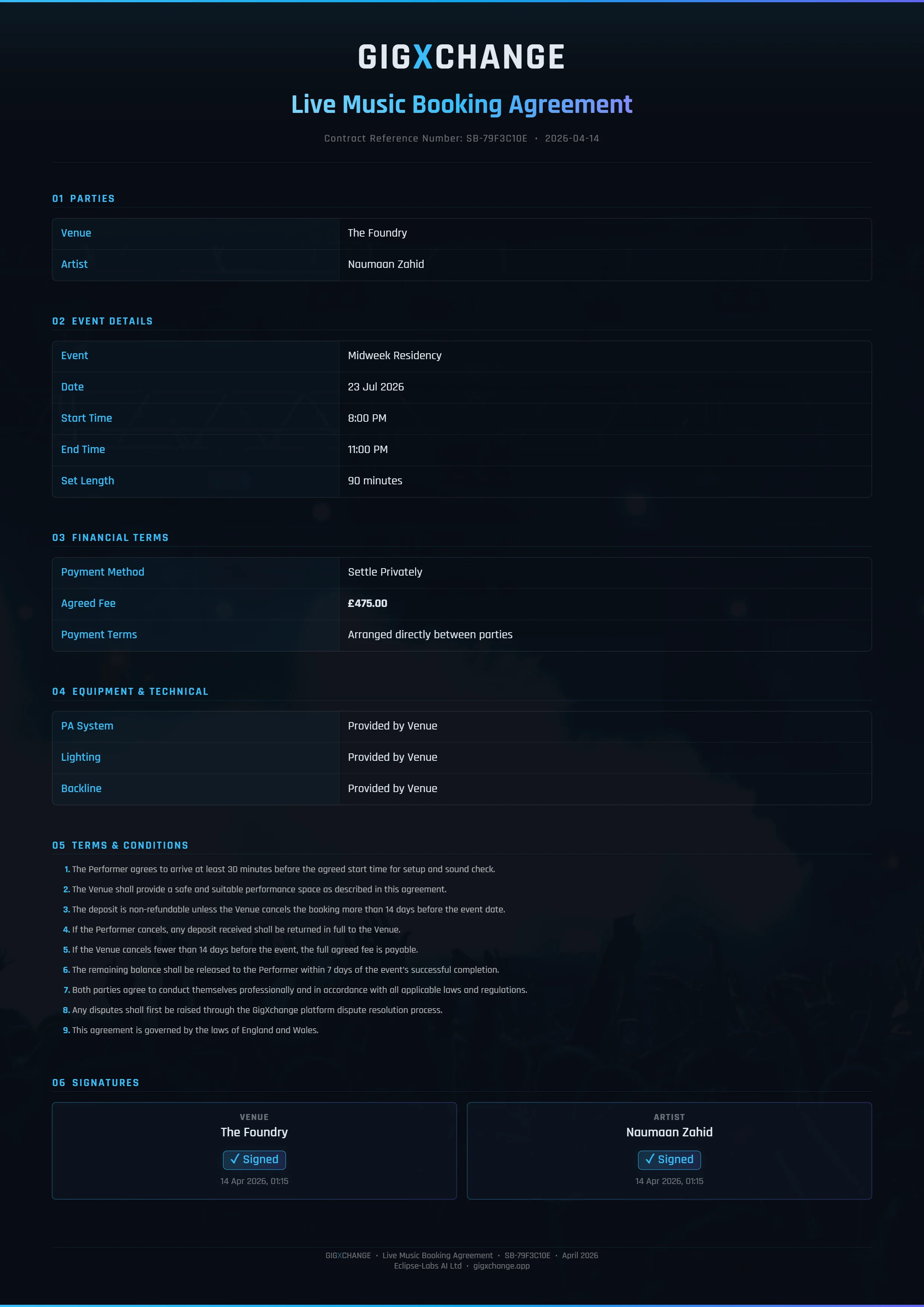
That’s it. Five fields. But the difference between having them written down and not is the difference between a professional booking and a gamble, and legally, the difference between something enforceable and a memory in a DM thread.
What UK Law Actually Says
A quick grounding (not legal advice; if you’re ever in a real dispute, speak to a solicitor or Citizens Advice):
- Verbal agreements are legally binding under English and Welsh contract law. The problem isn’t legality: it’s proof.
- The Consumer Rights Act 2015 governs fairness in consumer contracts: relevant whenever an artist or venue is dealing with a member of the public.
- For smaller disputes, the UK government runs Money Claim Online: a low-cost civil claims process for sums under £10,000.
Digital Contracts Make It Effortless
The reason most bookings don’t have written agreements isn’t that people think they’re unnecessary. It’s that they’re a hassle to create. Nobody wants to draft a Word doc for a £200 pub gig.
That’s where digital contracts change the game. On GigXchange, a contract is auto-generated on every booking. It contains the date, fee, venue details, artist details, and cancellation terms. Both sides e-sign with a single click.
The best contract is the one that creates itself. If it requires effort, it won’t happen.
Both parties can view, download, or reference the contract at any time. A timestamped, e-signed record is effectively impossible to dispute after the fact.
What Happens When Things Go Wrong
Cancellations happen. Emergencies happen. What matters is whether you have a framework for dealing with them. The same cancellation plays out two very different ways depending on whether anything was written down.
The contract doesn’t prevent cancellations: it prevents cancellations from becoming catastrophes. We cover the specific cancellation-handling playbook in how to handle cancellations and no-shows in live music.
The Trust Myth
Some people argue that contracts imply a lack of trust. The opposite is true. A written agreement says: “I take this seriously enough to put it in writing.” It’s a signal of professionalism, not suspicion.
The venues and artists who use agreements consistently have the fewest disputes. That’s not a coincidence: clear expectations up front eliminate the ambiguity that causes most disagreements. Contracts don’t replace trust; they protect it.
What to Look for in a Booking Tool
- Auto-generation: the contract should populate from the booking data, not require you to type it
- E-signature with timestamp: both parties, with the time of signing captured
- Downloadable PDF: both parties should get a permanent copy
- Clear cancellation terms: encoded in the contract, not left verbal
- Pre-agreed payment flow: who’s paying when, with protected payment or deposit handling built in
If a booking tool can’t do all five, it’s not really handling the contract side: it’s just a calendar with branding.
Handshake deals aren’t going to disappear overnight. But as more of the live music industry moves to platforms with built-in contracts, the expectation is shifting.
You don’t need to wait for the shift. Whether you use GigXchange or a template from the Musicians’ Union, the cost of putting things in writing is zero and the protection is real.
Related reading: the complete guide to booking live music, how to handle cancellations and no-shows, getting paid as a musician in the UK, how much should you pay a live band, and what venues get wrong about booking live music.
Frequently Asked Questions
Annual refresh commitment
This guide was published on 21 March 2026 and is refreshed every March. We re-verify every reference, recommendation, and data point once a year. Next scheduled refresh: March 2027. If any claim is outdated before then, email support@gigxchange.app and we will update it within 24 hours.